

QMY6-25 & QMY10-15 Egg-Layer Block Machine Manufacturer for Sale
Higher model numbers do not guarantee higher profits; they often guarantee higher downtime if your site logistics are unprepared.
The technical data sheet for an Egg-Layer Block Machine Technical Data Sheet is not merely a list of specifications; it is a feasibility checklist that determines whether your project will meet its deadline or stall due to logistical mismatches. For investors in emerging markets, the critical decision lies not in choosing the most powerful machine, but in aligning the molding cycle time with your mixer’s capacity and ensuring your ground foundation meets strict leveling tolerances. Misinterpreting "theoretical output" against "site-constrained reality" is the primary cause of costly operational delays.

Understanding the nuance between these two models requires looking beyond the brochure. Many buyers assume that a mobile machine requires no foundation preparation, yet precise flatness is more critical for egg-layer machines than for stationary lines to ensure block dimensional accuracy. This guide decodes the technical realities behind the specs, helping you avoid common selection errors in Middle East and Africa projects.
Why Do Standard Data Sheets Mislead First-Time Buyers?
Theoretical maximum output figures ignore the friction of site logistics, labor efficiency, and material handling delays.
Most manufacturers list output based on continuous, ideal-cycle operation. However, in real-world scenarios, the bottleneck is rarely the molding speed itself. It is the time lost during mixing, curing overlap, and mold changeovers. A common misconception is that the machine’s hydraulic pressure dictates the production rate. In reality, the synchronization between the batching plant’s discharge rate and the machine’s travel speed is the true limiter. [NEED_CITE: impact of logistics on concrete block production efficiency]
Consider a housing project in Saudi Arabia where the client initially selected a larger, stationary line under the assumption that higher capacity equated to faster completion. The site, however, was dense and urban, with limited space for raw material storage and cured block stacking. The large line became a bottleneck because the curing area could not keep up with the molding speed, leading to a significant gap between theoretical and actual output. When they switched to a mobile solution, the ability to move the machine directly to the curing yard eliminated the transport lag.
The key takeaway is that the Egg-Layer Block Machine Technical Data Sheet must be read with a focus on cycle time calculation rather than just daily capacity. You must account for the time required for mixing, molding, and the necessary curing overlap. If your mixer cannot supply concrete fast enough to keep the hopper full, the machine’s maximum speed is irrelevant. This mismatch often leads to idle time that erodes ROI, a fact that standard brochures rarely highlight.
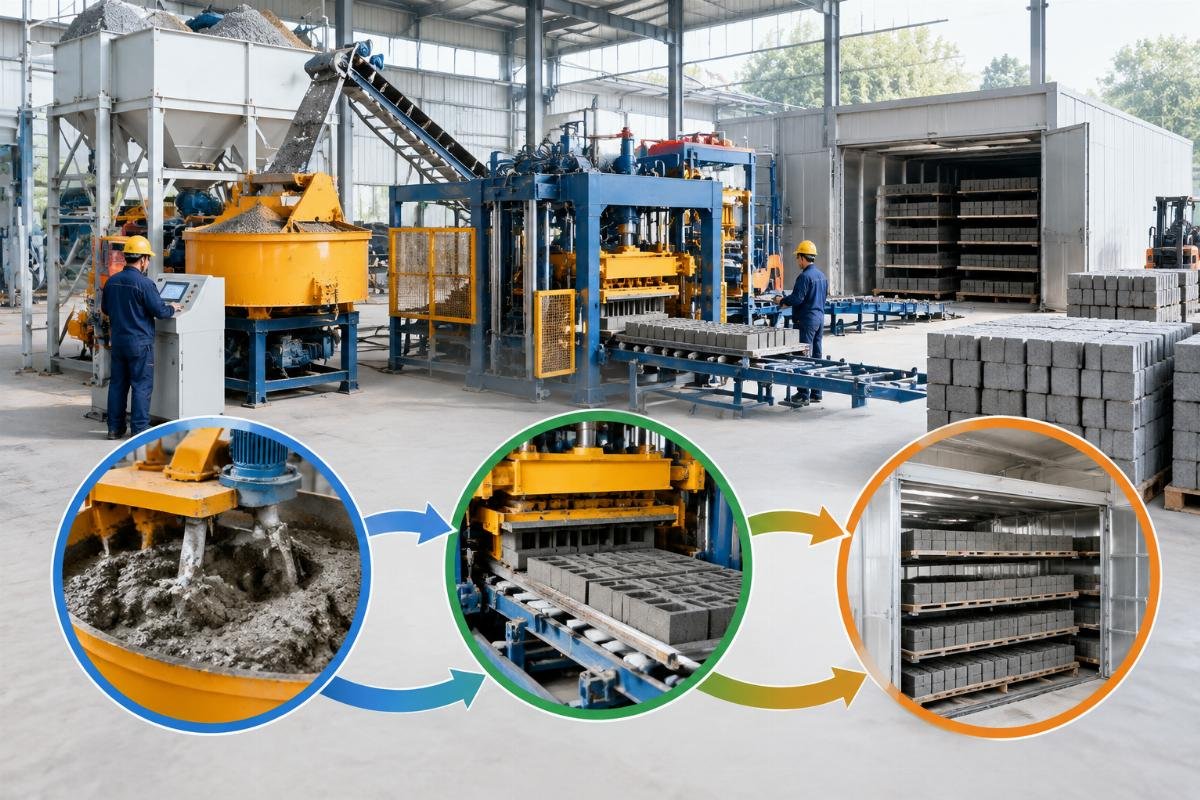
QMY6-25 vs. QMY10-15: Which Specs Actually Matter?
Compare molding area, hydraulic pressure consistency, and travel speed stability, not just the advertised daily block count.
When evaluating the Egg-Layer Block Machine Technical Data Sheet, the distinction between the QMY6-25 and QMY10-15 models goes beyond size. The QMY6-25 is designed for high-density urban sites where space is at a premium, while the QMY10-15 offers greater output for larger yards but demands more rigorous site preparation. The critical spec here is not just the number of blocks per hour, but the machine’s ability to maintain consistent vibration frequency across uneven terrain.
| Feature | QMY6-25 Profile | QMY10-15 Profile | Operational Impact |
|---|---|---|---|
| Molding Area | Compact | Extended | Determines batch size per cycle |
| Hydraulic System | Standard Pressure | High-Pressure Stability | Affects block density and strength |
| Travel Speed | Moderate | Fast | Influences cycle time efficiency |
| Foundation Requirement | Strict Leveling | Critical Precision | Impacts dimensional accuracy |
A case from a UAE paver yard illustrates this well. The contractor selected the QMY10-15 for producing interlocking bricks, attracted by its higher theoretical output. However, they underestimated the mold changeover time. Each swap required careful alignment to prevent dimensional drift, and the downtime during these swaps accounted for a significant portion of the shift. Had they chosen the QMY6-25, which has a simpler mold setup for smaller batches, they might have achieved better overall efficiency despite the lower per-cycle output.
The hydraulic pressure specification is another vital differentiator. The QMY10-15 typically operates with higher pressure to ensure denser blocks, which is essential for load-bearing applications. However, this requires a more stable power supply. In regions with fluctuating voltage, the QMY6-25’s simpler hydraulic system may offer more reliability. [NEED_CITE: hydraulic system reliability in varying power conditions] Therefore, when reviewing the Egg-Layer Block Machine Technical Data Sheet, pay close attention to the power consumption ratings and hydraulic stability metrics, not just the production volume.

How to Verify Site Compatibility Before Signing?
Check ground bearing capacity and power supply stability against the machine’s operational ratings to prevent vibration-induced misalignment.
Many buyers assume that "mobile" means "no foundation." This is a dangerous oversimplification. For an egg-layer machine to produce blocks with accurate dimensions, the ground must be level within a very tight tolerance. If the surface is uneven, the vibration mechanism will cause the machine to drift, resulting in blocks that are out of square. This issue was evident in a Nigerian roadside startup where the QMY6-25 was deployed on uneven ground. The lack of proper leveling led to consistent misalignment, forcing the operator to stop frequently for adjustments.
To verify site compatibility, you must assess the ground bearing capacity. The soil must be compacted enough to support the machine’s weight without settling during operation. Additionally, the power supply must be stable. Voltage fluctuations can damage the PLC controls and hydraulic pumps, leading to unexpected downtime. [NEED_CITE: electrical stability requirements for industrial machinery]
When reviewing the Egg-Layer Block Machine Technical Data Sheet, look for the specified foundation requirements. These are not suggestions; they are prerequisites for warranty validity and operational success. A simple laser level check before installation can save weeks of troubleshooting later. Furthermore, ensure that your local power grid can handle the startup surge of the hydraulic motors. If not, investing in a voltage stabilizer is far cheaper than repairing a fried control board.

What Hidden Costs Appear in the Technical Footnotes?
Mold wear rates and spare part consumption frequency are often omitted from main specs but significantly affect long-term operating costs.
The initial purchase price is only part of the equation. The Egg-Layer Block Machine Technical Data Sheet often lists standard molds, but it rarely details the wear rate of these molds under abrasive concrete mixes. In high-volume production, mold liners can wear down quickly, leading to dimensional inaccuracies and increased rejection rates. Replacing these molds is a recurring cost that must be factored into your ROI calculation.
Additionally, the frequency of spare part consumption, such as vibration motors and hydraulic seals, is crucial. These components are subject to high stress and require regular replacement. A machine that seems cheaper upfront may have higher maintenance costs if its components are not durable. [NEED_CITE: maintenance cost analysis for concrete block machinery]
For instance, a buyer in Latin America noted that while the QMY10-15 offered higher output, the cost of replacing its specialized mold liners was significantly higher than for the QMY6-25. Over a year, this difference added up to a substantial amount. Therefore, when analyzing the Egg-Layer Block Machine Technical Data Sheet, inquire about the expected lifespan of wear parts and the availability of replacements. Shiyue’s turnkey consulting service can help match these specs to your local material constraints, ensuring that you choose a model that balances output with manageable maintenance costs.

Conclusion
Selecting the right egg-layer machine is about matching technical specs to site reality, not just chasing higher output numbers.
The Egg-Layer Block Machine Technical Data Sheet serves as a critical tool for verifying feasibility before purchase. By focusing on cycle time, foundation requirements, and hidden maintenance costs, buyers can avoid the pitfalls of theoretical specifications. Whether choosing the QMY6-25 for compact sites or the QMY10-15 for larger operations, the key is ensuring that the machine’s capabilities align with your local logistics and material conditions. This approach ensures sustainable productivity and protects your investment from costly operational disruptions.

Industry expert sharing insights about concrete machinery, block making technology and turnkey production solutions.
View all posts →
Leave a Reply