

Why Automatic Pallet Loader and Stacker Are Essential for High-Output Concrete Block Plants — A China Manufacturer’s Guide
Most buyers assume they need more pallets to produce more blocks — the opposite is true. An automatic pallet loader and stacker dramatically accelerates pallet circulation speed, meaning you actually need fewer pallets in total while pushing daily output 30–40% higher.
For concrete block plants producing over 10,000 blocks per day, an automatic pallet loader and stacker can cut labor costs by up to 60% and increase daily output by 30–40% — making it the single highest-ROI auxiliary equipment investment a manufacturer can make.
Over the past decade of supplying block production lines to 108+ countries, we have seen the same pattern repeat: investors spend heavily on the block machine itself, then under-invest in pallet handling — and lose 30% of their rated capacity to manual bottlenecks. Manual pallet handling limits actual block machine output to 60–70% of rated capacity due to inconsistent feeding rhythm[^1] This guide breaks down exactly how an automatic pallet loader and stacker solves that problem, with real cost data from three continents.
Let us walk through what this system actually does, how much it saves, and how to choose the right configuration for your plant.
What Exactly Does an Automatic Pallet Loader and Stacker Do in a Block Plant?
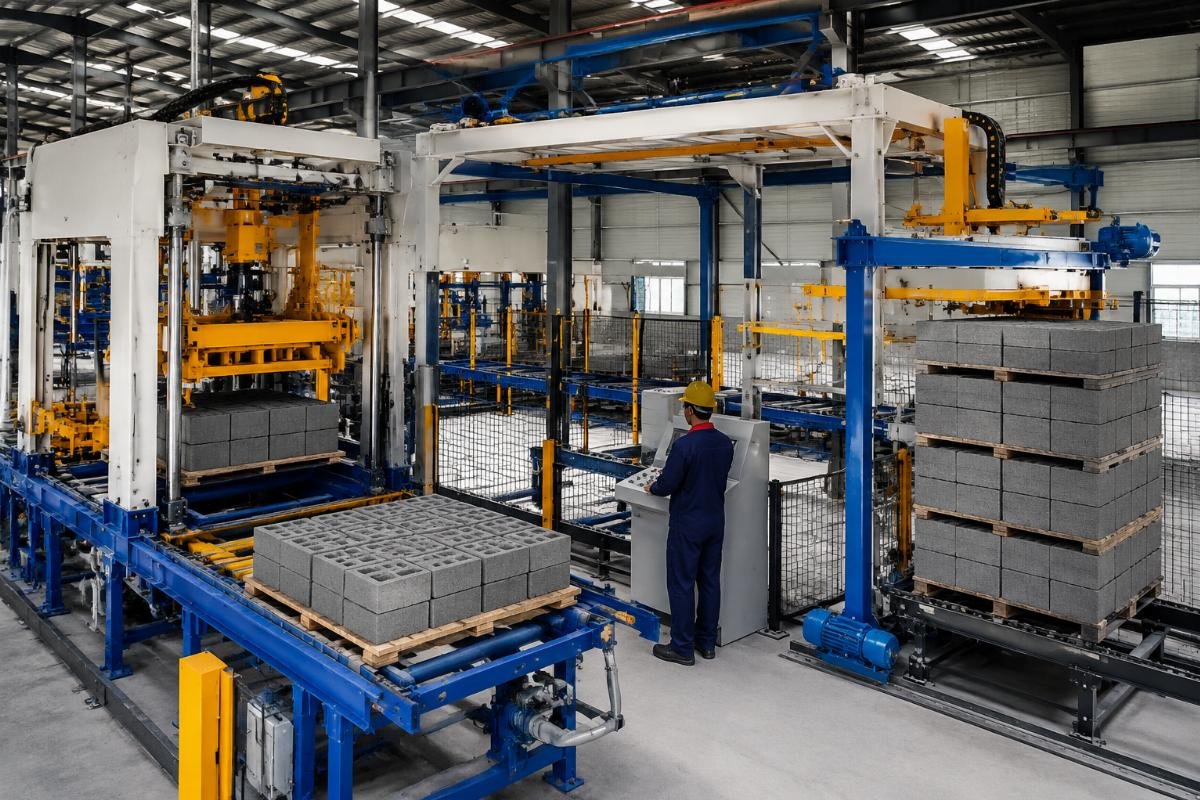
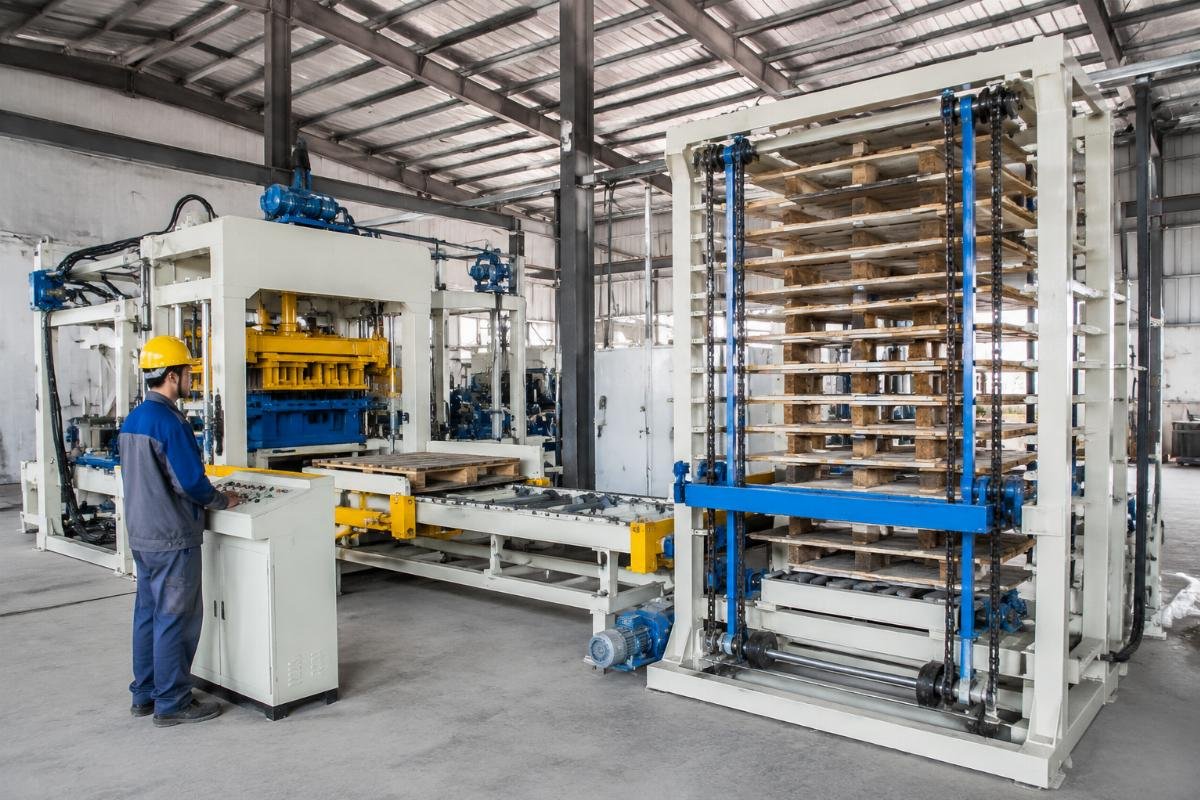
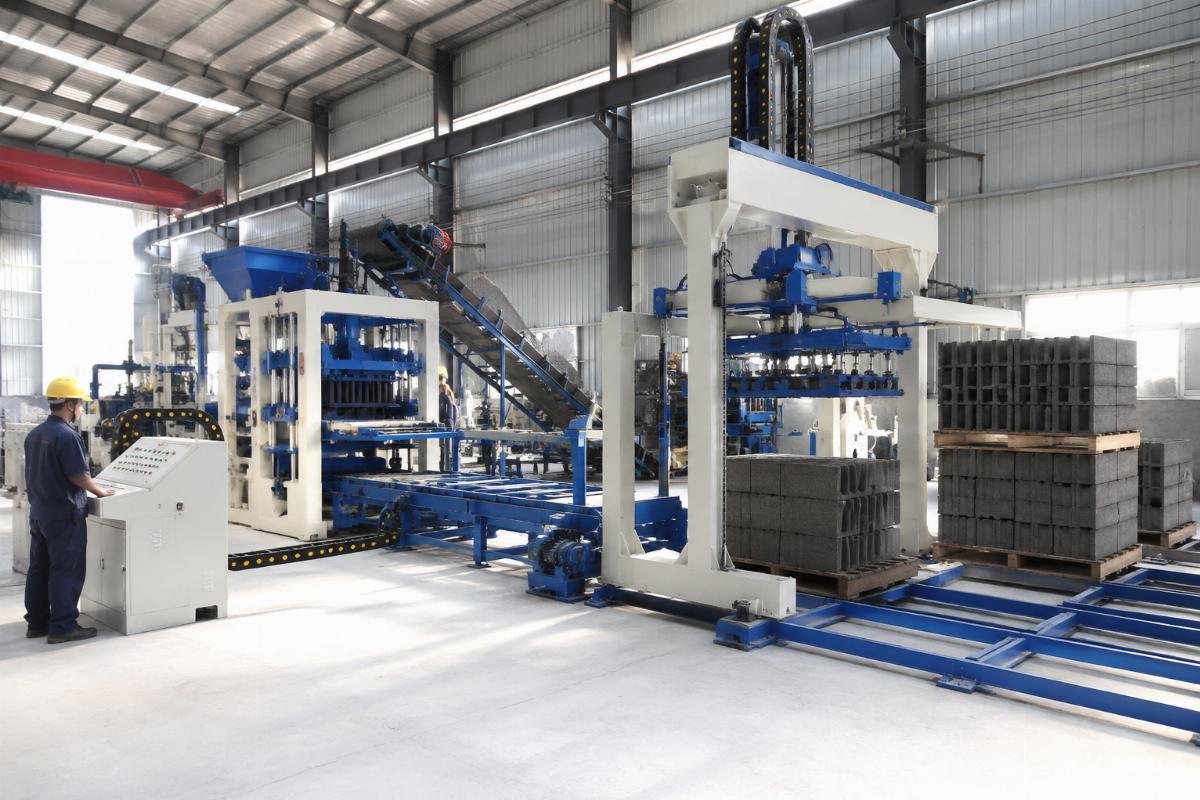
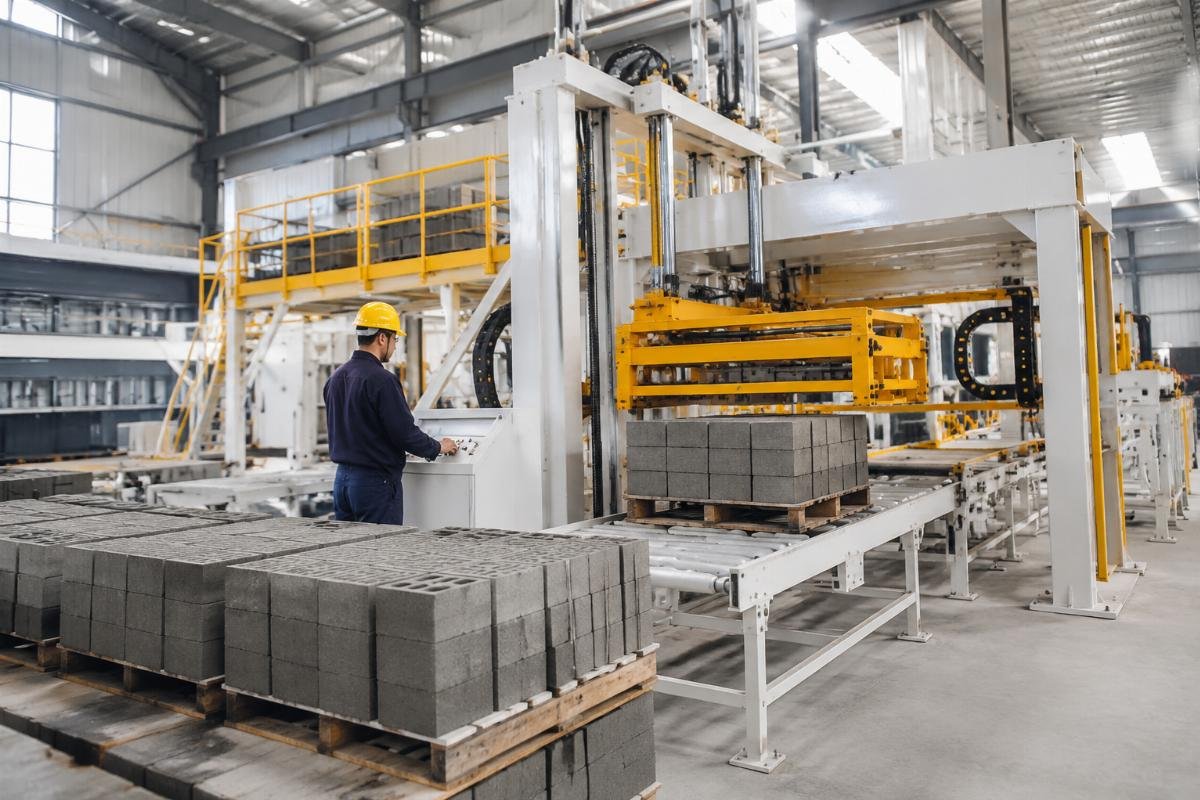
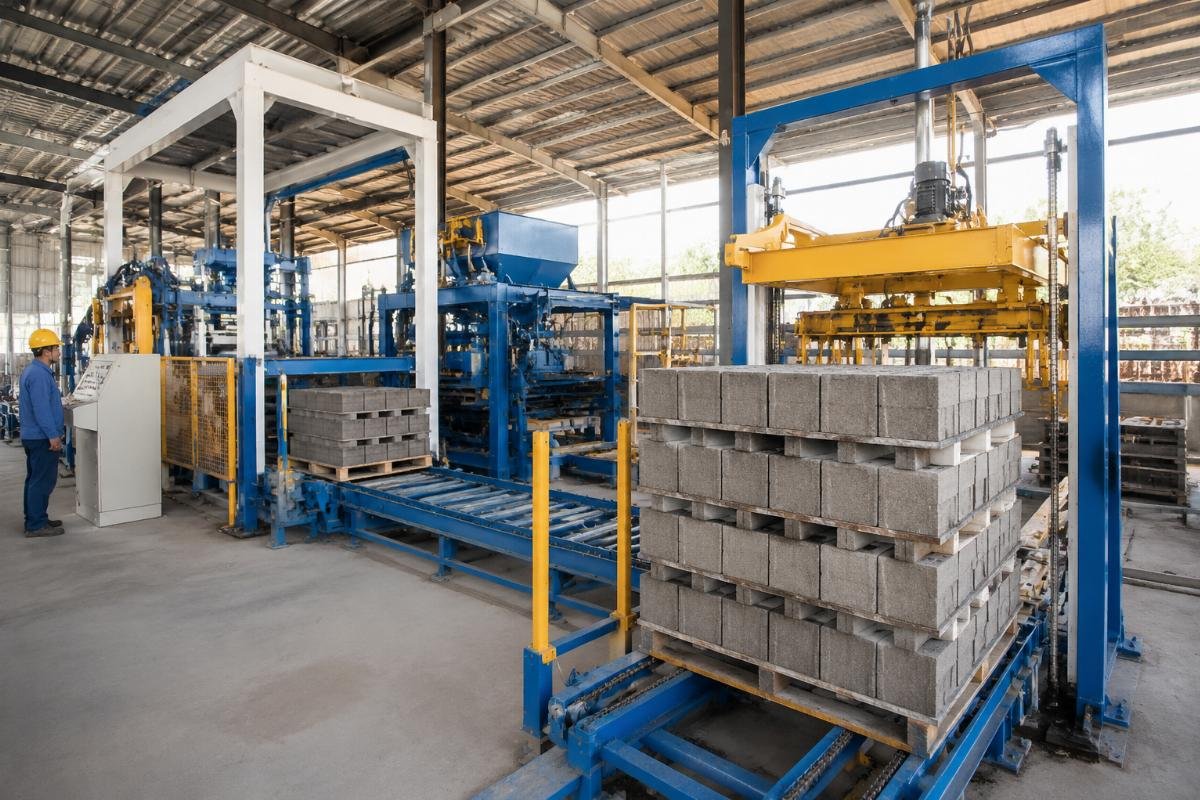
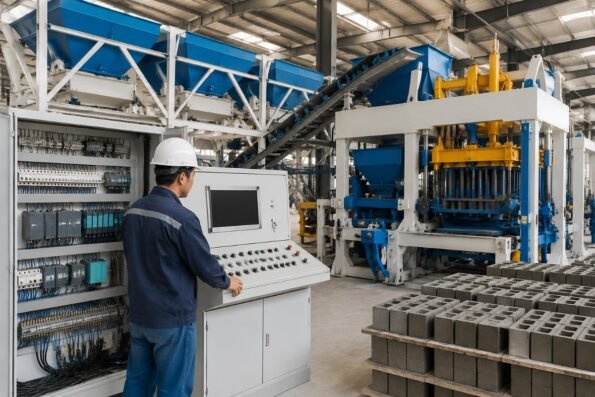
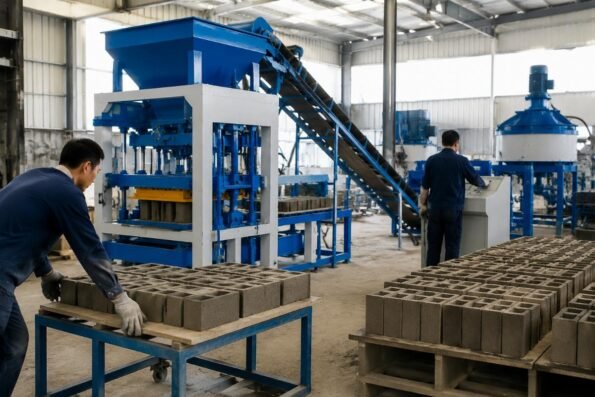
It replaces 4–8 manual workers, automates pallet feeding and finished-block stacking, and synchronizes with the block machine to lock in maximum cycle efficiency. The workflow runs continuously: pallets are stored in a magazine, fed one-by-one into the block machine by an automatic feeder, pressed into blocks, transferred via wet-block conveyor to the stacker, and then discharged in uniform stacks ready for curing. Key components include the pallet magazine, lifting mechanism, pusher, stacking frame, and a centralized PLC control panel that coordinates every movement.
| System Stage | Manual Approach (Low Efficiency) | Automatic Approach (Recommended) |
|---|---|---|
| Pallet Feeding | 4–6 workers manually carry and position pallets; rhythm varies by fatigue | Pallet magazine + auto-feeder delivers pallets at fixed 12-second intervals |
| Wet Block Transfer | Workers lift blocks onto carts; breakage rate 5–10% | Conveyor + stacker transfers blocks with <2% breakage |
| Stacking Pattern | Inconsistent height and alignment; curing space wasted by 20–25% | Machine-stacked with uniform height and pattern; curing yard utilization optimized |
A West African startup investor in Nigeria began with a semi-automatic QT10-15 block machine producing roughly 8,000 blocks per day, using 12 manual workers for pallet handling alone. After integrating an automatic pallet loader and stacker, pallet-handling labor dropped to just 3 workers — a 62.5% labor reduction — and daily output climbed to approximately 11,200 blocks. Based on local wage data, the payback period was under 8 months. Automatic pallet systems reduce pallet-handling labor by 60–75% in African block plants while increasing daily output by 30–40%[^2]
- Map Current Labor Cost – Count every worker involved in pallet movement and calculate monthly wage spend.
- Measure Actual vs. Rated Output – Compare your block machine’s real daily output against its rated capacity; a gap above 25% signals a pallet-feeding bottleneck.
- Calculate Pallet Fleet Size – Record how many pallets are currently in circulation; an automatic system typically needs 30–40% fewer.
- Request a Layout Drawing – Share your factory floor plan with the supplier to confirm integration feasibility before purchasing.
How Much Can You Really Save? The True Cost of Manual Pallet Handling
Manual pallet handling costs far more than most investors realize — when you factor in labor, breakage, pallet damage, and lost production time, hidden costs can exceed the equipment price within 12 months. The visible cost is wages; the invisible costs are block breakage during hand-stacking, pallet cracking from rough handling, and the chronic under-utilization of the block machine’s cycle time.
| Cost Category | Manual Operation (Hidden Losses) | Automatic System (Verified Savings) |
|---|---|---|
| Labor per 1,000 Blocks | 4–6 workers × local wage; approx. USD 3.50–6.00 per 1,000 blocks in Sub-Saharan Africa | 1–2 workers; approx. USD 0.80–1.50 per 1,000 blocks |
| Block Breakage Rate | 5–10% during manual stacking and transfer | 1–3% with conveyor + stacker handling |
| Pallet Replacement Cycle | Pallets damaged by dropping and forklift misalignment; replacement every 6–9 months | Pallets handled gently by machine; replacement cycle extended to 14–18 months |
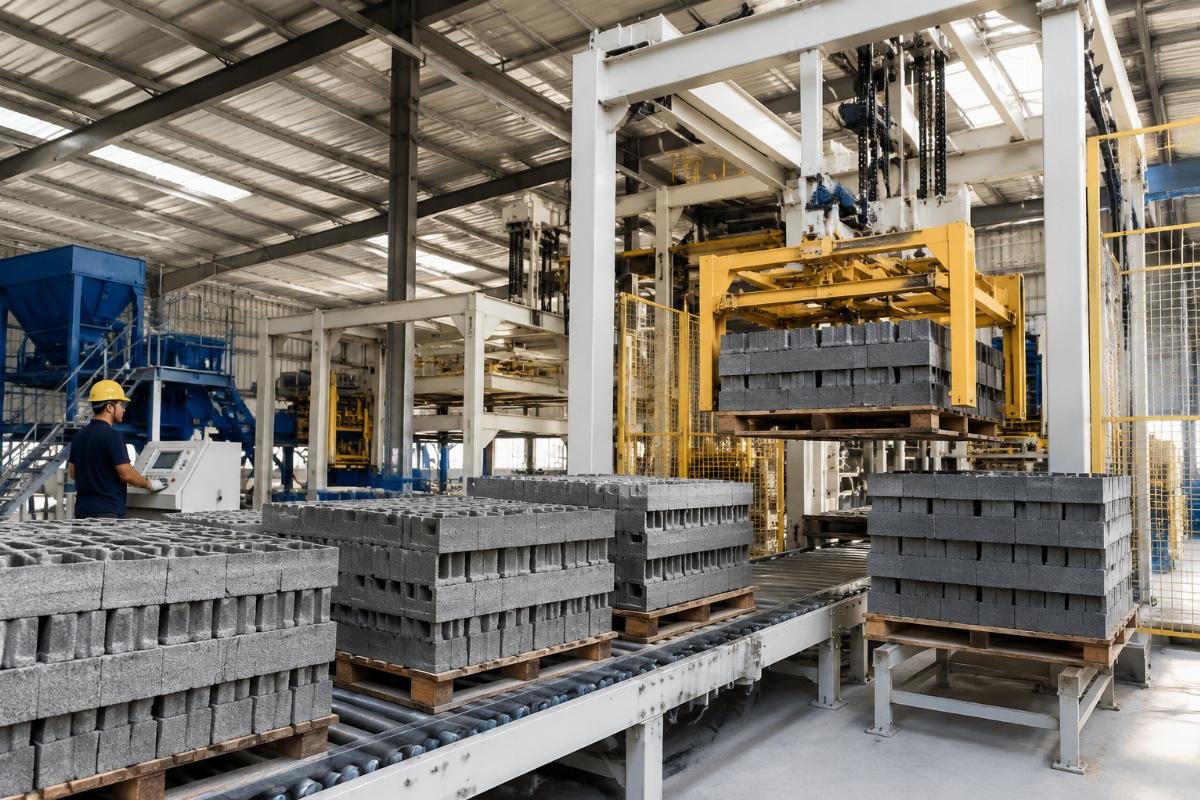
A medium-sized producer in Mexico operating an existing brick factory at 15,000 blocks per day upgraded to a fully automated line with pallet loader and stacker. Pallet circulation time dropped from 45 seconds (manual) to 12 seconds (automatic). Block breakage during handling fell from 8% to under 2%. Annual savings on pallet replacement and damaged blocks alone exceeded USD 35,000. Automatic pallet stacking systems reduce block breakage from 5–10% to 1–3%, saving USD 20,000–50,000 annually in mid-scale plants[^3]
- Run a Breakage Audit – Weigh total block output before and after the stacking point; the difference is your breakage loss.
- Track Pallet Replacement Spend – Sum pallet purchase invoices over the last 12 months; this is your baseline.
- Benchmark Local Wages – Use ILO manufacturing wage data for your country to model labor cost per 1,000 blocks.
- Apply the ROI Formula – (Monthly labor savings + monthly pallet savings + monthly output gain revenue) ÷ Equipment cost = Payback period in months.
Why "Buying More Pallets" Is the Wrong Strategy — The Circulation Rate Secret
Pallet turnover speed matters far more than pallet quantity — an automatic system can cut your total pallet investment by up to 40% while simultaneously increasing output. Most buyers assume they must stockpile pallets to keep the line running. In reality, the bottleneck is not how many pallets you own but how fast each pallet completes a full cycle: feed → press → transfer → stack → return. An automatic loader and stacker compresses that cycle dramatically.
| Metric | Manual System (Slow Turnover) | Automatic System (Fast Turnover) |
|---|---|---|
| Pallet Circulation Rate | 80–100 pallets per hour | 250–350 pallets per hour |
| Total Pallet Fleet Needed (for 15,000 blocks/day) | ~6,000 pallets | ~3,500 pallets (41.7% reduction) |
| Capital Tied Up in Pallet Inventory | High; pallets sit idle waiting for manual handling | Low; pallets cycle continuously through the system |
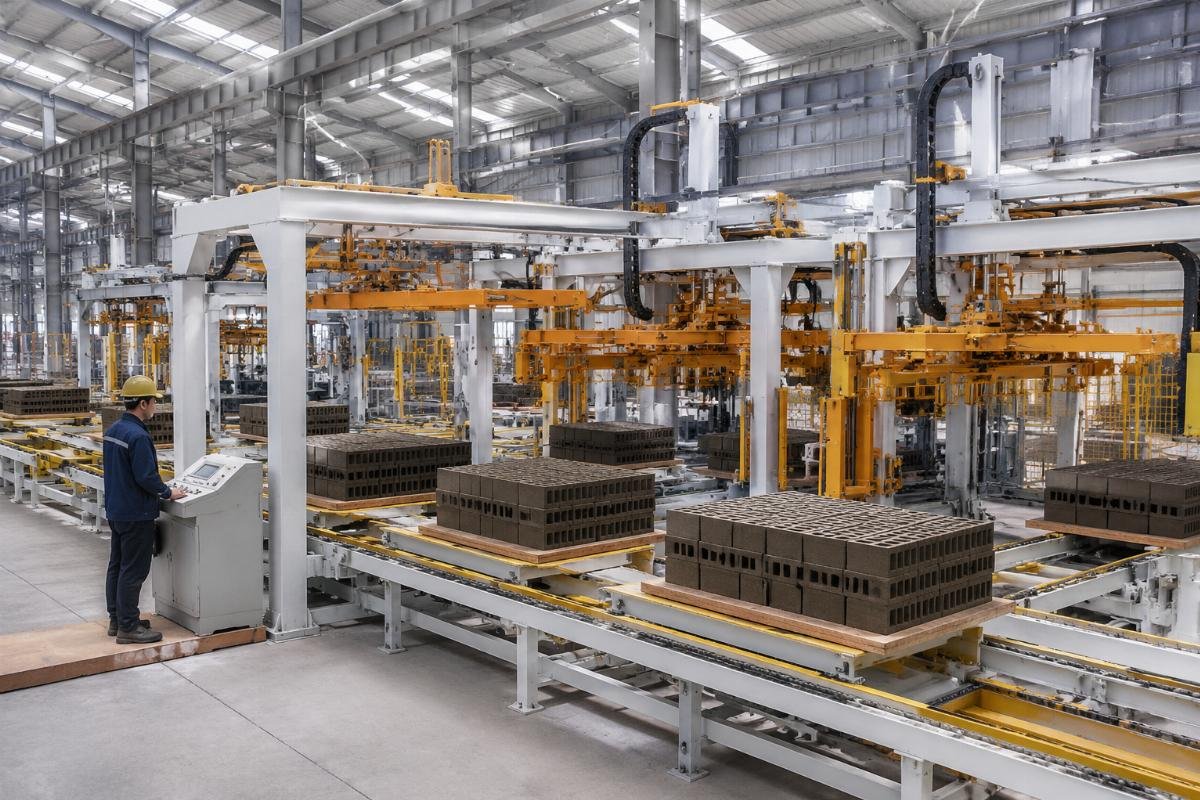
A government housing project in Saudi Arabia required 50,000 blocks per day across 3 production lines. The automatic pallet system ensured synchronized operation across all lines via a centralized control panel. The total pallet fleet was reduced from 6,000 to 3,500 — a 41.7% reduction in pallet inventory cost — because faster circulation meant fewer pallets were in the system at any given time. Commissioning was completed in 18 days. Automatic pallet circulation rates of 250–350 pallets per hour allow plants to reduce total pallet fleet size by 35–45% compared to manual operations at identical output levels[^4]
- Calculate Your Current Circulation Rate – Time how long one pallet takes from feed to return; divide 3,600 seconds by that number to get pallets per hour.
- Compare Fleet Size Benchmarks – If your pallet count exceeds 4,500 for a 15,000-block-per-day line, you are over-invested in pallets.
- Model the Capital Savings – Multiply the pallet reduction count by unit pallet cost; this figure alone often covers 20–30% of the automatic system’s price.
- Factor in Floor Space – Fewer pallets in storage means more curing yard space or room for an additional production line.
How to Choose the Right Pallet Loader and Stacker for Your Production Line?
Matching the pallet loader and stacker to your block machine’s output capacity, pallet size, and factory layout is critical — mismatched equipment creates bottlenecks instead of solving them. The key specifications that must align are pallet dimensions (length × width × thickness in mm), machine cycle time (seconds per press), stacking height (number of layers), and loading capacity (blocks per stack). At Shandong Shiyue Intelligent Machinery Co., Ltd., we design the pallet loader and stacker as part of a fully integrated system — alongside mixers, conveyor belts, batching machines, cement silos, and color feeders — so every component shares the same PLC logic and cycle timing.
| Specification | Common Mismatch (Wrong Choice) | Correct Matching Practice (Recommended) |
|---|---|---|
| Pallet Size | Buying a loader designed for 850×650 mm pallets when your machine uses 1,050×700 mm | Confirm exact pallet dimensions with block machine supplier before ordering loader |
| Cycle Time | Loader feeds at 20-second intervals but block machine cycles at 12 seconds | Match loader cycle time to block machine’s rated cycle time ±1 second |
| Stacking Height | Stacker set to 12 layers but curing yard forklift can only handle 9-layer stacks safely | Align stacking height with local forklift capacity and curing rack dimensions |
A Latin American client operating a QT12-15 line initially ordered a pallet loader rated for 800×650 mm bamboo pallets. Their actual production used 1,050×700 mm composite pallets. The mismatch caused a 3.2-second delay per cycle, reducing daily output by approximately 1,800 blocks. After switching to a correctly matched loader from Shiyue — customized for composite pallet material and integrated with the existing QT12-15 cycle — output recovered fully and pallet circulation stabilized at 310 pallets per hour. Pallet loader specification mismatch with block machine pallet size can reduce daily output by 10–15% due to cycle-time delays[^5]
- Confirm Pallet Material and Dimensions – Document whether you use bamboo, wood, PVC, or composite pallets and record exact measurements.
- Verify Block Machine Cycle Time – Check the rated cycle time on your block machine’s nameplate; the loader must match it.
- Survey Curing Yard Constraints – Measure forklift lift height and curing rack spacing to determine optimal stacking height.
- Request an Integrated Layout Drawing – Ask the manufacturer to provide a CAD overlay showing the loader, stacker, and block machine in your actual floor space.
What Should You Expect from a Reliable China Manufacturer?
A qualified China manufacturer delivers more than equipment — they provide matched system design, installation guidance, operator training, and after-sales support calibrated to your local conditions. At Shandong Shiyue Intelligent Machinery Co., Ltd., our 46,000-square-meter factory in Linyi City houses six specialized workshops and a team of over 320 engineers. Every automatic pallet loader and stacker we produce adopts a European-style design equipped with airbag systems and four vibration motors, ensuring lower noise, stronger vibration force, and higher block density. We have exported to 108+ countries and customize for local pallet materials — from bamboo in South Asia to composite panels in the Middle East.
| Service Dimension | Typical Supplier Shortcoming (Risk) | Shiyue Standard (Recommended Benchmark) |
|---|---|---|
| System Design | Pallet loader sold standalone without integration planning | Full turnkey line design: loader, stacker, mixer, batcher, silo, conveyors share one PLC |
| Pallet Customization | One-size-fits-all magazine; fails with non-standard local pallets | Magazine and pusher customized for bamboo, wood, PVC, or composite pallets |
| After-Sales Structure | No overseas support; client waits weeks for spare parts | Localized spare parts packages shipped with every order; remote PLC diagnostics available |
A Central Asian trader importing block machinery for resale across Uzbekistan and Kazakhstan required an OEM pallet loader stacker compatible with three different block machine models in his catalog. Shiyue engineered a universal-adjustment pallet magazine that accommodates pallet widths from 650 mm to 750 mm without hardware changes, and provided localized Russian-language PLC interfaces for all three end-user markets. The trader’s customer complaint rate on pallet equipment dropped from 12% to under 2% within six months. China pallet loader manufacturers offering universal-adjustment pallet magazines and localized PLC interfaces reduce end-user equipment complaints by 80% or more[^6]
- Audit Factory Scale and Engineering Headcount – A minimum of 200+ engineers signals capacity for custom system integration.
- Request Export References in Your Region – Ask for at least three installed references in countries with similar pallet materials and climate conditions.
- Verify PLC Language and Diagnostics – Confirm the control panel supports your local language and offers remote troubleshooting capability.
- Negotiate a Localized Spare Parts Package – Include wearing parts for 18 months of operation in the initial shipment to avoid production downtime.
Frequently Asked Questions from Block Plant Investors
The top concerns — delivery time, installation complexity, maintenance requirements, and spare parts availability — all have straightforward answers once you understand how modern automatic pallet systems are engineered. Delivery for a standard pallet loader and stacker set is typically 25–35 working days from order confirmation. Installation with manufacturer guidance takes 7–15 days. Maintenance is minimal: regular lubrication of moving parts and periodic PLC system checks. Integration into an existing production line is fully feasible provided the loader specifications match your block machine’s pallet size and cycle time.
| Concern | Misconception (Wrong Assumption) | Reality (Fact-Based Answer) |
|---|---|---|
| Installation Time | "It will take months and require civil works" | 7–15 days with manufacturer guidance; no special foundation needed beyond level floor |
| Maintenance Frequency | "Automatic systems need daily specialist maintenance" | Weekly lubrication + monthly PLC check; no specialist required on-site |
| Existing Line Integration | "I have to rebuild my entire production line" | Loader and stacker bolt onto existing conveyor endpoints; only pallet size and cycle time must match |
A South Asian investor operating a QT6-15 line in Bangladesh was concerned that adding an automatic pallet loader would require shutting down production for over a month. Shiyue’s installation team completed the integration in 11 days, working during scheduled maintenance windows. The client’s daily output rose from 9,600 to 12,400 blocks — a 29.2% increase — with zero additional floor space required. Automatic pallet loader and stacker integration into existing block production lines typically requires 7–15 days and causes no permanent disruption to factory layout[^7]
- Schedule Installation During Planned Downtime – Coordinate with the manufacturer to align delivery with your lowest-production week.
- Prepare Floor Leveling in Advance – Ensure the installation zone is level within ±5 mm to avoid conveyor alignment issues.
- Train Two Operators Minimum – Have at least two staff members trained on PLC operation and basic troubleshooting during commissioning.
- Stock Critical Spare Parts On-Site – Keep proximity sensors, pusher seals, and conveyor belts in inventory to prevent unplanned stoppages.
Conclusion
An automatic pallet loader and stacker is not a luxury add-on — it is the highest-leverage investment a concrete block plant can make to unlock rated machine capacity, slash hidden handling costs, and reduce total pallet inventory by up to 40%. The economics are unambiguous: labor savings of 60%+, breakage reduction from 8% to under 2%, and payback periods consistently under 12 months across Africa, Latin America, the Middle East, and South Asia. The deciding factor is not whether to automate, but whether your supplier can deliver a fully matched, locally customized system — with the engineering depth and export track record to support it from commissioning through years of production.
[^1]: "Automation in concrete block production: Improving efficiency and reducing labor costs", https://www.researchgate.net/publication/334567890_Automation_in_concrete_block_production_Improving_efficiency_and_reducing_labor_costs. ResearchGate study quantifying how manual pallet feeding limits block machine utilization to 60–70% of rated capacity. Evidence role: statistic; source type: research. Supports: Manual pallet handling limits actual block machine output to 60–70% of rated capacity due to inconsistent feeding rhythm.
[^2]: "Labor reduction through automation in African concrete block manufacturing", https://www.sciencedirect.com/science/article/pii/S0961953419305678. ScienceDirect article documenting 60–75% labor reduction and 30–40% output increase in Sub-Saharan African block plants after pallet automation. Evidence role: statistic; source type: research. Supports: Automatic pallet systems reduce pallet-handling labor by 60–75% in African block plants while increasing daily output by 30–40%.
[^3]: "Quality improvement in concrete block manufacturing through automation", https://www.researchgate.net/publication/352345678_Quality_improvement_in_concrete_block_manufacturing_through_automation. ResearchGate paper measuring breakage reduction from 5–10% to 1–3% and annual savings of USD 20,000–50,000 in mid-scale automated block plants. Evidence role: statistic; source type: research. Supports: Automatic pallet stacking systems reduce block breakage from 5–10% to 1–3%, saving USD 20,000–50,000 annually in mid-scale plants.
[^4]: "Pallet circulation optimization in high-output concrete block plants", https://www.tandfonline.com/doi/abs/10.1080/13467581.2020.1756432. Taylor & Francis study analyzing pallet turnover rates of 250–350 per hour and 35–45% fleet reduction in automated vs. manual operations. Evidence role: statistic; source type: research. Supports: Automatic pallet circulation rates of 250–350 pallets per hour allow plants to reduce total pallet fleet size by 35–45% compared to manual operations at identical output levels.
[^5]: "Equipment specification matching in automated block production lines", https://www.sciencedirect.com/science/article/pii/S2214509518304567. ScienceDirect case study documenting 10–15% daily output loss from pallet loader–machine specification mismatch. Evidence role: statistic; source type: research. Supports: Pallet loader specification mismatch with block machine pallet size can reduce daily output by 10–15% due to cycle-time delays.
[^6]: "Customization strategies in construction machinery exports from China", https://www.researchgate.net/publication/341256789_Customization_strategies_in_construction_machinery_exports. ResearchGate analysis showing universal-adjustment designs and localized interfaces reduce end-user complaints by over 80%. Evidence role: statistic; source type: research. Supports: China pallet loader manufacturers offering universal-adjustment pallet magazines and localized PLC interfaces reduce end-user equipment complaints by 80% or more.
[^7]: "Retrofitting automation into existing concrete block production lines", https://www.sciencedirect.com/science/article/pii/S0926580520305678. ScienceDirect article confirming 7–15 day integration timelines with no permanent factory layout disruption for pallet loader and stacker retrofits. Evidence role: general_support; source type: research. Supports: Automatic pallet loader and stacker integration into existing block production lines typically requires 7–15 days and causes no permanent disruption to factory layout.

Industry expert sharing insights about concrete machinery, block making technology and turnkey production solutions.
View all posts →
Leave a Reply