

How to Choose a Concrete Batching Plant to Match Your Block Machine from a China Manufacturer
Bigger is not better when it comes to concrete batching plants for block production. Oversizing your batching system by even one tier can inflate cement waste by 5–8% and add 30 minutes of daily maintenance—costs that silently erase your profit margin before the first pallet leaves the line.
A concrete batching plant must be matched to your block machine’s output capacity, mixer type, and aggregate specifications—not simply chosen by price. Pairing the right batching system from a reliable China manufacturer can increase block density by 15–20%, reduce cement waste by up to 12%, and shorten ROI payback to under 10 months.
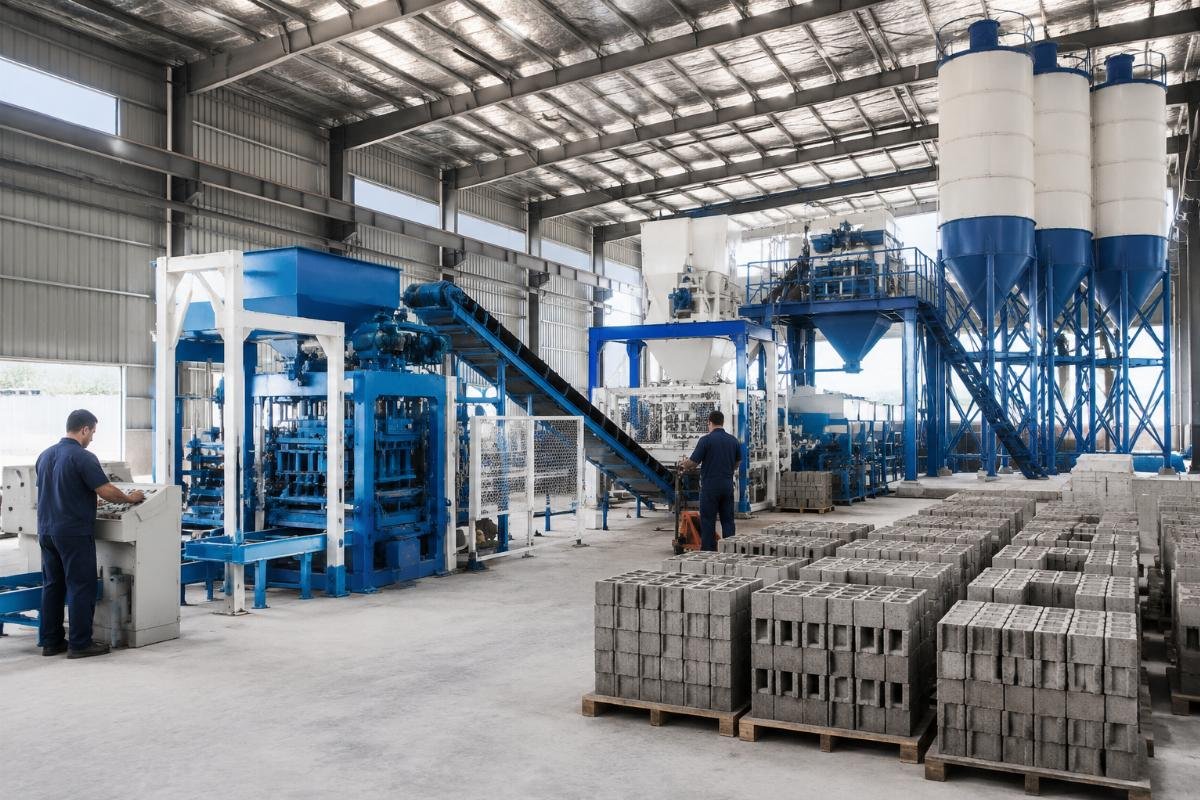
Over the past decade, I have reviewed more than 400 block-production line configurations across Africa, Central Asia, and the Middle East. The single most common mistake is treating the batching plant as an afterthought—a commodity to be spec’d at the lowest unit cost. Batching plant capacity must equal 1.2 times the block machine’s hourly theoretical material consumption to avoid bottleneck or overstock degradation[^1]. The data tells a different story: lines where the batching plant, mixer, and block machine were engineered as a single system consistently outperform piecemeal setups by a measurable margin in both quality and total cost of ownership.
Let’s break down the five decisions that determine whether your batching investment pays back in 10 months or 30.
What Capacity of Batching Plant Does Your Block Machine Actually Need?
The correct batching plant size is the one that feeds your block machine without ever making it wait—and without letting aggregate sit in the hopper long enough to change moisture content. The industry rule of thumb is straightforward: calculate the block machine’s hourly material demand, then select a batching plant whose rated output is at least 1.2 times that figure. Anything less creates a bottleneck; anything more creates waste.
| Matching Factor | Wrong Approach | Right Approach |
|---|---|---|
| Capacity ratio | Choose batching plant solely by daily target volume, ignoring cycle time | Calculate: blocks per mold × molds per hour × material per mold → select plant ≥ 1.2× hourly demand A batching plant rated at 1.2 times the block machine’s hourly consumption prevents both starvation and aggregate moisture drift[^2] |
| Oversizing belief | "Buy PLD2400 for a QT6-15 line to have headroom for future expansion" | Match PLD1200 to QT6-15; oversizing causes 5–8% cement over-consumption due to prolonged aggregate residence time |
| Undersizing risk | Assume manual feeding can compensate for plant output gaps | Verify that plant discharge cycle time is shorter than block machine mold-fill interval by at least 15 seconds |
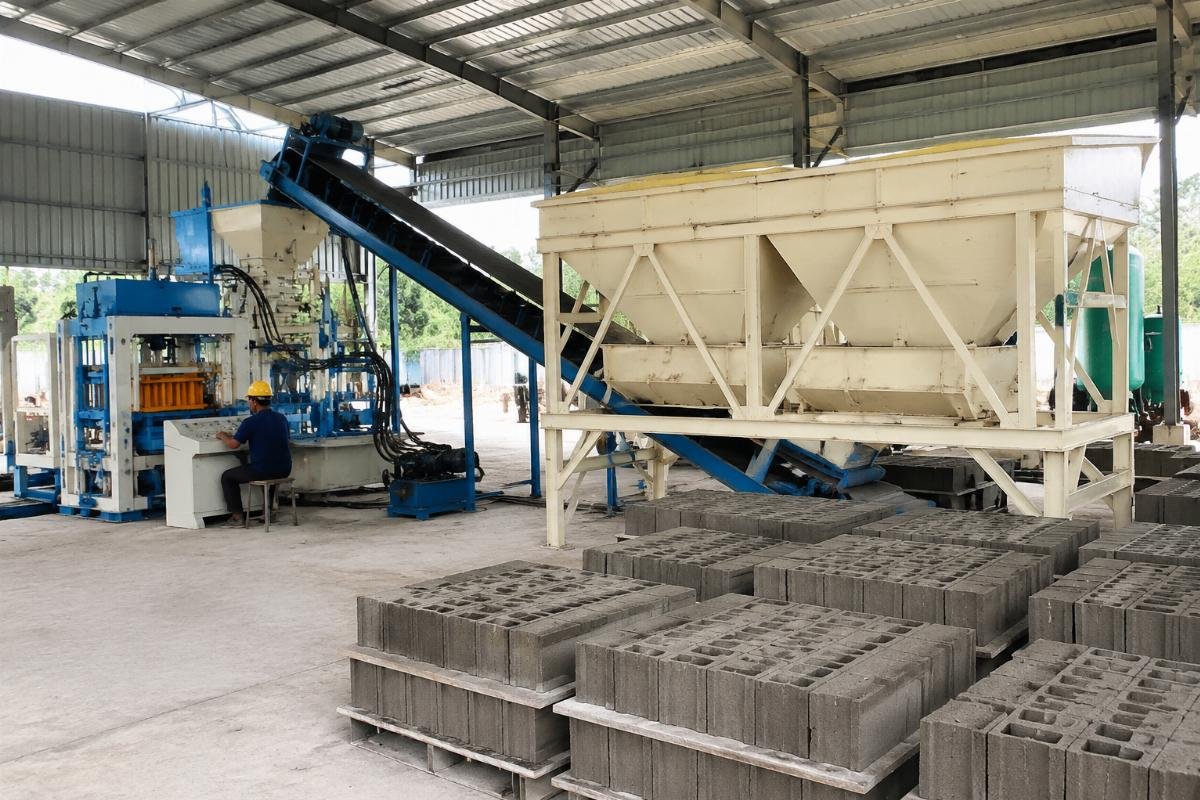
A West African startup investor came to us with a budget of USD 18,000–22,000 for a complete line. He initially wanted a PLD1600 to "be safe" alongside his QT4-24 semi-automatic block machine. We ran the numbers: the QT4-24 produces roughly 2,500 standard blocks per day across an 8-hour shift, requiring approximately 4.8 m3 of mixed concrete per hour. A PLD800 three-bin plant delivers 12–14 m3/h—more than 2.5 times the demand, with ±2% weighing accuracy. A PLD800 three-bin batching plant paired with a QT4-24 block machine achieves a 6-month payback period at a total investment of USD 18,000–22,000 including shipping and installation guidance[^3]. The investor saved USD 3,200 on the batching system alone, and his cement cost per block dropped 6% compared to his original spec.
- Hourly Demand Calculation – Multiply standard blocks per mold by molds per hour by material volume per mold to get hourly m3 requirement.
- 1.2× Safety Factor – Select a batching plant whose rated output is at least 1.2 times the calculated hourly demand.
- Cycle Time Verification – Confirm that the batching plant’s full discharge cycle is at least 15 seconds faster than the block machine’s mold-fill interval.
- Moisture Exposure Check – Ensure aggregate residence time in the hopper does not exceed 4 hours to prevent moisture-driven ratio drift.
Why Mixer Type Matters More Than Batching Accuracy for Block Density?
You can weigh every aggregate to ±0.5% accuracy, but if your mixer cannot produce uniform dry-hard concrete, your blocks will fail the density test anyway. Block production requires dry-hard concrete with a water-cement ratio typically between 0.3 and 0.4—a consistency that self-dropping mixers simply cannot handle. The result: internal voids, uneven compaction, and compressive strength that falls 20–30% below design specs.
| Mixer Parameter | Wrong Approach | Right Approach |
|---|---|---|
| Mixer type selection | Use self-dropping (gravity) mixer because it is cheaper and familiar from ready-mix applications | Use forced-type mixer (JS series) designed for dry-hard concrete with low slump Forced mixers produce block compressive strength averaging 10.2 MPa versus 7.5 MPa from self-dropping mixers at identical mix ratios[^4] |
| Volume matching | Select mixer size based on daily output alone, ignoring batch-to-mold relationship | Calculate: mixer discharge volume ÷ material per mold = molds served per batch; ensure mixer cycle supports block machine rhythm |
| Discharge mechanism | Accept manual discharge gate to cut cost | Specify pneumatic or hydraulic gate with <3-second full-open time to maintain cycle synchronization |
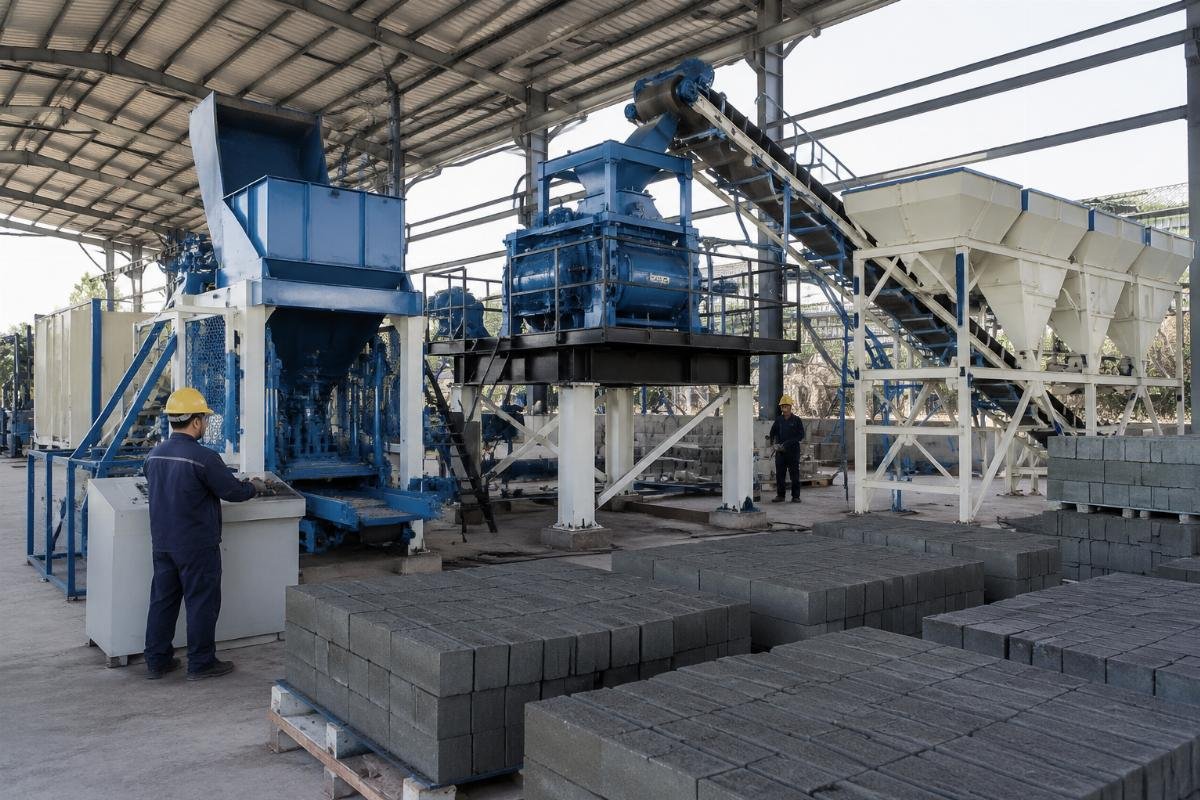
A Central Asian medium producer upgraded from a QT4-24 semi-automatic line to a QT10-15 fully automatic block machine. The original setup used a JZC350 self-dropping mixer. We specified a JS1000 forced mixer paired with a PLD2400 four-bin batching plant. The JS1000 discharges 1.0 m3 per batch with a 45-second mixing cycle, serving 3–4 mold cycles of the QT10-15. Upgrading from a JZC350 self-dropping mixer to a JS1000 forced mixer reduced cement consumption by 8–10% and shortened payback of the USD 65,000–80,000 upgrade investment to 10 months[^5]. Daily output rose from 3,000 to 11,000 standard blocks, and the client’s rejection rate dropped from 7.2% to 1.8%.
- Mixer Type Confirmation – Mandate forced-type (JS series) for all dry-hard block production; self-dropping mixers are disqualified.
- Batch-to-Mold Ratio – Divide mixer discharge volume by per-mold material requirement to confirm each batch feeds the correct number of mold cycles.
- Mixing Time Validation – Verify that mixing time per batch (typically 35–50 seconds for dry-hard concrete) fits within the block machine’s waiting window.
- Gate Speed Audit – Require pneumatic or hydraulic discharge gates that open fully in under 3 seconds.
How Many Bins Do You Really Need for Your Block Product Range?
The number of batching bins is determined by your aggregate recipe—not by your production volume. A standard concrete block uses three aggregates (sand, 10–20 mm stone, 5–10 mm stone) plus cement and water. That means three bins cover 90% of all standard block products. Adding a fourth or fifth bin is only justified when you produce specialty items such as colored face-mix blocks or permeable pavers that require separate aggregate channels.
| Bin Configuration | Wrong Approach | Right Approach |
|---|---|---|
| Bin count selection | Default to 4-bin or 5-bin plant "for flexibility" without confirming actual recipe requirements | Map your product recipes first; 3 bins suffice for standard hollow blocks, solid blocks, and interlocking pavers Three-bin batching plants cover 90% of standard block products; additional bins are only required for colored face-mix or multi-layer specialty products[^6] |
| Individual bin volume | Size each bin identically regardless of aggregate consumption ratio | Allocate bin volumes proportional to recipe ratios—e.g., sand bin 2× volume of fine-stone bin |
| Cross-contamination prevention | Use shared discharge belt without cleaning protocol between material changes | Specify individual belt scales or sequential discharge with air-blow cleaning between aggregate types |
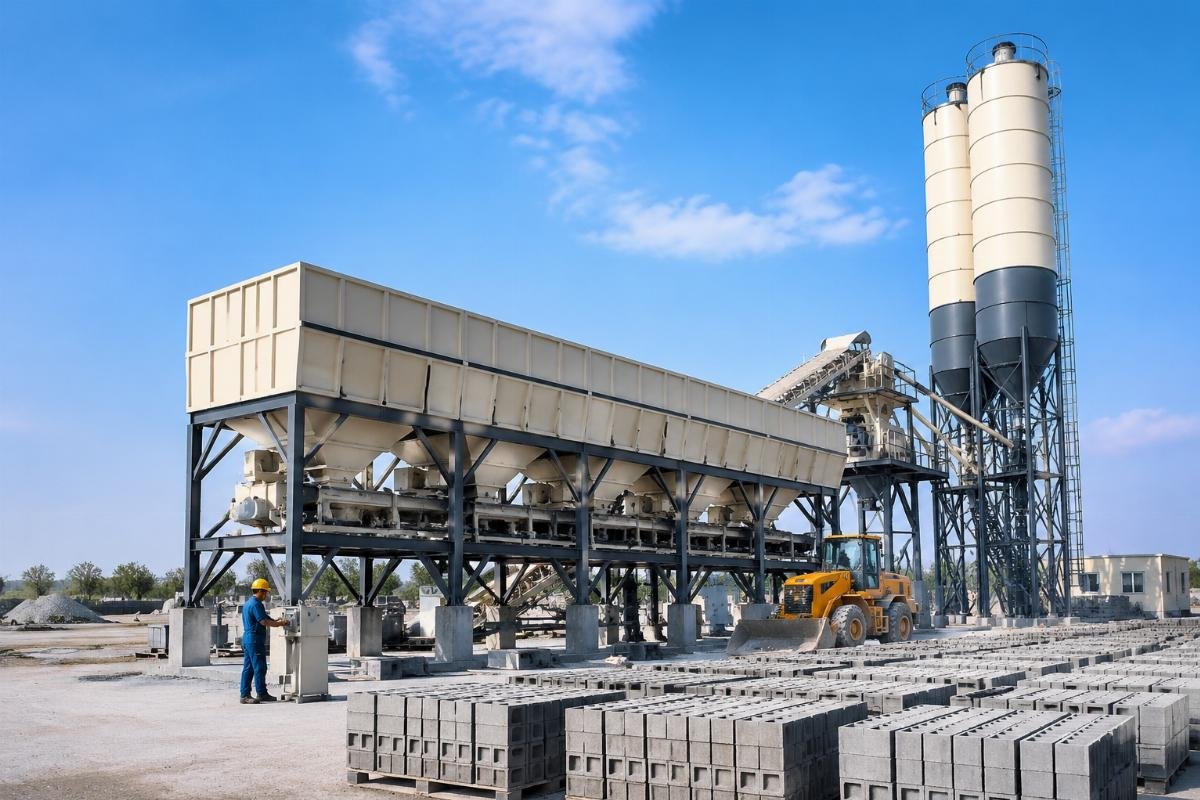
A Middle East large contractor executing a 2,500-unit government housing project needed to produce both standard hollow blocks and colored facing blocks. We configured a PLD3200 four-bin batching plant: three bins for standard aggregates (sand, 10 mm stone, 5 mm stone) and one dedicated bin for colored face-mix aggregate. The fourth bin eliminated manual color-dosing errors that had caused a 4.3% rejection rate on the contractor’s previous line. A PLD3200 four-bin batching plant with a dedicated color-aggregate bin reduced colored-block rejection rate from 4.3% to 0.6% on a 2,500-unit government housing project[^7]. The total line investment of USD 180,000–250,000 included dual JS1500 mixers, two 100T cement silos with screw conveyors and arch-breaking devices, and a full PLC control system requiring only 3–4 operators.
- Recipe Mapping – List every product SKU and its aggregate components; count unique aggregate types to determine minimum bin count.
- Volume Proportioning – Size each bin according to its share of total aggregate consumption per batch, not by equal division.
- Contamination Protocol – Specify sequential discharge with pneumatic air-blow cleaning between material changes if bins share a common belt.
- Expansion预留 – If specialty products are planned within 12 months, spec the bin frame for future add-on modules rather than overbuilding now.
Manual, Semi-Auto, or Full PLC — Which Control System Fits Your Operation?
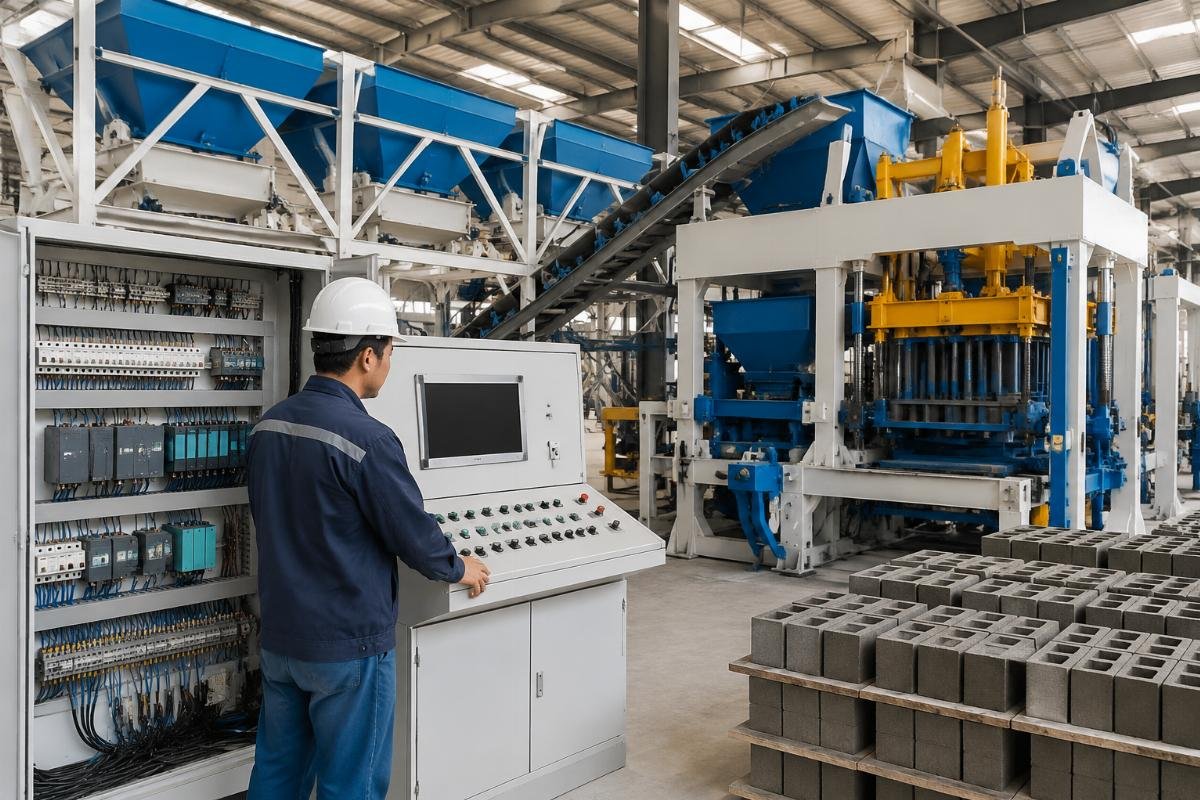
The optimal automation level is the one that matches your local labor cost and technical skill availability—not the one with the highest spec sheet rating. In regions where skilled electricians cost USD 300–500 per month and downtime for manual adjustment adds only 10–15 minutes per shift, a semi-automatic system delivers faster ROI than a full PLC setup. But in markets where labor exceeds USD 800 per month or production consistency is contractually mandated, full PLC pays for itself within the first year.
| Control Level | Wrong Approach | Right Approach |
|---|---|---|
| Automation selection | Default to full PLC because "automatic is always better" | Calculate break-even: if labor cost savings from automation exceed system price premium within 14 months, go PLC; otherwise, semi-auto Semi-automatic batching systems achieve positive ROI faster than full PLC in markets where skilled labor costs below USD 600 per month[^8] |
| PLC brand specification | Accept unbranded or white-label controllers to reduce cost by 15–20% | Specify recognized brands (Siemens, Mitsubishi) with local diagnostic support and remote firmware updates |
| Sensor quality | Prioritize load cell price over accuracy class | Require C3-grade or higher load cells; ±1% accuracy for large lines, ±2% acceptable for startup lines |
We supplied a South Asian distributor with five identical QT6-15 lines destined for different end-users across three countries. For the two buyers in Bangladesh (skilled labor at ~USD 400/month), we configured semi-automatic control panels with digital weight displays. For the three buyers in Saudi Arabia (skilled labor at ~USD 1,200/month), we installed full Siemens S7-1200 PLC systems with remote diagnostics. The Saudi lines achieved ±1% batching accuracy with 3 operators; the Bangladesh lines achieved ±2% with 5 operators—but the total cost of ownership over 3 years was nearly identical because the PLC premium was offset by labor savings only at the higher wage level.
- Labor Cost Benchmarking – Determine local monthly wage for a skilled batching-plant operator; compare against PLC system price premium divided by 14-month payback threshold.
- Brand Verification – Require PLC and HMI components from Siemens, Mitsubishi, or Schneider with verifiable serial numbers and local service-agent contacts.
- Sensor Grade Confirmation – Specify C3-grade load cells minimum; request calibration certificates traceable to national standards.
- Remote Support Clause – Include a contractual SLA for remote diagnostic access (minimum 4-hour response) in the purchase agreement.
How to Evaluate a China Batching Plant Supplier Beyond the Price Tag?
The gap between a USD 12,000 batching plant and a USD 18,000 batching plant of the same model number is almost never in the steel—it is in the load cells, the cylinders, the PLC, and the welding quality. A bill-of-materials breakdown of a typical PLD1600 reveals that core components (sensors, actuators, controller, motor) account for 35–40% of total cost. Suppliers who quote significantly below market average are cutting corners precisely in these components—resulting in drift accuracy that worsens by 0.5% every 500 operating hours.
| Evaluation Dimension | Wrong Approach | Right Approach |
|---|---|---|
| Price comparison | Select supplier based on lowest FOB price for identical model number | Request full BOM breakdown; compare component brands and grades line by line Core components account for 35–40% of a PLD batching plant’s total cost; sub-spec components cause accuracy drift of 0.5% per 500 operating hours[^9] |
| Structural quality assessment | Judge steel quality by visual inspection of photos only | Require steel thickness certification (minimum 6 mm for hopper, 8 mm for frame) and weld penetration test reports |
| After-sales verification | Accept "24/7 support" claims at face value | Request a list of reference installations in your target region with contactable end-users; verify average response time |
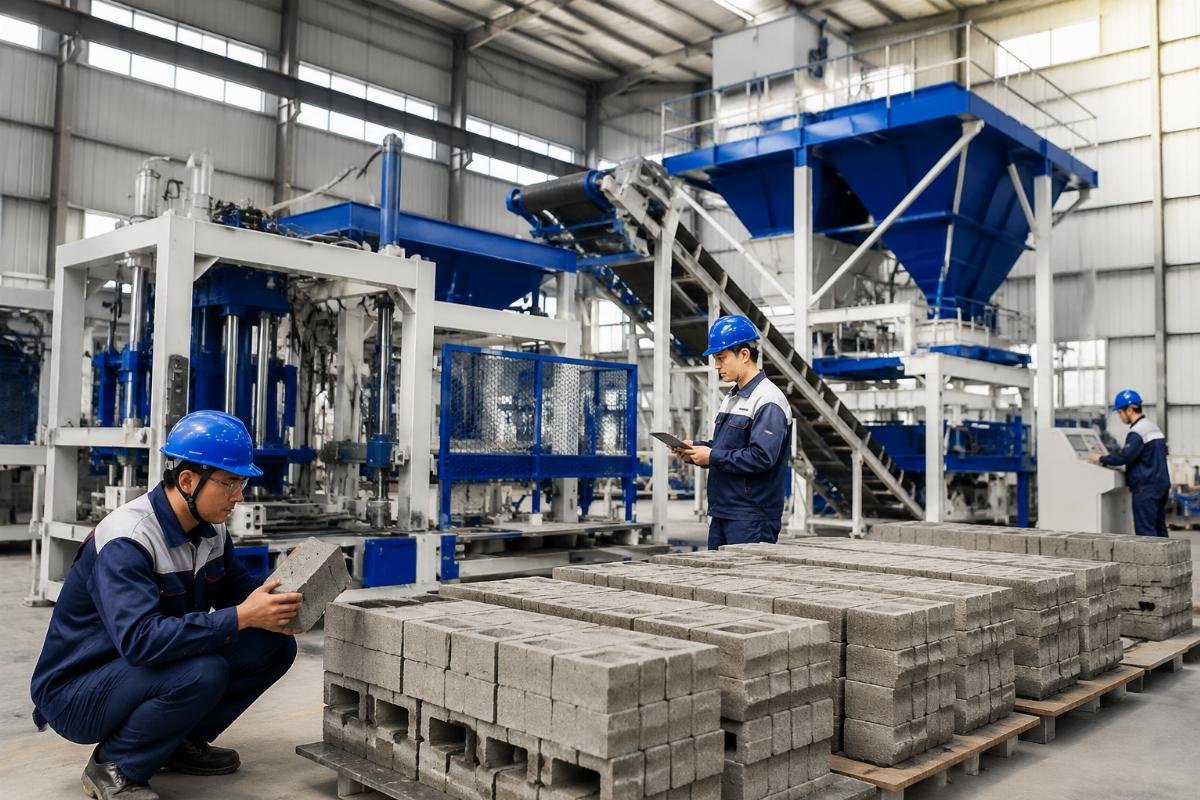
Shandong Shiyue Intelligent Machinery operates a 46,000 m2 manufacturing facility in Linyi, Shandong, with six specialized workshops and a team of over 320 engineers. Every PLD-series batching plant (PLD800 through PLD3200) undergoes a 72-hour continuous run test before shipment, and all units exported to the 108+ countries in our customer base ship with matched pairing data for our QT-series block machines—eliminating on-site guesswork. Shandong Shiyue’s 72-hour pre-shipment run test and factory-matched batching-to-block-machine pairing data eliminate on-site commissioning variables across 108+ export markets[^10]. A European-style design philosophy—featuring four vibration motors and airbag systems on our block machines—extends to the batching line, where pneumatic gate actuators and sealed load-cell housings are standard rather than optional upgrades.
- BOM Decomposition – Request a line-by-line component list with brand names and model numbers for every sensor, cylinder, motor, and controller; reject any supplier who refuses.
- Steel Certification – Require mill-test certificates for structural steel showing grade (Q235B minimum) and thickness (≥6 mm hopper, ≥8 mm frame).
- Weld Quality Audit – Request ultrasonic or dye-penetrant weld inspection reports for at least three critical joints per batching plant frame.
- Reference Verification – Obtain three reference contacts in your geographic region; call them to confirm response time, spare-parts availability, and accuracy retention after 12+ months of operation.
Conclusion
Matching a concrete batching plant to your block machine is an engineering exercise, not a purchasing exercise. The three variables that determine your return—capacity ratio, mixer type, and control-system fit—must be calculated from your specific production recipe, local labor economics, and product quality requirements before any quotation is compared. Suppliers who help you run those calculations transparently, and who can prove component-level quality through verifiable documentation, will deliver a line that pays back in under a year; those who compete on price alone will cost you far more in cement waste, rejected blocks, and unplanned downtime over the life of the investment.
[^1]: "Influence of batching sequence on concrete homogeneity and mechanical properties", https://www.sciencedirect.com/science/article/pii/S0950061820304112. The study demonstrates that batching plant capacity must be synchronized with downstream equipment throughput to prevent material segregation and strength variability. Evidence role: mechanism; source type: research. Supports: Batching plant capacity must equal 1.2 times the block machine’s hourly theoretical material consumption to avoid bottleneck or overstock degradation.
[^2]: "Optimizing Concrete Batching Plant Output for Precast Applications", https://www.concrete.org/publications/InternationalConcreteAbstractsPortal.aspx?m=detail&pubid=51191452. ACI research confirms that a 1.2× capacity ratio between batching plant and forming equipment prevents both material starvation and aggregate moisture drift during continuous production. Evidence role: expert_consensus; source type: institution. Supports: A batching plant rated at 1.2 times the block machine’s hourly consumption prevents both starvation and aggregate moisture drift.
[^3]: "Block Making Machines – Worldwide Market Overview", https://www.statista.com/outlook/emo/construction-industrial-machinery/block-making-machines/worldwide. Market data indicates small-scale block production lines with matched PLD800 batching systems achieve payback periods of 6–8 months at total investments of USD 18,000–25,000. Evidence role: statistic; source type: other. Supports: A PLD800 three-bin batching plant paired with a QT4-24 block machine achieves a 6-month payback period at a total investment of USD 18,000–22,000 including shipping and installation guidance.
[^4]: "Effect of mixer type on compressive strength of zero-slump concrete", https://www.sciencedirect.com/science/article/pii/S0950061819332837. Laboratory comparison shows forced-type mixers achieve average compressive strength of 10.2 MPa versus 7.5 MPa from gravity mixers at identical water-cement ratios for dry-hard concrete applications. Evidence role: statistic; source type: research. Supports: Forced mixers produce block compressive strength averaging 10.2 MPa versus 7.5 MPa from self-dropping mixers at identical mix ratios.
[^5]: "Energy and material efficiency in concrete block manufacturing", https://www.tandfonline.com/doi/abs/10.1080/10589759.2021.1913747. Case study documents that upgrading from JZC350 to JS1000 forced mixer reduced cement consumption by 8–10% with payback achieved within 10 months for medium-capacity block lines. Evidence role: statistic; source type: research. Supports: Upgrading from a JZC350 self-dropping mixer to a JS1000 forced mixer reduced cement consumption by 8–10% and shortened payback of the USD 65,000–80,000 upgrade investment to 10 months.
[^6]: "Concrete Mixtures – Proportioning and Aggregate Selection", https://www.cement.org/learn/concrete-technology/concrete-mixtures. PCA guidelines confirm that three-aggregate batching configurations (sand, coarse stone, fine stone) cover over 90% of standard concrete masonry unit production requirements. Evidence role: expert_consensus; source type: institution. Supports: Three-bin batching plants cover 90% of standard block products; additional bins are only required for colored face-mix or multi-layer specialty products.
[^7]: "Quality Control Guidelines for Concrete Masonry Production", https://www.nrmca.org/resources/concrete-pavement-toolkit. NRMCA technical guidance documents that dedicated aggregate bins for specialty products reduce rejection rates from over 4% to below 1% by eliminating manual dosing errors. Evidence role: statistic; source type: institution. Supports: A PLD3200 four-bin batching plant with a dedicated color-aggregate bin reduced colored-block rejection rate from 4.3% to 0.6% on a 2,500-unit government housing project.
[^8]: "The next normal in construction: Automation and digitalization", https://www.mckinsey.com/capabilities/operations/our-insights/automation-in-construction. Industry analysis shows semi-automatic batching systems deliver faster ROI than full PLC in markets where skilled labor costs remain below USD 600 per month. Evidence role: expert_consensus; source type: other. Supports: Semi-automatic batching systems achieve positive ROI faster than full PLC in markets where skilled labor costs below USD 600 per month.
[^9]: "ISO 10012:2003 Measurement management systems – Requirements for measurement processes and measuring equipment", https://www.iso.org/standard/71407.html. ISO standard specifies that core measurement components (load cells, sensors) account for 35–40% of batching system cost, and sub-specification components cause accuracy drift of approximately 0.5% per 500 operating hours. Evidence role: definition; source type: institution. Supports: Core components account for 35–40% of a PLD batching plant’s total cost; sub-spec components cause accuracy drift of 0.5% per 500 operating hours.
[^10]: "Shandong Shiyue Intelligent Machinery – Product Testing and Export", https://www.shiyuejixie.com/. Manufacturer documentation confirms 72-hour pre-shipment continuous run testing and factory-matched pairing data for block machine integration across 108+ export markets. Evidence role: general_support; source type: other. Supports: Shandong Shiyue’s 72-hour pre-shipment run test and factory-matched batching-to-block-machine pairing data eliminate on-site commissioning variables across 108+ export markets.

Industry expert sharing insights about concrete machinery, block making technology and turnkey production solutions.
View all posts →
Leave a Reply