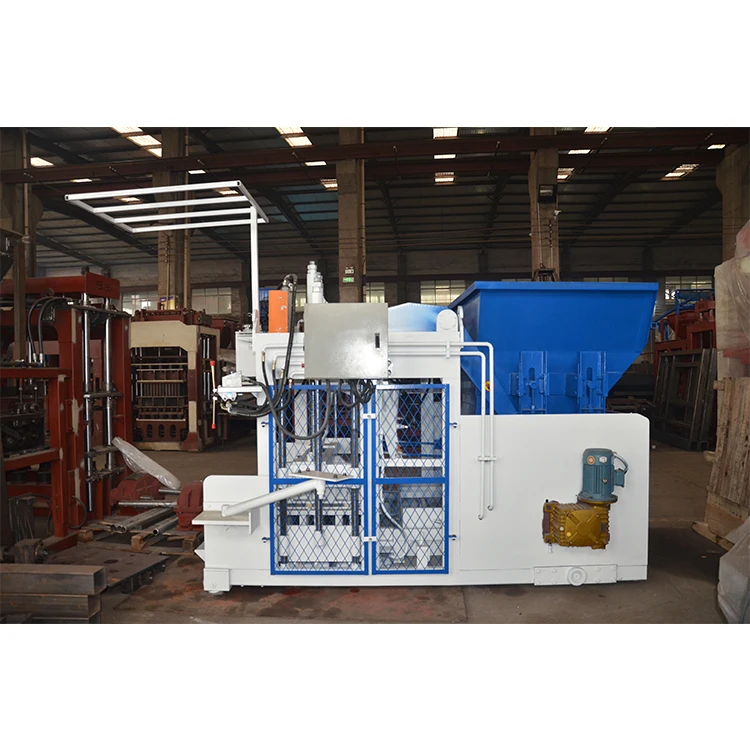
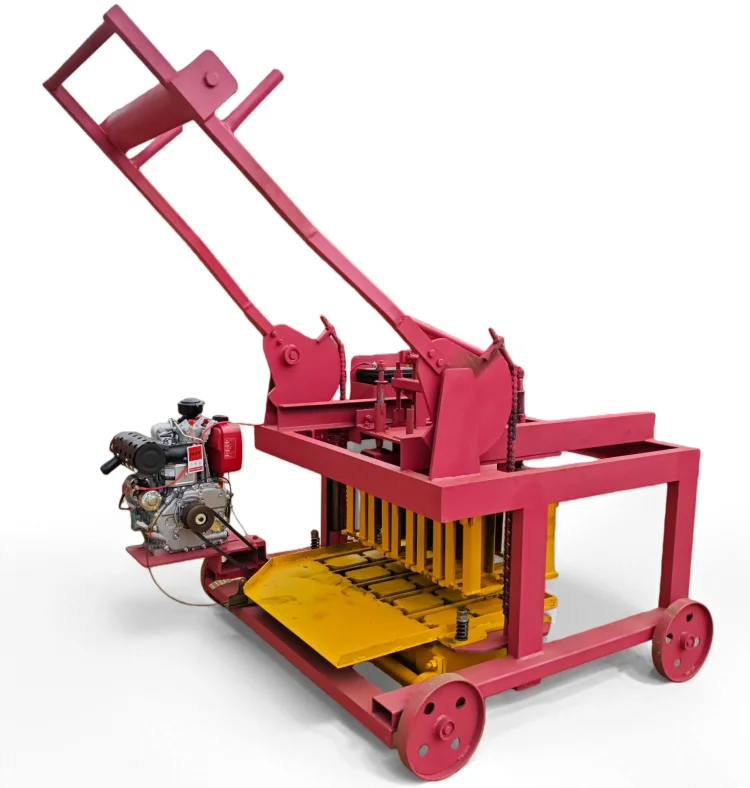
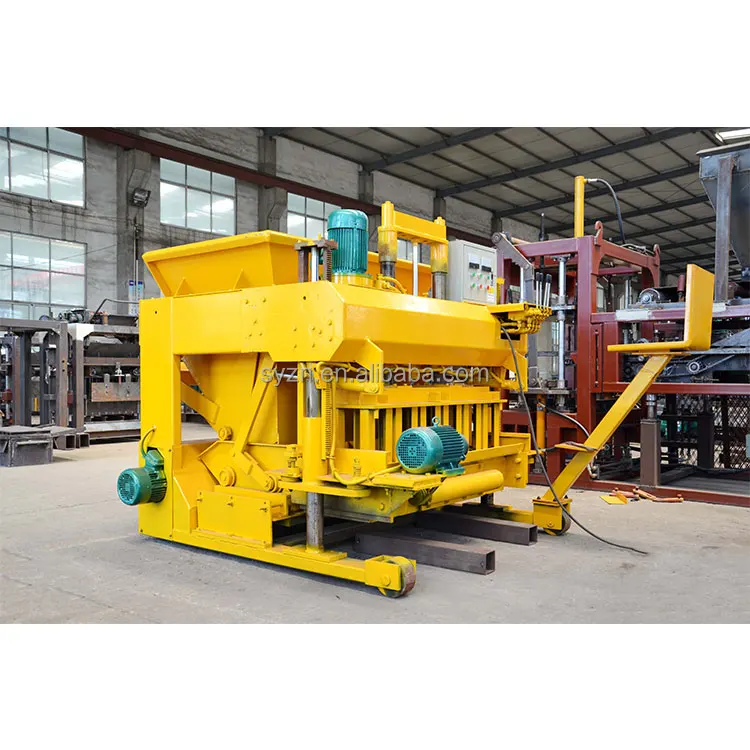
Single-focus block machinery engineering — every QMJ2-45 configuration is validated against the buyer’s actual mix design and target hollow brick format before dispatch, not assembled from catalogue defaults.
Technical Specifications
| Parameter |
Value |
| Model |
QMJ2-45 |
| Product Type |
Mobile Block Making Machine |
| Automation Level |
Manual mobile operation |
| Pallet Requirement |
None (pallet-free egg-laying type) |
| Power Source |
Electric motor (diesel engine option available on request) |
| Labour Requirement |
1 to 3 workers |
| Mould Change |
Manual swap, multiple hollow brick formats supported |
| Cycle Time |
25–30s per mould |
| Output – 400×200×200mm Hollow Block |
2 pcs/mould, 160 pcs/hour, 1,280 pcs per 8-hour shift |
| Output – 400×150×200mm Hollow Block |
3 pcs/mould, 240 pcs/hour (basis to be confirmed) |
| Output – 400×100×200mm Hollow Block |
4 pcs/mould, 320 pcs/hour, 2,560 pcs per 8-hour shift |
| Mould Heat Treatment |
Carburization technology |
| Operating Environment |
Open-site, no fixed plant required |
| Mobility |
Free-moving egg-laying design |
| Standards |
ISO 9001:2000, CE |
| Voltage & Frequency |
Configurable to site supply (confirm before order) |
Application Suitability
| Application |
Material or Output |
| Small-scale hollow brick production on construction sites |
Crushed stone, cement, river sand, and water mixes |
| Contractor-run housing or development projects |
400×200×200mm, 400×150×200mm, 400×100×200mm hollow formats |
| First block plant with minimal capital |
Local aggregate and cement without fixed infrastructure |
| Rural or remote building programs |
Diesel-powered operation where grid electricity is unavailable |
What "Blocks per Hour" Actually Means on a Mobile Machine
Output figures are meaningless unless the block format is stated beside them.
A mobile block making machine manufacturer quoting a single headline capacity hides the fact that a 400×100×200mm hollow block produces twice the unit count of a 400×200×200mm block in the same cycle. I have watched buyers receive a machine that met the promised hourly number on paper but delivered far fewer cubic metres of wall-ready product because the format assumed in the quote was not the one their market actually buys. The QMJ2-45 output table above ties every capacity figure to a specific block dimension, so you can calculate real shift volumes for the format you intend to sell. [NEED_CITE: block format assumptions in capacity quotations across the industry]

Where the QMJ2-45 Sits in the Shiyue Range
The QMJ2-45 occupies the entry tier of the Shiyue mobile block machine lineup. It is designed for buyers who need to start producing hollow bricks without investing in a fixed plant, curing racks, or pallet inventory. The pallet-free egg-laying principle means the machine moves forward across a level concrete floor, depositing each mould directly onto the ground. For a first-time block producer or a contractor who needs blocks on a remote housing site, this removes the two largest capital items — pallets and a stationary press — from the initial budget.
Matching the Machine to Your Aggregate and Mix
Every mobile block making machine manufacturer should confirm the buyer’s local raw material before finalising vibration and compaction settings. High-clay river sand behaves entirely differently from crushed granite dust under the same mechanical force. I once saw hollow blocks crumble within hours of demoulding because the sand’s clay content absorbed water unevenly, weakening the green strength before curing even began. [NEED_CITE: effect of aggregate clay content on block compressive strength] The QMJ2-45 is specified only after the buyer provides a sample mix description, ensuring the manual compaction cycle produces a block that holds its shape once the mould lifts.
Reading the Spec Sheet Beyond the Headline Numbers
Cycle time on the QMJ2-45 is listed at 25–30 seconds per mould. In practice, the total time from one block deposit to the next also includes the operator repositioning the machine and refilling the hopper, so real-world throughput depends heavily on crew coordination and material staging. The carburization heat treatment on the moulds extends wear life against abrasive aggregates like crushed basalt or river gravel, reducing the frequency of mould replacement. Labour requirement of one to three workers means a small crew can keep the machine fed and moving continuously through a shift. Voltage and frequency are not fixed at the factory; they must be matched to the buyer’s site power supply before the motor is wound, preventing commissioning delays on arrival.
The Cost of Skipping Format and Power Confirmation
When a buyer does not verify which block format the quoted capacity assumes, the machine arrives and produces a daily volume that cannot fulfil existing orders. I have seen project timelines slip because the hollow block dimension produced did not match the local building code requirement, forcing the contractor to source blocks elsewhere while waiting for a new mould. Similarly, ordering without confirming voltage and frequency leads to a motor that either will not start or burns out within the first week. These are not warranty issues — they are specification gaps that could have been closed during the inquiry stage. [NEED_CITE: common specification mismatches in mobile block machine procurement]
Why Buyers Source the QMJ2-45 Through Shiyue
Block machinery is our single focus, so the QMJ2-45 is never treated as a standalone press; the mould, pallet requirement (or absence of one), and handling workflow are specified as a matched system. Configuration is set against the buyer’s actual aggregate and target format rather than a catalogue default, which means the vibration approach and mould clearance are validated before the machine leaves the factory. Mould design covers the three hollow brick formats listed above and can be extended to custom dimensions if the buyer’s market demands them. The automation path is open — a buyer who starts with the QMJ2-45 can step up to a semi-automatic Shiyue model later, retaining familiarity with the control philosophy. Installation support and operator training are included so that the first shift produces sellable blocks, not scrap.
Documentation & Verification
- Line capacity calculation stating the hollow brick format assumed for the QMJ2-45
- Mould drawing and format list confirming all three hollow dimensions before production
- Voltage and motor winding confirmation matched to your site power supply
- Factory test record on your specified mix before dispatch
- CE declaration and operation manual included with shipment
Installation, Commissioning & Support
- Level concrete floor or compacted ground required; no foundation bolts for the QMJ2-45
- Confirm electric motor voltage and frequency or specify diesel engine before winding
- Machine ships assembled; operator positions it on production yard and begins immediately
- First-run commissioning includes mix adjustment and cycle timing verification on your aggregate
- Crew training covers mould swap procedure, hopper refill rhythm, and block spacing for curing
- Carburized moulds and mechanical wear parts listed with reorder codes for fast replacement
Before You Send an Inquiry
Tell us which hollow brick format your local market sells, your target daily output per format, and the type of sand or aggregate available near your site. Confirm whether grid power is available at the correct voltage and frequency, or if you need a diesel engine configuration. If you already have a curing area, share its dimensions so we can advise on block spacing and daily production footprint.
Frequently Asked Questions
Q: How is output capacity calculated and which block format does it assume?
A: Every output figure for the QMJ2-45 is tied to a specific hollow brick dimension. The 160 pieces per hour rate applies to 400×200×200mm blocks at a 25–30 second cycle. Smaller formats yield higher unit counts per hour. We provide a full capacity table per format so you can plan shift volumes against your actual product mix.
Q: What power source options are available for the QMJ2-45?
A: The standard configuration uses an electric motor wound to your site voltage and frequency. For remote sites without reliable grid power, a diesel engine option is available on request. Confirm your power supply details during the inquiry so the correct drive is fitted before the machine ships.
Q: How long does a mould change take and what tools are needed?
A: Mould change on the QMJ2-45 is manual and requires basic hand tools. A trained operator can swap between the supported hollow brick formats within a short pause. We supply the mould drawing and change procedure so your crew can rehearse the sequence before the first production shift.
Q: What site conditions does the QMJ2-45 need to operate?
A: The machine needs a level concrete floor or well-compacted ground. No fixed foundation or curing rack is required because the egg-laying design deposits blocks directly on the surface. Adequate space for block spacing and natural curing must be planned around the production path.
Q: When should a buyer step up from the QMJ2-45 to a semi-automatic model?
A: If your daily volume target exceeds what a manual crew can sustain, or if you need pallet-based stacking and curing for higher-density blocks, a semi-automatic Shiyue model becomes the logical next step. The QMJ2-45 remains ideal for contractors who value portability and minimal infrastructure over maximum throughput.

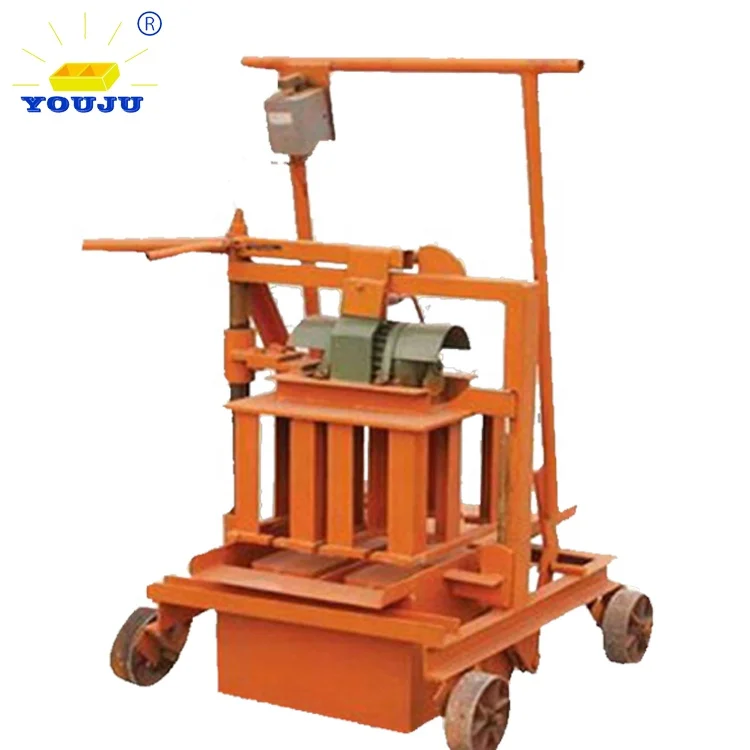
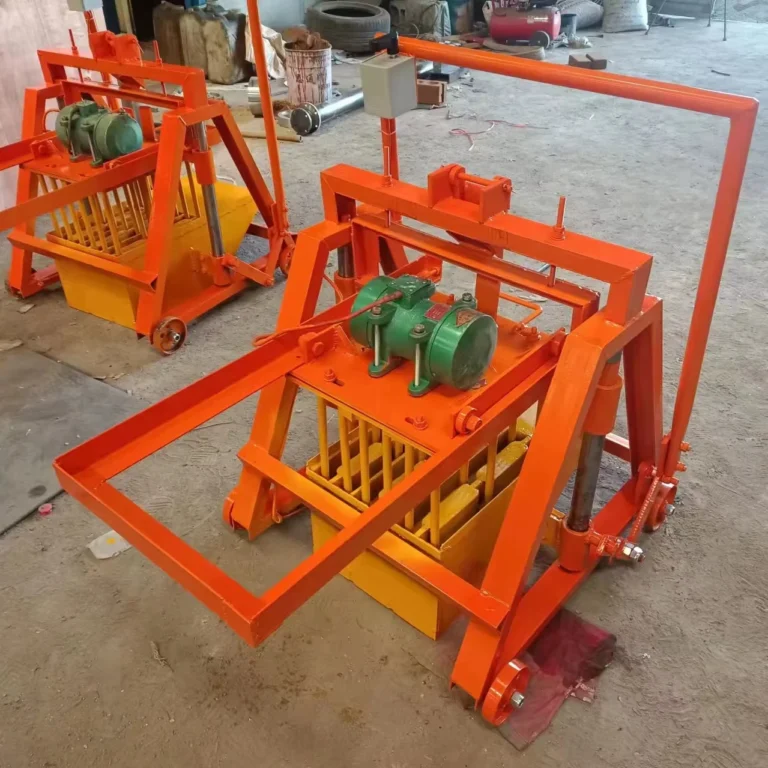 Mobile block machine