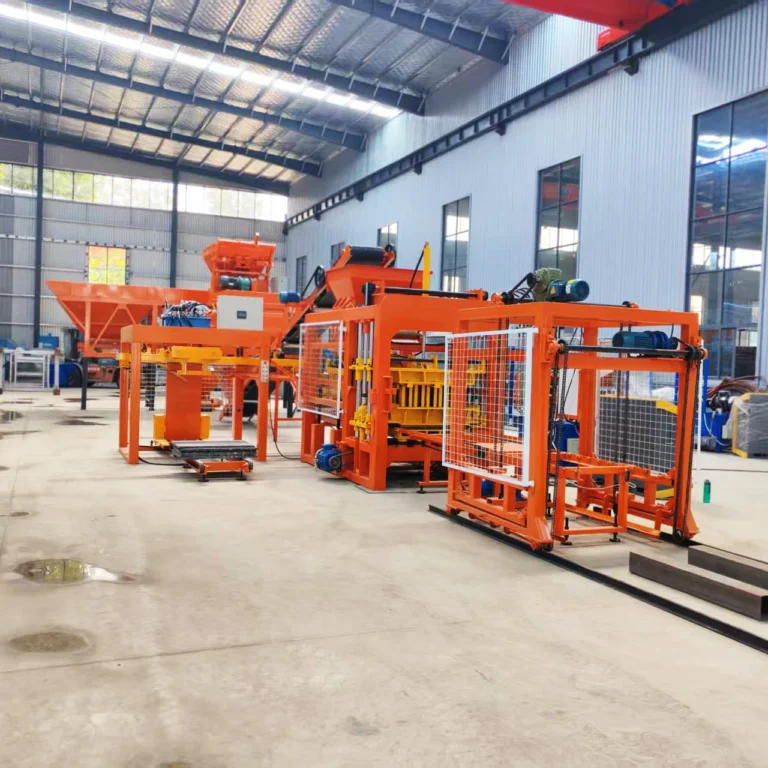
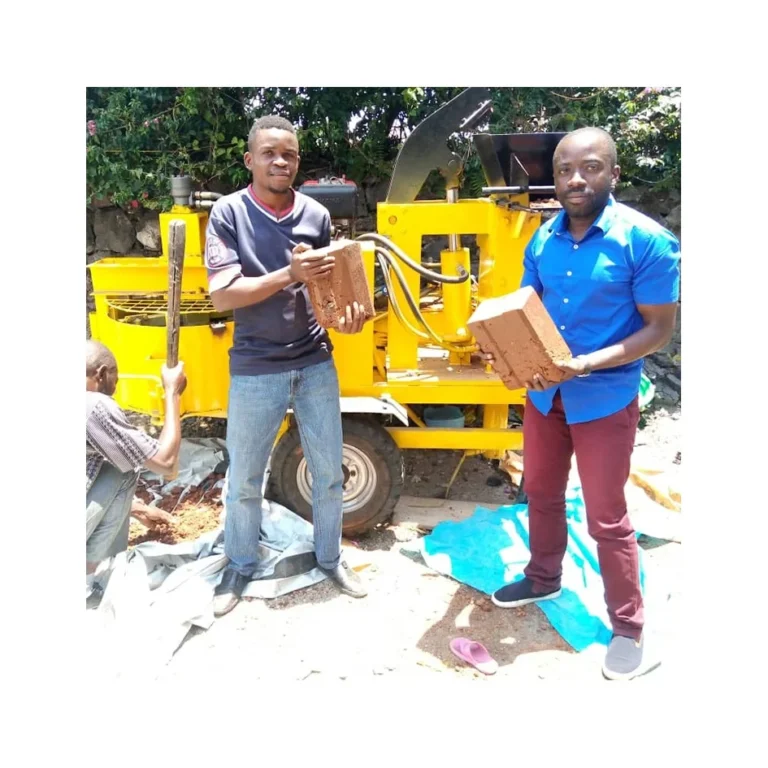
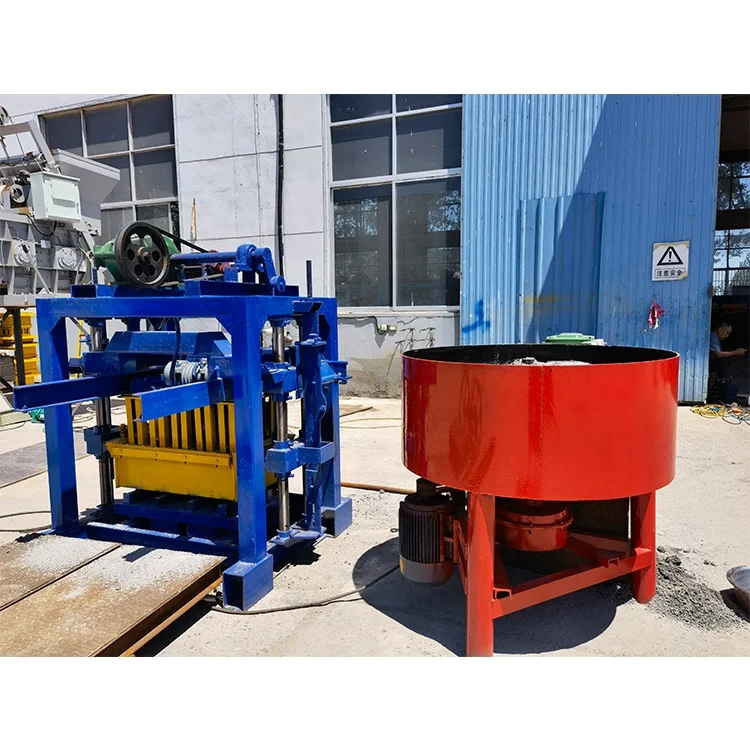
Specification-Driven Sizing — Every output figure for the QT6-15 is tied to a specific block format, mould cavity count, and cycle time, so buyers can map the machine against actual project requirements before committing.
Technical Specifications
| Parameter |
Value |
| Model |
QT6-15 |
| Product Type |
Fully Automatic Hydraulic Vibration Block Making Machine |
| Overall Dimensions |
7400 × 1900 × 2660 mm |
| Molding Cycle |
15–25 s (basis not stated in source — confirm block format and material) |
| Vibration Frequency |
4600 r/min |
| Exciting Power (Vibration Force) |
40–50 kN |
| Total Power |
31.25 kW (rated or peak not specified in source) |
| Mixer Model |
JQ350 |
| Pallet Size |
850 × 550 × 25 mm |
| Total Weight |
7 T |
| Control System |
PLC control system |
| Hydraulic Station |
Included, high-pressure configuration |
| Automation Level |
Fully automatic (pallet feeder, brick conveyor, block sweeper included) |
| Output Capacity |
1200–1680 pcs/hr based on 400×200×200 mm hollow block, 15–20 s cycle |
| Output Capacity |
1800–2400 pcs/hr based on 400×150×200 mm hollow block, 15–20 s cycle |
| Output Capacity |
3240 pcs/hr based on 240×115×53 mm solid brick, 15–20 s cycle |
| Daily Output (8 hr) |
9600–13440 pcs (400×200×200 mm hollow block) |
| Daily Output (8 hr) |
14400–19200 pcs (400×150×200 mm hollow block) |
| Daily Output (8 hr) |
16200–19440 pcs (240×115×53 mm solid brick) |
| Applicable Products |
Paver, solid block, hollow block, curbstone via mould change |
| Raw Materials |
Crushed stone, sand, cement, dust, fly ash |
| Included Equipment |
Block making machine, hydraulic station, PLC control system, pallet feeder, brick conveyor, block sweeper |
| Free Accessories |
Manual hydraulic trolley, spare parts and tools |
| Container Loading |
Nude packing in 20GP, approx. 500 pcs of pallets |
Application Suitability
| Application |
Material or Output |
| Hollow block production for wall construction |
Crushed stone, sand, cement at 400×200×200 mm or 400×150×200 mm format |
| Solid brick production for load-bearing and infill |
Cement, sand, fly ash at 240×115×53 mm format |
| Paver production for walkways and yards |
Aggregate-cement mix with colour-face option via mould change |
| Curbstone production for road and drainage edges |
High-density mix with extended vibration dwell via dedicated mould |
| On-site block production for housing projects |
Local river sand, crushed stone, and cement with mobile batching |
Why "Cycle Time" Alone Will Mislead Your Output Estimate
A cycle number means nothing without the block format it assumes.
I have watched buyers in Southeast Asia sign for machines quoted at 15-second cycles, only to discover on-site that their local river sand carries high clay content. The mix does not flow the same way, vibration parameters must be retuned, and the actual cycle stretches well past the brochure figure. The QT6-15 block making machine manufacturer documentation ties each capacity figure to a named format — 400×200×200 mm hollow, 400×150×200 mm hollow, or 240×115×53 mm solid — so the comparison stays honest. When a quote simply says "1200 pieces per hour" without naming the format, the number is decorative [NEED_CITE: capacity calculation methodology for concrete block machines]. Always ask which block size, which mix, and which mould cavity count produced the headline figure before you compare tiers.

Placing the QT6-15 Inside the Full Machine Range
The QT6-15 fully automatic block machine for sale sits in the mid-to-high output tier of the SHIYUE range. Below it, semi-automatic models handle smaller daily volumes with manual pallet handling and lower capital outlay. Above it, higher-capacity lines add automatic stacking, curing rack systems, and cubing stations for continuous multi-shift operation. This positioning matters because it defines the supporting equipment you need alongside the press itself.
Buyers evaluating a first block plant can use the QT6-15 as the reference point where automation begins to pay for itself. The included pallet feeder, brick conveyor, and block sweeper remove manual handling steps that dominate labour cost on smaller machines, while the press footprint remains manageable for a single-line layout.
Automation Tier and Where the Upgrade Path Leads
At the QT6-15 tier, the PLC control system manages the full pressing cycle, pallet indexing, and conveyor discharge without operator intervention during normal runs. The operator’s role shifts from feeding and pulling pallets to monitoring mix consistency and checking dimensional tolerances at intervals. This level of automation is where you start seeing consistent block density across a shift, because the vibration dwell and hydraulic pressure remain constant regardless of operator fatigue [NEED_CITE: PLC control impact on concrete block consistency].
The next tier up in the SHIYUE range adds automatic stacking and cubing, which removes the remaining manual step between press output and curing rack. If your project pipeline may grow into two-shift operation within a few years, specifying the QT6-15 with pre-wired stacking interfaces keeps that upgrade path open without replacing the press.
How Vibration Force and Hydraulic Pressure Shape Block Density
The 40–50 kN vibration force and 4600 r/min frequency work together with the hydraulic station to compact the mix inside the mould. Vibration liquefies the concrete so it fills the mould cavity; hydraulic pressure then squeezes out entrapped air and increases particle-to-particle contact. On the QT6-15, both parameters are adjustable, which is essential when local aggregate gradation varies between deliveries. The 850 × 550 × 25 mm pallet size determines the mould footprint and therefore the number of cavities per cycle — a 400×200×200 mm hollow block mould typically yields fewer cavities than a 240×115×53 mm solid brick mould, which explains the capacity spread across formats. Mould change between these formats is a mechanical swap on the press table, and the time it takes will determine whether your format flexibility is practical or just theoretical.
What Happens When Pallet Size and Curing Area Do Not Match
The 850 × 550 mm pallet dimension must align with the curing racks and forklifts already on your site. I have seen projects where the pallet size was chosen for the press alone, and the curing area could not accommodate the loaded racks. Blocks then sat stacked by hand on the floor, negating the automation you paid for. Voltage and frequency are another late-stage surprise: if the PLC display language and control voltage are not confirmed before production, commissioning stalls while panels are rewired on-site [NEED_CITE: voltage and frequency standards by export market]. These are not engineering failures — they are specification omissions that shift cost and delay from the factory to the job site.
Why Sourcing the Press as Part of a Matched System Matters
Block machinery is the single focus of the SHIYUE range, which means the QT6-15 press, moulds, pallets, and handling equipment are specified as one system rather than assembled from separate suppliers. The configuration is set against the buyer’s actual mix design and local aggregate, not a catalogue default. Mould design covers the formats the buyer’s market sells, including custom drawings when standard cavity layouts do not fit. Automation level is selectable so a buyer can start at this fully automatic tier or step up later. Installation and commissioning support includes operator training at the machine, and wear part supply is documented before shipment so the first replacement does not become a sourcing problem.
Documentation & Verification
- Line layout and capacity calculation stating the block format assumed for each QT6-15 output figure
- Machine specification sheet covering automation level, pallet size, and hydraulic schematic
- Mould drawing and format list confirming included cavity layouts and optional designs
- Voltage, frequency, and PLC display language confirmation before production starts
- Factory test record run on the buyer’s target block format before dispatch
- Packing photographs and customs documentation support for the 20GP container load
Installation, Commissioning & Support
- Foundation pad must accommodate the 7400 × 1900 mm footprint with level tolerance for the vibration table
- Dedicated power circuit sized for the 31.25 kW total draw with voltage and frequency confirmed at order
- Machine arrives in nude packing inside a 20GP container; press and hydraulic station are separated for reassembly
- First-run commissioning includes cycle timing verification on the buyer’s target block format
- Operator training covers PLC navigation, mould change procedure, and daily greasing points
- Wear parts and mould list provided so first replacements are on hand before production ramps
Preparing Your Inquiry with the Right Detail
To size the QT6-15 against other tiers in the range, share your target block formats, the daily output you need per format, and the local aggregate you plan to use. Include your available floor space and curing area dimensions so the pallet size and conveyor layout can be matched. Confirm your site voltage, frequency, and preferred PLC display language to avoid commissioning delays after the machine arrives.
Frequently Asked Questions
Q: Where does the QT6-15 sit compared to semi-automatic and higher-capacity models in the range?
A: The QT6-15 occupies the mid-to-high fully automatic tier. Below it, semi-automatic machines offer lower output with manual pallet handling. Above it, larger lines add automatic stacking and cubing for continuous multi-shift production. The QT6-15 bridges the gap by including pallet feeding, conveyor discharge, and PLC control within a footprint that still suits a single-line plant.
Q: How is output capacity calculated per block format, and what are realistic daily figures?
A: Each capacity figure is tied to a specific block format and cycle time. For 400×200×200 mm hollow blocks at 15–20 s cycles, the QT6-15 produces 9600–13440 pieces in an 8-hour shift. For 240×115×53 mm solid bricks under the same cycle range, daily output reaches 16200–19440 pieces. These figures assume uninterrupted operation and consistent material feed.
Q: Can I start with a lower automation level and upgrade to fully automatic later?
A: Yes. The SHIYUE range allows buyers to begin at a semi-automatic tier and move up as production volume grows. The QT6-15 can be specified with pre-wired interfaces for future stacking and cubing additions, so upgrading does not require replacing the press or rewiring the PLC panel from scratch.
Q: What plant footprint does this tier need versus smaller or larger models?
A: The QT6-15 press itself measures 7400 × 1900 × 2660 mm, but the full line including mixer, pallet feeder, conveyor, and curing rack space requires a considerably larger area. Smaller semi-automatic models need less conveyor and handling space, while higher-capacity lines add stacking and cubing stations that extend the layout further.
Q: What is the investment difference between the QT6-15 tier and the next tier up?
A: The next tier adds automatic stacking, curing rack handling, and cubing equipment, which increases both capital outlay and floor space requirements. The exact difference depends on the stacking configuration and pallet return system selected. Requesting a line layout comparison for your target format will show where the cost steps fall.

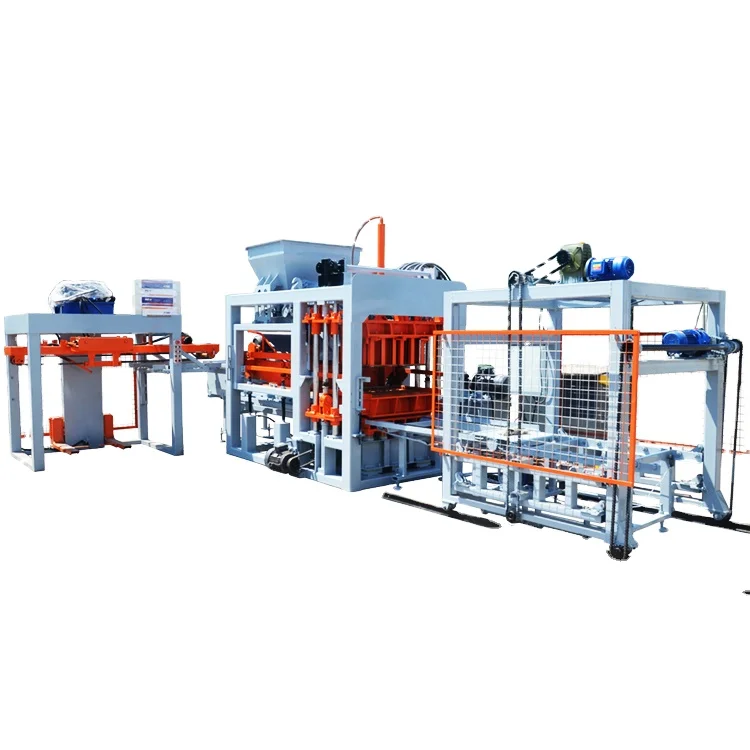 High quality block machine