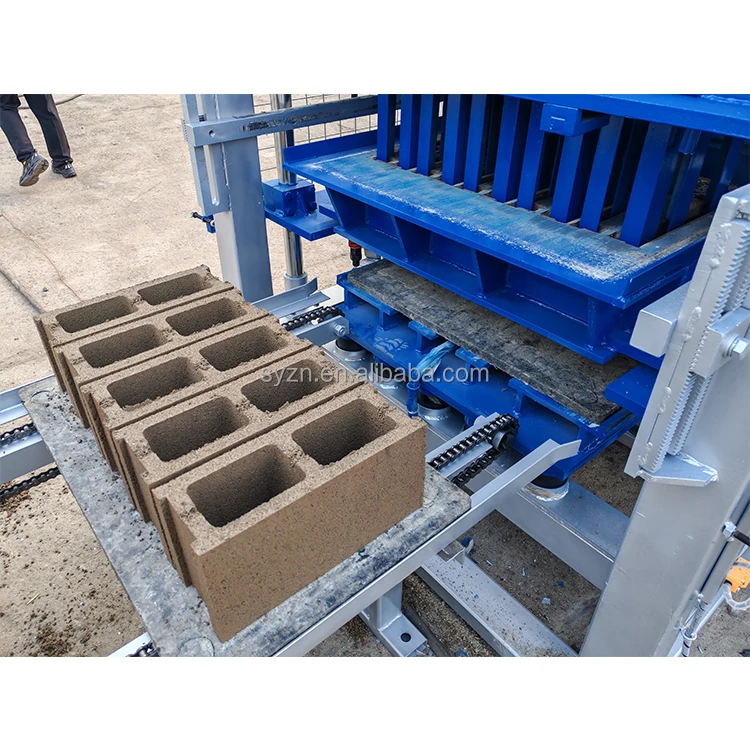
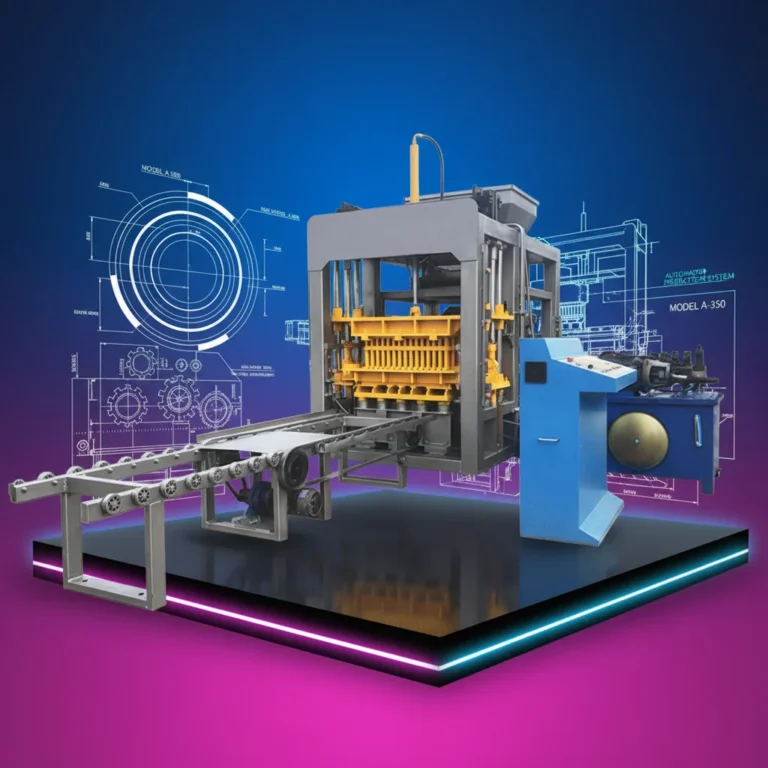
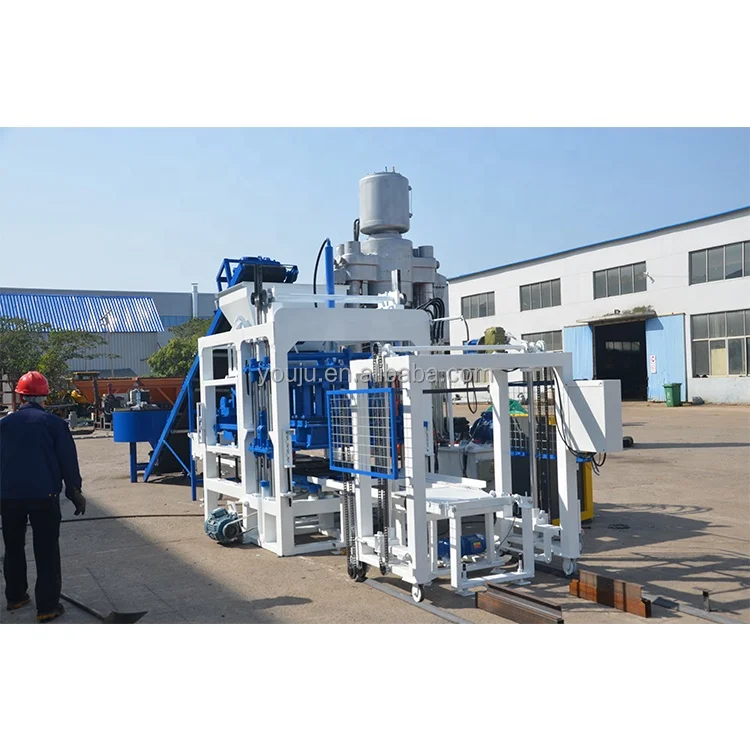
Mid-tier automation matched to block format — the QT4-25 is configured as one integrated system where machine, mould, pallet and stacking are sized together, so your daily output matches the format you actually sell rather than a catalogue default.
Technical Specifications
| Parameter |
Value |
| Model |
QT4-25 |
| Product Type |
Automatic Concrete Block Making Machine |
| Rated Power |
16.58 kW |
| Voltage & Frequency |
Configured to local supply (basis to be confirmed before order) |
| Control System |
PLC controlled, fully automatic |
| Overall Dimensions |
6400 × 1500 × 2700 mm |
| Net Weight |
5000 kg |
| Molding Cycle |
25 seconds |
| Pallet Size |
850 × 480 mm |
| Motor |
Siemens brand |
| Frame |
Thickened steel construction |
| Vibration System |
Vibration motor with large vibration box |
| Hydraulic Pressure |
Non-hydraulic design |
| Automation Level |
Fully automatic — pallet feeding, material feeding and scraping, block stacking |
| Output Capacity |
4600 pcs / 8 hours (basis not stated in source — confirm block format) |
| Warranty |
One year with free parts supply |
Application Suitability
| Application |
Material or Output |
| Medium-scale hollow block production |
Concrete, sand, cement, fly ash, crushed stone |
| Solid brick and paver manufacturing |
Concrete mix with local aggregate and cement |
| On-site contractor block plants |
Sand, cement, lime, water with site-sourced aggregate |
| Fly ash brick production |
Fly ash blended with cement and crushed stone |
What "4600 Pieces per Shift" Actually Means for Your Plant
The QT4-25 output figure only holds meaning when tied to a specific block format, mould cavity count, and mix design.
Many quotations quote a single cycle count and leave the buyer to discover later that the 4600-piece figure assumed a small solid brick, not the 200 mm hollow block their market actually demands. When the block format changes, the cycle time and mould cavity count change with it — and so does daily throughput. As an automatic block machine manufacturer, we state the capacity per format in the proposal, not as a blanket number. I have walked onto sites where the owner believed they had purchased a mid-tier line only to find the real output was half the brochure figure because the hollow block they sell requires a longer press cycle and fewer cavities per mould [NEED_CITE: block format impact on daily output calculation].

Where the QT4-25 Sits in the Full Machine Range
The Shiyue lineup spans from entry-level semi-automatic machines for workshop-scale production up to high-capacity hydraulic lines with full cubing systems. The QT4-25 occupies the middle tier: a fully automatic block machine with PLC control, automatic pallet feeding, material scraping, and block stacking. Buyers moving up from manual or egg-laying machines typically land here when their daily volume justifies automation but does not yet demand the hydraulic pressure and larger pallet sizes of the upper tiers.
Choosing Between Semi-Automatic and Full Automation
The deciding factor is usually labor cost and consistency requirements. A semi-automatic machine still requires operators to handle pallets and stack blocks manually, which introduces variability in curing rack loading. The QT4-25 removes those manual stations — pallet feeding is automated, the material hopper feeds and scrapes without operator input, and finished blocks are stacked automatically. For buyers evaluating an automatic block machine manufacturer, the question is whether the labor savings and batch-to-batch consistency justify the investment step from semi-automatic [NEED_CITE: automation level selection criteria for block plants].
How Vibration Force, Molding Cycle, and Pallet Size Shape Real Output
The QT4-25 uses a vibration motor paired with a large vibration box rather than hydraulic pressure to compact the mix. This means block density depends heavily on matching vibration force to the buyer’s specific aggregate gradation and cement content — a mix that works in one region may produce weak blocks in another if the vibration parameters are not adjusted. The 25-second molding cycle applies to standard formats; heavier or thicker blocks require longer vibration to achieve target strength. The 850 × 480 mm pallet size determines how many blocks fit per cycle, and this size must align with the curing racks and forklifts already on site. The 16.58 kW rated power reflects the combined draw of the vibration motor, material feed system, and stacker — buyers should verify their site electrical capacity can support continuous operation at this draw, particularly where supply voltage fluctuates [NEED_CITE: voltage stability requirements for vibration block machines].
The Hidden Cost of Skipping Voltage and Language Confirmation
Buyers who rush past electrical specifications often face weeks of delay after the machine arrives. A PLC configured for a language the operator cannot read turns commissioning into a guessing game. Voltage mismatches can damage the Siemens motor or cause the vibration system to underperform, producing blocks that fail strength tests. I have seen machines sit idle for months because the frequency was wrong for the local grid and a replacement transformer had to be sourced [NEED_CITE: common commissioning delays in exported block machinery].
Why Source the QT4-25 Through This Range
The machine, mould, pallet, and handling equipment are specified as one matched system, not assembled from separate suppliers — this eliminates the interface problems that arise when the stacker cycle does not match the press cycle. Configuration starts from the buyer’s actual mix design and target block format rather than a catalogue default. Moulds are designed for the specific formats the buyer’s market sells, including custom drawings. The automation level is selectable, so a buyer can start with the QT4-25 and move to a higher tier as volume grows. Installation support includes operator training on the PLC interface and maintenance routines for the vibration box and frame.
Documentation & Verification
- Line layout with capacity calculation stated per block format for the QT4-25
- Machine specification sheet confirming pallet size, cycle time, and power ratings
- Mould drawing and format list showing which block types fit the 850 × 480 mm pallet
- Voltage and PLC display language confirmation before production begins
- Factory test record on the buyer’s specified block format before dispatch
Installation, Commissioning & Support
- Foundation pad sized to the 6400 × 1500 mm footprint with level tolerance specified
- Dedicated electrical circuit rated for 16.58 kW continuous draw at confirmed voltage
- Machine arrives partially assembled; vibration box and stacker require on-site mounting
- PLC parameters set to buyer’s block format and molding cycle during commissioning
- Operator training covers mould change procedure, PLC navigation, and daily maintenance
- Wear parts list identifies vibration motor brushes and scraper blades for first reorder
Starting Your Inquiry
To position the QT4-25 correctly within the range, share the specific block formats your market sells and the daily output you need per format. Confirm your local voltage and frequency so the motor and PLC are configured before build. If you already have curing racks and forklifts on site, provide the pallet dimensions they accept so the 850 × 480 mm pallet can be verified or adjusted.
Frequently Asked Questions
Q: How is the 4600 pcs/8hours capacity calculated, and which block format does it assume?
A: That figure is based on a specific block format and mould cavity count that was not stated in the source data. Real output varies significantly depending on whether you are producing hollow blocks, solid bricks, or pavers — each has a different cavity count and may require a different vibration duration. We provide a capacity table per format in the proposal so you can match it to your actual product mix.
Q: Where does the QT4-25 sit compared to semi-automatic and high-capacity hydraulic models?
A: It is the mid-tier fully automatic option. Below it, semi-automatic machines require manual pallet handling and stacking. Above it, hydraulic machines offer greater compaction force and larger pallet sizes for higher volume. The QT4-25 suits buyers whose daily output justifies full automation but does not yet require hydraulic pressure levels needed for dense pavers or kerbstones.
Q: What voltage, frequency, and PLC language options are available?
A: The machine is configured to your local supply before production. Voltage and frequency must be confirmed at order stage to ensure the Siemens motor and PLC are matched to your grid. The PLC display language is also confirmed at this point so operators can navigate the interface in their working language from day one.
Q: What plant footprint and supporting equipment does the QT4-25 require?
A: The machine itself measures 6400 × 1500 × 2700 mm. Beyond the press, you need space for raw material storage, a mixer feeding the hopper, a curing area sized to the 850 × 480 mm pallets, and a forklift compatible with that pallet dimension. We provide a line layout showing all stations and their spatial relationships in the proposal.
Q: How does the one-year warranty and spare parts supply work?
A: The warranty covers free parts supply for one year from commissioning. A wear parts list is included with the shipment, identifying items like vibration motor components and scraper blades that will need periodic replacement. Parts availability after the warranty period is confirmed at order stage so you are not searching for components when the first replacement is due.

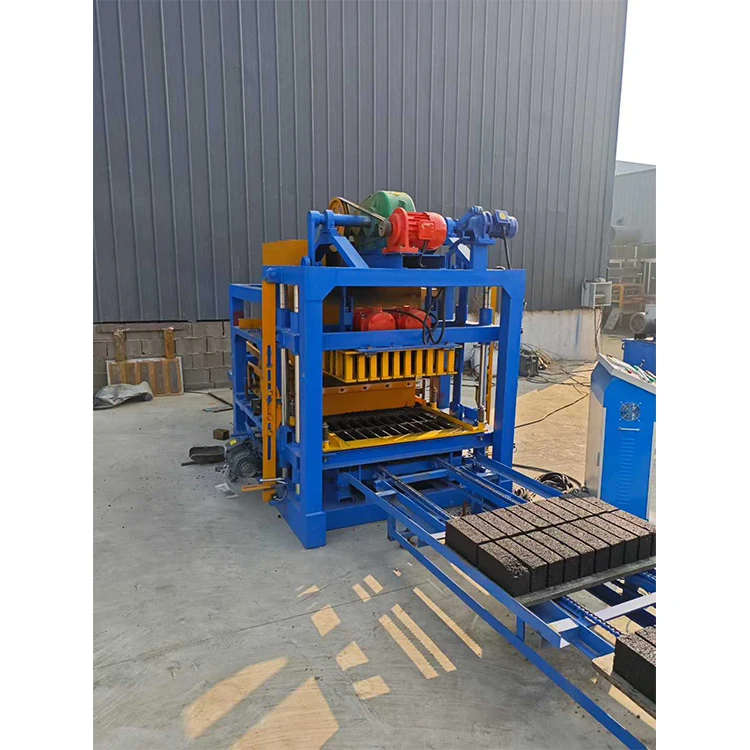
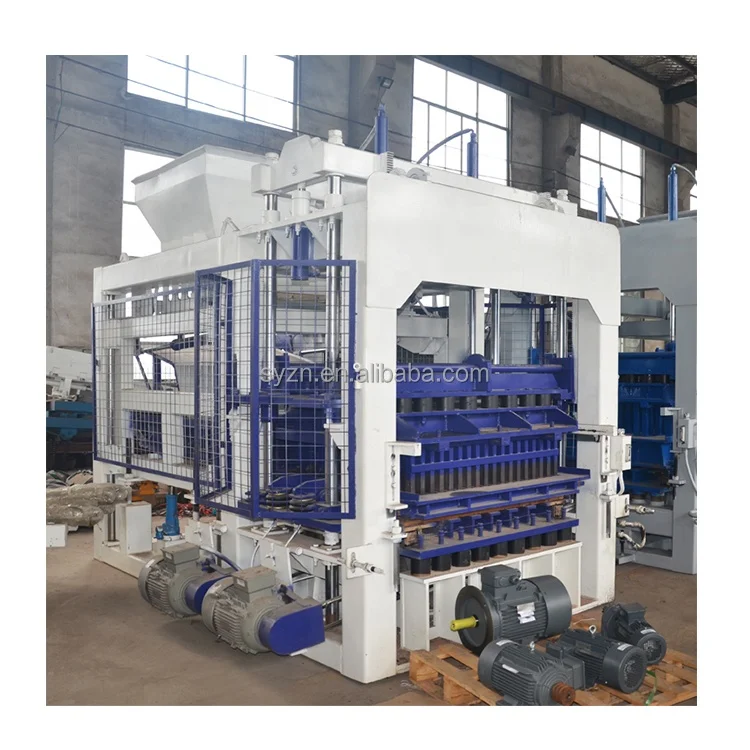 Automatic block machine