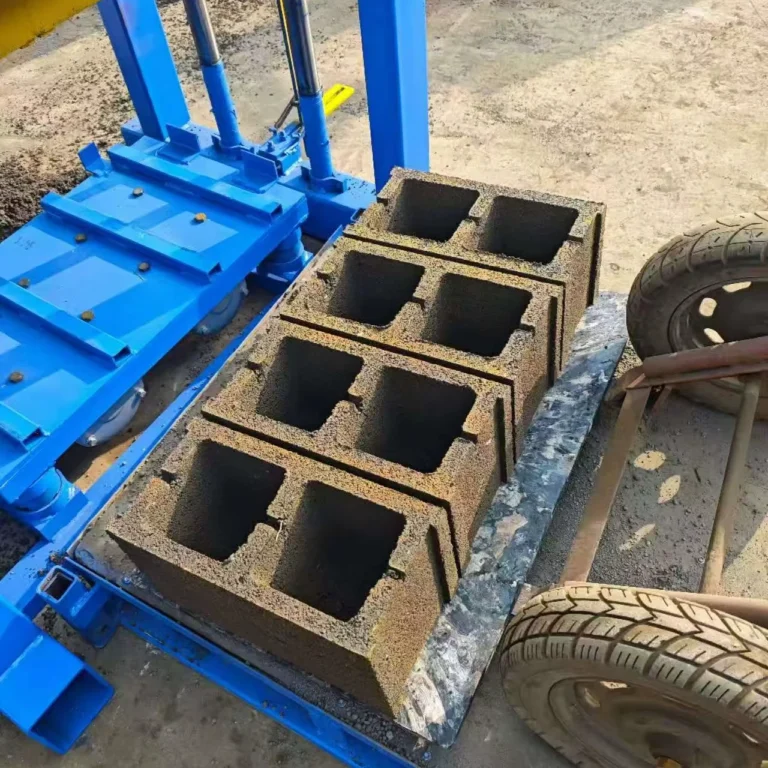
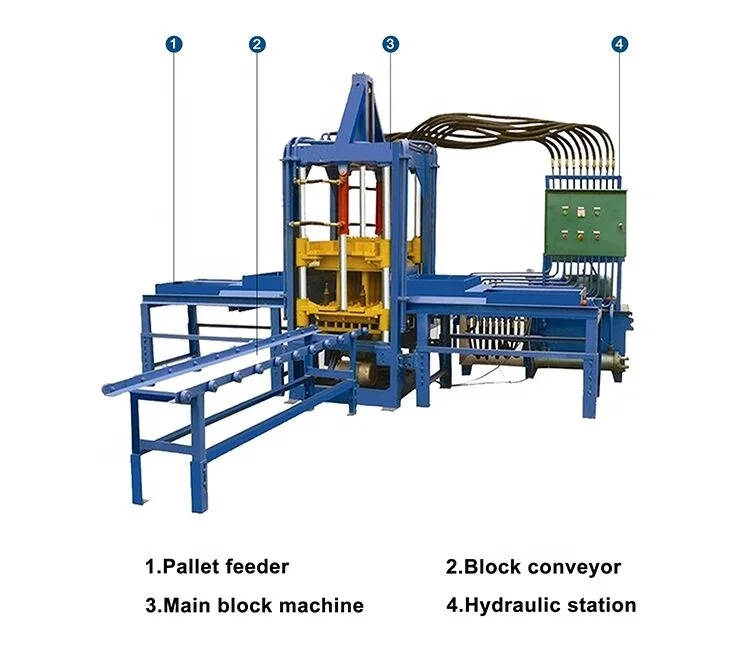
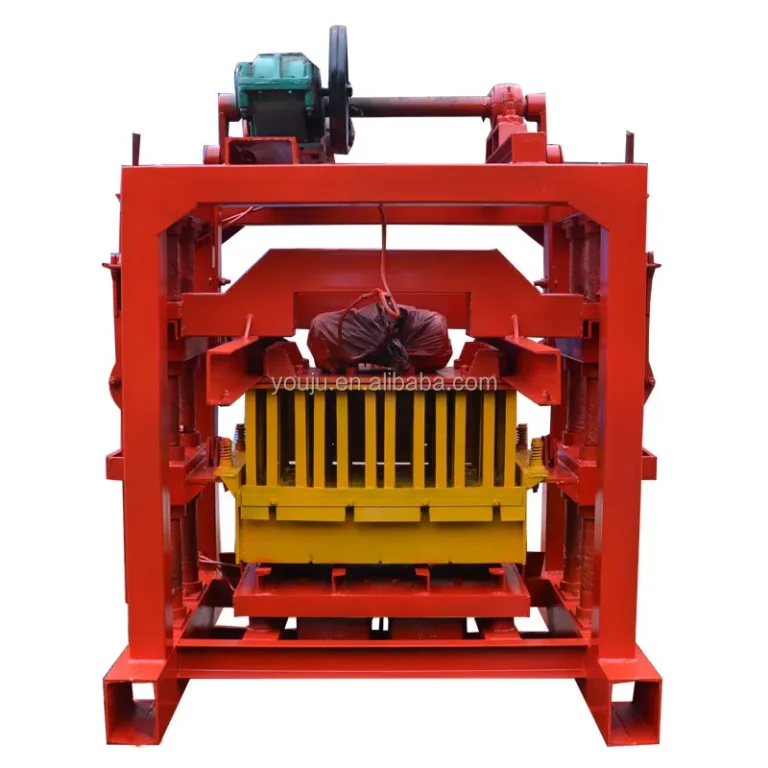
Matched system design — machine, mould, pallet and handling specified together for QT15-15 so capacity figures reflect your actual block format, not a catalogue default.
Technical Specifications
| Parameter |
Value |
| Model |
QT15-15 |
| Product Type |
Stationary Concrete Block Making Machine |
| Overall Dimensions (L×W×H) |
9350×2520×2950 mm |
| Net Weight |
15 T |
| Rated Power |
45.7 kW |
| Voltage |
380 V or customized |
| Hydraulic Pressure |
21 MPa |
| Pallet Size |
1350×850×40 mm |
| Control System |
PLC (language and brand to be confirmed) |
| Automation Level |
Fully automatic (stacking and cubing inclusion to be confirmed) |
| Vibration System |
Four external vibration motors |
| Mould Synchronization |
Dual-side synchronous gear for upper mould |
| Feeding System |
Material feeder cylinder with turning arm |
| Noise & Vibration Damping |
Airbag system with adjustable air pressure |
| Output Capacity (Hollow Block) |
3,600 pcs/h based on 400×200×200 mm block, 15 pcs/mould |
| Output Capacity (Block) |
4,320 pcs/h based on 400×150×200 mm block, 16 pcs/mould |
| Output Capacity (Solid Brick) |
14,000 pcs/h based on 240×115×53 mm brick, 62 pcs/mould |
| Daily Output (Hollow Block) |
28,800 pcs/day based on 400×200×200 mm, 8-hour shift assumption to be confirmed |
| Daily Output (Block) |
34,560 pcs/day based on 400×150×200 mm, 8-hour shift assumption to be confirmed |
| Daily Output (Solid Brick) |
112,000 pcs/day based on 240×115×53 mm, 8-hour shift assumption to be confirmed |
| Cycle Time |
Basis to be confirmed per format |
| Standards |
ISO 9001:2008, CE |
| Warranty |
1 year |
Application Suitability
| Application |
Material or Output |
| High-capacity hollow block production |
Crushed stone, sand, cement, and fly ash aggregates |
| Solid brick manufacturing |
Clay, shale, and cement-based mixes |
| Interlocking paver production |
Colored concrete mixes with fine aggregates |
| Large-scale building material supply |
Multi-format output for distributors and contractors |
| Housing project on-site production |
Local aggregate and cement adapted to regional conditions |
What "3,600 Pieces per Hour" Actually Means for the QT15-15 Stationary Block Machine Manufacturer
Hourly capacity numbers are meaningless unless you know which block format they assume.
I once watched a buyer in West Africa take delivery of a high-output press, only to discover the rated throughput was based on a hollow block his market never ordered. His actual product — a smaller solid brick — ran through the same machine at a completely different pace, and his daily volume fell well short of the business plan he had presented to his bank. That gap between quoted capacity and real output is where most block plant investments quietly fail. The QT15-15 stationary block machine manufacturer approach ties every throughput figure to a specific block dimension, mould cavity count, and per-mould piece count so you can verify the numbers against your actual product before signing anything. [NEED_CITE: block plant capacity calculation methods by format]

Positioning the QT15-15 Within the Full Shiyue Range
The QT15-15 sits at the top tier of the Shiyue stationary block machine lineup, built for plants that need to move serious daily volume across multiple formats. Buyers stepping up from a semi-automatic or mobile tier will find the pallet size, hydraulic pressure, and vibration system in a different class altogether. The machine footprint demands a dedicated plant bay, and the power draw requires its own circuit. Understanding where this model lands helps you decide whether you are buying for current demand or for the capacity headroom you plan to fill over the next production cycle.
Matching Automation to Your Starting Point
A first-time buyer setting up a block plant does not always need full automatic stacking and cubing on day one. The QT15-15 stationary block machine manufacturer configuration allows the automation level to be selected — starting with semi-automatic pallet handling and adding automatic stacking later as the operation scales. This flexibility matters because over-specifying automation adds upfront cost and maintenance complexity that a new plant may not yet justify. At the same time, an existing manufacturer replacing an ageing line will want the full automatic package to cut labour costs and maintain batch consistency across shifts. [NEED_CITE: automation upgrade paths in stationary block production]
Reading the Specs That Actually Matter
The 21 MPa hydraulic pressure works in combination with the four external vibration motors to compact the concrete mix into the mould cavity. Insufficient pressure against weak vibration produces blocks with inconsistent density — strong at the edges, crumbly in the middle. The dual-side synchronous gear on the upper mould keeps the pressing force evenly distributed across the full 1350×850 mm pallet, which matters when you are running a wide paver format alongside a tall hollow block. The airbag damping system lets you adjust vibration amplitude by block format; a delicate interlocking paver needs a different vibration profile than a structural hollow block. And the European-style material feeder with turning arm cylinder fills the mould cavity faster and more uniformly, reducing the dead time between vibration cycles.
The Hidden Cost of a Pallet Size Nobody Checked
One of the most common oversights I see is a buyer ordering a high-capacity press without confirming that the pallet size matches the curing racks and forklifts already in the yard. When the 1350×850 mm pallets arrive and your existing racks were built for a smaller size, you are suddenly hand-stacking thousands of blocks per shift — exactly the bottleneck you paid the machine to eliminate. The curing area layout, forklift fork width, and rack spacing all need to be checked against the pallet spec before the machine ships. Fixing a mismatch after installation means either rebuilding your curing yard or running a custom pallet order that delays production by weeks. [NEED_CITE: pallet handling compatibility in block plant design]
Why Buyers Specify the Full Line Here
Block machinery is the single focus at this facility, which means the QT15-15 press, its moulds, pallets, and handling equipment are specified as one matched system rather than sourced from separate suppliers and bolted together. Configuration is set against your actual mix design, local aggregate, and target block format — not pulled from a catalogue default. Mould design covers the formats your market actually sells, and custom drawings are available when standard options do not match. The automation level is selectable so you can start at a point that fits your budget and upgrade as volume grows. Installation includes operator training so your team is producing saleable blocks before the commissioning engineer leaves site.
Documentation & Verification
- Line layout with capacity calculation stating the block format assumed for each output tier
- Machine specification sheet with hydraulic pressure and vibration force matched to your mix
- Mould drawing and format list documenting cavity count and changeover procedure
- Voltage, frequency, and PLC display language confirmed in writing before production
- Factory test record on your specified block format before dispatch
- Hydraulic and electrical schematic for on-site maintenance reference
Installation, Commissioning & Support
- Foundation must support the 15 T net weight and vibration loads across the 9350 mm machine length
- Dedicated power circuit required for the 45.7 kW rated draw at your confirmed voltage and frequency
- Machine arrives dismantled for container loading; reassembly scope documented before shipment
- PLC language and control parameters set to your operator requirements during commissioning
- Mould change procedure trained on-site so your team can switch formats within a single shift
- Wear parts and hydraulic seal list provided with recommended first replacement intervals
- Daily maintenance schedule tied to vibration motor, hydraulic pressure, and airbag system checks
What to Include With Your Enquiry
To size the QT15-15 correctly for your plant, share your target block formats with dimensions, the daily volume you need per format, and the raw materials available locally including aggregate type and cement grade. Confirm your site voltage and frequency, the PLC display language your operators need, and whether your existing curing racks and forklifts are sized for the 1350×850 mm pallet. If you are replacing an existing line, send the current machine footprint and pallet spec so the layout team can plan the changeover.
Frequently Asked Questions
Q: How is the quoted hourly capacity verified, and which block format is each figure based on?
A: Every capacity figure for the QT15-15 is tied to a specific block dimension and mould cavity count. For example, 3,600 pieces per hour is based on a 400×200×200 mm hollow block with 15 cavities per mould. Your actual throughput depends on the format you run, and the line layout document states the assumption for each product in your range.
Q: What automation level does the QT15-15 ship with compared to the semi-automatic and mobile tiers?
A: The QT15-15 is configured as a fully automatic stationary press, sitting above the semi-automatic and mobile tiers in both output capacity and automation scope. Buyers can select a reduced automation package for initial operation and add automatic stacking or cubing modules later as production volume justifies the investment.
Q: What pallet size does the QT15-15 require, and is it compatible with standard curing setups?
A: The machine uses a 1350×850×40 mm pallet. Before ordering, you need to verify that your curing racks, forklift fork spacing, and yard layout accommodate this size. If your existing infrastructure was built around a different pallet dimension, the curing area may need adjustment to avoid hand-stacking bottlenecks.
Q: How does the QT15-15 footprint compare to mid-tier models in the stationary range?
A: At 9350 mm in length with a 15 T net weight, the QT15-15 requires a larger dedicated plant bay than mid-tier presses. Buyers upgrading from a smaller model should confirm their building height, foundation capacity, and power supply can handle the step up before finalizing the layout.

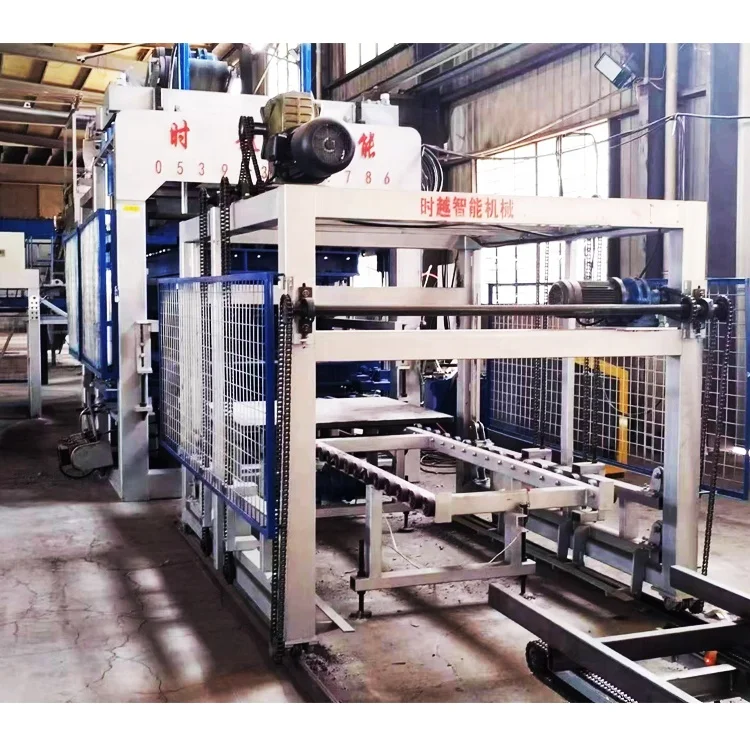
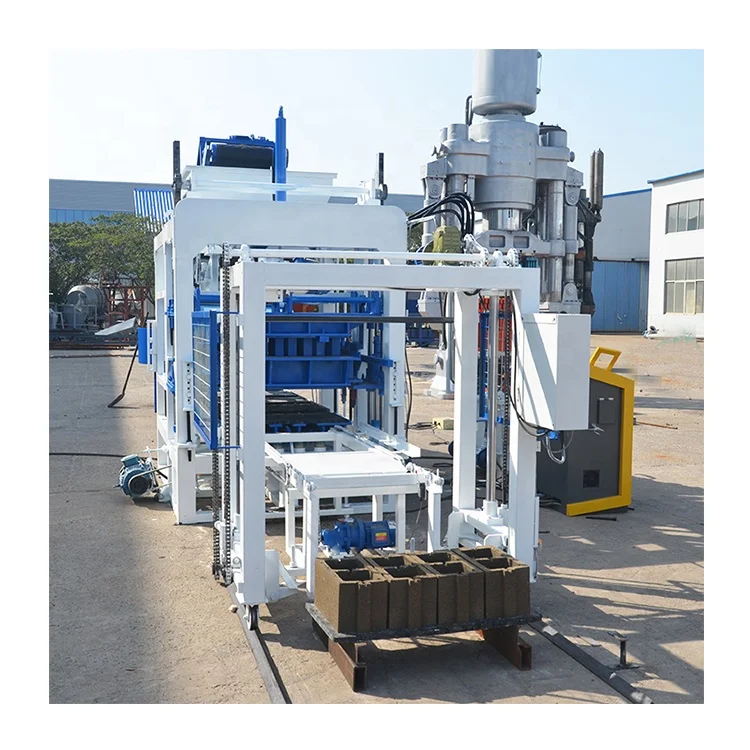 Stationary block machine