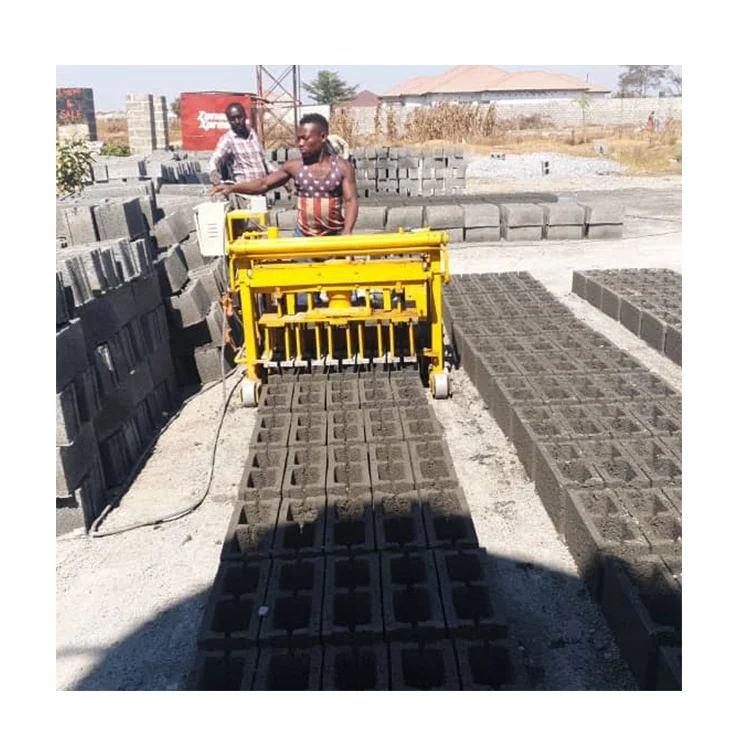
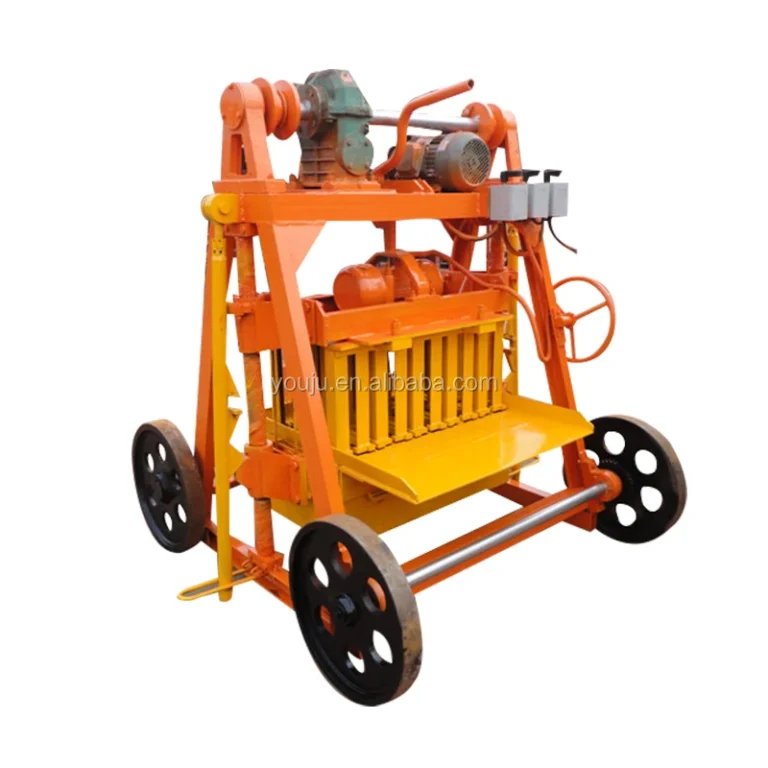
Technical Specifications
| Parameter |
Value |
| Model |
QMJ2-45 |
| Product Type |
Mobile Egg-Laying Block Making Machine |
| Machine Format |
Palletless, egg-laying (blocks deposited directly on ground) |
| Hollow Brick 400×200×200 mm |
2 pcs/mould, 25–30 s cycle, 160 pcs/h, 1280 pcs/8 hr |
| Hollow Brick 400×150×200 mm |
3 pcs/mould, 25–30 s cycle, 240 pcs/h (basis to be confirmed) |
| Hollow Brick 400×100×200 mm |
4 pcs/mould, 25–30 s cycle, 320 pcs/h, 2560 pcs/8 hr |
| Pallet Requirement |
None |
| Power Source |
Electric (voltage, frequency and phase to confirm before order) |
| Control System |
Manual / semi-automatic operation (basis to be confirmed) |
| Labor Requirement |
1 to 3 operators |
| Hydraulic Pressure |
Not applicable (mechanical type) |
| Certification |
ISO 9001:2000, CE |
| Key Features |
Free-moving on site, interchangeable moulds, no fixed plant footprint |
Application Suitability
| Application |
Material or Output |
| On-site hollow block production for building contractors |
Cement, sand, crushed stone aggregate deposited directly on prepared ground |
| First-time block plant with limited capital |
Hollow bricks in three standard formats without pallet inventory |
| Housing or development project sites |
Local production of 400×200×200, 400×150×200 and 400×100×200 mm hollow blocks |
| Remote construction locations |
Electric-drive production where diesel logistics or pallet supply chains are unavailable |
Why the Voltage Question Should Come Before the Price on a mobile block making machine complete range
Voltage mismatch at the job site is the single most preventable cause of commissioning delays.
I learned this the hard way. A client in the Middle East received a QMJ2-45, wired it up on arrival, and discovered the local supply was 415V three-phase while the motor was wound for 380V. The machine sat idle for an entire week while we sourced a transformer locally. That delay cost the contractor more than any price difference between suppliers could have saved. [NEED_CITE: voltage and frequency standards by export market]
When evaluating the mobile block making machine complete range, the electrical specification is not a footnote — it is the first line of the purchase conversation. Confirming voltage, frequency, and phase before production begins prevents a situation where the machine arrives on schedule but cannot run on schedule.

Where the QMJ2-45 Sits in the Range
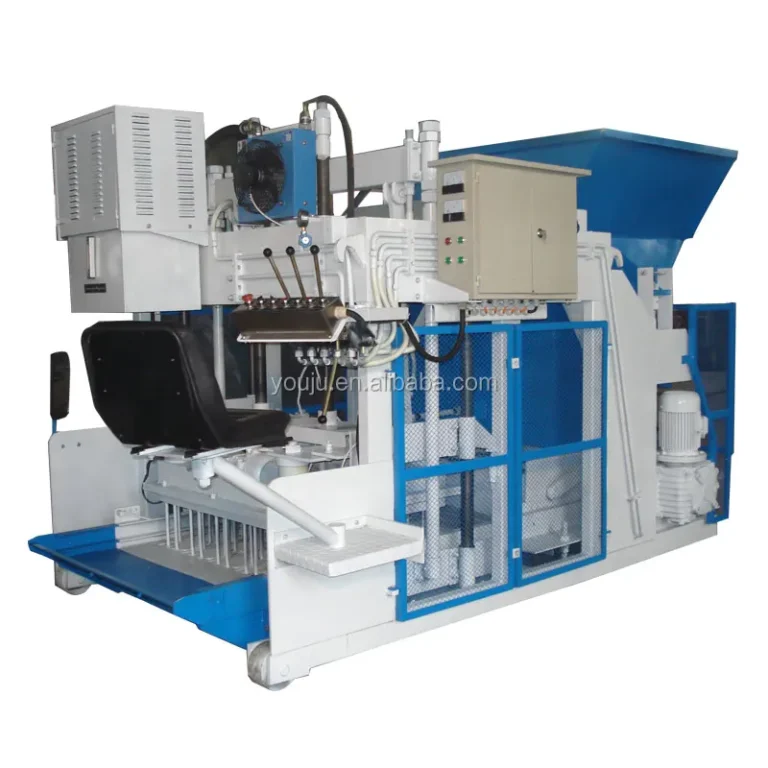
The mobile block making machine complete range spans from palletless egg-laying units at one end to fully automatic stationary lines at the other. The QMJ2-45 occupies the entry position: it requires no pallets, no fixed foundation, and no dedicated curing rack system. For a contractor who needs hollow blocks on a building site or an entrepreneur launching a first production operation with limited space, it removes the infrastructure that larger machines demand.
The trade-off is output volume. An egg-laying machine lays blocks on the ground and moves forward, so cycle time includes travel between positions. Buyers who have outgrown this volume and need continuous production shift to the semi-automatic or automatic tiers, where pallet-based systems allow stacking and curing at scale.
What Palletless Design Actually Eliminates
Egg-laying machines deposit wet blocks directly onto a flat, prepared surface. There is no pallet to buy, store, rotate, or replace. For a first-time block producer, pallets represent a recurring cost and a logistics problem — they occupy curing space, they warp and crack over time, and a forklift fleet is needed to move them. [NEED_CITE: pallet lifecycle costs in block production]
The QMJ2-45 sidesteps all of that. The trade-off is ground preparation: the surface must be level and firm enough to support wet blocks until initial set. This suits outdoor sites and open yards far better than enclosed workshops.
Reading the Specifications Honestly
The cycle time of 25–30 seconds per mould applies across all three hollow brick formats, but the hourly output varies because each mould cavity count differs. A 400×200×200 mm hollow brick mould holds 2 cavities, producing 160 pieces per hour. A 400×100×200 mm mould holds 4 cavities, producing 320 pieces per hour. This is a mechanical consequence of cavity count, not a difference in machine speed.
The labour requirement of 1 to 3 operators reflects the manual or semi-automatic control system. One operator manages the mix feed and machine movement, while additional hands handle ground preparation and block spacing. Unlike pallet-based machines where stacking is automated, the egg-laying design relies on the ground layout to manage production flow.
The absence of hydraulic pressure means block density comes entirely from mechanical vibration and the weight of the mould head. This is adequate for hollow blocks used in non-load-bearing walls, but buyers targeting high-strength structural blocks should look at the hydraulic tiers in the mobile block making machine complete range.
The Cost of Skipping Electrical Confirmation
A machine configured for the wrong voltage does not simply underperform — it can destroy the motor winding on first startup. I have seen transformers sourced locally at emergency prices, and I have seen commissioning engineers sitting in hotel rooms waiting for the correct electrical supply to be installed. The QMJ2-45 has no complex PLC to reprogram, but the motor and any control relays must match the site supply exactly.
Skipping the electrical confirmation step also delays the documentation package. The CE declaration and wiring schematic must reflect the actual installed voltage. A mismatch discovered after shipment forces revised paperwork, which can delay customs clearance at the destination port. [NEED_CITE: CE machinery directive requirements for electrical specifications]
Why Source the QMJ2-45 Through This Range
Block machinery is the single focus here, which means the QMJ2-45 is specified alongside its moulds, control system, and spare parts as one matched set rather than assembled from separate suppliers.
The capacity calculation for every quotation states which hollow brick format the output figure assumes — no inflated hourly numbers detached from actual mould configuration.
Voltage, frequency, and control language are confirmed in writing before production starts, not discovered after the container arrives at the port.
Mould design covers the three standard hollow brick formats, and custom mould drawings can be produced if the buyer’s local market requires a non-standard dimension.
The QMJ2-45 sits at the entry point of the mobile block making machine complete range, so a buyer who later needs higher volume can add a semi-automatic or automatic machine without abandoning the original unit.
Documentation & Verification
- Machine specification sheet with voltage, frequency, and phase confirmed for the destination market
- Capacity calculation stating the hollow brick format assumed for each quoted output figure
- Mould drawing and format list for every hollow brick size included in the order
- Operation and maintenance manual with wear parts list specific to the QMJ2-45
- Factory test record on the buyer’s specified mould format before dispatch
- CE declaration reflecting the confirmed electrical specification
Installation, Commissioning & Support
- Site must provide a level, firm ground surface for egg-laying block deposition with adequate drainage
- Electrical supply must match the confirmed voltage, frequency, and phase before the QMJ2-45 is energized
- Machine arrives as a single mobile unit requiring no fixed foundation or anchor bolts
- First commissioning includes cycle time verification on each hollow brick mould format
- Operator training covers mould change procedure, mix consistency, and ground preparation standards
- Wear parts list identifies vibration pads, mould liners, and mechanical linkages with replacement intervals
What to Include in Your Inquiry
To configure the QMJ2-45 correctly, start with the hollow brick format your local market actually sells and the daily volume you need to sustain. Confirm the electrical supply available at the production site — voltage, frequency, and phase — so the motor and controls are wound for the correct standard. If you are comparing the QMJ2-45 against other tiers in the mobile block making machine complete range, share your available space and whether a pallet system is feasible, so the right machine tier can be recommended.
Frequently Asked Questions
Q: How is hourly capacity calculated, and which block format does the quoted figure assume?
A: Hourly capacity depends on mould cavity count and cycle time. For the QMJ2-45, a 25–30 second cycle produces 160 hollow bricks per hour in 400×200×200 mm format (2 cavities) and 320 per hour in 400×100×200 mm format (4 cavities). Every quotation states the assumed format alongside the output figure so daily production can be calculated honestly.
Q: Where does the QMJ2-45 sit compared to semi-automatic and automatic machines?
A: The QMJ2-45 is the entry tier — palletless, mobile, and requiring minimal infrastructure. Semi-automatic machines add pallet handling for higher output, while automatic lines include stacking and cubing for continuous production. Buyers choose based on volume need, available space, and investment level.
Q: What voltage, frequency, and phase must the site supply before the machine arrives?
A: The exact electrical specification must be confirmed in writing before production begins. Supplying the wrong voltage can damage the motor and delay commissioning. Provide your site voltage, frequency in Hz, and phase type during the inquiry stage so the motor and control components are matched to your supply.
Q: How long does a mould change take, and does it require special tools?
A: Mould change on the QMJ2-45 involves releasing the current mould and securing the replacement format. The time depends on operator familiarity and whether the change is planned in advance. Including the procedure in initial training reduces changeover time significantly compared to learning on the job.
Q: Can I add a larger machine later without replacing the QMJ2-45?
A: Yes. The QMJ2-45 continues to serve lower-volume production or remote site work even after a semi-automatic or automatic machine is added. Many buyers use the mobile unit for on-site project work while the larger machine handles steady commercial output from a fixed location.

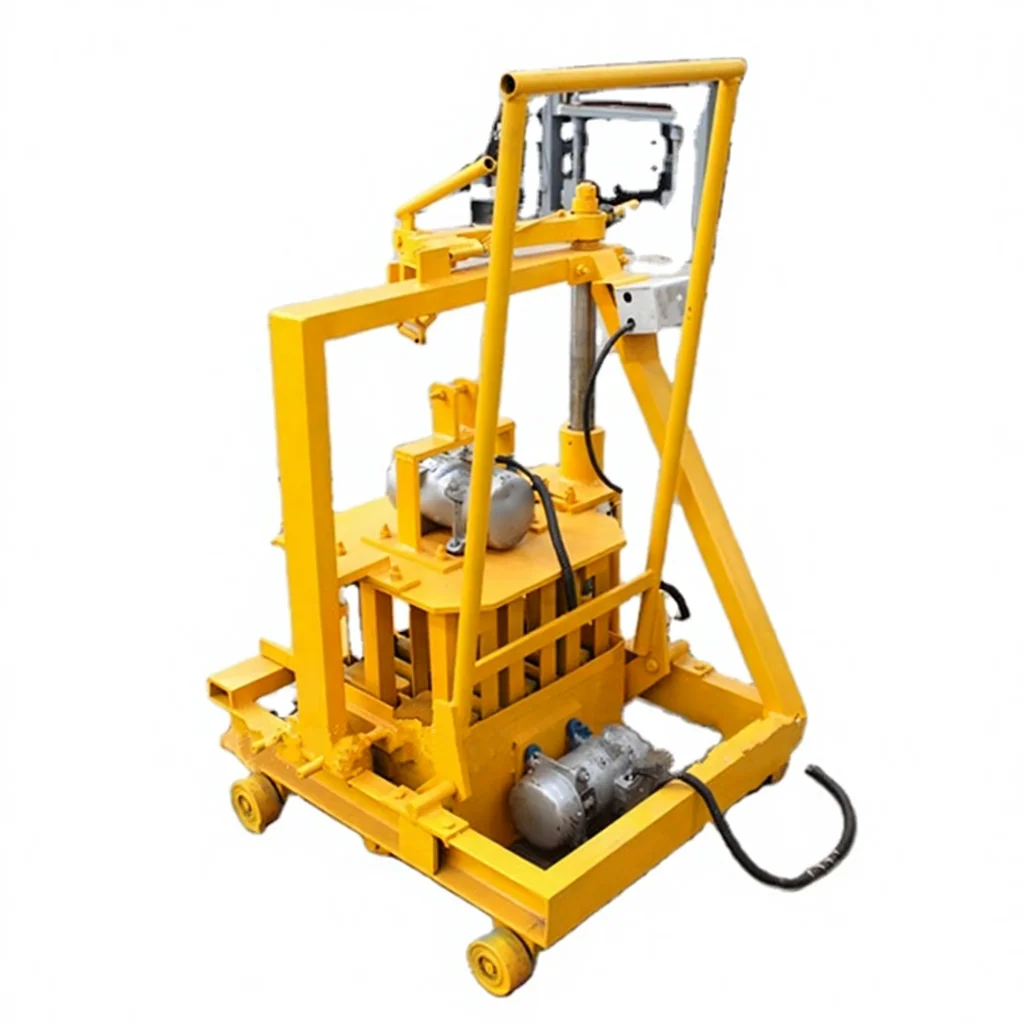
 Mobile block machine