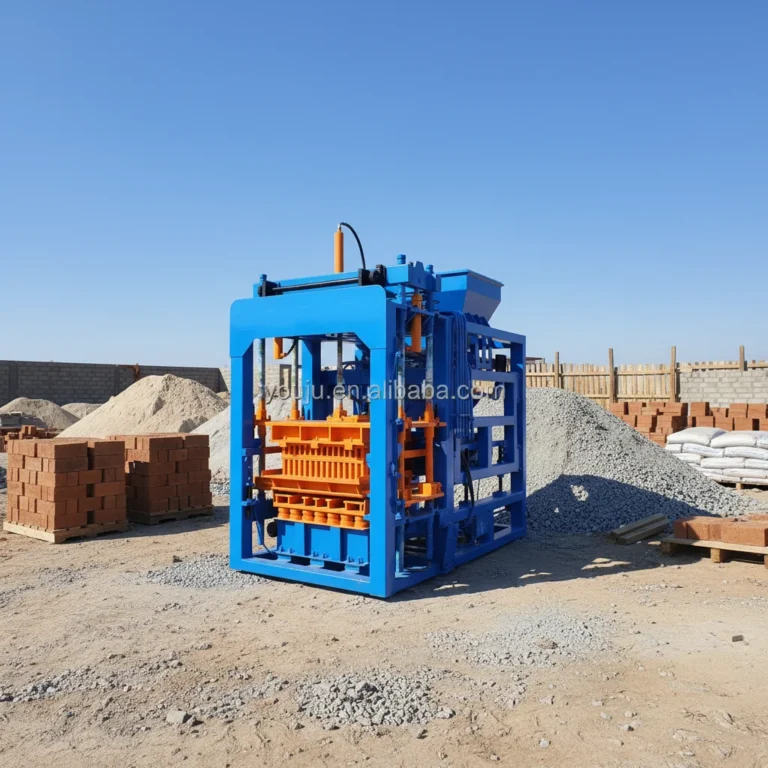
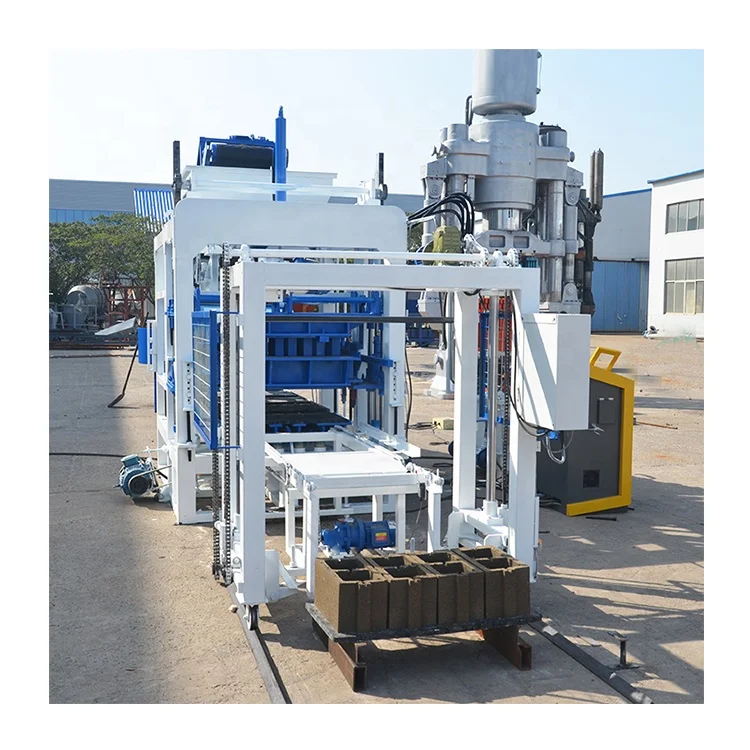
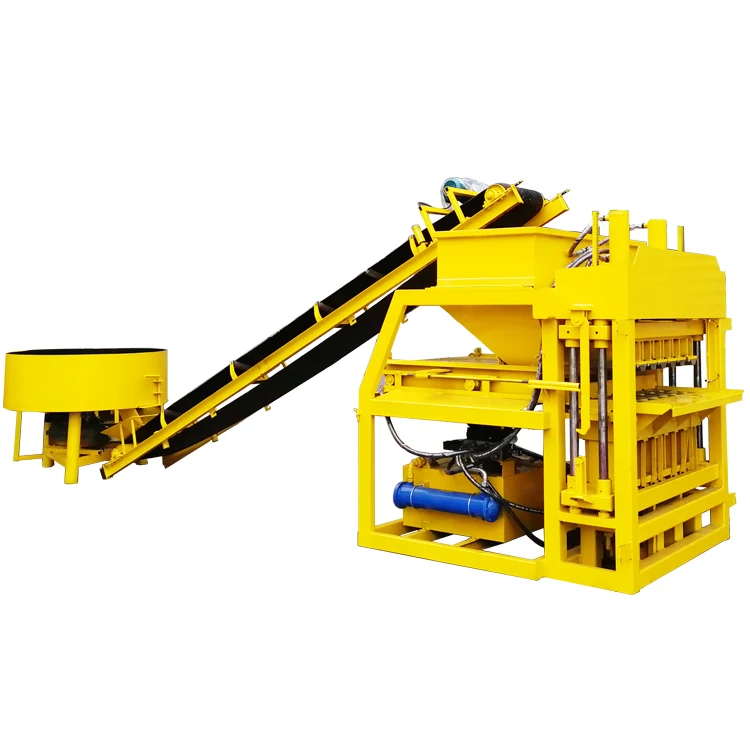
Stationary block machines as a single focus — the QT5-15 is specified as a matched system of press, mould, pallet, and handling rather than assembled from separate catalogues.
Technical Specifications
| Parameter |
Value |
| Model |
QT5-15 |
| Product Type |
Automatic Hydraulic Concrete Block Making Machine |
| Overall Dimensions (L×W×H) |
7400×1950×2800 mm |
| Rated Hydraulic Pressure |
21 MPa |
| Main Vibration Form |
Hydraulic platform vibration |
| Vibrating Frequency |
2800–4500 r/min |
| Cycle Time |
15–20 s |
| Total Motor Power |
26.5 kW |
| Pallet Size |
1100×550 mm |
| Net Weight |
6 T |
| Voltage |
According to buyer requirement (basis not stated in source — confirm voltage/frequency) |
| Control System |
PLC with fault diagnosis and remote monitoring capability |
| Mould Formats Listed |
240×115×90 mm (16 pcs/mould) / 400×115×53 mm (32 pcs/mould) / 400×200×200 mm (5 pcs/mould) |
| Output Capacity |
23,040–28,800 pcs/8h (based on 240×115×90 mm solid brick) / 61,440–70,400 pcs/8h (based on 400×115×53 mm paver) / 7,200–9,600 pcs/8h (based on 400×200×200 mm hollow block) |
| Automation Level |
Full automatic (storage, feeding, vibration, stacking) |
| Vibration System |
Synchronization vibration with adjustable frequency |
| Assembly State |
Stationary, foundation-required |
| Warranty |
1 year for the whole machine |
| CE Declaration |
Declared in company documentation |
Application Suitability
| Application |
Material or Output |
| Hollow block production |
7,200–9,600 pcs/8h using crushed stone, sand, and cement with 400×200×200 mm mould |
| Solid brick production |
23,040–28,800 pcs/8h using fly ash or natural sand with 240×115×90 mm mould |
| Paving block production |
61,440–70,400 pcs/8h using fine aggregate and pigment with 400×115×53 mm mould |
| Interlocking brick production |
Custom mould dependent on buyer’s local market format |
| Construction contractor on-plant manufacturing |
Stationary installation with dedicated curing area required |
| Building material distributor block supply |
Mid-tier output suitable for broadening an existing product catalogue |
Why "Output per Hour" Tells You Almost Nothing
Every capacity figure on this page names the block format, mould count, and shift length it was calculated against.
A quote that says 500 blocks per hour without telling you which block size is a meaningless number. I have seen buyers commit to a QT5-15 automatic block making machine manufacturer based on a headline output figure, then discover on site that the number assumed a small solid brick while their market actually needs 200 mm hollow blocks — and the real daily yield drops to a fraction of what was promised. Here the output is stated per format so you can match it to what your customers actually buy before you sign anything. [NEED_CITE: common block plant output miscalculation in procurement]

Where the QT5-15 Sits in the Full Machine Range
The Shiyue stationary range runs from small semi-automatic presses for workshop output up to high-capacity lines with fully automatic cubing. The QT5-15 sits in the mid-tier of that range — full automatic with PLC-controlled feeding, vibration, and stacking, but without the footprint and investment of a high-capacity line. For a first-time plant entrepreneur or a distributor adding a second format line, the QT5-15 automatic block making machine manufacturer configuration provides an entry point into automated production without over-building capacity you have not yet earned from the market.
Matching Automation Level to Your Actual Operation
Not every buyer needs full automation from day one. The range allows a semi-automatic start with pallet handling done manually, then upgrading stacking and cubing later as volume justifies the investment. The QT5-15 is configured here as full automatic, but the automation level is selectable against the buyer’s current labour cost and output target. A building material distributor already running a manual line may only need the press itself, while a housing project contractor setting up a dedicated site plant benefits from the full stacking sequence to reduce manual handling of wet green blocks. [NEED_CITE: automation upgrade paths in block production]
How Pressure, Vibration, and Pallet Size Connect on Site
Hydraulic pressure and vibration force together determine block density and demoulding strength. The QT5-15 delivers 21 MPa rated pressure with synchronization vibration adjustable between 2800 and 4500 r/min — low frequency during material feeding to settle the mix evenly, then high frequency during compaction to drive out air. This two-stage vibration matters when the local aggregate varies in particle shape, because a uniform feed bed produces consistent block weight across the pallet. The 1100×550 mm pallet size must be checked against the buyer’s existing curing racks and forklift capacity before the order is placed. A mismatch here means either replacing the curing area or running with pallets that do not fit the rack slots, both of which add cost after the machine arrives.
The Cost of Skipping the Configuration Conversation
When a machine ships with a default configuration instead of one built around the buyer’s actual mix design and local aggregate, the problems show up on the first day of production. Blocks crack during curing because the compaction force was too high for a lightweight aggregate mix, or they fail strength tests because vibration frequency was never matched to the material’s particle size. I once sent a mid-range press to a site where the buyer used volcanic ash as aggregate and the factory-default vibration settings produced blocks that crumbled at the edges — a full day of lost output before we adjusted the frequency remotely through the PLC. The QT5-15 automatic block making machine manufacturer quotation process asks for your raw material samples and target block formats before any configuration is locked in. [NEED_CITE: block strength failures from mismatched vibration settings]
Why Buyers Source the Full Line Here
The QT5-15 is specified as one matched system — press, mould, pallet, and handling — rather than a press paired with third-party conveyors that may not align on cycle time. Mould design covers the formats your market sells, and custom moulds are available from buyer drawings when local building codes require non-standard sizes. The capacity calculation you receive states the assumed block format for every output number, removing the guesswork that leads to disappointed expectations. Factory testing runs the machine on your specified pallet size and format before dispatch, and voltage along with PLC display language is confirmed before production starts so the machine can run on arrival without electrical rework.
Documentation & Verification
- Line layout with capacity calculation naming each block format assumed
- Machine specification sheet confirming voltage, frequency, and PLC language
- Mould drawing and format list including any custom sizes ordered
- Factory test record run on buyer’s specified pallet and block format
- Packing photographs showing dismantling state before container loading
- CE declaration documentation where applicable to destination market
Installation, Commissioning & Support
- Foundation plan sized to the 7400×1950 mm footprint and 6 T operating weight
- Dedicated electrical circuit matched to confirmed voltage and 26.5 kW total motor power
- Assembly from stationary dismantled state with on-site alignment of vibration platform
- PLC parameter setup for local aggregate density and target block format on first run
- Operator training covering mould change procedure and synchronization vibration adjustment
- Wear parts list and mould maintenance schedule provided at commissioning
Before You Request a Quotation
Tell us the block format your market buys most — size, weight, and whether hollow or solid. Share what raw material you can source locally and its particle size range. Confirm your site voltage and frequency, the PLC display language your operators need, and the pallet size that matches your existing curing racks. With those details the configuration proposal and capacity calculation can be built around what you will actually produce.
Frequently Asked Questions
Q: How is the QT5-15 daily output verified, and which block format does each capacity figure assume?
A: Each output number is tied to a specific mould format and an eight-hour shift. For example, 7,200–9,600 pieces per shift assumes the 400×200×200 mm hollow block mould with five cavities. The capacity calculation document you receive names the format, mould cavity count, and cycle time range behind every figure.
Q: Where does the QT5-15 sit in the Shiyue machine range, and when should a buyer step up or down?
A: The QT5-15 occupies the mid-tier of the full automatic stationary range. Buyers whose market demands higher daily volume or larger pallet formats step up to a higher tier, while those with limited space or lower initial investment choose a semi-automatic model from the same range.
Q: What plant footprint and foundation does the QT5-15 need compared to other tiers?
A: At 7400×1950 mm the press footprint is moderate within the range, but the full line including pallet feeding and stacking requires additional length. A level concrete foundation capable of supporting 6 T plus dynamic vibration load is required, and the layout document specifies exact clearances.
Q: Can the QT5-15 start semi-automatic and upgrade to full automation later?
A: Yes. The automation level is selectable at order and can be upgraded on site afterward. A buyer can begin with manual pallet handling and add automatic stacking and cubing when production volume and labour costs justify the additional equipment.

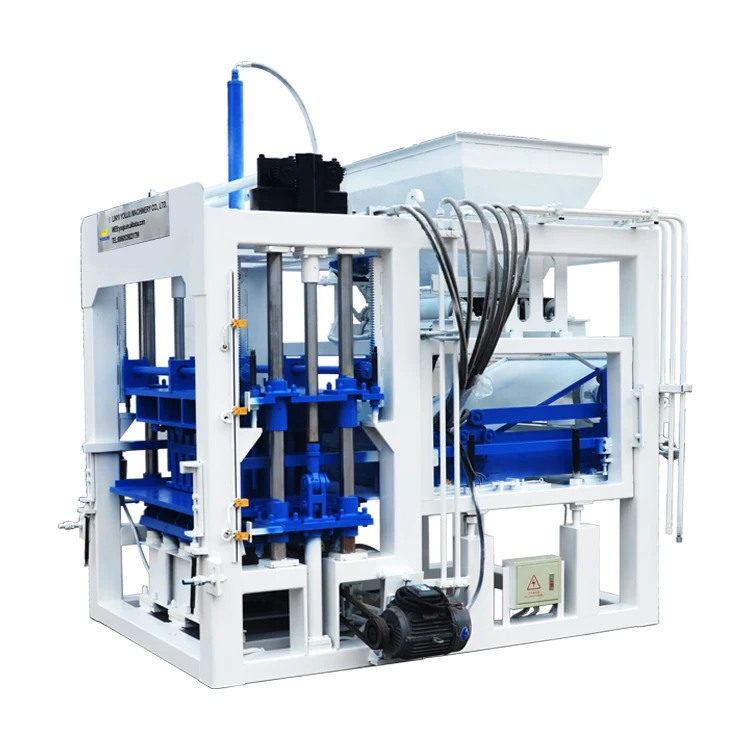
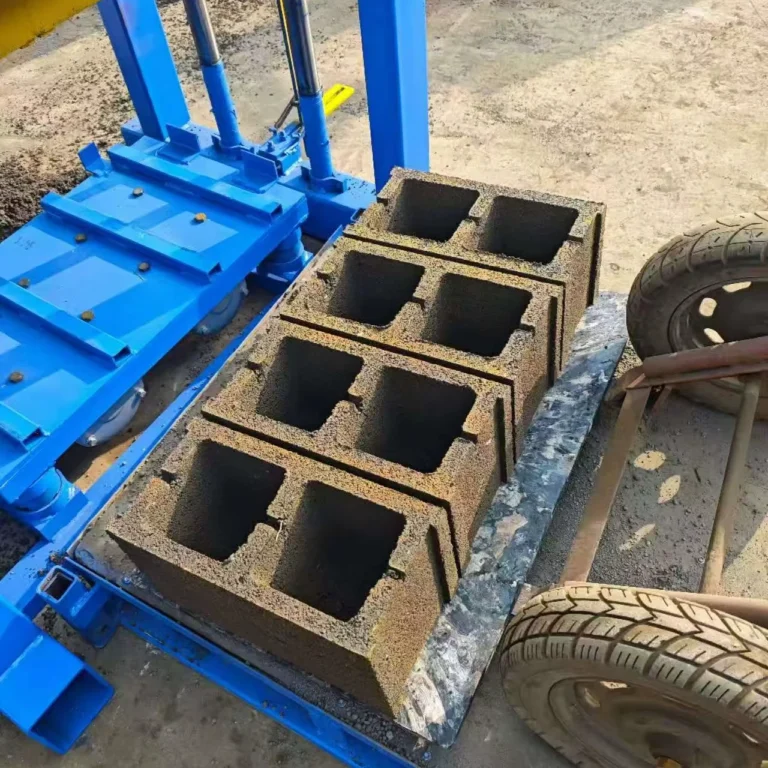 Stationary block machine