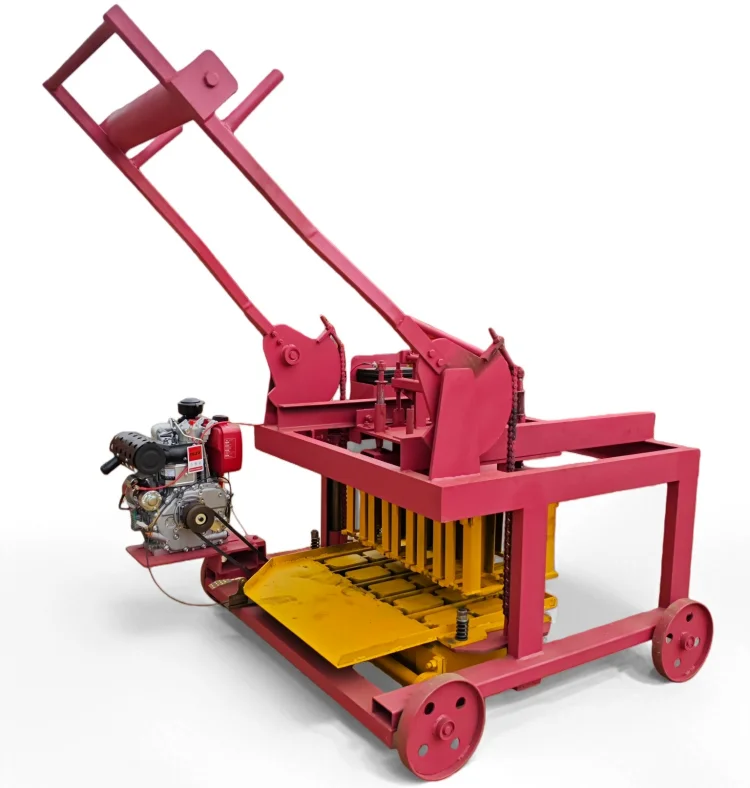
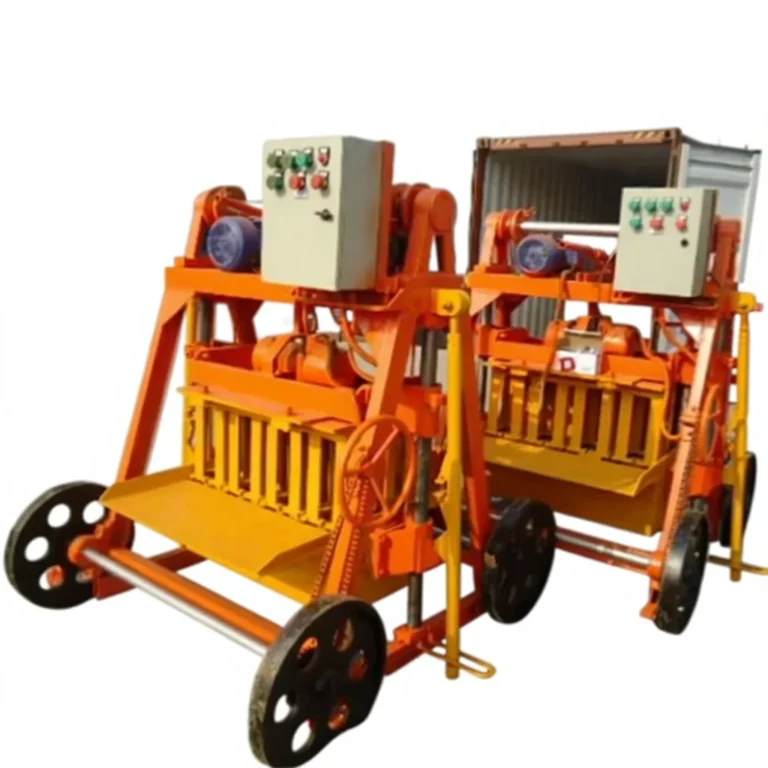
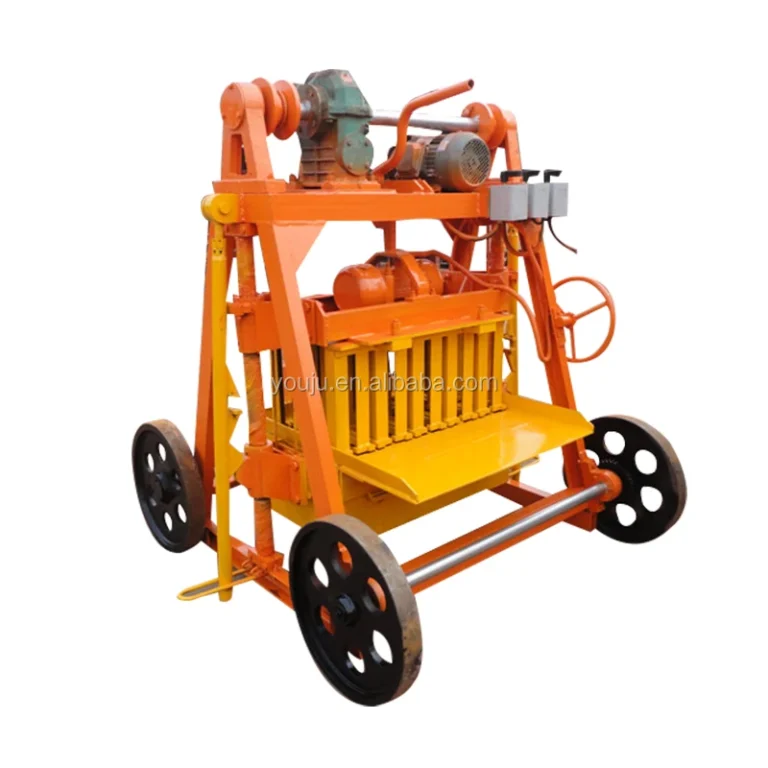
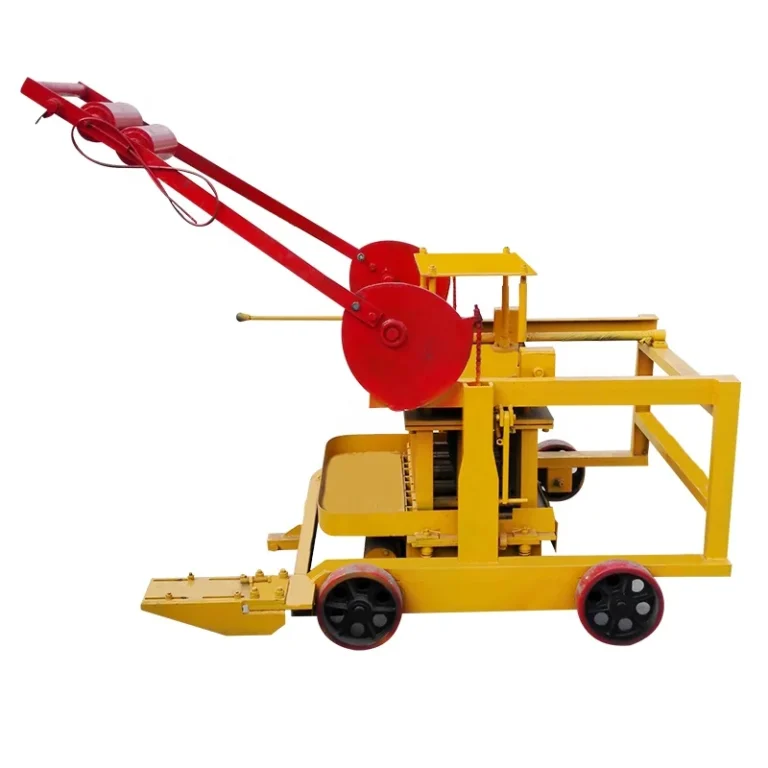
Machine-mould-pallet matched as one system — every QMJ4-45 configuration is specified against the buyer’s target block format and local aggregate, not pulled from a catalogue default.
Technical Specifications
| Parameter |
Value |
| Model |
QMJ4-45 |
| Product Type |
Mobile Egg Laying Block Making Machine |
| Forming Method |
Mold vibration (twice-vibration core) |
| Molding Cycle |
45 seconds |
| Demold Method |
Manual |
| Turning Method |
Manual |
| Vibration Frequency |
2400 r/min |
| Total Power |
6 kW |
| Power Source |
Diesel engine / Petrol engine / Electric motor (configurable) |
| Hollow Block 400×200×200 mm |
4 pcs/mould, 40–45 s cycle, approx. 3000 pcs per 8-hour shift |
| Hollow Block 400×150×200 mm |
5 pcs/mould, 40–45 s cycle, approx. 3500 pcs per 8-hour shift |
| Hollow Block 400×120×200 mm |
6 pcs/mould, 40–45 s cycle, approx. 4500 pcs per 8-hour shift |
| Daily Productivity |
2600–4000 pcs/day (basis not stated in source — confirm block format and material) |
| Automation Level |
Manual operation with engine or motor drive |
| Pallet Requirement |
Not stated in source — confirm pallet size and material |
| Standards |
CE (verify for specific configuration) |
Application Suitability
| Application |
Material or Output |
| On-site hollow block production at construction projects |
Crushed stone, river sand, cement, and water mixes laid directly on cured concrete ground |
| First block plant for entrepreneurs entering the market |
Low-capital entry producing hollow blocks in 400×200×200, 400×150×200, or 400×120×200 mm formats |
| Housing and development contractors producing locally |
Diesel or petrol engine drive for sites without stable grid power, eliminating transport cost for purchased blocks |
| Remote-area block supply where fixed plants are not viable |
Egg-laying operation on flat, compacted ground without pallets or curing racks |
What "3000 Blocks per Day" Actually Means on a Mobile Block Machine
Output figures only matter when the block format behind them is named.
Many quotations for mobile egg-laying machines quote a single daily number without stating which block size, mould cavity count, or shift length that figure assumes. A mobile block machine manufacturer may list 3000 pieces per day, but if the buyer’s market actually sells 400×120×200 mm blocks rather than 400×200×200 mm, the real output and revenue picture shift considerably. I have seen contractors arrive on site expecting a certain daily volume, only to discover the quoted capacity was based on a format they never intended to produce [NEED_CITE: capacity calculation transparency in block machine quotations]. Stating the assumed format, mould cavity count, and cycle time up front removes that gap between expectation and reality.

Where the QMJ4-45 Sits in the Range
The QMJ4-45 occupies the mobile egg-laying tier, the entry point for buyers who need block production without investing in a fixed plant, pallets, or curing racks. This machine lays blocks directly on a flat concrete floor and moves forward after each cycle, leaving the freshly formed blocks to cure in place. Compared to semi-automatic and automatic tiers further up the range, the mobile tier demands the lowest capital outlay and the smallest site footprint, making it the natural starting point for contractors producing on their own project or entrepreneurs testing a local market before scaling.
Engine Drive and the Grid Power Question
One defining feature of this mobile block machine is the configurable power source: diesel engine, petrol engine, or electric motor. For construction sites in regions where grid connections are unreliable or absent entirely, an engine-driven configuration removes the dependency on electrical infrastructure and allows production to begin as soon as the machine is offloaded [NEED_CITE: power supply constraints on construction sites in developing regions]. Buyers who do have stable three-phase power can opt for the electric motor variant, which reduces running cost per shift and eliminates fuel logistics on site.
Vibration, Cycle Time, and Block Density
The QMJ4-45 uses a twice-vibration molding core running at 2400 r/min, which increases block density and shortens the forming window compared to single-vibration designs common in this tier. The 40–45 second molding cycle applies across all three hollow block formats, meaning the operator’s rhythm stays consistent regardless of which mould is fitted. The manual demold and manual turning method keep the machine mechanically simple and the investment low, which suits first-time plant operators who are still building their maintenance capability. Mould change between formats is a manual process, and the time it takes should be factored into any daily output plan when a production run involves more than one block size.
When a Mobile Machine Becomes the Wrong Choice
Choosing an egg-laying machine for a market that demands high block strength and tight dimensional tolerance can lead to complaints from buyers further down the supply chain. Mobile machines produce blocks on the ground without hydraulic pressure, so block density depends entirely on vibration force and mix design — if the local aggregate is poorly graded or the cement content is too low, the blocks may not meet the compressive strength that hardware distributors or government tenders require [NEED_CITE: block compressive strength standards for load-bearing masonry]. A buyer who already knows their market demands consistent high-strength output may need to look at the semi-automatic or automatic tiers where hydraulic pressure supplements vibration.
Why Source This Range Here
Block machinery is the single focus of this operation, which means the machine, mould, and any supporting handling equipment are specified as one matched system rather than assembled from unrelated suppliers. Configuration is set against the buyer’s actual mix design and target block format, not a catalogue default, so the QMJ4-45 arrives with moulds that produce the sizes the buyer’s market actually purchases. Mould design and supply cover standard hollow formats as well as custom drawings when a buyer needs a non-standard block. The automation level is selectable across the range, so a buyer who starts with this mobile tier can move to semi-automatic or automatic machines later without changing suppliers. Installation support includes operator training so the crew understands cycle rhythm, mix proportions, and mould change procedure from the first day.
Documentation & Verification
- Capacity calculation sheet stating block format, mould cavities, and cycle time for each output figure
- Machine specification sheet confirming engine type or motor voltage and frequency
- Mould drawing and format list showing which block sizes ship with the machine
- Factory test record with photographs before container loading
- Operation and maintenance manual in the buyer’s preferred language
Installation, Commissioning & Support
- Flat, compacted concrete ground required — no fixed foundation or pallet system needed for egg-laying operation
- Diesel or petrol engine serviced and fuel lines checked before first production run; electric motor variant requires confirmed three-phase supply at rated voltage
- Machine shipped as a single unit, offloaded by forklift or crane, no on-site assembly of major components
- First-day commissioning covers mix proportion adjustment to local aggregate and cycle rhythm familiarisation for the operator
- Mould cavity surfaces and vibration motor mounts inspected at regular intervals per the maintenance schedule
- Wear parts list provided at dispatch so spares can be ordered before the first replacement is due
What to Include in Your Inquiry
To match the right configuration, share the block formats your market sells, the daily volume you need per format, and whether grid power is available on site or an engine drive is required. Details on your local aggregate type and cement source help set realistic expectations for block strength and mix proportion before the machine ships.
Frequently Asked Questions
Q: Which block format does the 3000 pcs/day figure assume, and how does output change for other sizes?
A: The 3000 pieces per 8-hour shift figure is based on 400×200×200 mm hollow blocks with 4 cavities per mould and a 40–45 second cycle. Switching to 400×150×200 mm (5 cavities) raises output to approximately 3500 pcs/day, and 400×120×200 mm (6 cavities) reaches approximately 4500 pcs/day under the same cycle time.
Q: Is the machine supplied with a diesel engine, petrol engine, or electric motor — and how do I specify?
A: All three power sources are available. Specify your preference during inquiry along with site conditions. Diesel or petrol engines suit sites without reliable grid power, while the electric motor option reduces running costs where stable three-phase supply exists. Voltage and frequency must be confirmed for the motor variant before production begins.
Q: What plant footprint and ground preparation does a mobile egg-laying machine require?
A: The QMJ4-45 lays blocks directly on a flat, compacted concrete surface and moves forward after each cycle, so no fixed plant building, pallets, or curing racks are needed. The working area must be level and large enough to accommodate the day’s output laid out for curing, plus manoeuvre space for the machine and material feed.
Q: Which mould formats are included in the base price, and how long does a mould change take?
A: The quotation specifies which mould formats are included — confirm this in the mould drawing and format list before order confirmation. Mould change is a manual process, and the time required should be planned into the production schedule when switching formats during a single shift.
Q: Where does the QMJ4-45 sit in the range compared to semi-automatic and automatic tiers?
A: The QMJ4-45 is the mobile egg-laying entry point, requiring the lowest capital investment and smallest site footprint. Semi-automatic and automatic tiers add pallet systems, hydraulic pressure, stacking, and higher output for buyers whose market demands greater volume or block consistency. The range allows upgrading later without changing suppliers.

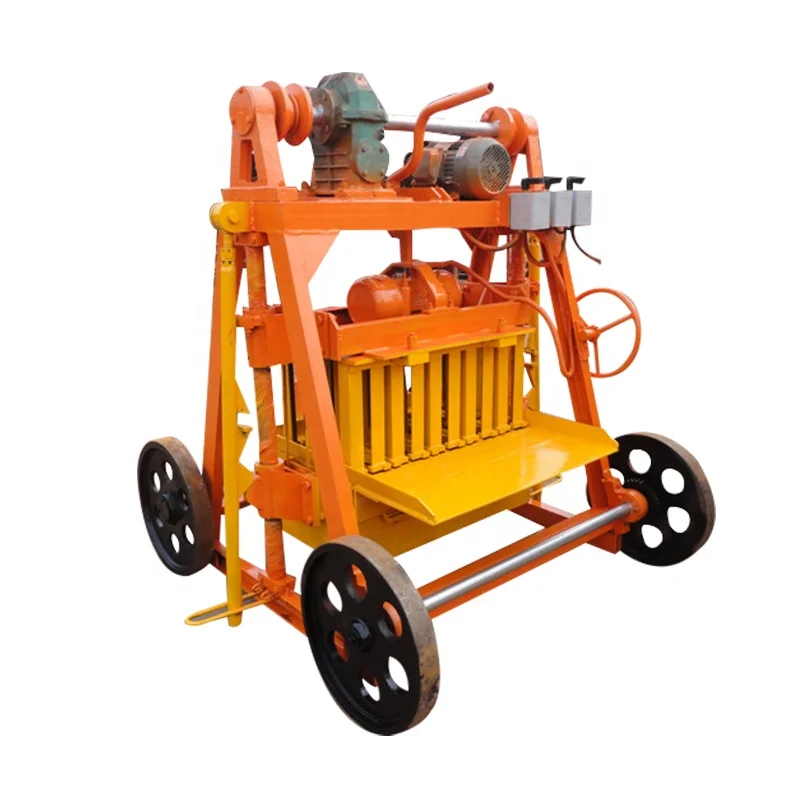
 Mobile block machine