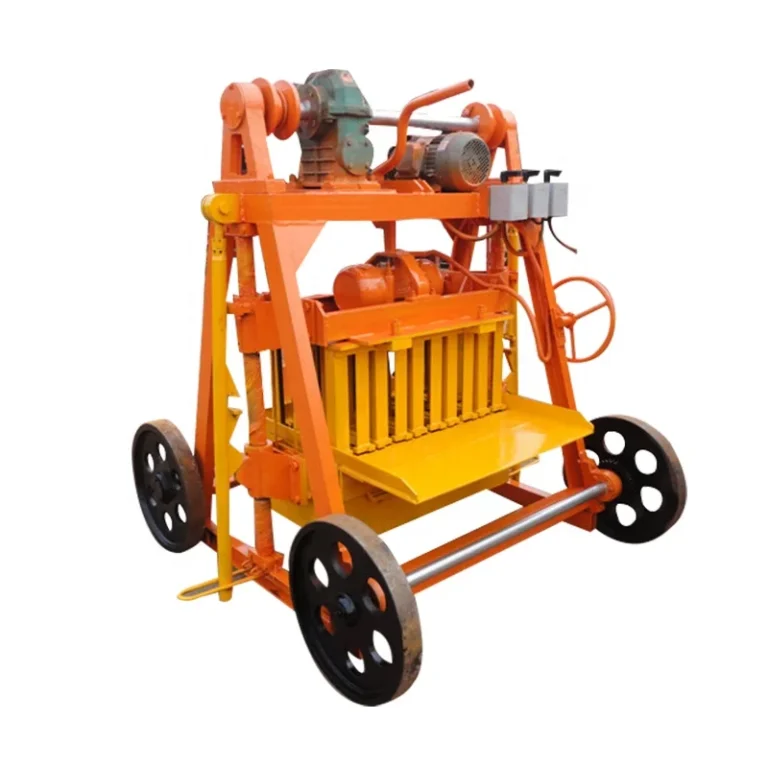
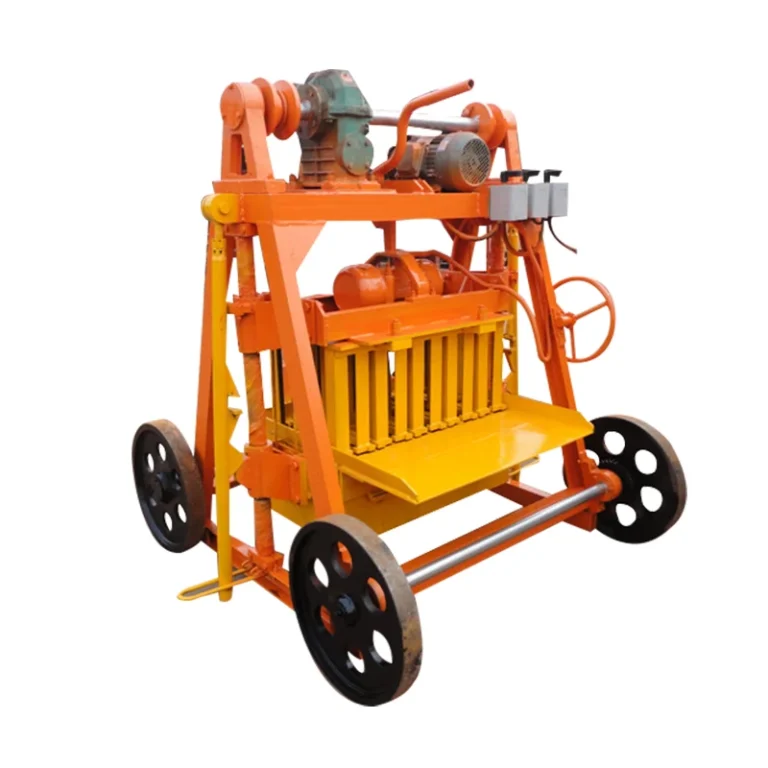
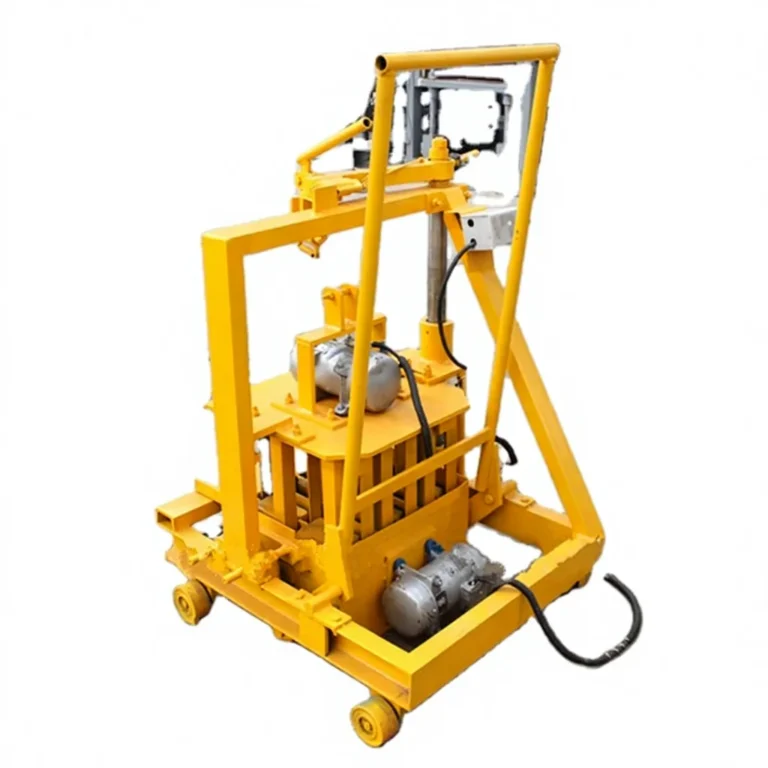
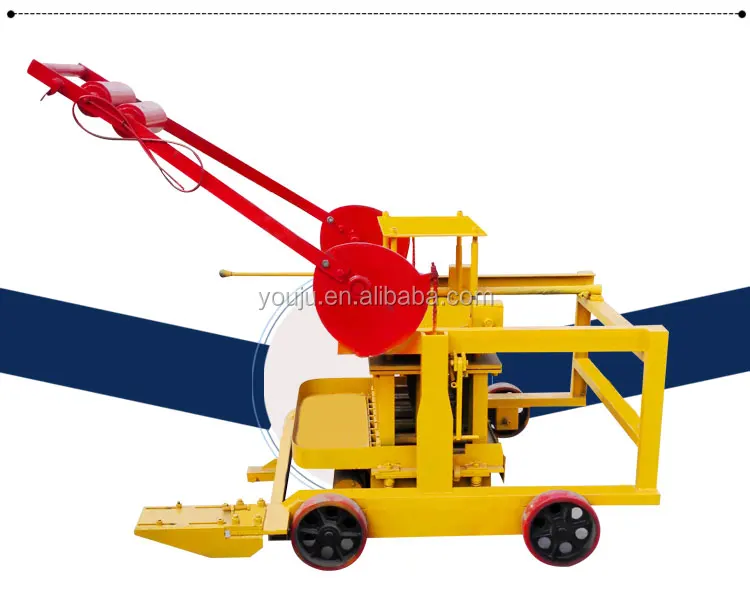
Configuration set against your actual site conditions — rather than shipping a catalogue default, the QMR4-45 mobile block machine manufacturer approach matches power source, mould format, and capacity assumptions to the ground you are building on.
Technical Specifications
| Parameter |
Value |
| Model |
QMR4-45 |
| Product Type |
Mobile Block Making Machine |
| Overall Dimensions (L×W×H) |
1100 × 950 × 2100 mm |
| Net Weight |
810 kg |
| Molding Cycle |
30–45 seconds |
| Power Source Options |
Diesel engine / Petrol engine / Electric motor |
| Output Capacity |
2,560 pcs/day (basis not stated in source — confirm block format, material, and thickness before ordering) |
| Pallet Requirement |
None — egg-laying operation directly on ground |
| Included Ancillary Equipment |
JZC350 diesel concrete mixer or JQ350 diesel concrete mixer with electric generating unit; trolley |
| Block Formats Available |
Paver brick, hollow block, concrete block, solid brick, fly ash brick |
| Automation Level |
Semi-automatic / manual operation |
| Structure Type |
Linear, simple structure |
| Warranty |
1 year |
Application Suitability
| Application |
Material or Output |
| On-site hollow block production for building contractors |
Crushed stone, sand, and cement blends laid directly on compacted ground |
| Paver brick manufacturing at housing project sites |
Fine aggregate and cement mixes for interlocking or rectangular pavers |
| Solid brick runs for small-scale entrepreneurs |
Fly ash, sand, or local soil blended with cement binder |
| Remote construction camps without grid power |
Diesel-powered operation producing blocks from locally sourced aggregate |
| Multi-phase development projects requiring machine relocation |
Lightweight 810 kg unit moved between zones as each phase completes |
What "2,560 Pieces per Day" Leaves Out When Sourcing a Mobile Block Machine
Capacity numbers without a block format attached are marketing, not engineering.
I have watched contractors in arid project sites unpack a machine, run it for a week, and then call the supplier because daily output sits well below the quoted figure. The disconnect is almost always the same: the capacity was measured on a small solid brick, while the buyer needs 200 mm hollow blocks that consume more material per cycle and take longer to form. On desert sites where heat shortens working hours and aggregate arrives in irregular batches, that gap between quoted and real output decides whether the block yard keeps the masons supplied or the whole wall schedule slips. A mobile block machine manufacturer worth working with will tell you the exact format behind every number before the invoice is raised [NEED_CITE: block format assumptions behind quoted output capacities].

Power Source Flexibility for Sites Without Reliable Grid Access
Choosing between diesel, petrol, and electric power on a QMR4-45 is not a cosmetic option — it determines whether the machine runs at all during the first weeks on an undeveloped site. Diesel configuration with the included JZC350 mixer gives a fully self-contained production cell that can follow the building footprint as the project grows. For sites where grid connection exists but voltage fluctuates, specifying the electric motor with confirmed frequency and phase prevents motor burnout that would otherwise surface only after the machine is bolted to the ground. This power-source matching is what separates a mobile block machine manufacturer that ships a box from one that delivers a working production unit.
Mould Format Range and What It Means for a Single-Machine Operation
The QMR4-45 accepts moulds for paver bricks, hollow blocks, solid bricks, concrete blocks, and fly ash bricks from one chassis. For a contractor producing blocks at the project site, this means a single machine can supply the retaining wall, the partition block, and the driveway paver across different construction phases without a second capital outlay. Mould change on a linear-type mobile unit is a manual process, so the real question is how many format switches per week the operation can absorb before lost production time outweighs the flexibility. Buyers planning frequent format changes should confirm mould change procedure and tooling requirements with the mobile block machine manufacturer before committing to a production schedule [NEED_CITE: mould change procedures for egg-laying block machines].
Reading the Specs That Actually Matter on Site
The 1100 × 950 × 2100 mm footprint and 810 kg weight place the QMR4-45 in a range where two workers and a trolley can relocate it between pouring zones — but only if the ground is compacted and level enough to prevent the mould from tilting during the vibration cycle. The 30–45 second molding cycle is the press time alone; total throughput depends on how fast the mixer feeds the hopper and how quickly the operator moves the unit forward after each lay. Pallet-free egg-laying operation removes the cost of pallets, curing racks, and the forklift to move them, but it also means block quality is tied directly to ground preparation and the consistency of the concrete mix arriving at the hopper.
The Hidden Cost of Skipping Ground Preparation and Mix Verification
When a mobile block machine arrives on site and the contractor pours on un-compacted fill, the first hundred blocks often crack along the base or emerge with uneven density because the machine settles during the vibration stroke. I have seen crews blame the machine, swap moulds, adjust the mix, and lose days before someone checks the ground with a straight edge. Similarly, if the local aggregate is coarser than what the standard mix design assumes, the block face tears during demoulding and rejects climb. These are not machine defects — they are configuration gaps that a thorough pre-shipment dialogue with the supplier would have closed [NEED_CITE: site preparation standards for mobile block laying equipment].
Why Procurement Through a Focused Block Machinery Supplier Matters
Every unit shipped is specified against the buyer’s stated block format, local aggregate, and site power conditions rather than pulled from a catalogue default. The QMR4-45 leaves the workshop with a capacity calculation that names the block size behind the daily figure, so there is no ambiguity when production starts. Mould drawings are provided for each format the buyer intends to run, including custom formats when the local market demands dimensions outside the standard range. Power source, voltage, and frequency are confirmed in writing before production begins, eliminating the commissioning delays that arise when an electric motor meets an unexpected three-phase supply. The machine, mixer, and trolley are quoted as a matched set so that no ancillary equipment gap surfaces after arrival. Documentation, from factory test records to packing photographs, supports every step from production through customs clearance.
Documentation & Verification
- Capacity calculation sheet stating the exact block format behind the daily output figure
- Machine specification sheet confirming diesel or electric power source matched to your site
- Mould drawing and format list for every block type in your production plan
- Voltage and frequency confirmation document when electric motor is selected
- Factory test record showing the QMR4-45 running your specified mould before dispatch
- Packing photographs and customs documentation to support import clearance
Installation, Commissioning & Support
- Ground must be compacted and level across the laying path to maintain block dimensional accuracy
- Diesel mixer fuel and oil checks required before first start when JZC350 configuration is supplied
- Electric motor variant requires confirmed voltage and dedicated circuit before commissioning
- Mould installation and first-run parameter adjustment covered during on-site commissioning visit
- Operator training on mix consistency, machine relocation, and manual mould change included
- Wear parts list with mould and hydraulic component reorder references supplied at handover
What to Include in Your Inquiry
Send the block format and dimensions your market requires, the local aggregate type and maximum particle size, and whether your site has grid power with confirmed voltage and frequency or needs a fully diesel-powered setup. Include the daily output target you need to hit and the ground conditions where the machine will operate. This lets the mobile block machine manufacturer return a configuration proposal where the capacity number is tied to your actual block, not a catalogue assumption.
Frequently Asked Questions
Q: What block format is the 2,560 pcs/day capacity based on, and how does output change across formats?
A: The published daily figure has not been tied to a specific block format in the source data, so treat it as a reference point only. Hollow blocks consume more material per cycle and typically reduce daily count versus solid bricks, while thin pavers may increase it. Request a capacity calculation that names your exact block size before confirming the order.
Q: Diesel vs. electric power — which configuration suits my site?
A: Sites without grid access or with unreliable supply should specify the diesel engine and included JZC350 mixer for full independence. Where stable three-phase power exists, the electric motor reduces fuel cost and noise. Confirm voltage, frequency, and phase with the supplier before production so the motor and control panel match your supply.
Q: How is the QMR4-45 relocated between sites and what ground preparation is needed?
A: At 810 kg with a trolley included, the unit can be moved by a small crew across compacted ground. The laying surface must be level and firm enough to prevent settling during the vibration cycle, otherwise block density becomes uneven. Plan ground preparation before the machine arrives to avoid lost production days.
Q: What moulds are available and can custom formats be designed?
A: Standard moulds cover paver brick, hollow block, solid brick, concrete block, and fly ash brick. Custom mould design to buyer drawings is available for formats outside the standard range. Submit your target dimensions and block cross-section so the mobile block machine manufacturer can confirm mould compatibility and cycle time implications.
Q: When should a buyer consider stepping up to a semi-automatic or automatic stationary line?
A: The QMR4-45 serves on-site and small-scale production where pallet-free operation and low capital outlay are priorities. When daily volume targets grow beyond what a single mobile unit can sustain, or when pallet handling and automatic stacking become necessary for consistency, moving to a stationary semi-automatic or automatic line is the logical next step.

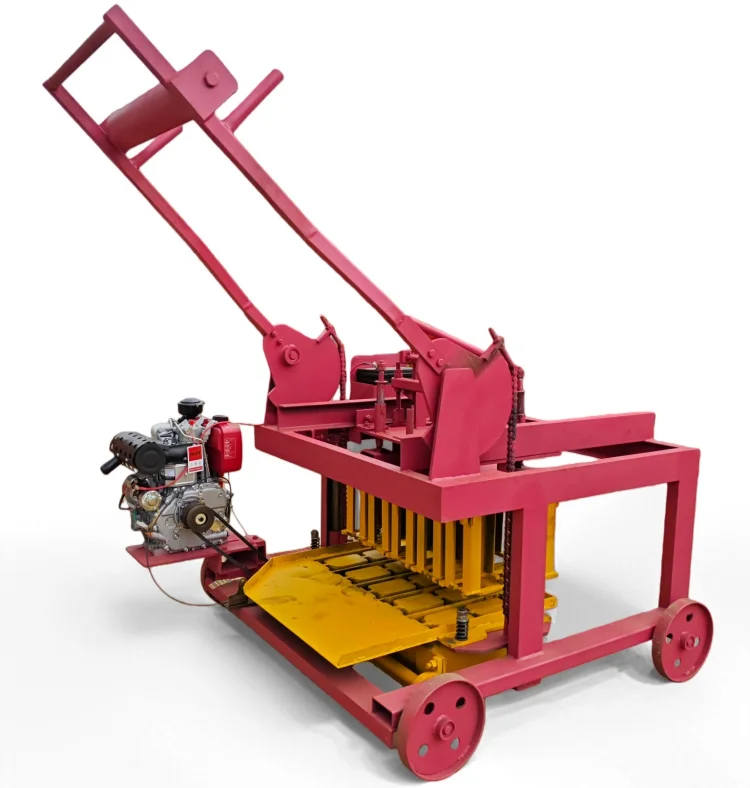
 Mobile block machine