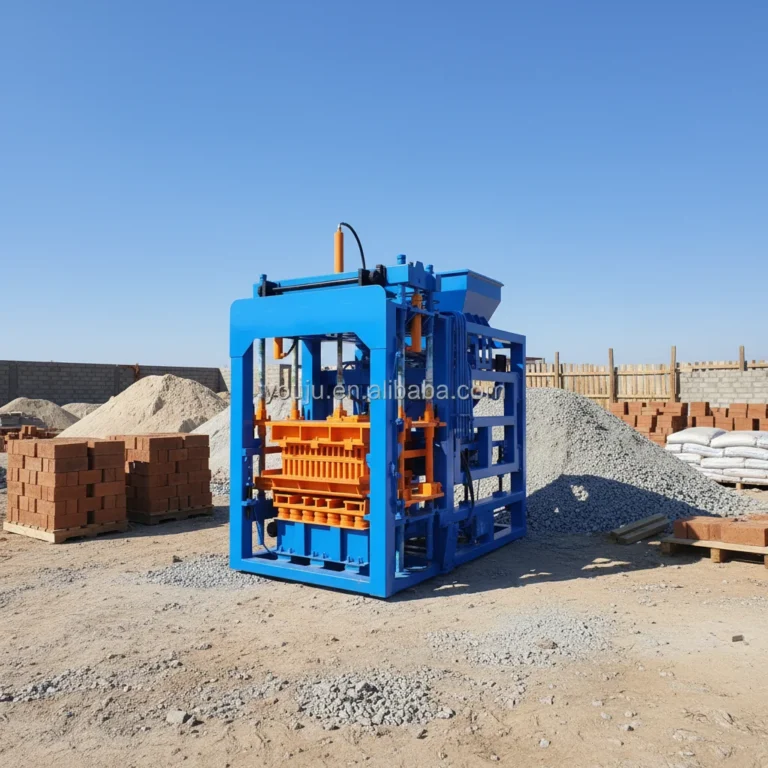
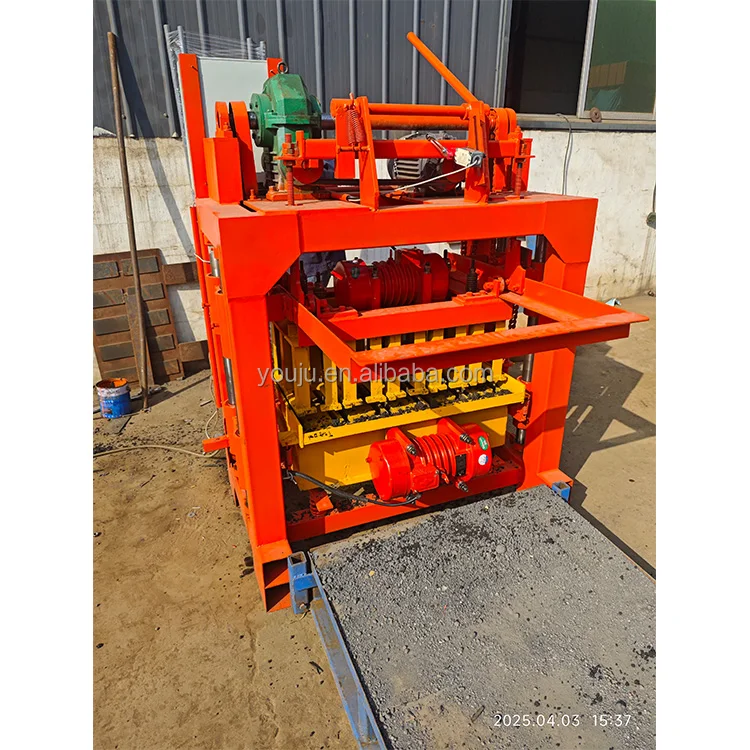
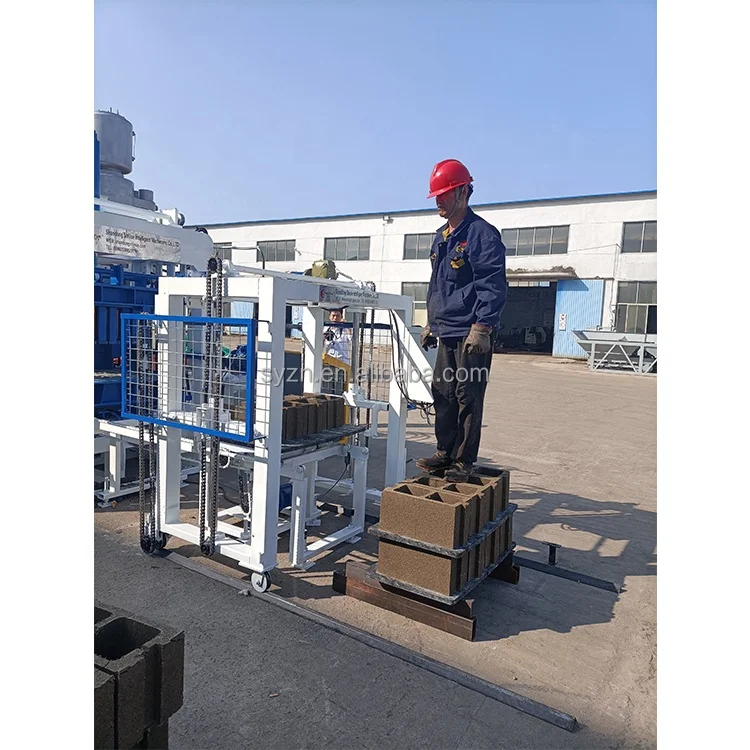
Positioning Mid-Tier Output — The QT7-15 fills the gap between entry-level semi-automatic presses and high-capacity lines, specified here as a complete matched system rather than a standalone host machine.
Technical Specifications
| Parameter |
Value |
| Model |
QT7-15 |
| Product Type |
Automatic Concrete Block Making Machine |
| Host Machine Dimensions |
3200 × 2300 × 2750 mm |
| Host Machine Weight |
6 Tons |
| Molding Area |
1150 × 700 mm |
| Workshop Area Requirement |
200 ㎡ |
| Host Machine Power |
45 kW |
| Vibration Force |
100 kN |
| Vibration Method |
Hydraulic + Platform Vibration |
| Vibration Frequency |
2800–4500 Times/Minute |
| Molding Period |
15 Seconds |
| Pallet Size |
1150 × 700 × 25 mm |
| Voltage |
220/380/415/440V (Customized) |
| Control System |
Siemens PLC with independently developed control program |
| Motor Brand |
Germany SIEMENS or CE standard brand |
| Travel Switch |
France Schneider and Japan Omron |
| Mould Treatment |
Heat treatment and carburizing treatment (54–58 HRC) |
| Batching Machine (PLD1200) |
1200L weigh-batching hopper, 4 × 2.5 m³ storage, ±2% precision |
| Mixer (JS500) |
800L charging / 500L discharging, 18.5 kW mixing motor |
| Stacker (SY-4) |
3 kW, mobile pallet stack, suitable for hollow blocks and pavers |
| Standards |
CE |
Application Suitability
| Application |
Material or Output Context |
| Concrete hollow block production |
Crushed stone, sand, cement, and fly ash blends |
| Solid load-bearing block manufacturing |
Dense aggregate mixes requiring high compaction force |
| Paving block and paver production |
Fine aggregate face mix with standard base concrete |
| On-site contractor block production |
Locally sourced gravel and cement for housing projects |
| Building material distributor inventory |
Multiple block formats on a single pallet size platform |
Why Stated Cycle Times Rarely Match Your Daily Tally
Capacity numbers only hold weight when the block format is named alongside them.
A moulding period of 15 seconds sounds definitive until you realize that figure assumes a specific block dimension, wall thickness, and concrete consistency. When the actual mix contains higher clay content or the target format is a wide paver rather than a standard hollow block, the cycle extends and the daily tally drops. The QT7-15 automatic block making machine for sale sits in a mid-to-high output tier, but quoting its throughput without naming the reference format leaves buyers planning around numbers they will never see on the shop floor [NEED_CITE: block format assumptions in manufacturer capacity tables].

Mapping the Range: Where This Model Lands
Buyers evaluating their first block plant or replacing an aging press need a clear picture of the investment steps available. The QT7-15 automatic block making machine for sale occupies the mid-to-high tier in our stationary block machine range, positioned above mobile egg-laying units and semi-automatic workshop presses but below the fully continuous high-capacity lines designed for 24-hour operation. This placement means the buyer gets a complete grouped equipment set — batching machine, mixer, pallet feeder, brick receiver, hydraulic station, and stacker — without committing to the larger footprint and dedicated curing infrastructure that a top-tier line demands.
Matching Automation to Your Workforce Reality
The degree of automation should follow the labour available on site, not the other way around. With the Siemens PLC running an independently developed control program, the QT7-15 handles pallet feeding, moulding cycles, and brick receiving automatically, while the SY-4 stacker consolidates output into mobile pallet stacks for curing area transport. A plant owner who starts at this tier can later add higher levels of stacking automation without replacing the press itself, because the PLC architecture supports modular upgrades. This path matters when skilled operators are scarce and consistency between shifts cannot rely on manual timing [NEED_CITE: PLC integration standards for modular block line upgrades].
Reading the Vibration and Pressure Numbers
The 100 kN vibration force combined with hydraulic pressure determines how densely the concrete is compacted inside the mould cavity. Higher density translates directly to block compressive strength, which must meet the structural codes of the buyer’s local market. The vibration frequency range of 2800 to 4500 cycles per minute allows the operator to dial in the right amplitude for different mix designs — a fine sand face mix for pavers needs a different setting than a coarse aggregate hollow block body. Moulds treated to 54–58 HRC through heat treatment and carburizing withstand this repeated vibration without edge wear that would otherwise cause dimensional drift over production runs. The JS500 mixer’s 500-litre discharge volume pairs with the press cycle so that fresh concrete arrives at the hopper without the press idling between batches.
What Happens When Pallet and Curing Are an Afterthought
Choosing the pallet size without considering the curing racks already on site or the forklift fork width in use creates a bottleneck the moment blocks leave the press. The 1150 × 700 × 25 mm pallet specified for this model must match the curing area layout, because every pallet that cannot be slotted into a rack sits on the floor consuming space and slowing handling. Buyers who discover this mismatch after delivery face weeks of reorganizing their curing yard while output piles up unstacked [NEED_CITE: pallet handling logistics in concrete block production].
Why the System Approach Matters Here
Every configuration begins with the buyer’s actual mix design, local aggregate properties, and target block format rather than a catalogue default — the vibration and pressure settings on this QT7-15 are calibrated to those inputs before dispatch. Mould design covers the specific formats the buyer’s market demands, including custom drawings when standard cavity layouts do not match local block dimensions. The grouped equipment list ensures batching, mixing, pressing, and stacking are specified as one matched system so cycle times align across stations. Voltage and PLC display language are confirmed before production starts, eliminating the commissioning delays that occur when a control panel arrives in a language the local electrician cannot read. Factory test records document the machine running the buyer’s chosen format, providing a baseline for on-site commissioning.
Documentation & Verification
- Line layout showing the 200 ㎡ workshop footprint with station clearances marked
- Capacity calculation sheet stating the exact block format assumed for each output figure
- Mould drawing and format list covering every cavity the QT7-15 will produce
- Hydraulic and electrical schematic matching the confirmed voltage and frequency
- Factory test record on the buyer’s specified block dimension before dispatch
- Packing photographs documenting dismantling state and container loading arrangement
Installation, Commissioning & Support
- Foundation plan aligned to the 6-ton host machine weight and vibration isolation needs
- Dedicated power circuit for the 45 kW host plus 18.5 kW mixer motor confirmed on site
- On-site assembly from dismantled shipment state with re-alignment of the 1150 × 700 mm moulding area
- PLC parameter tuning to match the buyer’s local aggregate density and moisture content
- Operator training covering mould change procedure and daily vibration system inspection
- Wear parts list with mould cavity lifespan expectations based on 54–58 HRC treatment
Before You Request a Quote
To configure this QT7-15 automatic block making machine for sale to your actual production conditions, we need your target block formats with dimensions and wall thickness, the source and grading of your local aggregate, and the daily output volume you plan to sustain. Share your workshop dimensions, available voltage and frequency, and the PLC display language your operators require. If you already have curing racks, pallets, or forklifts on site, send their specifications so the pallet feeder and stacker integrate without modification.
Frequently Asked Questions
Q: Where does this model sit compared to semi-automatic and higher-capacity options?
A: The QT7-15 occupies the mid-to-high automatic tier in the stationary block machine range. It delivers a fully grouped line with batching, mixing, and stacking, positioned above semi-automatic workshop presses but below continuous high-capacity plants designed for round-the-clock output. This tier suits buyers who need reliable daily volume without the infrastructure investment a top-tier line demands.
Q: Which block formats and pallet sizes does this tier support?
A: The 1150 × 700 mm moulding area accommodates hollow blocks, solid blocks, paving blocks, and kerbstones through interchangeable moulds. The 1150 × 700 × 25 mm pallet is standard across this tier. Custom mould designs can be produced to buyer drawings when local market formats fall outside the standard cavity catalogue.
Q: How is daily output calculated and which format is assumed?
A: Output figures are tied to a specific block format, moulding cycle, and mix design. A 15-second moulding period applies to a reference block dimension; wider or thicker formats extend the cycle. We provide a capacity calculation sheet that names the assumed format for every output number so buyers can plan against realistic daily tallies.
Q: Can automation be upgraded after initial installation?
A: The Siemens PLC architecture supports modular additions. Buyers can start with the standard pallet feeder, brick receiver, and SY-4 stacker, then add higher-level stacking or cubing automation later without replacing the host press. This path allows a plant to scale its automation investment alongside growing production volume and available workforce.
Q: What supporting equipment is included in the grouped line?
A: The standard grouping includes the PLD1200 batching machine, JS500 mixer, conveyor belt, pallet feeder, brick receiver, hydraulic station, and SY-4 stacker alongside the QT7-15 host machine. Curing racks, additional pallets, and forklift handling within the curing yard are not part of the standard package and should be specified separately based on the buyer’s site layout.

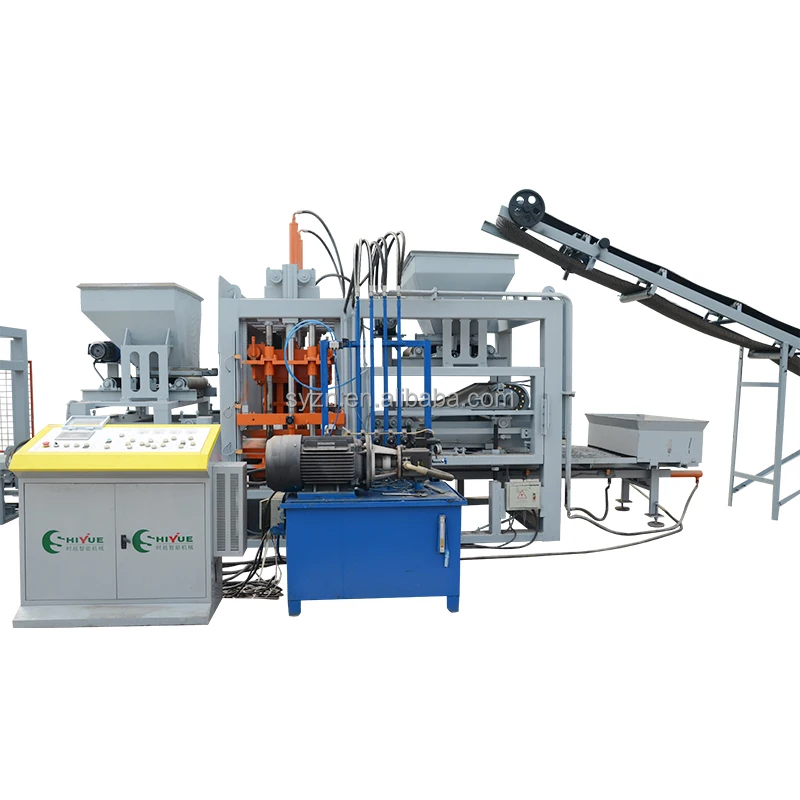
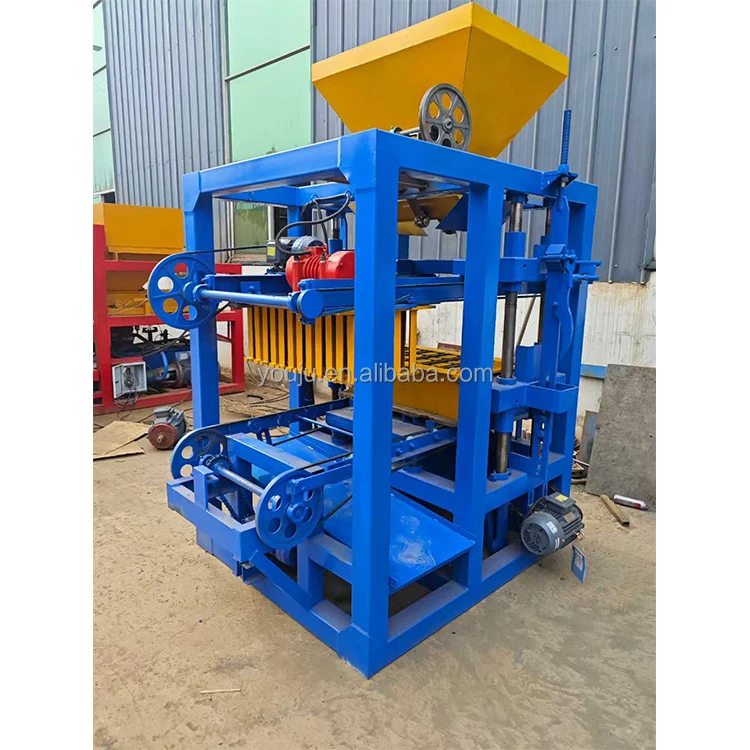 Stationary block machine