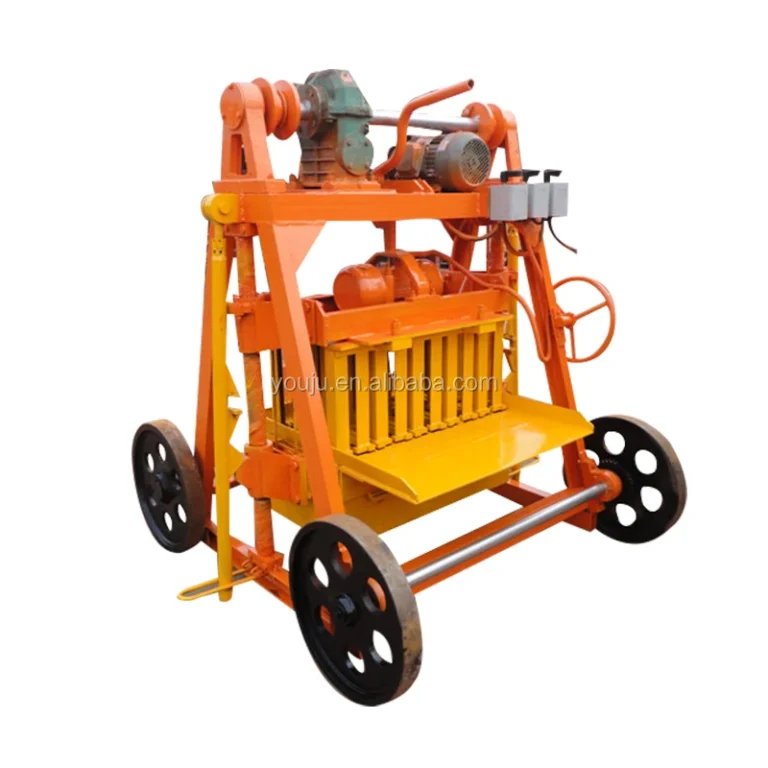
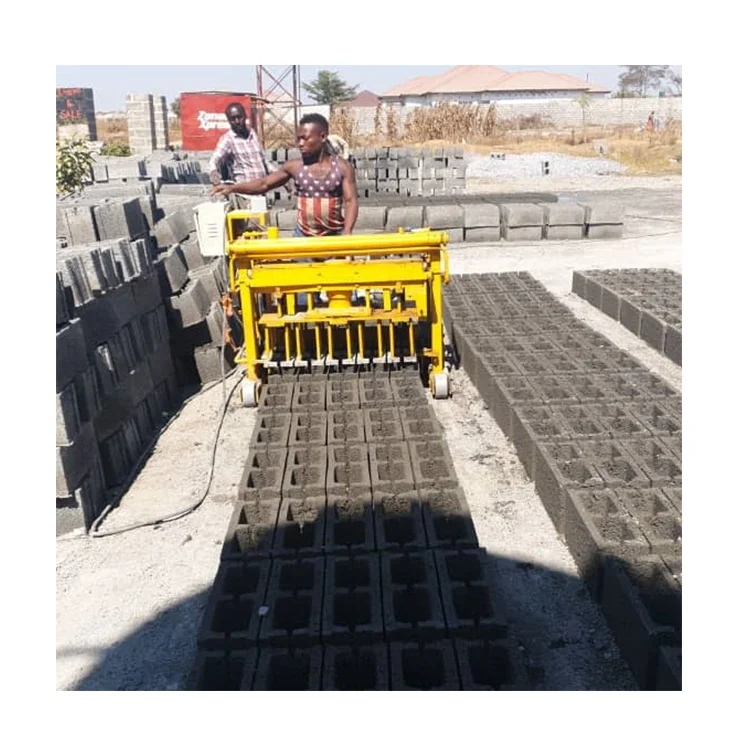
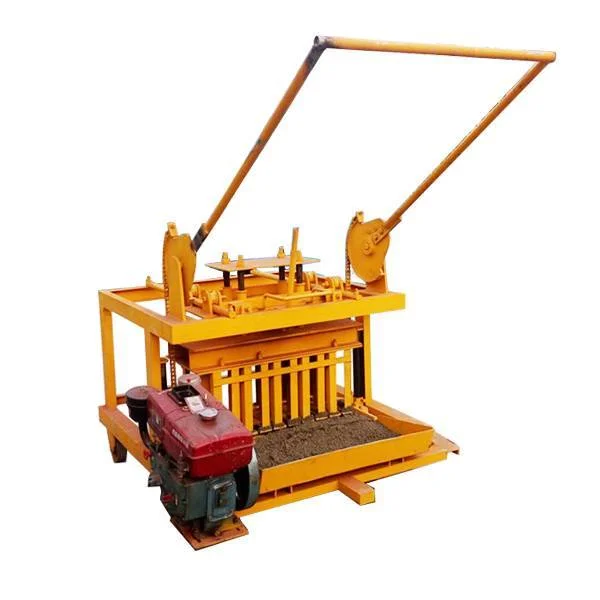
Single-focus machinery alignment — The QMR4-45 is specified as a matched system where diesel power output, mould cavity count, and cycle time are confirmed together before dispatch, not quoted as isolated headline figures.
Technical Specifications
| Parameter |
Value |
| Product Type |
Diesel Engine Egg Laying Block Making Machine |
| Model |
QMR4-45 |
| Dimension |
2420 × 1320 × 1650 mm |
| Weight |
810 kg |
| Power |
6 kW |
| Diesel Engine |
6 kW or 6–8 HP |
| Voltage |
220V or 380V or according to client local voltage |
| Moulding Cycle |
40–45 s |
| Pallet Size |
No need pallet |
| Power Source |
Diesel engine for hydraulic pressure supply |
| Floor Requirement |
No need of concrete floor |
| Productivity (Hollow Block 400×200×200mm) |
4 pcs/mould, 40–45 s cycle, approx. 3000 pcs/day (8 hours) |
| Productivity (Hollow Block 400×150×200mm) |
5 pcs/mould, 40–45 s cycle, approx. 3500 pcs/day (8 hours) |
| Productivity (Hollow Block 400×120×200mm) |
6 pcs/mould, 40–45 s cycle, approx. 4500 pcs/day (8 hours) |
Application Suitability
| Application |
Material or Output |
| On-site hollow block production for housing projects |
Crushed stone, sand, cement, water |
| Small workshop block manufacturing |
Local aggregate blends with cement binder |
| Remote construction sites without grid electricity |
Standard concrete mix, diesel-powered operation |
| Paving brick and standard brick production |
Interchangeable moulds on the same machine base |
| Entrepreneurial first block plant |
Low-capital entry with movable egg-laying format |
Why the Voltage Question Should Come Before the Price
Confirming local electrical supply before ordering avoids weeks of idle time on site.
A mobile block machine arriving with a 380V motor into a region that only offers 220V single-phase will sit non-functional until an electrician rewinds or replaces the drive. I spent years handling after-sales calls across Latin America, and voltage mismatch was the single most common reason a Diesel Engine Block Making Machine for sale could not start upon arrival. The QMR4-45 ships configurable for 220V or 380V, but the buyer must verify local supply and state it explicitly before production begins [NEED_CITE: voltage and frequency standards by export market]. Skipping this step does not just delay commissioning — it forces field modifications that compromise motor warranty and introduce vibration issues from mismatched winding.

Where a Diesel-Powered Mobile Unit Fits in the Range
The QMR4-45 occupies the entry tier of the mobile block machine manufacturer lineup, built for buyers who need production capability without investing in a fixed plant, conveyor systems, or curing racks. The diesel engine removes dependence on grid electricity entirely, making this unit practical for rural project sites, temporary housing developments, and regions where three-phase power is unavailable or unreliable. Buyers who have outgrown hand-moulding but are not yet ready for semi-automatic lines with pallet circulation find this tier a natural starting point.
Egg-Laying Versus Fixed Press — What Changes on Site
An egg-laying machine lays each block directly onto the ground and then moves forward to the next position, eliminating the need for pallets and the curing rack infrastructure that a fixed press requires. This means the QMR4-45 can operate on any reasonably level compacted surface, not a poured concrete floor. The trade-off is that block curing happens in place, so the production area must be large enough to accommodate a full day’s output spread across the ground before the blocks reach handling strength [NEED_CITE: concrete block curing time before handling].
Reading the Specs That Actually Determine Daily Output
The moulding cycle of 40–45 seconds is consistent across all three hollow block formats, but the pieces per mould varies from four to six depending on block width. A 400×200×200mm hollow block yields four per cycle, while a narrower 400×120×200mm block yields six — the same cycle time produces meaningfully different daily totals. The diesel engine rated at 6 kW or 6–8 HP drives the hydraulic system that compacts the mix, and its pressure must be matched to the buyer’s aggregate gradation and cement ratio to achieve target block density. The machine weight of 810 kg contributes to vibration damping during moulding, which matters for surface finish consistency on thinner block formats.
The Cost of Overlooking Site Preparation Details
Buyers who focus only on the press and ignore ground conditions often find that uneven terrain causes the egg-laying machine to tilt during moulding, producing blocks with inconsistent wall thickness. Without a flat working surface, the machine’s movement between positions becomes irregular, and freshly laid blocks can be bumped before initial set. Additionally, failing to confirm local fuel availability for the diesel engine can mean sourcing diesel at significant transport cost in remote areas, eroding the operating advantage the machine was meant to provide [NEED_CITE: diesel fuel logistics for remote construction sites].
Why Source the QMR4-45 Through This Range
Block machinery is the sole product focus here, which means the QMR4-45 is not bundled from separate suppliers but specified as a complete unit with matching mould, hydraulic circuit, and engine. Each machine ships with a capacity calculation that names the block format and cycle assumption behind the daily output figure, so buyers can verify production claims against their own product mix. Mould design covers the formats the buyer’s local market actually demands, and custom mould drawings are available when standard cavity options do not match. Configuration is set against the buyer’s local aggregate and mix, not pulled from a catalogue default, reducing the risk of blocks failing compression tests after arrival.
Documentation & Verification
- Machine specification sheet with output stated per block format and cycle time
- Mould drawing and format list confirming cavity count for each quoted block size
- Voltage and frequency confirmation document signed before production release
- Factory test record showing cycle time and block density with the buyer’s target mix
- Diesel engine specification sheet with power rating and fuel consumption data
Installation, Commissioning & Support
- Site must provide a level compacted area of at least 500 m² for daily output and curing spread
- Diesel fuel supply confirmed on site before first engine start and hydraulic warm-up
- Machine arrives as a single 810 kg unit requiring no reassembly of major structural components
- First-day commissioning includes cycle timing verification against the 40–45 second specification
- Operator training covers mould change procedure and hydraulic pressure adjustment for local aggregate
- Wear parts list provided at delivery identifying mould liners and hydraulic seals for first reorder
Before You Request a Quote
To configure the QMR4-45 accurately, share the specific hollow block dimensions you intend to produce, the daily volume you need to sustain, and the exact voltage and frequency available at your site. If you already have an established mix design using local aggregate, provide the gradation and cement ratio so the hydraulic pressure can be matched before the machine leaves the factory.
Frequently Asked Questions
Q: How is the daily productivity figure calculated for each block format?
A: The output assumes an eight-hour production day with the QMR4-45 running at its 40–45 second moulding cycle. A 400×200×200mm block yields four pieces per mould, a 400×150×200mm yields five, and a 400×120×200mm yields six. Actual daily totals depend on operator pace, mix feeding continuity, and ground conditions.
Q: Can the diesel engine be swapped for an electric motor later?
A: The hydraulic system on the QMR4-45 is driven by the diesel engine, and converting to electric requires replacing the power unit and adjusting the pump coupling. If your site is expected to gain stable grid power in the future, discuss this at the inquiry stage so the machine can be prepared for a simpler conversion path.
Q: What voltage options exist and how do we confirm before shipment?
A: The QMR4-45 can be configured for 220V or 380V depending on the electrical accessories and controls fitted. Before production begins, you will receive a voltage confirmation document to verify your local supply. This step prevents the machine arriving with an incompatible electrical setup.
Q: Where does this model sit compared to semi-automatic and automatic lines?
A: The QMR4-45 is the mobile entry point of the range, requiring no pallets, no fixed floor, and no conveyor infrastructure. Semi-automatic and fully automatic tiers add pallet circulation, stacking, and cubing for higher sustained output but demand greater capital, a dedicated building, and stable three-phase power.
Q: What is the minimum site area needed for operation?
A: The QMR4-45 itself occupies roughly 3.2 m², but egg-laying production requires enough flat ground for a full day’s blocks to cure in place. Plan for a working and curing area that accommodates the daily output footprint, plus space for raw material storage and mix preparation.

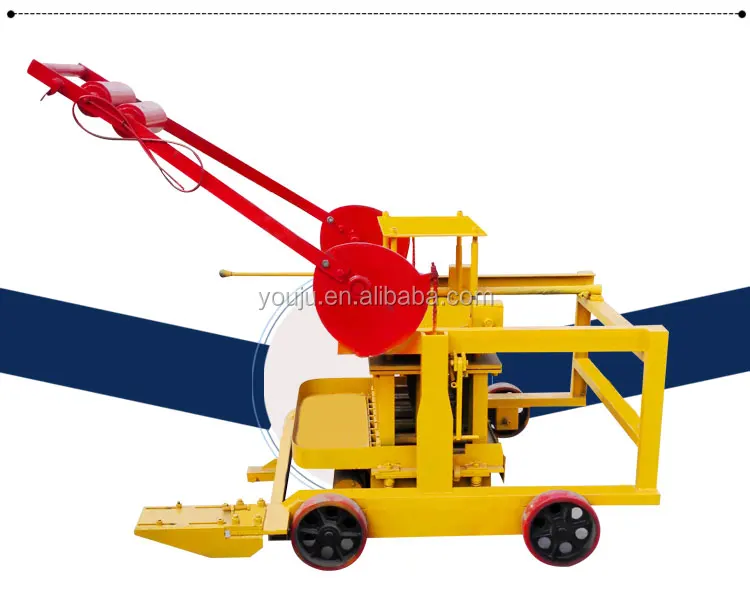
![QMY4-30 Mobile Block Machine for Hollow Block | Full Range 80243 → 8+0+2+4+3=17, 17 mod 6 = 5 结构5: [站点修饰词] [品类词] – [规格或产能限定] shiyueblockmachine.com → 全品类目录类角色 → Manufacturer / Factory Supply / Full Range 17 mod 3 = 2 → Full Range → Full Range QMY4-30 Mobile Block Machine – 5 kW Cement Brick Maker = 63 chars ✓ QMY4-30 Mobile Block Machine for Hollow Block | Full Range](https://shiyueblockmachine.com/wp-content/uploads/2026/04/Hca7e15e2bc404a5391aee52b9c7213b9L.webp) Mobile block machine
Mobile block machine