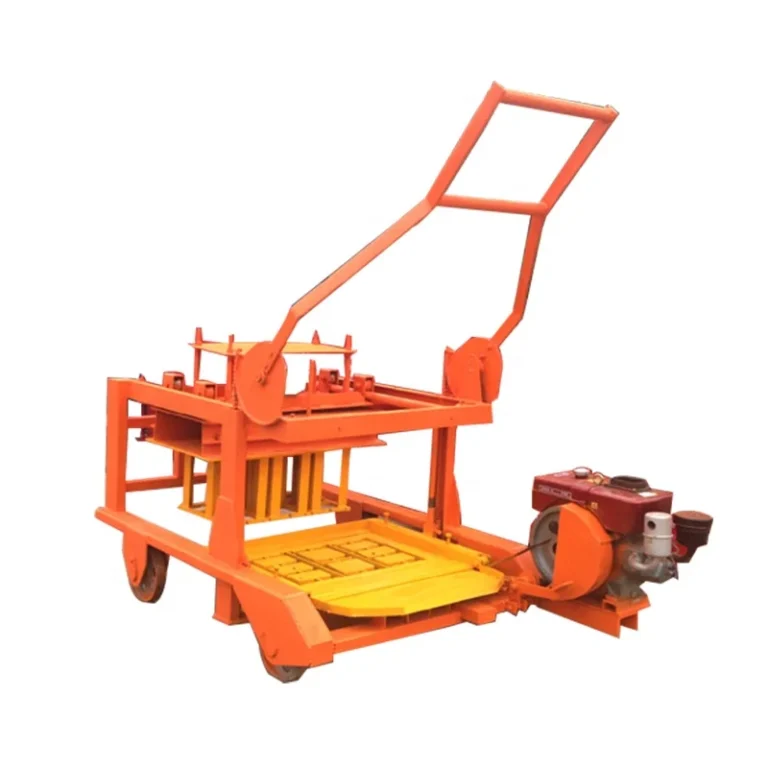
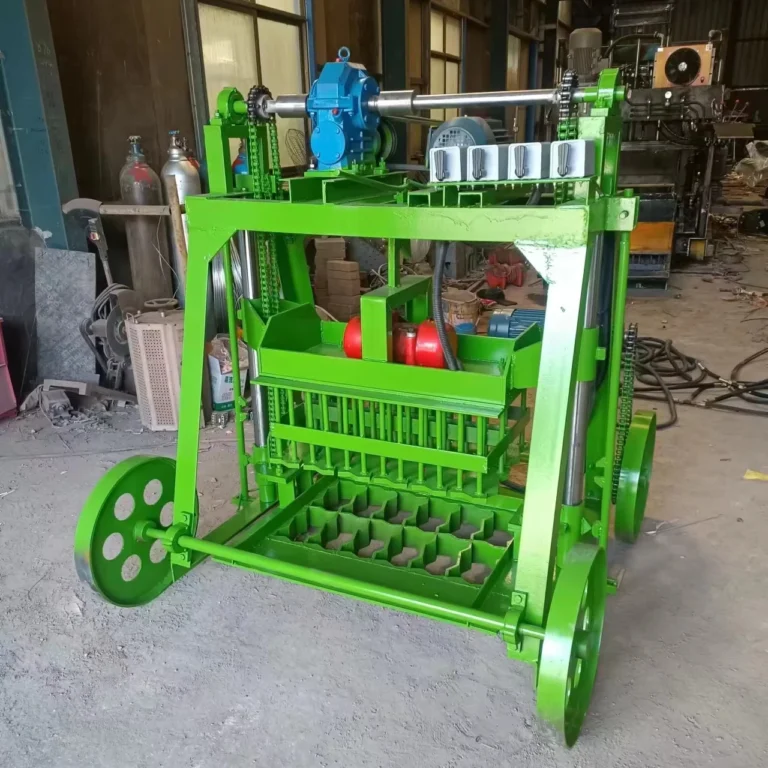
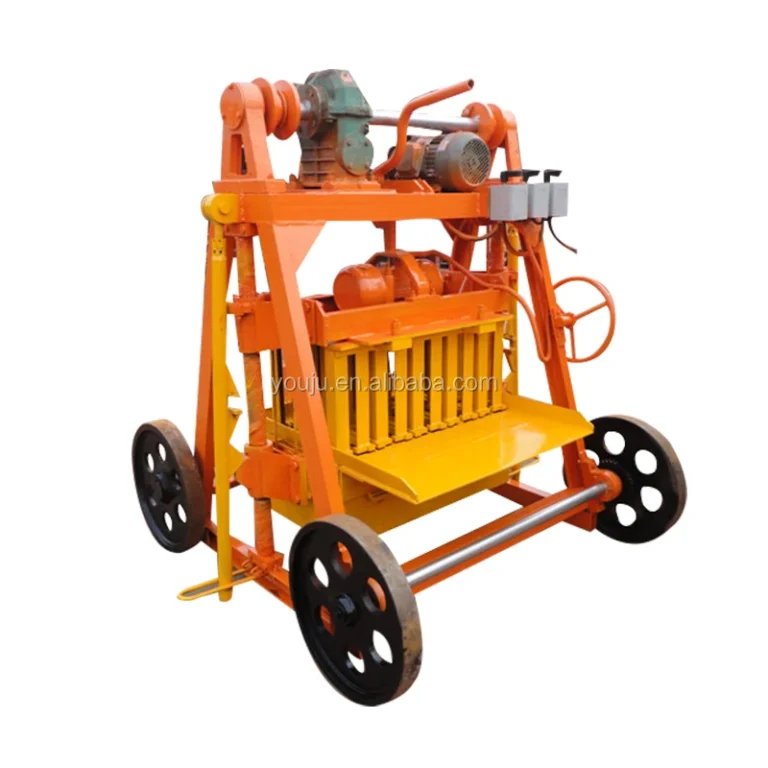
Single Focus Block Line Integration — this QMY4-30 mobile block machine is specified as a matched system covering mould, power draw, and ground-level curing so buyers avoid assembling a line from mismatched suppliers.
Technical Specifications
| Parameter |
Value |
| Model |
QMY4-30 |
| Product Type |
Mobile Concrete Block Making Machine |
| Rated Power |
5 kW |
| Overall Dimensions (L×W×H) |
1200 × 1200 × 1100 mm |
| Net Weight |
950 kg |
| Molding Cycle Time |
30 seconds |
| Raw Materials |
Cement, sand, crushed stones, slag |
| Mould Format |
Changeable for hollow block and solid brick |
| Output Capacity (400×200×200 mm) |
480 pcs/hour (4 pcs/mould), 3840 pcs/8 hours |
| Output Capacity (400×150×200 mm) |
600 pcs/hour (5 pcs/mould), 4800 pcs/8 hours |
| Output Capacity (400×100×200 mm) |
840 pcs/hour (7 pcs/mould), 6720 pcs/8 hours |
| Automation Level |
Manual operation, mobile (egg-laying) type |
| Voltage & Frequency |
Basis not stated in source — confirm with buyer’s site supply |
| Control System |
Basis not stated in source — confirm PLC or relay logic |
| Pallet Size |
Not applicable (blocks laid directly on ground) |
| Assembly State |
Shipped as single skid unit |
Application Suitability
| Application |
Material or Output |
| On-site construction production |
Hollow blocks from cement, sand, and crushed stone |
| First-plant entrepreneur setup |
Solid bricks using locally sourced slag and aggregate |
| Housing project contractor supply |
Mobile egg-laying output without fixed curing racks |
| Small workshop block manufacturing |
Interchangeable formats for hollow and solid masonry units |
Why "Pieces per Hour" Can Mislead a First-Time Buyer
Capacity claims are only meaningful when the block format and mix design are stated.
When buyers see a mobile block machine for sale listed with a high hourly figure, they often assume that number applies to whatever product they intend to make. In reality, a QMY4-30 mobile hollow block machine produces four 400×200×200 mm hollow blocks per cycle but seven 400×100×200 mm blocks in that same 30-second window. The difference is substantial over an eight-hour shift. I have seen contractors order a machine based on the headline capacity of the smallest brick format, only to discover their market primarily demands large hollow blocks. The daily output then falls far short of their project schedule. Before any quotation is finalized, the exact block format must be confirmed so the capacity calculation reflects what the buyer will actually produce [NEED_CITE: block format and cycle time relationship in egg-laying machines].

Positioning the QMY4-30 Within the Full Range
The QMY4-30 sits at the entry tier of the mobile block machine range, designed for buyers who need to produce masonry units directly on a job site without investing in a fixed batching plant, pallet circulation system, or curing racks. Its egg-laying operation means blocks are deposited onto a prepared ground surface and left to cure in place. This eliminates the pallet investment entirely, which is often a hidden cost in stationary block line quotations. For contractors working on remote housing developments or entrepreneurs launching a first block plant with constrained capital, this mobile block machine for sale offers the lowest infrastructure threshold in the catalog.
Where Mobile Production Outperforms Stationary Lines
A mobile machine removes the transport leg between a central factory and the construction site. When a housing project requires thousands of blocks and the nearest supplier is hours away, producing on-site with a QMY4-30 cuts logistics cost and breakage. The machine moves along the curing yard as it lays each row, so a single operator can cover a large ground area over a shift. This mobility also suits buyers who move between project sites seasonally. The trade-off is that output consistency depends heavily on ground preparation and the operator maintaining a steady walking pace and mix feed rate [NEED_CITE: ground preparation requirements for egg-laying block machines].
Reading the Specs That Matter on Site
The 5 kW rated power draw is significant because it means the QMY4-30 can typically run from a standard site generator without requiring a dedicated high-capacity supply. Many remote construction sites in developing markets operate on limited generator capacity, and a machine pulling substantially more power would force the buyer to upgrade their entire electrical infrastructure. The 30-second molding cycle is fixed by the vibration and compaction sequence, so daily throughput is a direct function of how many hours the crew keeps the machine fed with raw material. The 1200 × 1200 mm footprint allows the machine to operate in constrained yards where larger stationary presses cannot fit. Mould interchangeability between hollow block and solid brick formats gives the buyer product flexibility without purchasing a second machine, though the changeover time should be confirmed before planning production schedules around multiple formats in a single shift.
The Cost of Skipping the Mix Design Conversation
Buyers who select a mobile block machine for sale based solely on price and headline capacity often encounter problems once the machine arrives on site. If the vibration force and compaction pressure are not matched to the buyer’s local aggregate and cement ratio, blocks may crack during curing or fail compression tests. I have seen African project sites where high clay content in local sand caused blocks to crumble because the machine was configured for clean river sand. Three days of adjusting the mix ratio and vibration duration brought the line into acceptable output, but that downtime could have been avoided with a pre-shipment material assessment. Confirming the local raw material profile before the machine leaves the factory is a step that protects both the buyer’s schedule and block quality [NEED_CITE: aggregate properties and block compression strength correlation].
Why This Machine Is Specified Differently Here
Block machinery is our single focus, so the QMY4-30 is not sourced from a generalist trading company but configured by a team that handles machine, mould, and ground-curing workflow as one system. The capacity calculation in every quotation states the block format assumed, so buyers know exactly what daily output to plan for. Mould design covers the formats the buyer’s local market actually sells, with custom drawings available when standard sizes do not match regional building codes. Voltage, frequency, and control display language are confirmed before production begins, preventing commissioning delays when the machine arrives. Installation support includes operator training on mix proportioning and mould changeover, which directly affects whether the machine reaches its stated capacity from the first week.
Documentation & Verification
- Machine specification sheet confirming voltage and control language for your site supply
- Capacity calculation document stating output per block format with 30-second cycle assumption
- Mould drawing and format list matching your target hollow block and solid brick dimensions
- Operation manual covering mix proportioning guidance for cement, sand, and crushed stone
- Factory test record showing machine run on your specified block format before dispatch
Installation, Commissioning & Support
- Requires a leveled, compacted ground surface of at least 20 meters length for continuous egg-laying operation
- 5 kW power draw compatible with most site generators; confirm voltage and phase before connection
- Shipped as a single skid unit, offloaded by forklift or crane onto prepared working area
- First-run commissioning includes mould alignment check and vibration duration calibration to your mix
- Operator training covers manual feed rate pacing to maintain consistent 30-second cycle output
- Wear parts list provided for mould liners and vibration components with recommended replacement intervals
Preparing Your Inquiry
To receive a configuration proposal that reflects your actual production conditions, share the block format and dimensions your market demands, the daily output you need to meet your project schedule, and the type of sand and aggregate available locally. If your site runs on generator power, include the voltage, phase, and frequency so the electrical system is built to match. Mentioning whether you need only hollow blocks or also plan to produce solid bricks helps determine which moulds to include in the initial shipment.
Frequently Asked Questions
Q: How is the output capacity verified and which block format does it assume?
A: Every capacity figure for the QMY4-30 is calculated against a specific block format and a 30-second molding cycle. For example, 480 pieces per hour assumes the 400×200×200 mm hollow block at four pieces per mould. If your target product is a different size, the hourly and daily output will change accordingly, and this is stated in the quotation capacity sheet.
Q: What voltage and frequency are confirmed before the machine ships?
A: These are confirmed during the quotation stage based on your site’s electrical supply. Many project sites in export markets run on generator power with varying voltage and phase configurations. The motor and control wiring are built to your confirmed specification so the machine can be connected and commissioned without electrical modification on arrival.
Q: Which mould formats can be supplied and are custom sizes available?
A: Standard moulds cover common hollow block and solid brick dimensions used across export markets. If your local building code or market preference requires a non-standard size, custom moulds can be produced to your drawings. The mould format list in your quotation documents every included size with dimensional tolerances.
Q: What ground preparation does the mobile machine require on site?
A: The QMY4-30 lays blocks directly onto a compacted, leveled surface. The ground must be firm enough to support wet blocks without settling and smooth enough to allow the machine to move steadily. A concrete floor is ideal, but well-compacted earth can work if properly prepared. Curing space must extend beyond the daily laying area.
Q: What does the machine range look like above this model if output needs to grow?
A: The range extends through semi-automatic machines with pallet systems for higher daily volumes and fully automatic lines with batching, stacking, and cubing for large-scale block plants. Buyers who start with the QMY4-30 and later expand can transition to a stationary line while applying the mix design knowledge gained from mobile production.

![QMY4-30 Mobile Block Machine for Hollow Block | Full Range 80243 → 8+0+2+4+3=17, 17 mod 6 = 5 结构5: [站点修饰词] [品类词] – [规格或产能限定] shiyueblockmachine.com → 全品类目录类角色 → Manufacturer / Factory Supply / Full Range 17 mod 3 = 2 → Full Range → Full Range QMY4-30 Mobile Block Machine – 5 kW Cement Brick Maker = 63 chars ✓ QMY4-30 Mobile Block Machine for Hollow Block | Full Range](https://shiyueblockmachine.com/wp-content/uploads/2026/04/Hca7e15e2bc404a5391aee52b9c7213b9L.webp)
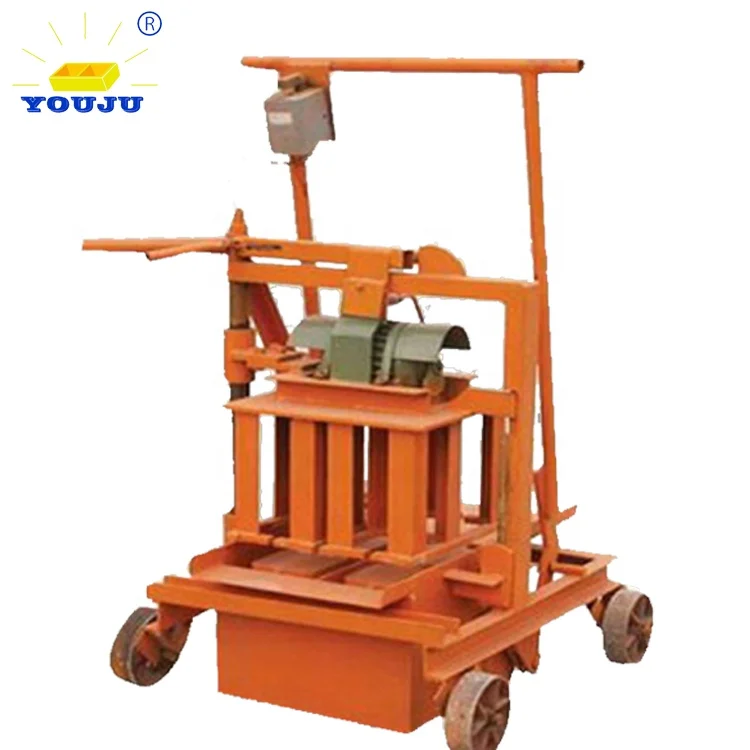 Mobile block machine