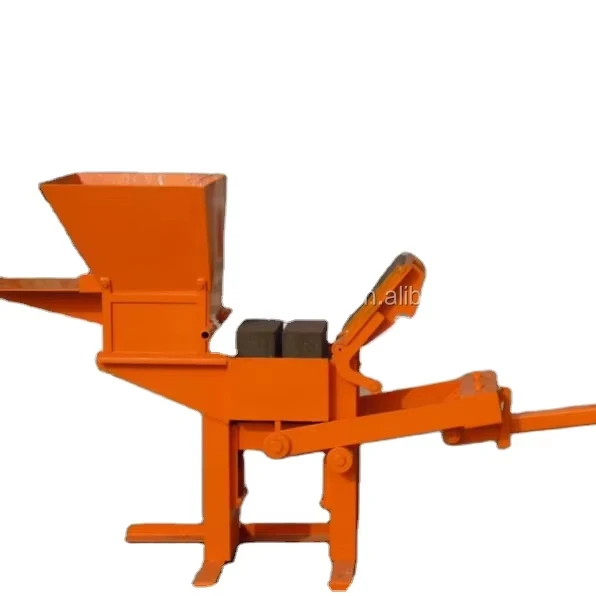
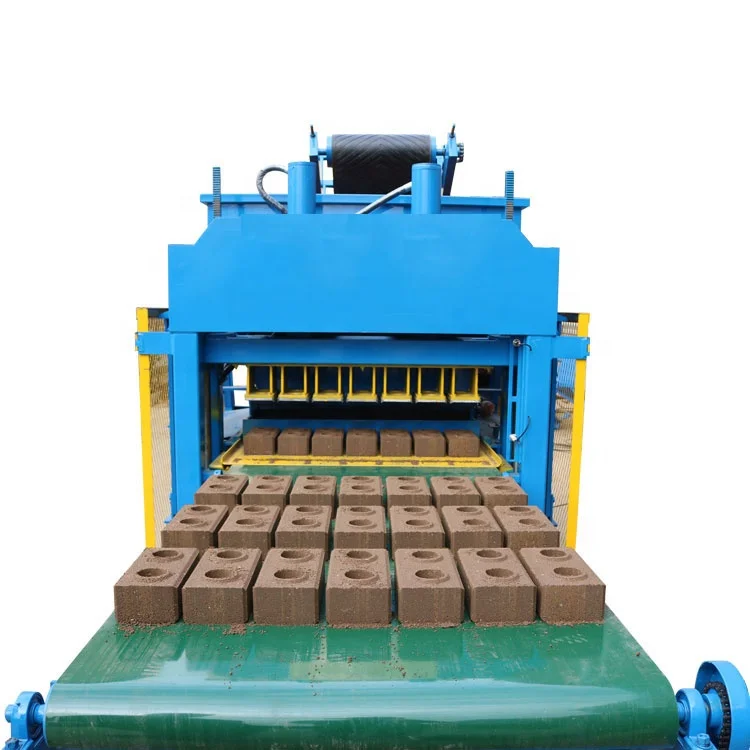
Mould Match Over Catalogue Defaults — every LY2-40 manual clay interlocking brick making machine for sale is configured around the buyer’s local soil-cement mix, target interlocking profile, and crew capacity rather than a generic brochure line.
Technical Specifications
| Parameter |
Value |
| Model |
LY2-40 |
| Product Type |
Manual Clay Interlocking Brick Making Machine |
| Rated Power |
No Power, Completely Manual |
| Voltage & Frequency |
Not applicable (manual operation) |
| Control System |
Manual lever operation |
| Overall Dimensions (L×W×H) |
1600 x 700 x 1200 mm |
| Net Weight |
200–240 kg |
| Molding Cycle |
30–40 s |
| Output Capacity |
400–1,000 pcs/day (basis not stated in source — confirm block format, material, thickness) |
| Mould Format |
Changeable moulds for various interlocking block formats |
| Mobility |
Steel wheels for on-site repositioning |
| Basic Equipment Supplied |
JFA-1 Mixer or JQ350 Mixer |
| Warranty |
1 Year |
Application Suitability
| Application |
Material or Output |
| Off-grid interlocking brick production |
Soil-cement mixes in areas without grid electricity |
| On-site housing project forming |
Local clay blended with cement directly at construction locations |
| Small-scale clay brick workshops |
Hand-fed soil-cement batches with manual mixing and handling |
| Contractor-operated mobile block making |
Repositionable pressing without fixed plant infrastructure |
What "400 to 1,000 Pieces per Day" Actually Means for a Manual Press
The daily figure only holds when block format, soil-cement ratio, and crew size are defined together.
Capacity sheets for manual clay interlocking brick making machines often quote a single range without stating whether that number assumes a thin paver or a full-depth interlocking block, a lean or rich cement ratio, or a two-person versus four-person crew. I have stood on sites where the operator expected the upper end of the range on day one, only to find the real output sat closer to the lower bound because the local clay required longer mixing and the crew was still learning the lever rhythm. When the format and mix are not locked down before the machine ships, the gap between quoted and actual throughput becomes the buyer’s problem, not the seller’s. [NEED_CITE: block output calculation standards by format and crew size]

Where the LY2-40 Sits in the Full Block Machine Range
The LY2-40 occupies the entry tier of the manual clay interlocking brick making machine for sale range, positioned below semi-automatic and fully automatic lines that require grid power, hydraulic systems, and fixed foundations. Buyers who have no electricity on site, who are testing a first interlocking brick venture with minimal capital, or who need to produce directly beside a construction trench will find this tier relevant. As volume requirements grow and grid access becomes available, the same product range extends upward through semi-automatic and automatic tiers, preserving mould compatibility in many cases so the initial investment is not abandoned.
Mobility and Footprint on Unprepared Ground
The steel-wheel chassis lets a two-person crew roll the press across compacted soil without a forklift or concrete pad, which matters when the production point shifts as a housing development progresses. At 1,600 mm long and roughly 240 kg, the unit is heavy enough to resist walking during lever compression yet light enough to reposition within a shift. This mobility removes the need for a dedicated block yard and lets contractors press bricks near the curing and laying area, cutting internal transport. [NEED_CITE: on-site block production logistics for rural housing projects]
Reading the Specs That Determine Real Output
The 30–40 s molding cycle governs how many bricks one crew can press in an hour, but the cycle only translates into daily volume when paired with a defined interlocking profile and a consistent soil-cement feed rate. The absence of hydraulic pressure and vibration means compaction relies entirely on lever force and the operator’s technique, making the soil moisture window narrower than on powered presses — too dry and the brick crumbles on release, too wet and it slumps before curing. The changeable mould design supports multiple interlocking formats from one base frame, yet the time to swap moulds is not published, which affects how practical it is to run two formats in a single day. The accompanying JFA-1 or JQ350 mixer choice determines whether the crew batches enough material to keep the press fed or spends idle cycles waiting for the next mix.
The Hidden Cost of Skipping the Mix Conversation
When a manual press arrives and the local clay has a higher silt content than the seller assumed, the bricks crack on demoulding or cure to a strength below what the project engineer specified. The contractor then spends weeks adjusting water ratios and cement percentages by feel, producing a pile of waste bricks that cannot be reused. I have seen crews blame the machine when the real issue was that nobody asked for a soil sample before the order was confirmed. Getting the mix right before shipment avoids that costly on-site trial period. [NEED_CITE: soil-cement compatibility testing for interlocking brick production]
Why Buyers Source This Tier Here
The LY2-40 manual clay interlocking brick making machine for sale is treated as one element in a matched system — press, mould profile, mixer, and pallet spec are discussed together so nothing arrives mismatched. Mould design covers the interlocking formats the buyer’s local market actually sells, and custom profiles can be produced from buyer drawings when the standard catalogue does not include them. Configuration starts from the buyer’s local aggregate and target block strength, not a default setting. Automation level is selectable, so a buyer can begin with this manual tier and move to semi-automatic later without changing product lines entirely. Installation support and operator training accompany the machine so the crew learns correct lever technique and soil moisture targets from the first day.
Documentation & Verification
- Line layout and capacity sheet stating the exact interlocking format, soil-cement ratio, and crew size assumed for the daily output figure.
- Mould drawing and profile list confirming which interlocking shapes are included and which need custom tooling.
- Voltage confirmation document for the auxiliary mixer, specifying plug type, frequency, and amperage draw.
- Factory test record showing sample bricks pressed with the buyer’s specified soil-cement blend before crating.
- Operation and maintenance manual covering lever pivot greasing intervals, mould wear-part replacement schedules, and target soil moisture percentages.
Installation, Commissioning & Support
- Level compacted ground with no fixed foundation required; steel wheels allow positioning on prepared soil.
- Auxiliary JQ350 mixer requires a dedicated single-phase or three-phase circuit depending on local voltage confirmation.
- Press ships partially assembled; lever arm and mould frame are bolted on site with included hardware.
- First-day commissioning includes soil moisture calibration and lever stroke adjustment to match the confirmed interlocking profile.
- Operator training covers cycle rhythm, mould release technique, and daily pivot-point greasing.
- Mould wear parts and replacement lever pivot pins listed in the spare parts schedule with reorder intervals.
What to Share Before Quoting
Provide the interlocking brick profile your market sells, the local soil type and any available lab test data, and the daily volume you need from a single crew. Confirm whether grid electricity is available for the auxiliary mixer or if a diesel-driven mixer is required. With those details the correct mould, mixer pairing, and realistic output figure can be set before production begins.
Frequently Asked Questions
Q: How is the 400–1,000 pcs/day output calculated, and which format does it assume?
A: That range appears in the source material without a stated block format, soil-cement ratio, or crew size. A realistic figure can only be given once your target interlocking profile and local mix are confirmed, because a thin paver and a deep wall block produce very different daily counts from the same press.
Q: Which interlocking profiles can the moulds produce, and can I order custom shapes?
A: The base machine accepts changeable moulds for various interlocking formats, but the exact profile list depends on what is in stock at the time of order. Custom moulds can be manufactured from buyer-supplied drawings, allowing you to produce the specific interlocking shape your local construction market requires.
Q: What soil types and cement ratios work with this manual press?
A: The press compacts soil-cement blends through lever force alone, so the clay must fall within a workable plasticity range and the moisture content must be controlled carefully. High-silt or highly organic soils may require a higher cement percentage or partial replacement with sand to reach acceptable compressive strength after curing.
Q: How does this manual tier compare to the semi-automatic and automatic machines in the range?
A: The LY2-40 sits at the entry tier, requiring no electrical or hydraulic power. Semi-automatic tiers add powered mixing, pallet conveyors, and vibration for higher throughput, while automatic tiers include stacking and cubing. Buyers often start here and move up as daily volume targets and grid access grow.

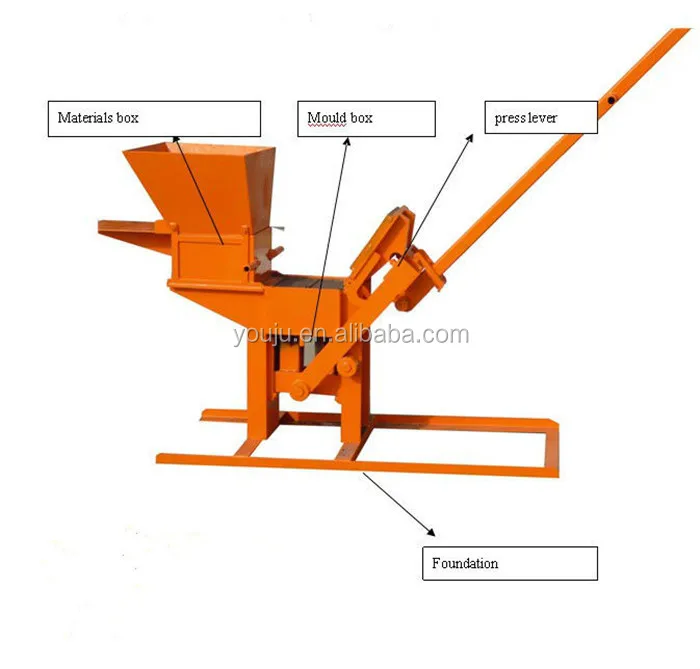
 Clay interlocking brick