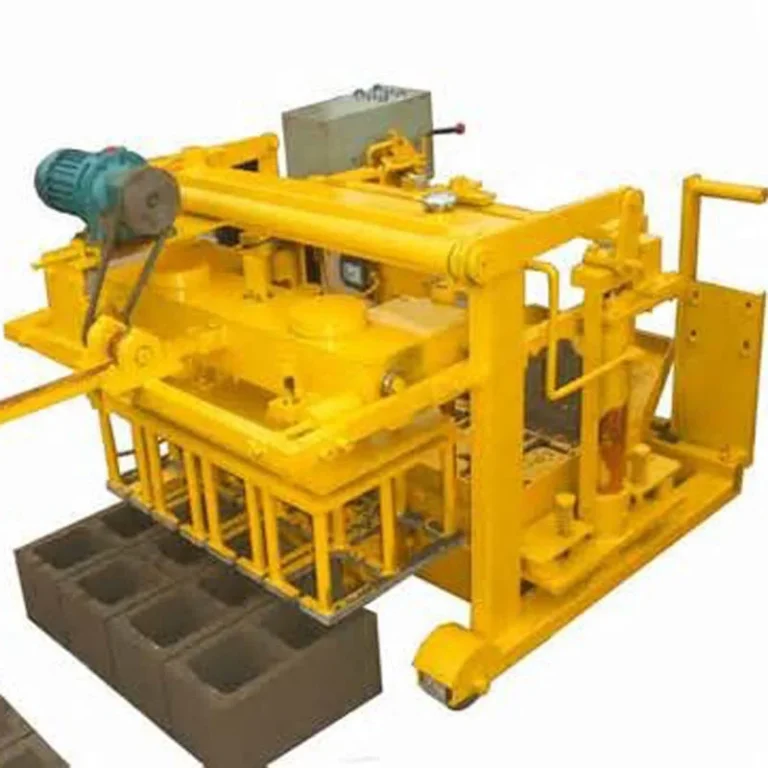
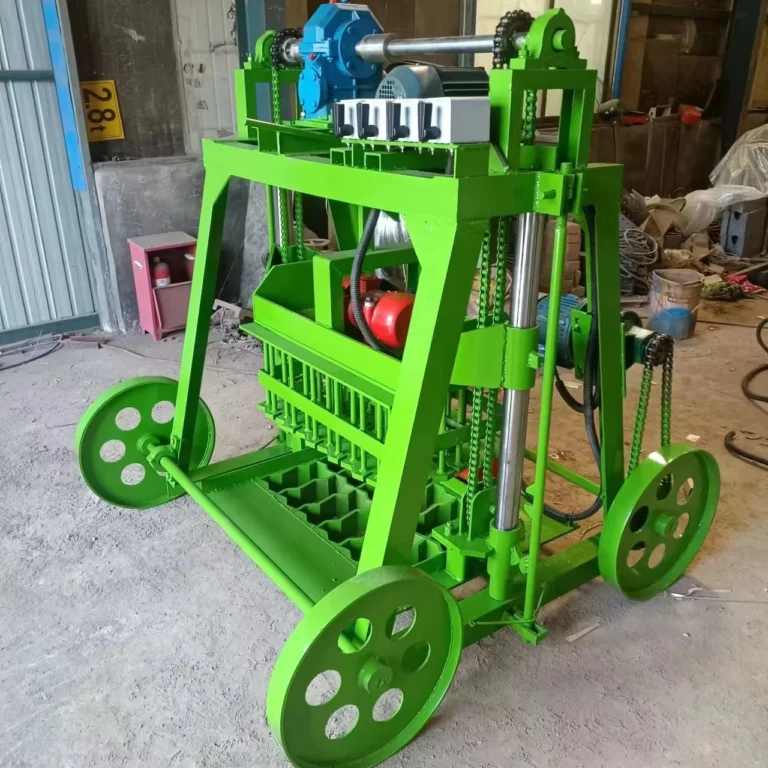
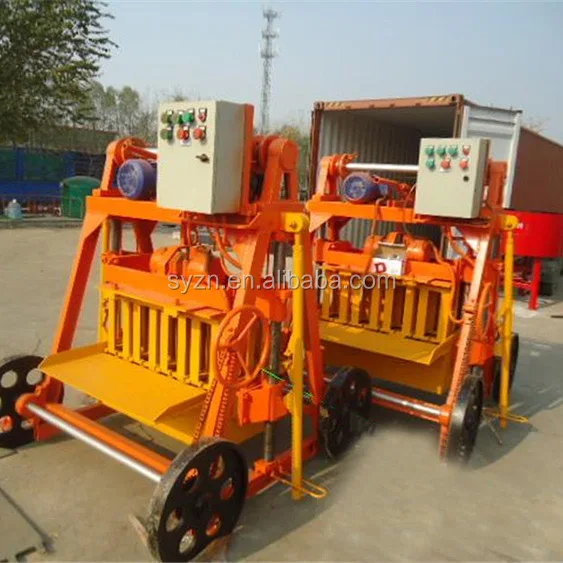
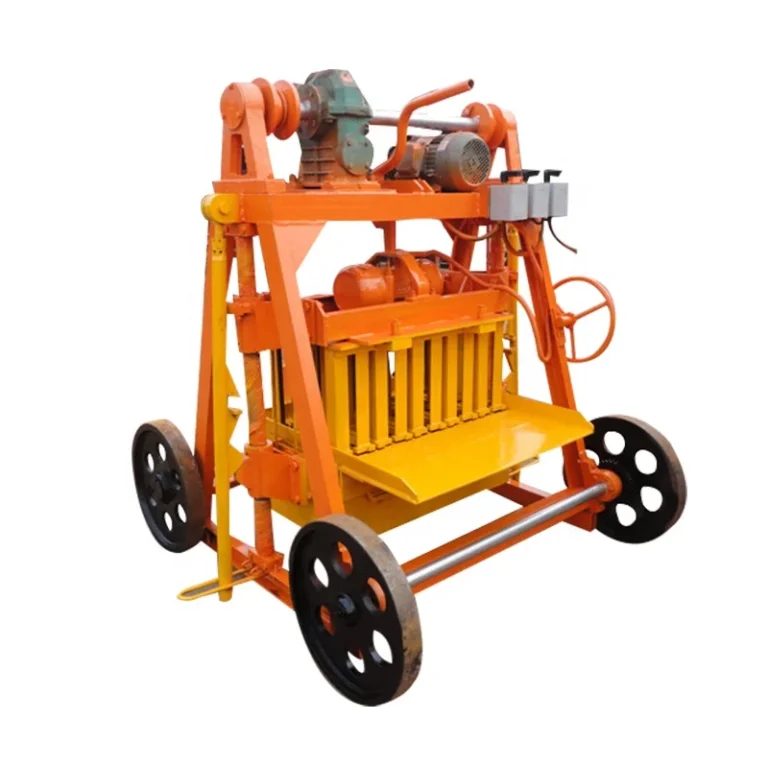
Configuration Set to Local Mix — Every QMJ4-45 mobile egg laying block machine is configured against the buyer’s available cement and aggregate, not a catalogue default, so blocks crack less and cure predictably on the actual job site.
Technical Specifications
| Parameter |
Value |
| Model |
QMJ4-45 |
| Product Type |
Mobile Egg Laying Block Making Machine |
| Molding Capacity |
4 pcs/mold |
| Vibration Frequency |
2400 r/m |
| Productivity (400×200×200mm hollow block) |
3000 pcs/day (8 hours) |
| Productivity (400×150×200mm hollow block) |
3500 pcs/day (8 hours) |
| Productivity (400×120×200mm hollow block) |
4500 pcs/day (8 hours) |
| General Productivity |
2600–4000 pcs/day (basis to be confirmed by block format and material) |
| Hydraulic Method |
Mold vibration |
| Demold Method |
Manual |
| Turning Method |
Manual |
| Total Power |
6 KW |
| Power Resource |
Diesel/Petrol engine |
| Molding Cycle |
45 S |
| Automation Level |
Manual operation |
| Pallet Requirement |
None (egg laying type) |
| Warranty |
One year guarantee for the whole machine |
| Certification |
Certification available (specific standard to be confirmed) |
Application Suitability
| Application |
Material or Output |
| On-site hollow block production for housing projects |
Crushed stone, river sand, cement, and locally sourced aggregate |
| Paving brick laying at development sites |
Concrete mix with fine aggregate and cement |
| Standard brick manufacturing for local contractors |
Cement, sand, and fly ash blends |
| Multicellular brick runs for small building firms |
Lightweight aggregate or pumice-based mixes |
Why "4000 Blocks a Day" Is Only Half the Story
Daily output figures mean nothing until the block format and local raw material are named.
A mobile block machine manufacturer may quote a broad productivity range, but that number shifts dramatically depending on whether you are pressing a 120mm wall hollow block or a 200mm unit. The mix itself — the aggregate size, cement ratio, and moisture content available at your site — further widens the gap between brochure claims and actual daily tallies [NEED_CITE: concrete block density standards and mix ratio guidelines]. When a machine arrives tuned for standard quartz sand and meets volcanic ash or laterite instead, operators spend days chasing the right vibration time and pressure balance, losing entire shifts to trial and error. That is the exact scenario I have watched unfold on site more than once. Asking the right capacity questions up front prevents costly material substitutions and schedule overruns once the mobile egg laying block machine for sale is already bolted to the ground.

Engine Power Removes the Grid Dependency
Diesel or petrol engine drive means the QMJ4-45 mobile block machine operates wherever the project sits, without waiting for temporary electrical connections or generator rentals. This matters for remote housing developments and rural infrastructure jobs where three-phase power is either unavailable or unreliable. The 6 kW total power requirement is modest enough that a standard small diesel unit covers the full vibration and molding cycle without power drops that weaken block density.
Egg Laying Design Eliminates Pallet Costs
Because the machine lays blocks directly onto a prepared concrete floor, there is zero pallet consumption, zero pallet storage area, and zero pallet replacement budget. For contractors running a mobile egg laying block machine for sale on active job sites, this removes a logistics layer that fixed-plant operations take for granted. A smooth, level concrete surface is the only prerequisite, and blocks cure in place until they reach handling strength.
Twice-Vibration Molding and What It Controls
The mold vibration system at 2400 r/m delivers a two-stage compaction action: the initial vibration settles the mix into the mold cavity, and the secondary pulse compresses it further before the operator lifts the mold. This twice-vibration approach directly influences block density and wall uniformity. A 45-second molding cycle gives the operator enough time to feed, vibrate, and demold without rushing, which reduces edge chipping and keeps dimensional tolerances within acceptable limits for load-bearing hollow blocks [NEED_CITE: vibration compaction principles in concrete block forming].
What Happens When Machine and Material Are Mismatched
Specifying a mobile block machine without confirming the local aggregate type leads to blocks that crack during curing or fail compression tests at the site lab. I have seen a South American contractor lose a full week recalibrating a machine originally set for standard sand after feeding it a pumice-heavy mix. Vibration frequency, cycle time, and even the mold release angle all interact with aggregate particle shape and absorption rate. When those variables are ignored at the quoting stage, the result is inconsistent strength, excessive cement usage to compensate, and frustrated masons who lose trust in the block before the wall goes up [NEED_CITE: aggregate particle shape effect on concrete block compressive strength].
What Sets This Machine Line Apart
Block machinery is the single focus here, which means the QMJ4-45 is not assembled from mismatched components sourced across unrelated suppliers. Every mold, engine mount, and vibration motor is specified as a matched set. Configuration starts from the buyer’s actual mix design and target block format rather than a default factory setting. Custom mold design is available when the local market demands formats outside the standard hollow block range. The automation path is also open — a buyer can start with manual demolding and turning today, then transition to a higher-output semi-automatic line later without scrapping the initial investment. Installation guidance and operator training ensure the first block laid on site meets the same standard as the factory test sample.
Documentation & Verification
- Line layout drawing showing machine travel path and curing area dimensions per block format
- Machine specification sheet confirming diesel or petrol engine type and total power rating
- Mold drawing with cavity count and dimensional tolerances for the selected block format
- Factory test record run on a mix simulating the buyer’s local aggregate before dispatch
- Operation and maintenance manual covering daily greasing points and vibration motor inspection intervals
Installation, Commissioning & Support
- Site must provide a level concrete floor of adequate length for daily block output and curing space
- Diesel or petrol engine arrives pre-mounted; no external electrical wiring or dedicated circuit needed
- Machine ships in a single unit with minimal dismantling for container loading and quick on-site setup
- First production run guided by commissioning notes that match the agreed mix design and block format
- Operator training covers manual demolding technique, mold change procedure, and 45-second cycle discipline
- Wear parts list identifies vibration motor brushes and mold liner plates with reorder intervals
What We Need to Size This Correctly
Before quoting the QMJ4-45 mobile block machine, share the target block dimensions, the local aggregate type and cement brand you plan to use, and your expected daily output requirement based on an eight-hour shift. If the project site has specific floor conditions or climate factors that affect curing, mention those as well so the mold and vibration settings can be adjusted before the machine leaves the factory.
Frequently Asked Questions
Q: What block format is the daily output based on?
A: The 3000 pcs/day figure assumes a 400×200×200mm hollow block over an eight-hour shift. Output rises to 3500 or 4500 pieces per day when producing narrower 150mm or 120mm wall hollow blocks respectively. Actual numbers depend on mix workability, operator pace, and site conditions. Always confirm the format before comparing productivity across machines.
Q: What mix design and aggregate does this machine require?
A: The QMJ4-45 mobile block machine works with crushed stone, river sand, fly ash, pumice, or locally available aggregate blended with cement. The vibration frequency and cycle time are adjusted during commissioning to match your specific material. Providing an aggregate sample or lab report before production ensures the machine arrives pre-configured for your mix.
Q: The machine runs on an engine — are there any electrical components?
A: The primary power source is a diesel or petrol engine driving the vibration system. Some control or lighting accessories may require a small battery or low-voltage circuit, but no grid connection or three-phase supply is needed. Confirm any ancillary voltage requirements with the supplier before dispatch to match local standards.
Q: What site preparation is needed for on-site operation?
A: A flat, cured concrete floor is essential. The surface must be long enough to accommodate a full day’s block output with spacing for curing. No foundation bolts or fixed plant infrastructure is required. Ensure the work area is clear of overhead obstructions and has space for the operator to move the machine forward after each molding cycle.
Q: What does the operator need to do each cycle?
A: Each 45-second cycle involves feeding the mold with mixed concrete, activating the vibration, waiting for full compaction, then manually lifting the mold and turning or repositioning the machine for the next block. Manual demolding and turning keep the system simple and eliminate hydraulic complexity, but the operator must maintain consistent timing to keep block quality uniform.

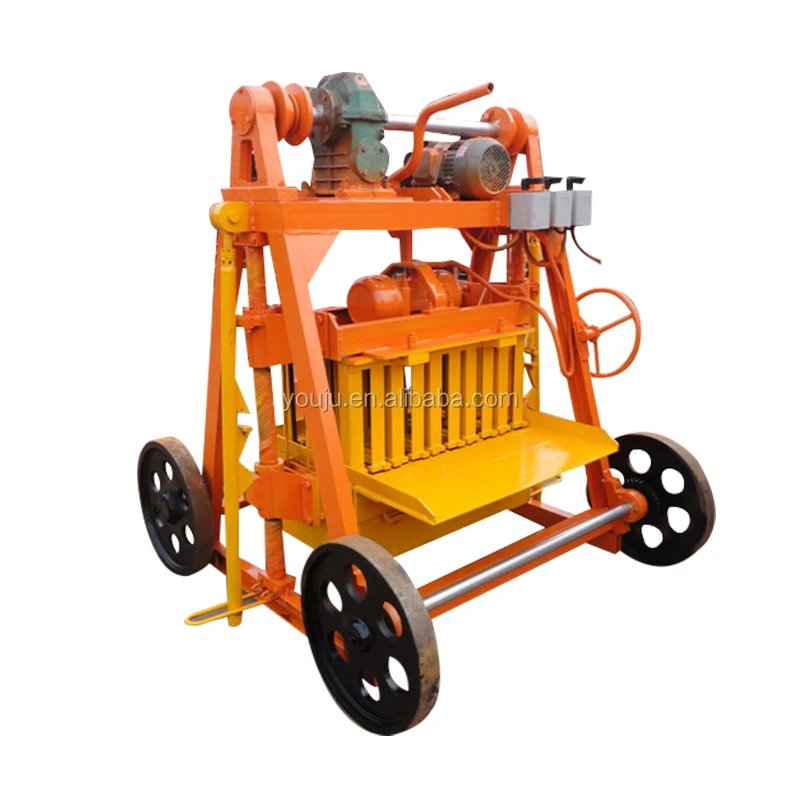
 Mobile block machine