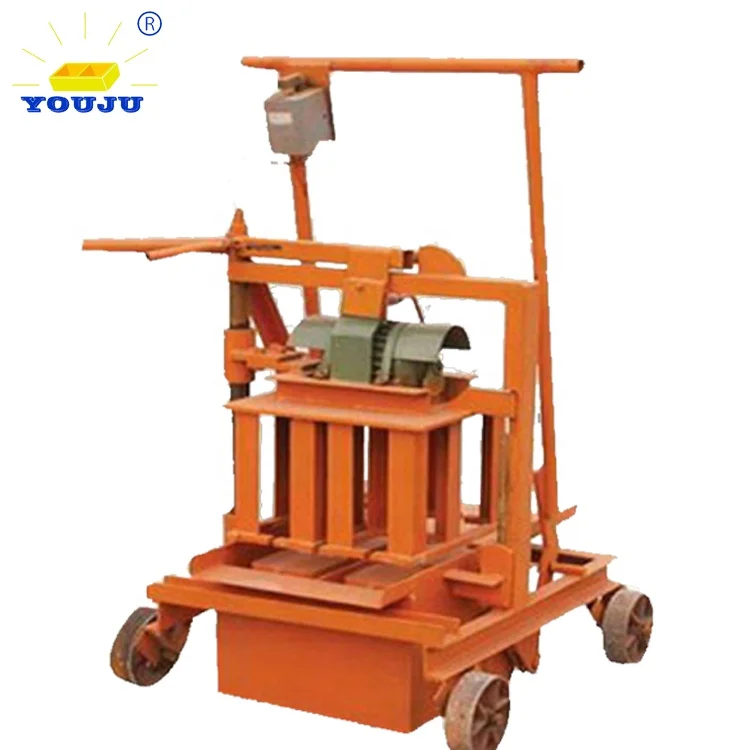
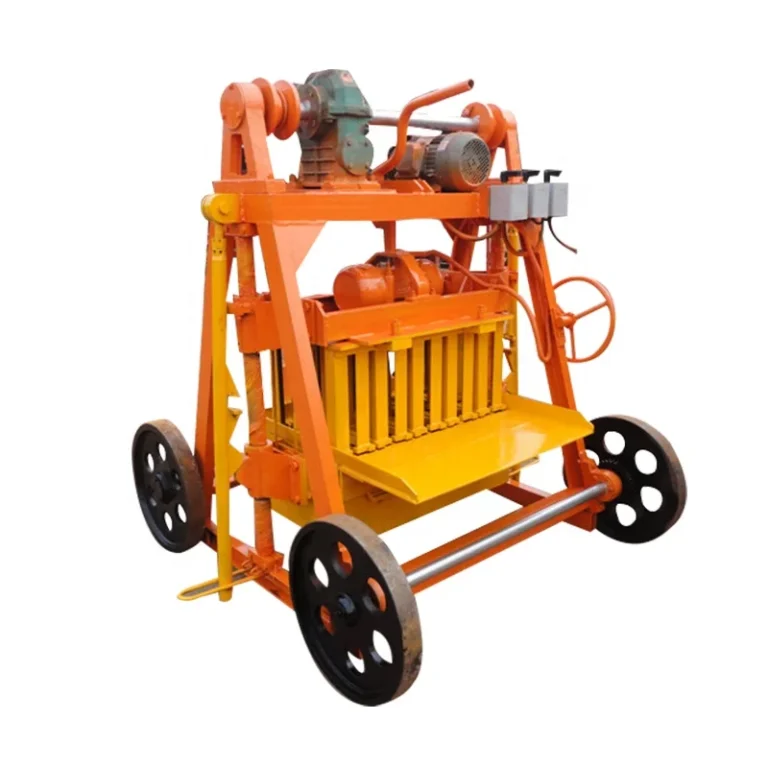
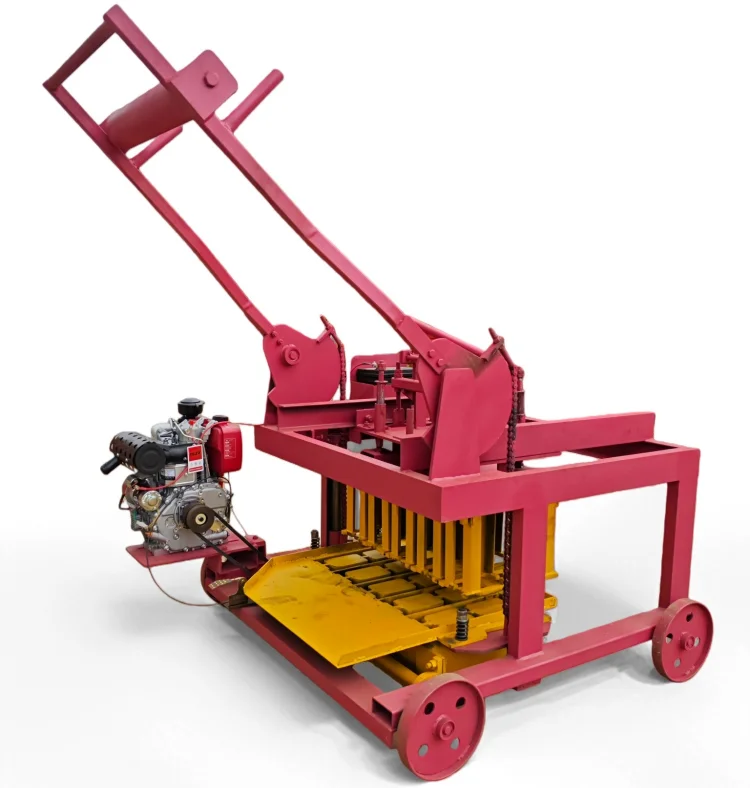
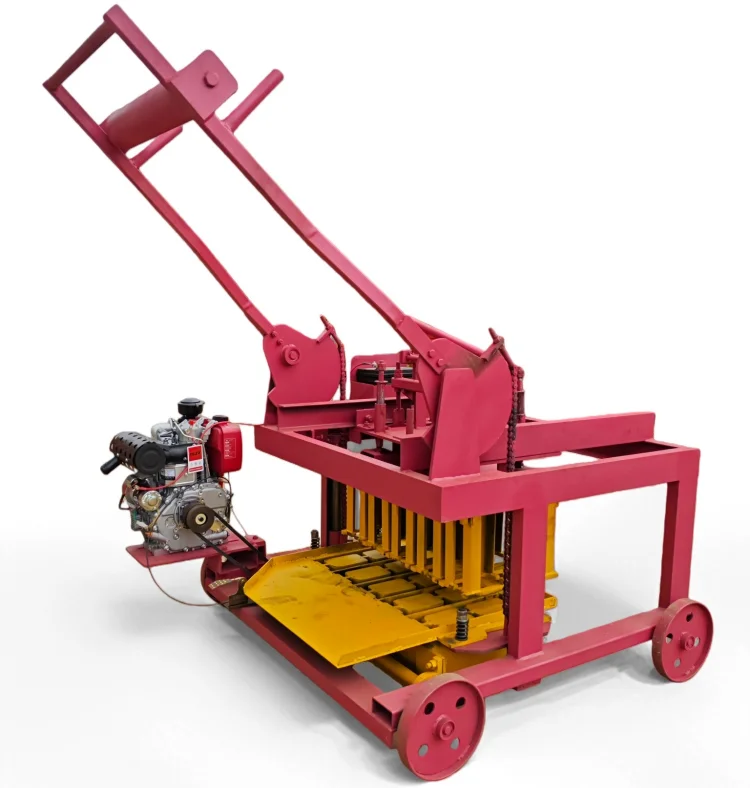
Pallet-Free Production — the QMJ4-45 is specified as one matched mobile system where block format, mould cavity count and local aggregate drive the capacity figure you actually see on site.
Technical Specifications
| Parameter |
Value |
| Model |
QMJ4-45 |
| Product Type |
Mobile Egg Laying Block Machine |
| Rated Power |
7.4 kW |
| Voltage & Frequency |
Configurable to local voltage and frequency standard |
| Control System |
Manual force control with jog control |
| Overall Dimensions (L×W×H) |
1550 × 1335 × 1580 mm |
| Net Weight |
1 T |
| Moulding Cycle |
45 s |
| Output Capacity (400×200×200 mm hollow block) |
2400 pcs / 8 h (basis: 4 pcs per mould) |
| Output Capacity (400×150×200 mm block) |
3200 pcs / 8 h (basis: 5 pcs per mould) |
| Output Rate (400×200×200 mm hollow block) |
300 pcs/h (basis: 4 pcs per mould) |
| Output Rate (400×150×200 mm block) |
400 pcs/h (basis: 5 pcs per mould) |
| Pallet Requirement |
None (egg-laying type, blocks deposited on ground) |
| Orientation Mechanism |
Four-pole guided with extended orientation bearing |
| Raw Materials |
Concrete, sand, cement, fly ash, lime, gypsum |
| Mould Versatility |
Hollow block, solid block, road block, curb stone via mould change |
| Electrical Components |
Imported electrical appliances, sealing parts, and hydraulic components |
| Assembly State |
Fully assembled for mobile on-site operation |
| Standards |
CE declaration applicable per shipment |
Application Suitability
| Application |
Material or Output |
| On-site hollow block production for housing projects |
Crushed stone, sand, and cement producing 400×200×200 mm hollow blocks |
| Remote infrastructure site block supply |
Fly ash, lime, and local aggregate for solid blocks and curb stones |
| Small-scale block plant with minimal footprint |
Concrete and sand for 400×150×200 mm solid and hollow formats |
| Contractor producing paving and road blocks on location |
Cement and aggregate for road blocks and interlocking formats via mould change |
What "300 Blocks per Hour" Actually Means When You Arrive on Site
A cycle-time figure only matters once you know which block format and cavity count it assumes.
When a mobile block machine manufacturer quotes output per hour, many buyers later discover that number was based on the smallest block in the catalogue, not the hollow block their market actually purchases. The QMJ4-45 produces 300 pcs/h rated at 400×200×200 mm hollow blocks at 4 pcs per mould, and 400 pcs/h rated at 400×150×200 mm blocks at 5 pcs per mould. These are two different production realities on the same machine. [NEED_CITE: block machine capacity calculation standards by format] Choosing the wrong assumption means your daily output falls short before the first week ends, and your mobile block machine investment underperforms against the project schedule you committed to.

Where the QMJ4-45 Sits in the Full Machine Range
Our range covers automatic, semi-automatic, and mobile tiers, each sized to a different investment level and plant footprint. The QMJ4-45 occupies the mobile egg-laying tier — the entry point for buyers who need on-site production without committing to pallet infrastructure, curing racks, or a fixed factory building. This mobile block machine manufacturer positions it for construction contractors and entrepreneurs starting block production directly on a project site or in a small open yard.
How Egg-Laying Design Removes Infrastructure from Your Budget
The pallet-free design means you eliminate the capital cost of pallets, the labour of pallet handling, and the space required for curing racks. Blocks are deposited directly onto a prepared concrete floor, cured in place, and collected after strength gain. For a remote housing project or a temporary infrastructure site, this removes three line stations — pallet feeder, stacking system, and rack handling — that a fixed plant requires. [NEED_CITE: egg laying block machine site preparation requirements] The trade-off is that floor flatness and surface preparation become critical to block dimensional consistency, which we address during commissioning.
Vibration Force, Mould Alignment, and the Blocks You Actually Sell
The 7.4 kW rated power drives both vibration and compaction in a 45-second moulding cycle. The four-pole guided press head with extended orientation bearings keeps the mould aligned through every cycle, which directly controls block dimensional accuracy and corner integrity. When vibration force and hydraulic pressure are not matched to the buyer’s mix design and local aggregate, blocks arrive at the curing area with weak corners or inconsistent density. The QMJ4-45 accepts concrete, sand, cement, fly ash, lime, and gypsum — but the machine must be adjusted to the specific aggregate grading and moisture content at your site before production stabilises.
The Hidden Cost of Skipping Voltage and Aggregate Confirmation
Buyers who confirm machine price before confirming local voltage and aggregate properties often face commissioning delays that cost more than the adjustment itself. A mobile block machine arriving with the wrong frequency rating cannot run at its designed vibration force, producing blocks that crumble under handling. [NEED_CITE: voltage and frequency mismatch impact on vibration motors] Similarly, a machine set for clean river sand but fed high-clay local aggregate produces hollow blocks that lose corners before reaching the curing area. Both problems are entirely avoidable when voltage, frequency, and aggregate photos are confirmed before dispatch.
Why Source This Mobile Unit Through a Block-Line Specialist
Block machinery is our single focus, so the QMJ4-45 is specified as part of a matched system — machine, mould, and handling are evaluated together rather than assembled from separate suppliers. Configuration is set against your actual mix design, local aggregate, and the block format your market sells, not a catalogue default. Mould design covers the formats you need, including custom drawings for non-standard block dimensions. Automation level is selectable within the range, so a buyer can start with this mobile unit and move to a semi-automatic or automatic line as volume grows. Installation support includes operator training on your specific raw materials and target block format.
Documentation & Verification
- Capacity calculation document stating the block format and cavity count assumed for your quoted output
- Mould drawing and format list confirming every block size the machine can produce on your site
- Voltage, frequency, and control language confirmation sheet signed before production begins
- Factory test record run on your target block format before dispatch
- Packing photographs and customs documentation support for container loading
Installation, Commissioning & Support
- Prepared concrete floor with verified flatness tolerance for the 1550 × 1335 mm machine footprint
- Dedicated electrical circuit matching confirmed voltage and frequency for the 7.4 kW rated power draw
- Fully assembled arrival — no on-site mechanical assembly required, only electrical connection and calibration
- First-run parameter adjustment against your local aggregate sample and target block density
- Operator training covering jog control operation, mould change procedure, and daily maintenance schedule
- Wear parts list and mould replacement schedule provided at commissioning
Before You Request a Quote
To size the QMJ4-45 accurately to your project, we need the block format and dimensions your market purchases, the daily output target in that specific format, and photographs of your local sand and aggregate. Please also confirm the voltage and frequency standard at your site, the control panel language preference, and whether a prepared concrete floor already exists or needs to be included in site preparation planning.
Frequently Asked Questions
Q: How is the QMJ4-45 output capacity calculated, and which block format does it assume?
A: Output is stated per block format with cavity count included. At 400×200×200 mm hollow blocks with 4 pieces per mould, the rate is 300 pcs/h. At 400×150×200 mm blocks with 5 pieces per mould, the rate is 400 pcs/h. Both figures assume a 45-second moulding cycle. We provide a capacity calculation document stating the format assumed for your quotation.
Q: Where does this model sit in the full range — mobile vs semi-automatic vs automatic?
A: The QMJ4-45 sits at the mobile egg-laying entry tier of our range, designed for on-site production without pallets, curing racks, or a fixed plant. Semi-automatic and automatic tiers above it add pallet systems, stacking, and higher output. Buyers can start here and move to a higher tier as project volume and site permanence increase.
Q: What plant footprint and site preparation does a mobile egg-laying machine require?
A: The machine itself occupies 1550 × 1335 × 1580 mm and arrives fully assembled. Site preparation requires a flat concrete floor for block deposition, a dedicated electrical circuit for the 7.4 kW power draw, and raw material storage adjacent to the machine path. No curing racks or pallet storage area is needed since blocks cure in place on the floor.
Q: Which voltage and frequency options are available for my target market?
A: Voltage and frequency are configured to your local standard before production. We require written confirmation of your site voltage, frequency, and preferred control panel language before dispatch to avoid commissioning delays on arrival. This confirmation is part of our standard documentation package.
Q: Can I start with the QMJ4-45 and upgrade to a higher tier later?
A: Yes. The QMJ4-45 is the entry point in a range that extends through semi-automatic and fully automatic lines. When your production volume justifies moving up, the mould formats and block specifications you established on this mobile unit carry forward into the next tier, reducing the learning curve and market risk of the transition.

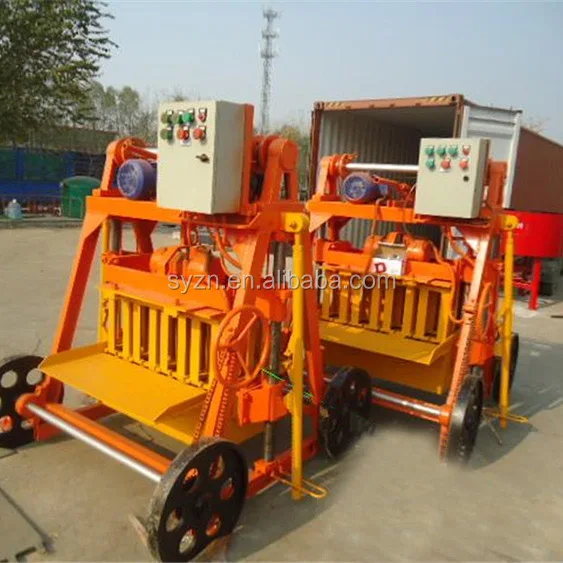
 Mobile block machine