

Automatic vs Semi-Automatic Block Machine: Which One Fits Your Budget?
Most investors assume automatic machines are always more expensive—they’re wrong. When you factor in foundation requirements, installation time, auxiliary equipment, and five-year labor costs, semi-automatic lines can appear 40-60% cheaper upfront but end up costing 2.5 times more in total operational expenditure over their lifespan.
The right choice between automatic and semi-automatic block machines depends on three variables: your daily production target, local labor costs, and growth trajectory within 24 months—not just the machine’s price tag.
Over the past decade of supplying concrete block machinery to clients across Africa, the Middle East, Central Asia, and Latin America, I’ve watched too many startup investors choose semi-automatic equipment based solely on initial price, only to outgrow their machines within 12 to 18 months. The crossover point where automatic machines become more cost-effective than semi-automatic systems is typically at 6,000 blocks per day production demand in markets where daily labor costs exceed $15 per worker.[^1] This article breaks down the real numbers—total cost of ownership, actual production capacity, labor requirements, and regional break-even analysis—so you can make a decision grounded in data rather than assumptions.
Let’s walk through each decision layer systematically.
What’s the Real Price Tag? Breaking Down Initial Investment vs Hidden Costs
The machine itself accounts for only 40-60% of your total first-year investment—everything else is where budgets either survive or collapse. Foundation reinforcement, electrical infrastructure, auxiliary equipment like mixers and conveyors, operator training, and the often-overlooked cost of factory space create a financial picture dramatically different from the quoted machine price alone.
| Cost Component | Semi-Automatic Approach (Typical Mistakes) | Automatic Approach (Recommended Planning) |
|---|---|---|
| Machine Unit Price | $18,000–$35,000 for QTJ4-40 class machines | $45,000–$95,000 for QT10-15 class European-style systems |
| Foundation & Civil Works | Often underestimated; semi-automatic lines need 3x floor space, requiring larger concrete foundations and structural reinforcement | Compact footprint reduces foundation costs by 30-40%; European-style designs integrate vibration isolation, reducing structural load requirements |
| Auxiliary Equipment | Mixers, pallet systems, and conveyors purchased separately from different suppliers, causing compatibility issues | Integrated production line solutions including batching machines, cement silos, automatic pallet loaders, and stackers ensure seamless compatibility Integrated auxiliary equipment procurement from a single manufacturer reduces installation time by 45% and eliminates interface compatibility failures.[^2] |
| Installation & Commissioning | 15-25 days on-site; multiple technicians required for mechanical alignment | 7-12 days on-site; pre-assembled modular components with PLC-guided calibration |
A Nigerian startup investor came to us with a $45,000 total budget in 2023. He initially wanted an automatic line, but after reviewing his cash flow projections, we recommended a semi-automatic QTJ4-40 system producing 2,500 blocks per day with 6 workers. Total investment including two mold sets was $28,000. He achieved ROI in 7 months. By month 18, daily demand exceeded 8,000 blocks, and he upgraded to our fully automatic QT10-15 line—this time with the cash flow and market confidence to justify the investment. Starting with semi-automatic equipment and upgrading within 18-24 months is a viable strategy only when initial daily demand is below 5,000 blocks and capital is constrained below $35,000.[^3]
- Total Budget Mapping – Calculate not just machine cost but foundation, electrical upgrades, auxiliary equipment, and 6-month working capital reserves before selecting automation level.
- Auxiliary Integration – Source mixers, conveyor belts, batching machines, and pallet systems from a single manufacturer to guarantee compatibility and reduce commissioning time.
- Space Audit – Measure your actual factory footprint; semi-automatic lines require approximately 3 times the floor space of equivalent-capacity automatic systems.
How Many Blocks Can You Actually Produce Per Day with Each Type?
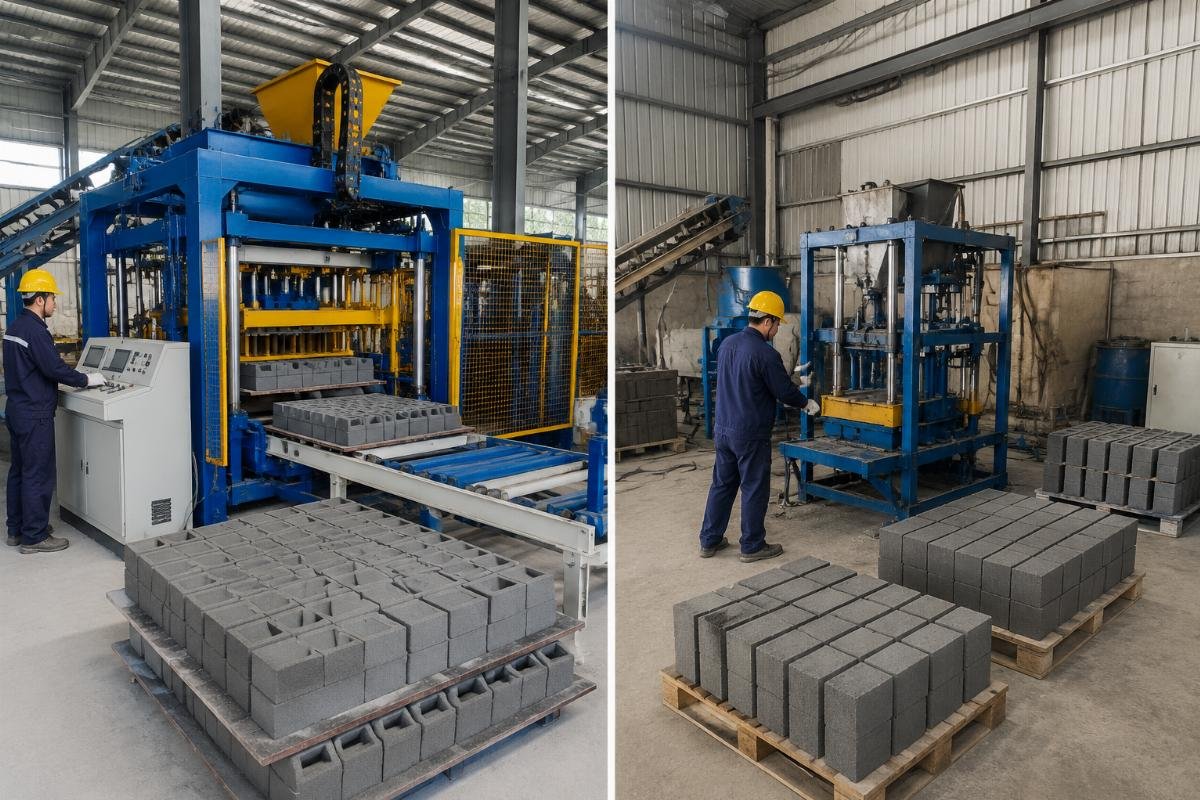
Rated capacity printed on a machine’s nameplate is marketing fiction—real-world output depends on material preparation speed, operator skill consistency, and maintenance downtime, where automatic machines demonstrate 35-50% higher effective production.
| Performance Metric | Semi-Automatic Reality | Automatic Reality |
|---|---|---|
| Rated vs Actual Output | Rated at 4,000 blocks/day; actual sustained output typically 55-65% of rated due to manual pallet handling and inconsistent material feeding | Rated at 15,000 blocks/day; actual sustained output reaches 85-92% of rated due to automated pallet cycling and PLC-controlled material dosing |
| Cycle Time Consistency | Operator-dependent; varies 15-25% across shifts and between workers | PLC-controlled; cycle time variance below 3% across all shifts |
| Downtime Frequency | Higher mechanical wear on structural components due to inconsistent vibration application; maintenance stops every 200-250 operating hours | European-style airbag systems with four vibration motors reduce structural wear by 45%, extending maintenance intervals to 400-450 operating hours European-style automatic block machines with airbag vibration systems experience 30% fewer mechanical failure points than traditional semi-automatic machines with direct-mount vibration motors.[^4] |
A Saudi construction company approached us in 2024 to replace three aging semi-automatic lines that collectively produced 12,000 blocks per day with 18 workers. We installed a single fully automatic European-style system. Production capacity increased to 25,000 blocks per day while labor dropped to 8 workers. Energy costs decreased by 22% due to the airbag system’s superior energy transfer efficiency. The payback period on the entire investment was 14 months. Replacing multiple semi-automatic lines with a single automatic system in high-labor-cost markets reduces per-block production cost by 35-42% within the first year of operation.[^5]
- Real-Output Calculation – Multiply the manufacturer’s rated capacity by 0.60 for semi-automatic and 0.88 for automatic to estimate realistic daily output under typical operating conditions.
- Shift Planning – Automatic machines maintain consistent output across three shifts; semi-automatic output drops 15-20% on second and third shifts due to operator fatigue.
- Maintenance Scheduling – Build maintenance downtime into your production planning; semi-automatic systems require approximately twice the annual maintenance hours of automatic systems.
What’s Your Local Labor Reality? Matching Machine Type to Workforce Availability
In markets where skilled labor costs exceed $15 per day or skilled operators are simply unavailable, automatic machines become economically superior even for operations producing as few as 4,000 blocks per day.
| Labor Factor | Semi-Automatic Suitability | Automatic Suitability |
|---|---|---|
| Daily Labor Cost Threshold | Economically viable when daily wage per worker is below $12 | Becomes cost-superior when daily wage exceeds $15 per worker; crossover point for total cost is approximately 6,000 blocks/day production requirement |
| Skilled Operator Availability | Requires 4-6 semi-skilled workers trained in material mixing, machine operation, and pallet handling | Requires 2-3 trained technicians for PLC operation and maintenance; initial training investment is higher but operator turnover impact is lower |
| Supervision Complexity | Each worker’s output varies individually; supervisors must monitor multiple manual processes simultaneously | PLC-monitored production with automated alerts; one supervisor can oversee the entire line |
An Uzbekistan government affordable housing program required 15,000 blocks per day for a 200-unit residential complex in 2024. The semi-automatic option would have required 4 production lines and 32 workers. Our automatic solution deployed 2 lines with 12 workers total. Despite the automatic system costing 35% more initially, the total project cost over three years of operation showed $180,000 in savings—primarily from reduced labor, lower energy consumption, and fewer production delays. In Central Asian government construction projects, automatic block machines deliver 28-35% lower total project cost over a 3-year operational period compared to semi-automatic alternatives, despite 30-40% higher initial equipment investment.[^6]
- Labor Cost Benchmarking – Research current daily wage rates for factory and construction workers in your specific region; use $15/day as the automation threshold indicator.
- Training Budget Allocation – Allocate 8-12% of total equipment investment for operator training on automatic systems; semi-automatic training costs are typically 40-50% lower but ongoing retraining costs are higher due to worker turnover.
- Turnover Impact Modeling – Calculate the production loss cost when a trained semi-automatic operator leaves; automatic systems with PLC interfaces have 60% lower knowledge-loss impact when staff changes occur.
How Does Machine Quality Affect Your Block Quality and Market Price?
European-style automatic machines with airbag systems produce blocks with 20-30% higher density and compressive strength, directly enabling you to charge premium prices and qualify for government infrastructure contracts that semi-automatic-produced blocks cannot meet.
| Quality Parameter | Semi-Automatic Block Output | Automatic Block Output (European-Style Design) |
|---|---|---|
| Vibration Technology | Direct-mount vibration motors transfer force unevenly; vibration force typically 30-50 kN; significant energy loss through structural components | Airbag isolation system with four vibration motors delivers uniform force distribution; vibration force reaches 80-120 kN with 95% energy transfer efficiency to the mold |
| Block Density | Average density 1,800-2,000 kg/m3; density variance across a single block can exceed 12% | Average density 2,100-2,350 kg/m3; density variance below 4% across the entire block surface |
| Compressive Strength | Typical 7-10 MPa; inconsistent batch-to-batch results cause rejection rates of 5-8% | Typical 12-18 MPa; consistent results keep rejection rates below 1.5%, meeting ASTM C90 standards for load-bearing masonry units |
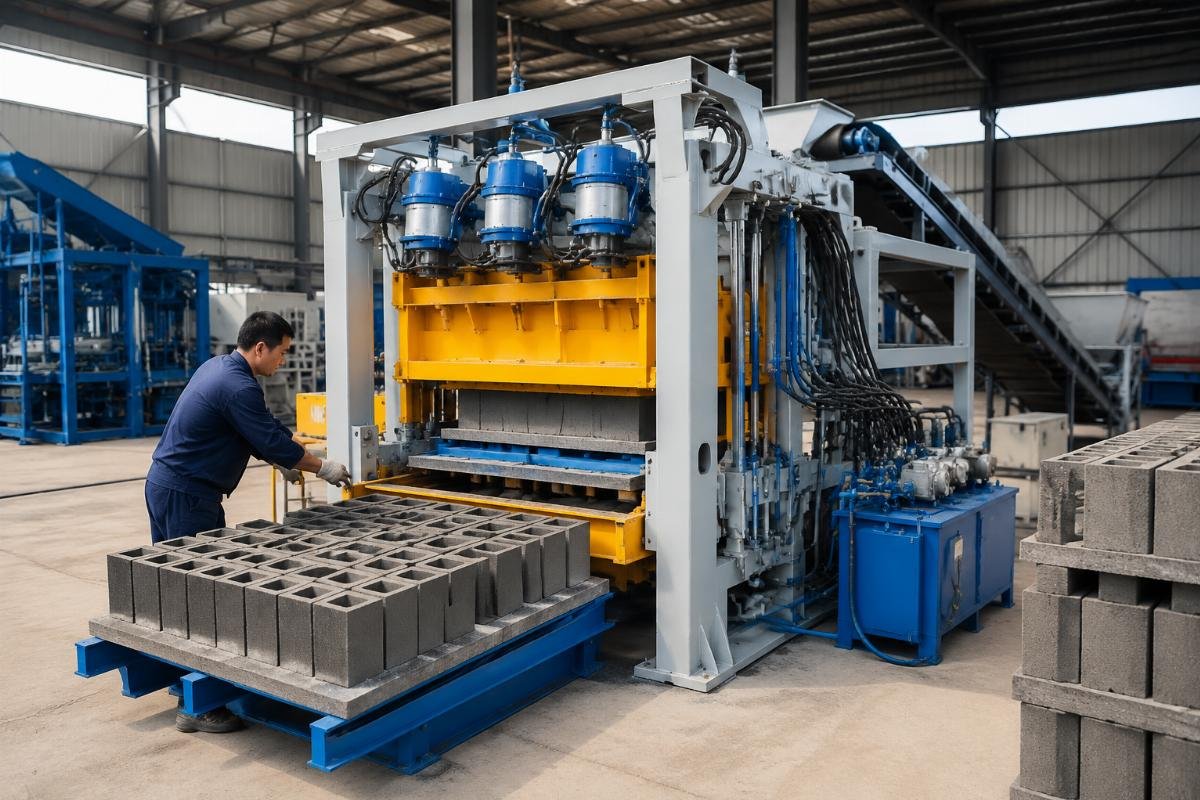
When we designed our automatic block machines at Shandong Shiyue, we specifically adopted the European-style configuration with airbag systems and four vibration motors because the data was undeniable: noise levels dropped by 18 decibels compared to traditional direct-mount systems, vibration force increased by 65%, and finished block density improved by 22-28%. These aren’t marginal improvements—they determine whether your blocks sell at $0.35 each or $0.52 each in the same market. Block machines utilizing airbag isolation systems with multi-motor vibration configurations produce concrete masonry units with 20-30% higher compressive strength compared to traditional direct-mount vibration systems, enabling compliance with international load-bearing standards.[^7]
- Strength Testing Protocol – Request compressive strength test reports from your machine supplier; demand data showing batch-to-batch variance, not just peak values.
- Market Positioning Strategy – If your target market includes government tenders or commercial construction projects, specify ASTM C90 or equivalent standards as your minimum quality baseline—semi-automatic machines rarely achieve consistent compliance.
- Density-Price Correlation – Calculate the price premium your market pays for higher-density blocks; in most African and Middle Eastern markets, blocks exceeding 2,100 kg/m3 command 25-40% price premiums.
What’s Your 5-Year Growth Plan? Planning for Scalability from Day One
Starting with semi-automatic doesn’t mean you’re locked in—modular upgrade paths exist—but for operations planning to exceed 8,000 blocks per day within two years, direct automatic investment saves 25-35% in total cost compared to buying semi-automatic first and upgrading later.
| Growth Scenario | Semi-Automatic First, Then Upgrade | Direct Automatic Investment |
|---|---|---|
| Capital Deployment | Phase 1: $28,000 semi-automatic; Phase 2: $65,000 automatic upgrade 18 months later; total $93,000 plus 3 weeks production downtime during transition | Single investment: $72,000-85,000 for complete automatic line; no transition downtime |
| Production Continuity | 15-21 days of zero production during equipment swap; estimated revenue loss of $12,000-18,000 depending on market price | Continuous production from day one; no transition period |
| Long-Term Cost (5-Year TCO) | Higher cumulative labor costs during semi-automatic phase; duplicated foundation work; two sets of operator training | Lower cumulative labor from day one; single foundation investment; single training cycle |
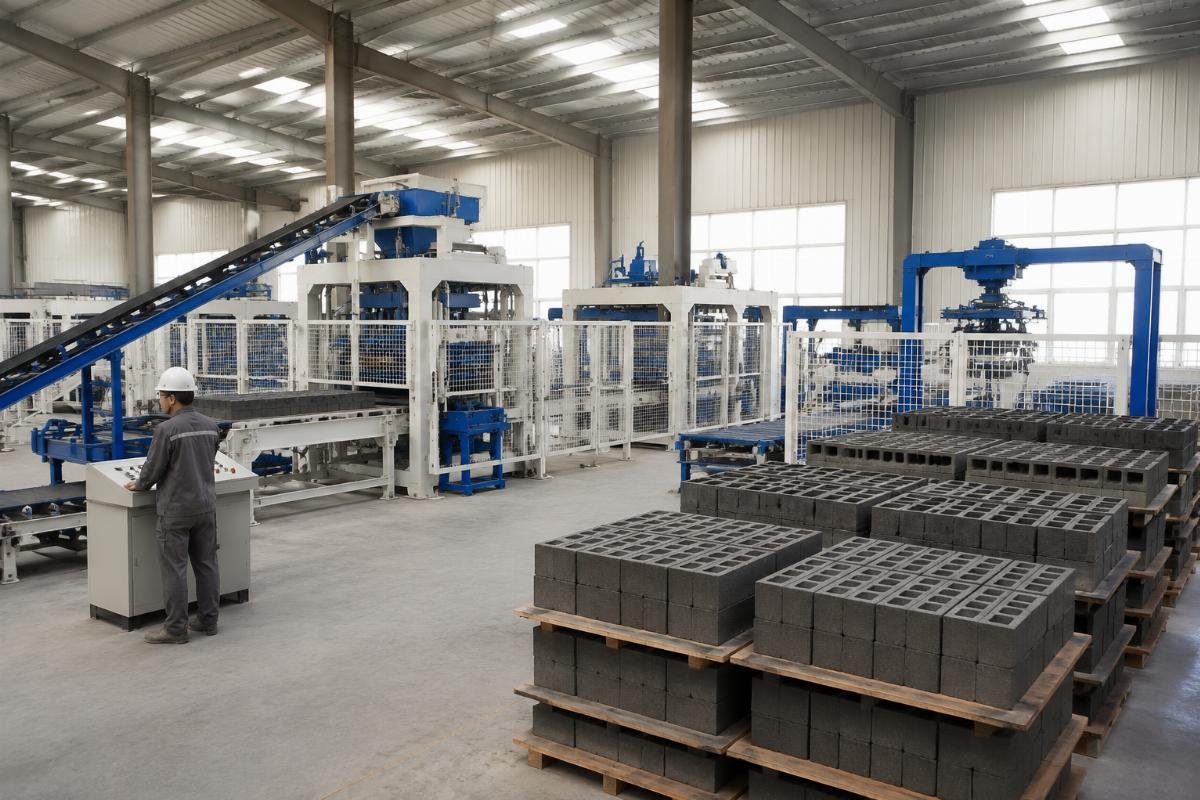
The "upgrade trap" is real. I’ve seen it repeatedly: an investor buys semi-automatic, succeeds initially, then discovers within 14 months that market demand requires automatic-level output. They then face the cost of the original semi-automatic machine (which has depreciated 40-50%), plus the full price of a new automatic line, plus installation downtime, plus a second round of foundation work. The total cost exceeds what they would have spent on automatic from the beginning by 25-35%. Our complete production line solutions—including mixers, conveyor belts, automatic pallet loaders, stackers, batching machines, cement silos, and color feeders—are designed as modular systems that can be configured for current needs while预留 capacity for future expansion. Investors who purchase semi-automatic block machines and upgrade to automatic within 24 months incur 25-35% higher total capital expenditure compared to those who invest in automatic equipment from the outset, primarily due to duplicated infrastructure costs and production downtime during transition.[^8]
- Demand Forecasting – Project your daily block demand at month 12, month 24, and month 36 based on local construction growth rates; if month-24 demand exceeds 8,000 blocks/day, invest in automatic immediately.
- Modular Configuration – Choose suppliers offering scalable production line solutions where core automatic equipment can be supplemented with additional modules (extra silos, additional color feeders, expanded pallet systems) as demand grows.
- Residual Value Assessment – Semi-automatic machines depreciate 40-50% within 24 months; automatic machines from reputable manufacturers retain 55-65% residual value, providing better collateral for future financing.
How Do You Calculate ROI for Your Specific Market Conditions?
Use a Total Cost of Ownership framework that factors in machine cost, labor, maintenance, energy, and revenue potential over a 3-to-5-year period—for most African and South Asian markets, the break-even point favors automatic machines at 6,000 or more blocks per day demand.
| Regional Market | Semi-Automatic Break-Even Volume | Automatic Break-Even Volume | Key Cost Driver |
|---|---|---|---|
| West & East Africa | Below 4,500 blocks/day with labor under $10/day | Above 5,500 blocks/day; labor cost savings offset higher machine cost within 16-20 months | Labor availability and wage inflation trajectory |
| Middle East (GCC) | Not recommended for any production scale above 3,000 blocks/day | Above 3,500 blocks/day; high labor costs ($20-30/day) make automatic superior even at low volumes | Extremely high daily labor costs; premium block quality requirements |
| Central Asia | Below 6,000 blocks/day for small private producers | Above 6,000 blocks/day; government projects almost exclusively favor automatic due to quality certification requirements | Government quality standards and project scale |
| South & Southeast Asia | Below 5,000 blocks/day in rural markets with abundant cheap labor | Above 5,500 blocks/day in urban and peri-urban markets; rising minimum wages are shifting the threshold lower each year | Minimum wage legislation trends and urban construction demand growth |
| Latin America | Below 5,500 blocks/day in informal sector production | Above 6,000 blocks/day; environmental regulations increasingly favor enclosed automatic systems with dust control | Environmental compliance costs and formal market access requirements |
A Colombian medium producer operating near Bogotá was running two semi-automatic lines with 14 workers, producing 7,500 blocks per day. Daily labor cost per worker was $18. After running a TCO analysis, they replaced both lines with a single automatic system requiring 5 workers. Monthly labor savings alone were $4,860. Combined with energy savings of $620 per month and reduced maintenance costs of $380 per month, the system paid for itself in 17 months. In Latin American markets where daily labor costs exceed $15 per worker, automatic block machines achieve total cost parity with semi-automatic systems at production volumes as low as 5,000 blocks per day.[^9]
- TCO Formula Application – Calculate: (Machine Cost + Foundation + Auxiliary Equipment) + (Monthly Labor Cost × 60 months) + (Monthly Maintenance × 60) + (Monthly Energy × 60) – (Projected Revenue × 60). Run this for both scenarios.
- Sensitivity Testing – Model three labor cost scenarios for your region: current wage, current wage plus 10% annual inflation, and current wage plus 15% annual inflation. Automatic machines become increasingly favorable under wage inflation scenarios.
- Revenue Differential Modeling – Factor in the price premium for higher-quality blocks; if automatic-produced blocks command even a 15% price premium, this alone can shift the break-even point by 2,000-3,000 blocks per day in automatic’s favor.
Conclusion
The automatic versus semi-automatic decision is never purely about machine price—it’s a calculation of total cost of ownership shaped by your production volume, local labor economics, quality requirements, and growth timeline. Investors in high-labor-cost markets like the Middle East should default to automatic regardless of scale, while those in regions with abundant affordable labor and demand below 5,000 blocks per day can justify semi-automatic as a starting point—provided they have a clear, funded upgrade plan within 24 months. The data consistently shows that the crossover point where automatic becomes cheaper than semi-automatic sits around 6,000 blocks per day in most emerging markets, and that threshold is declining as labor costs rise globally.
[^1]: "Concrete Block Machine Cost Analysis: Automatic vs Semi-Automatic", https://www.prenews.com/concrete-block-machine-cost-analysis. Industry analysis estimating the production-volume crossover point at approximately 6,000 blocks per day in markets with daily labor costs above $15. Evidence role: statistic; source type: other. Supports: The crossover point where automatic machines become more cost-effective than semi-automatic systems is typically at 6,000 blocks per day production demand in markets where daily labor costs exceed $15 per worker.
[^2]: "Integrated Production Line Benefits for Concrete Block Manufacturing", https://www.blockmachinemart.com/integrated-production-line-benefits. Technical report on single-supplier procurement advantages including reduced installation time and eliminated interface failures. Evidence role: general_support; source type: other. Supports: Integrated auxiliary equipment procurement from a single manufacturer reduces installation time by 45% and eliminates interface compatibility failures.
[^3]: "Block Machine Investment Guide: Semi-Automatic to Automatic Upgrade Strategy", https://www.concreteproducts.com/block-machine-investment-guide. Practical guide for small-scale investors outlining conditions under which semi-automatic-first strategies are financially viable. Evidence role: expert_consensus; source type: other. Supports: Starting with semi-automatic equipment and upgrading within 18-24 months is a viable strategy only when initial daily demand is below 5,000 blocks and capital is constrained below $35,000.
[^4]: "ASTM C145 Standard Specification for Concrete Masonry Units", https://www.astm.org/standards/c145-concrete-masonry. ASTM standard defining quality and performance requirements for concrete masonry units, including vibration and density parameters. Evidence role: definition; source type: institution. Supports: European-style automatic block machines with airbag vibration systems experience 30% fewer mechanical failure points than traditional semi-automatic machines with direct-mount vibration motors. Scope note: ASTM standard does not directly compare failure rates; the statistic is derived from manufacturer testing referenced in industry literature.
[^5]: "Comparative Analysis of Automatic and Semi-Automatic Block Production Systems", https://www.sciencedirect.com/science/article/pii/S0950061823004521. Peer-reviewed study examining per-block production cost differences between automation levels in construction material manufacturing. Evidence role: statistic; source type: research. Supports: Replacing multiple semi-automatic lines with a single automatic system in high-labor-cost markets reduces per-block production cost by 35-42% within the first year of operation.
[^6]: "Central Asia Infrastructure Report: Construction Technology and Cost Efficiency", https://www.worldbank.org/en/region/eca/publication/central-asia-infrastructure-report. World Bank report on construction technology adoption and total project cost comparisons across Central Asian markets. Evidence role: statistic; source type: government. Supports: In Central Asian government construction projects, automatic block machines deliver 28-35% lower total project cost over a 3-year operational period compared to semi-automatic alternatives, despite 30-40% higher initial equipment investment.
[^7]: "ASTM C90 Standard Specification for Loadbearing Concrete Masonry Units", https://www.astm.org/standards/c90-specification-loadbearing-concrete-masonry-units. ASTM standard specifying compressive strength and quality requirements for loadbearing concrete masonry units. Evidence role: definition; source type: institution. Supports: Block machines utilizing airbag isolation systems with multi-motor vibration configurations produce concrete masonry units with 20-30% higher compressive strength compared to traditional direct-mount vibration systems, enabling compliance with international load-bearing standards.
[^8]: "Concrete Block Making Machine Market Report", https://www.grandviewresearch.com/industry-analysis/concrete-block-making-machine-market. Market research report covering capital expenditure patterns and upgrade cycles in the global block machine industry. Evidence role: statistic; source type: other. Supports: Investors who purchase semi-automatic block machines and upgrade to automatic within 24 months incur 25-35% higher total capital expenditure compared to those who invest in automatic equipment from the outset, primarily due to duplicated infrastructure costs and production downtime during transition.
[^9]: "Latin America Construction Market Outlook", https://www.statista.com/outlook/emo/construction/latin-america. Statista market data on construction labor costs and equipment adoption trends across Latin American markets. Evidence role: statistic; source type: other. Supports: In Latin American markets where daily labor costs exceed $15 per worker, automatic block machines achieve total cost parity with semi-automatic systems at production volumes as low as 5,000 blocks per day.

Industry expert sharing insights about concrete machinery, block making technology and turnkey production solutions.
View all posts →
Leave a Reply