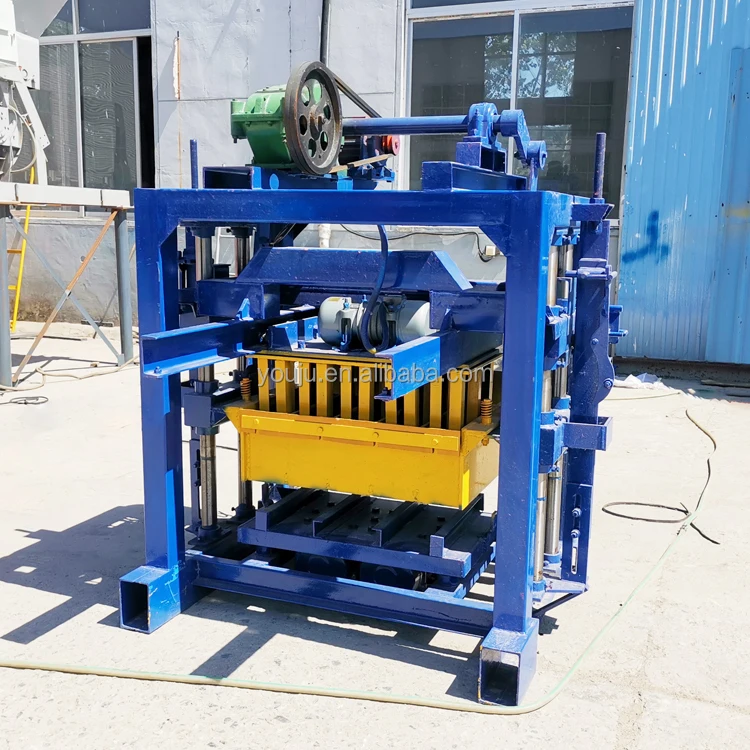
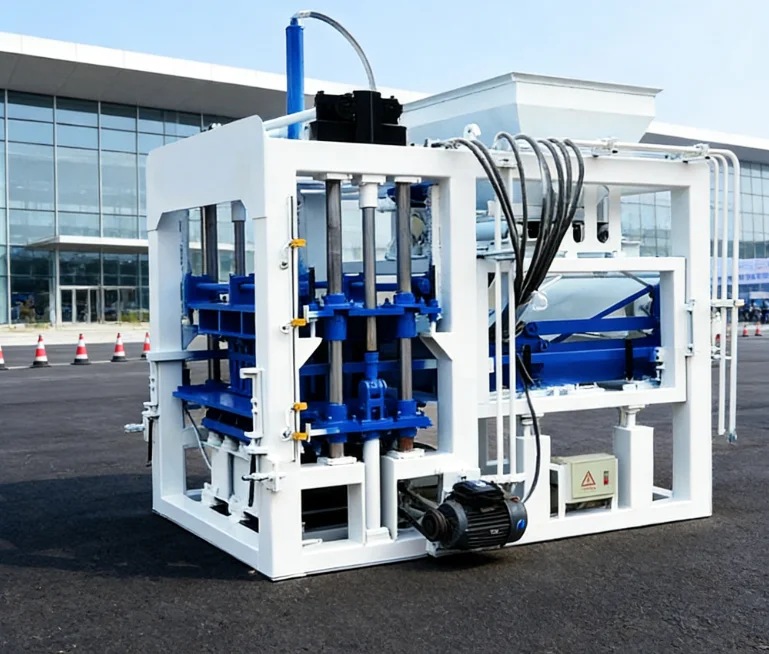
Matched System Configuration — The QTJ4-25 is specified as a complete unit with host machine, block mould, and JQ350 mixer rather than sourced from separate suppliers, helping buyers avoid the mismatch between press output and upstream material handling.
Technical Specifications
| Parameter |
Value |
| Model |
QTJ4-25 |
| Product Type |
Semi-Automatic Concrete Block Making Machine |
| Rated Power |
17.9 kW |
| Vibration Force |
60 kN |
| Vibration Frequency |
2800 r/min |
| Molding Cycle |
25 s |
| Output Capacity |
960 pcs/h, 7680 pcs/day (based on 400×200×200mm hollow block, 4 pcs/mould) |
| Pallet Size |
850×550×20 mm |
| Overall Dimensions |
6400×1500×2700 mm |
| Total Mass |
2500 kg |
| Automation Level |
Semi-automatic |
| Control System |
Motor-driven with hydraulic station |
| Configuration |
Host machine 1 set, block mould 1 set, JQ350 mixer |
| Mould Formats |
Hollow, solid, paver, curbstone |
| Block Sizes Supported |
8 inch, 6 inch, 5 inch, 4 inch |
Application Suitability
| Application |
Material or Output |
| Small block production plants |
Hollow and solid blocks from crushed stone, sand, and cement |
| On-site contractor block production |
Paving blocks and curbstones produced directly at the construction site |
| First-time plant entrepreneurs |
Multiple block formats through mould change on a single host machine |
| Medium-scale block supply |
Hollow blocks at 960 pcs/h based on 400×200×200mm format at 4 pcs/mould |
Why "960 Pieces per Hour" Means Less Than You Think
The capacity number on a semi-automatic concrete block making machine manufacturer datasheet only holds true for the specific block format and mould configuration stated beside it.
When a buyer reads 960 pieces per hour, the figure assumes a 400×200×200mm hollow block produced at four pieces per mould with a 25-second cycle. Switch to a smaller solid block or a paving format with different compaction requirements and the cycle time shifts, sometimes significantly. I have seen buyers budget their entire project timeline around a quoted throughput, only to discover during commissioning that their primary selling format produces at a noticeably lower rate [NEED_CITE: block format impact on cycle time in stationary presses]. The vibration force of 60 kN at 2800 r/min is tuned for a particular mix design and block geometry. Change the format, and the vibration energy per cavity changes with it.
This is why our proposals always state capacity per format, not a single headline number.

Where the QTJ4-25 Sits in the Full Machine Range
The QTJ4-25 occupies the accessible entry tier of Shiyue’s stationary block machine range. It targets buyers setting up a first block plant or replacing aging equipment who need a semi-automatic concrete block making machine manufacturer solution without the footprint and capital commitment of a fully automatic line. The host machine, one block mould set, and a JQ350 mixer ship as a matched package.
Comparing Tiers Before You Commit
Buyers evaluating their first stationary plant often move between the semi-automatic tier and higher-capacity automatic lines. The decision hinges on daily output requirements, available curing area, and labour cost in the local market. The QTJ4-25 requires manual pallet handling at the discharge end, meaning labour configuration must account for pallet movement, stacking, and transport to the curing zone [NEED_CITE: labour requirements for semi-automatic block plants]. A fully automatic line removes those manual steps but demands a larger footprint, higher power supply, and greater upfront investment.
What the Numbers Actually Mean on the Floor
The 60 kN vibration force combined with the integrated hydraulic station determines the compaction density achievable in each mould cycle. At 2800 r/min, the bed mould vertical vibration works alongside upper mould compression vibration to consolidate the mix from both directions. This dual-action approach matters because one-directional vibration tends to leave density variation between the top and bottom faces of the block. The 850×550×20 mm pallet size defines not just the mould cavity area but also the curing rack spacing and forklift tine width the buyer must have in place before the machine arrives. With an overall footprint of 6400×1500×2700 mm and a total mass of 2500 kg, the machine requires a level concrete foundation with sufficient load-bearing capacity and clearance for mould change access on both sides.
The Commissioning Delays Nobody Budgets For
Voltage and frequency mismatches remain one of the most common reasons stationary block machines sit idle after arrival. A buyer in a region running 60 Hz power will find a motor wound for 50 Hz runs hotter and at a different speed, altering the vibration frequency that was calibrated at the factory. Control panel language is another frequent oversight — operators facing instructions in an unfamiliar language make setup errors that compound through the first week of production [NEED_CITE: voltage and frequency standards by export market]. The QTJ4-25’s voltage, frequency, and control language specifications must be confirmed with the supplier before production begins, not after the container is loaded.
Why Buyers Source This Tier from Shiyue
Block machinery is our single focus, which means the QTJ4-25’s machine, mould, pallet, and handling requirements are evaluated as one system. We configure each unit against the buyer’s actual mix design and local aggregate rather than shipping a catalogue default that may not compact correctly on arrival. Mould design covers the specific hollow, solid, paver, and curbstone formats the buyer’s market demands, including custom sizes from buyer drawings. The semi-automatic configuration is a deliberate starting point — buyers can begin with the QTJ4-25 and plan an upgrade path to higher automation as their output requirements grow. Every unit undergoes a factory test before dispatch, and we provide operator training alongside installation and commissioning support.
Documentation & Verification
- Line layout showing QTJ4-25 placement with capacity calculation per block format
- Machine specification sheet confirming rated power, vibration force, and pallet size
- Mould drawing and format list covering hollow, solid, paver, and curbstone options
- Voltage, frequency, and control language confirmation document before production
- Factory test record demonstrating cycle performance on your specified block format
Installation, Commissioning & Support
- Level concrete foundation required to support 2500 kg total mass with clearance for mould change access
- Power supply must match confirmed voltage and frequency for the 17.9 kW rated motor and hydraulic station
- JQ350 mixer and host machine require coordinated positioning to maintain material feed continuity
- First commissioning includes vibration force calibration against the buyer’s confirmed mix design
- Operator training covers mould change procedure across hollow, solid, paver, and curbstone formats
- Wear parts list provided with recommended reorder intervals for hydraulic and vibration components
What to Prepare Before Requesting a Proposal
To size the QTJ4-25 correctly against your production requirements, we need your primary block format and dimensions, target daily output, and the raw materials available locally including aggregate type and gradation. Confirm your site’s voltage, frequency, and preferred control panel language so these can be locked in before production. If you have existing pallets, curing racks, or forklifts on site, share their dimensions so the 850×550 mm pallet configuration can be verified for compatibility.
Frequently Asked Questions
Q: How is the 960 pcs/h capacity calculated, and what happens when I switch formats?
A: The 960 pieces per hour figure is based on producing 400×200×200mm hollow blocks at four pieces per mould with a 25-second molding cycle. When you switch to a different format such as a solid block or paver, the cycle time and pieces per mould change, which alters the hourly output. We provide a capacity table showing realistic throughput for each format you plan to produce.
Q: Where does the QTJ4-25 sit compared to fully automatic and mobile options?
A: The QTJ4-25 is positioned as an entry-tier stationary semi-automatic machine, requiring lower capital and a smaller plant footprint than a fully automatic line while delivering higher output than mobile egg-laying machines. It suits buyers who want a fixed plant with room to scale. Fully automatic tiers add pallet feeding, stacking, and cubing to reduce manual labour.
Q: What supporting equipment do I need alongside the QTJ4-25?
A: The standard configuration includes the host machine, one block mould set, and a JQ350 mixer. Beyond that, you will need pallets sized to 850×550×20 mm, a curing area with racks or floor space, and a means of transporting loaded pallets from the machine discharge to the curing zone. We confirm these requirements during the proposal stage.
Q: Can I start semi-automatic and upgrade to higher automation later?
A: Yes. The QTJ4-25 is designed so that buyers can begin with manual pallet handling and later add automatic pallet feeding, stacking, or cubing stations as their production volume justifies the investment. We plan the line layout from the outset to accommodate this upgrade path without relocating the host machine.
Q: What voltage and control language options are available?
A: Voltage, frequency, and control panel language must be confirmed with the supplier before production to match your site’s electrical infrastructure and operator requirements. These parameters are not preset to a single standard. We verify all three during the proposal and lock them in before the machine enters the build cycle.

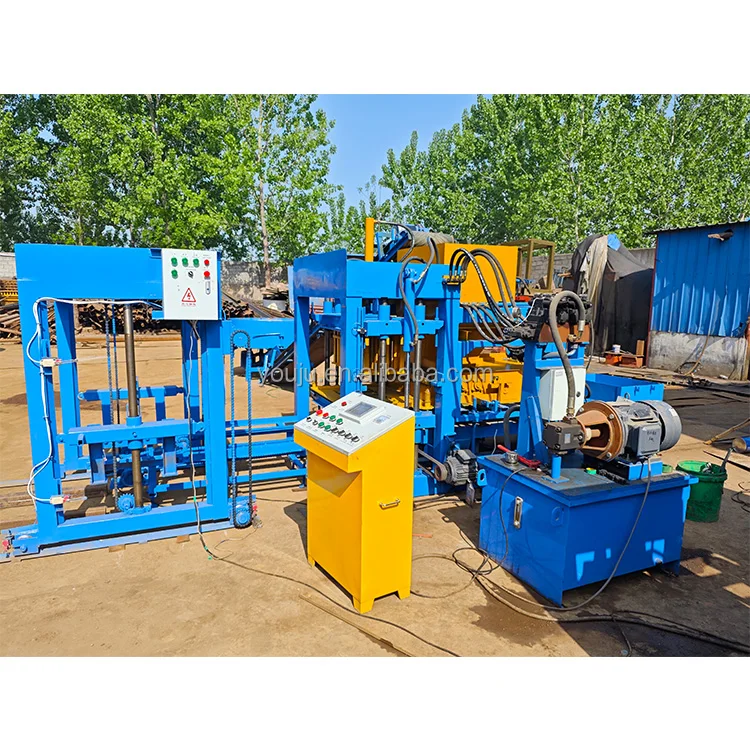
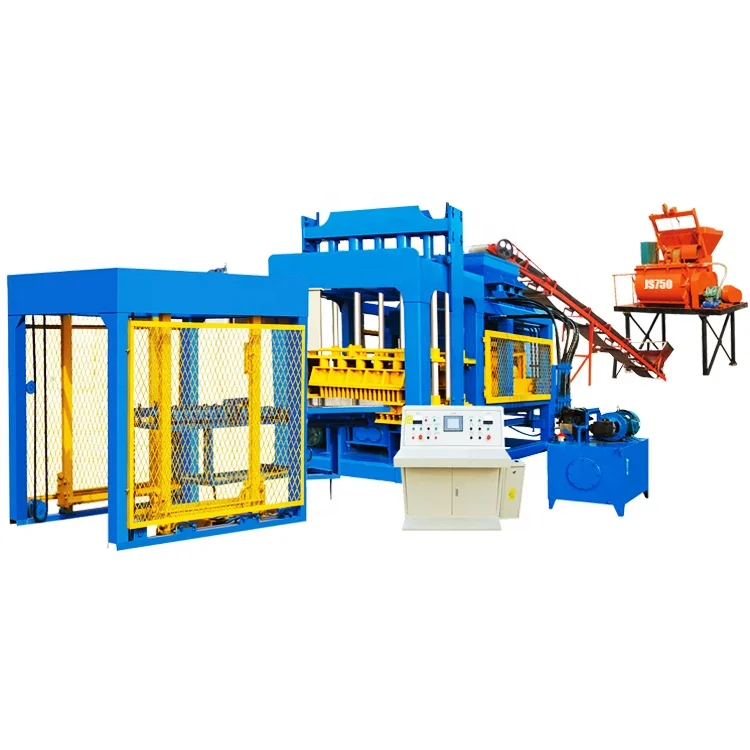 Stationary block machine