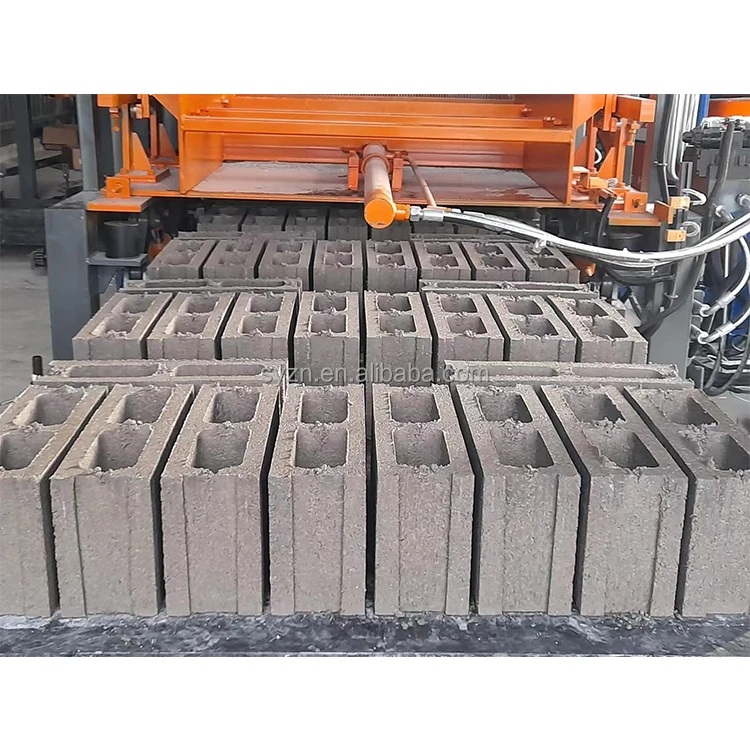
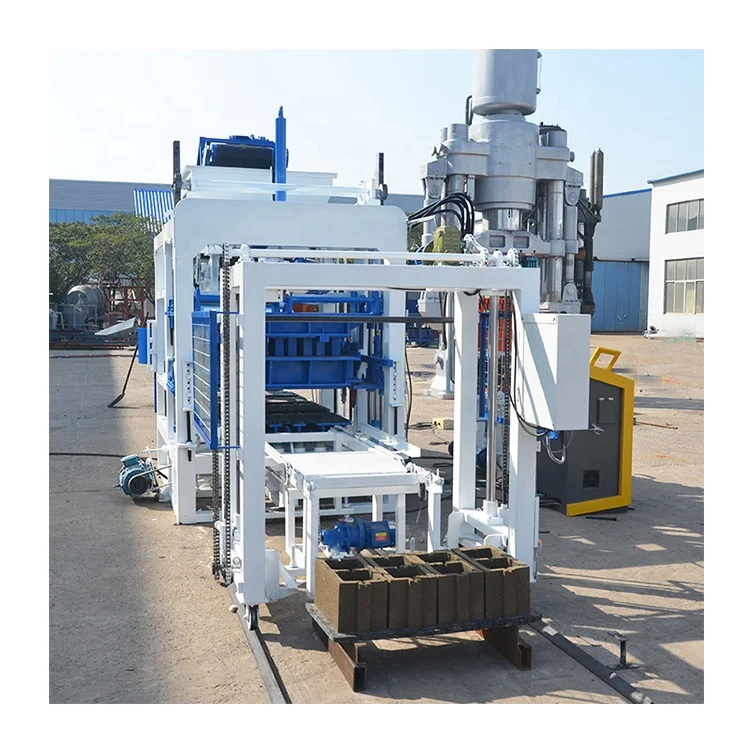
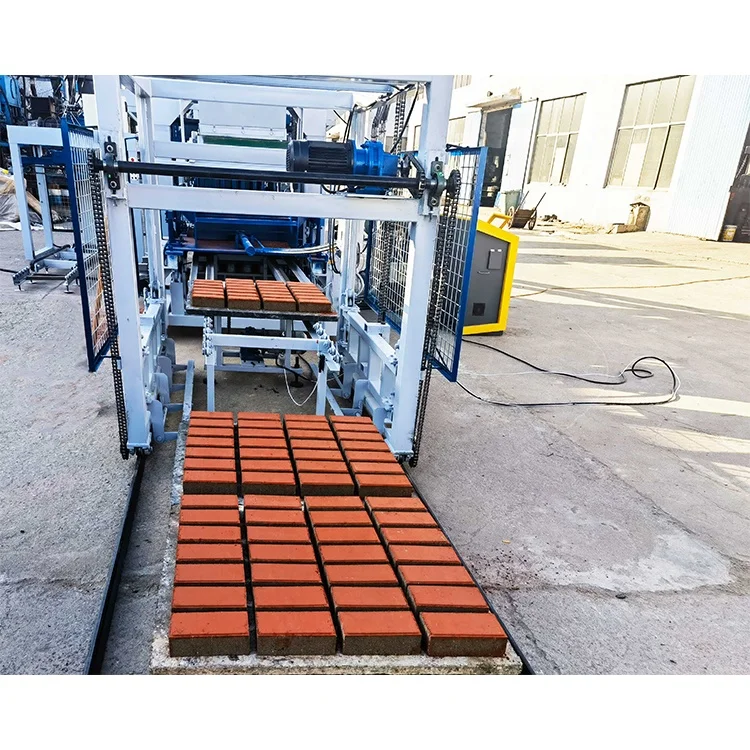
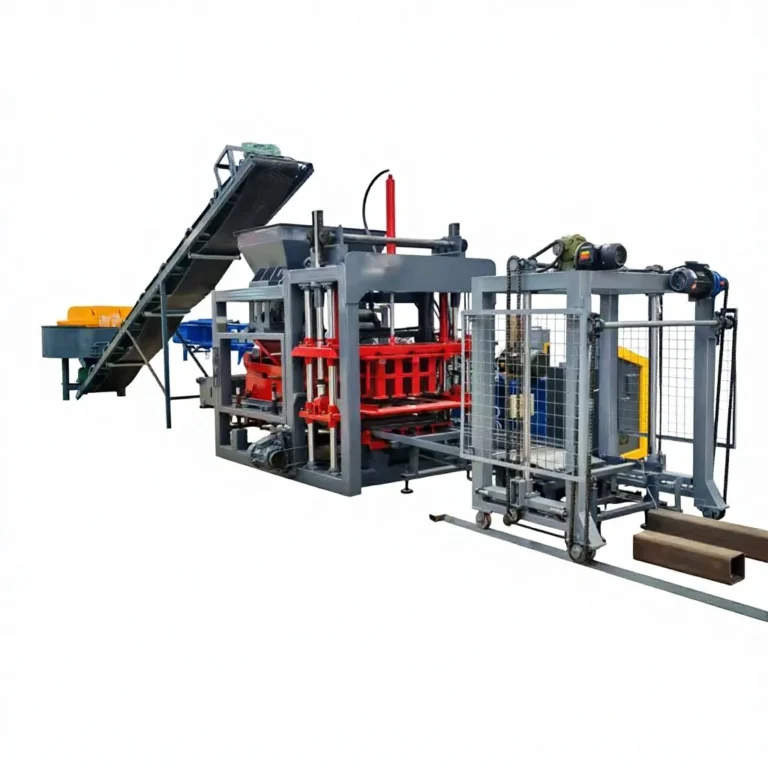
Matched System Configuration — The QT7-15 full automatic block machine manufacturer approach ensures the press, pallets, moulds, and handling equipment are specified as one coordinated line, preventing the common mismatch where components from separate suppliers create bottleneck failures during commissioning.
Technical Specifications
| Parameter |
Value |
| Model |
QT7-15 |
| Product Type |
Full Automatic Hollow Block Making Machine |
| Pallet Size |
1150×700 mm |
| Molding Cycle |
15–20 s (20–25 s for rectangular paving brick) |
| Overall Power |
45 kW |
| Vibration Force |
100 kN |
| Vibration Frequency |
0–60 Hz |
| Vibration Form |
Platform Vibration |
| Total Mass |
8 T |
| Demolding Method |
Hydraulic |
| Control System |
PLC with touch screen interface |
| Automation Level |
Full automatic (pallet feed, block making, storage hopper, conveyor, hydraulic unit, PLC cabinet) |
| Output — 400×200×200 mm Hollow Block |
7 pcs/mould, 1260–1680 pcs/h, 10080–13440 pcs/8 hr |
| Output — 400×150×200 mm Hollow Block |
8 pcs/mould, 1440–1920 pcs/h, 11520–15360 pcs/8 hr |
| Output — 200×100×60 mm Rectangular Brick |
27 pcs/mould, 3888–4860 pcs/h, 31104–38880 pcs/8 hr |
| Warranty |
1 year for whole machine (excluding spare parts) |
Application Suitability
| Application |
Material or Output |
| Hollow block production (400×200×200 mm) |
Crushed stone, sand, cement, fly ash aggregates |
| Hollow block production (400×150×200 mm) |
Standard concrete mix with local fine aggregate |
| Rectangular paving brick (200×100×60 mm) |
High-density mix with graded aggregate for surface finish |
| Multi-cellular and standard brick formats |
Various concrete mixes matched to local material availability |
| On-site construction block production |
Adaptable to project-specific aggregate and cement sources |
Why the Capacity Figure Without a Block Format Is Meaningless
Every buyer deserves to know exactly what the QT7-15 full automatic block machine manufacturer quotes actually mean for daily production.
Capacity numbers only matter when tied to a specific block format and mould configuration.
Too often, quotations arrive stating cycles per hour without clarifying which block size that figure assumes. A machine cycling 180 times per hour sounds impressive until you discover the figure was based on a small solid brick, while your operation needs 400×200×200 mm hollow blocks that require longer vibration and curing handling. The gap between quoted capacity and actual daily output becomes a costly surprise once the line is running [NEED_CITE: capacity calculation transparency in block machine quotations]. This mismatch affects not just revenue projections but also raw material procurement planning and labour scheduling across the curing yard.

Where the QT7-15 Sits in a Tiered Machine Range
Buyers surveying options for a first plant or replacing aging equipment need clarity on investment tiers. The QT7-15 occupies the mid-to-high capacity bracket, positioned between smaller semi-automatic machines suited for workshop-scale production and the largest high-capacity lines designed for continuous industrial output. This tier suits operations ready to move beyond manual pallet handling and inconsistent batch quality without committing to the footprint and power demands of maximum-capacity equipment. The 45 kW overall power draw reflects this balance, drawing enough energy for full hydraulic demolding and PLC-controlled consistency while remaining manageable for sites with moderate electrical infrastructure.
Matching Automation Level to Your Starting Point and Growth Path
The full automatic configuration includes pallet feeding, block forming, storage hopper management, conveyor transport, hydraulic unit operation, and PLC cabinet control as an integrated system. Buyers transitioning from manual or semi-automatic operation benefit from understanding which tasks the automation removes from the operator and what it adds in batch-to-batch consistency. The PLC touch screen interface supports fault diagnosis, reducing dependency on highly skilled technicians during routine production [NEED_CITE: PLC control systems in concrete block manufacturing]. For operations planning future expansion, the automation level permits starting with standard pallet handling and upgrading stacking or cubing functions as volume grows and market demand justifies the additional equipment investment.
Platform Vibration, Hydraulic Pressure, and Pallet Dimensions Explained
The 100 kN vibration force at adjustable 0–60 Hz frequency works together with hydraulic demolding to determine block density and surface finish. Higher vibration frequency suits finer aggregate mixes producing smooth-faced pavers, while lower frequency with extended cycle time compacts coarser crushed stone mixes for structural hollow blocks. The 1150×700 mm pallet size must align with your existing curing rack dimensions and forklift capacity; ordering pallets that exceed your forklift’s width rating creates daily handling friction. The molding cycle of 15–20 seconds for standard hollow blocks extends to 20–25 seconds for rectangular paving bricks because the denser mix and surface finish requirement demand longer vibration exposure. Platform vibration distributes force evenly across the mould cavity, reducing density variation between blocks at the centre versus edges of each pallet.
The Hidden Cost of Skipping Voltage and Language Confirmation
Commissioning delays after machine arrival trace back to unconfirmed electrical specifications more often than mechanical failures. A motor wired for 380V connected to a 415V supply burns out within days, while frequency mismatch between 50 Hz and 60 Hz grids alters vibration motor speed and destroys cycle time consistency. PLC display language left as factory default forces operators to navigate error messages in a language they cannot read, extending every fault diagnosis from minutes to hours [NEED_CITE: electrical specification verification for exported industrial machinery]. Pallet handling and stacking equipment omitted from the original quotation leaves output stacked manually, negating the labour reduction that justified the automatic line investment in the first place.
Why Buyers Choose This Source for the QT7-15
Block machinery as a single focus means the QT7-15 arrives with machine, mould, pallet, and handling specified as one matched system rather than assembled from separate suppliers who point blame at each other when cycle times fail to synchronize. Configuration is set against your actual mix design and local aggregate characteristics, not pulled from a catalogue default that assumes materials you cannot source. Mould design covers the formats your market actually sells, with custom drawings available when standard options miss your regional block dimensions. Automation level remains selectable, permitting a buyer to start semi-automatic and upgrade specific stations as production volume justifies the capital outlay. Installation and commissioning support includes operator training so your team runs the line independently before the technician departs.
Documentation & Verification
- Line layout showing QT7-15 footprint with pallet flow and curing rack spacing
- Capacity calculation sheet stating output per specific block format and mould
- Mould drawing and format list covering hollow block and paving brick dimensions
- Voltage, frequency, and PLC display language confirmation record before production
- Hydraulic and electrical schematic for local maintenance team reference
- Factory test record on your specified block format before container loading
Installation, Commissioning & Support
- Foundation pad leveled for 8 T total mass with anchor bolt pattern matching QT7-15 base frame
- Dedicated 45 kW circuit with voltage and frequency matching confirmed before motor connection
- PLC cabinet configured with operator language and fault codes tested during on-site commissioning
- Mould change procedure trained with your team achieving format switch within documented time target
- Wear parts list and hydraulic seal kit provided for first replacement cycle scheduling
- Pallet handling system synchronized to press cycle time preventing bottlenecks at stacking station
What to Prepare Before Requesting a Quotation
Provide your target block formats with dimensions, daily output requirement stated per specific block size, and local aggregate type with cement availability. Confirm your site voltage and frequency supply, existing curing yard dimensions, and forklift specifications so pallet size recommendations align with equipment you already operate. State your preferred PLC display language and whether stacking automation is required in the initial configuration or planned as a future addition.
Frequently Asked Questions
Q: How is the QT7-15 hourly capacity calculated for different block formats?
A: Output figures are stated per specific mould configuration: 400×200×200 mm hollow blocks yield 1260–1680 pieces per hour at 7 per mould, while 200×100×60 mm rectangular bricks produce 3888–4860 per hour at 27 per mould with an extended 20–25 second cycle. The capacity calculation sheet provided with each quotation makes these format assumptions explicit.
Q: Where does the QT7-15 fit compared to smaller and larger models?
A: The QT7-15 sits in the mid-to-high tier between workshop-scale semi-automatic machines and maximum-capacity industrial lines. It suits buyers ready to scale beyond manual pallet handling with 45 kW power draw and full PLC control, without committing to the larger footprint and electrical infrastructure that high-capacity automatic lines demand.
Q: What automation is included and can I upgrade later?
A: The standard configuration covers pallet feeding, block forming, storage hopper, conveyor, hydraulic unit, and PLC cabinet. Stacking and cubing automation can be added as separate stations when production volume justifies the investment, allowing a phased upgrade path from the initial installation.
Q: How do I confirm electrical specifications before shipment?
A: Voltage, frequency, and PLC display language are confirmed in writing during the quotation stage and recorded in the documentation package. The factory test runs on your specified electrical parameters before the machine is dismantled for container loading, preventing commissioning delays on arrival.
Q: What supporting equipment does a complete QT7-15 line require?
A: Beyond the press itself, the line needs raw material feeding and mixing, pallet feeding and return, curing rack handling, and stacking or cubing. The 1150×700 mm pallet size must match your curing area dimensions and forklift capacity, which are confirmed during the configuration proposal stage.

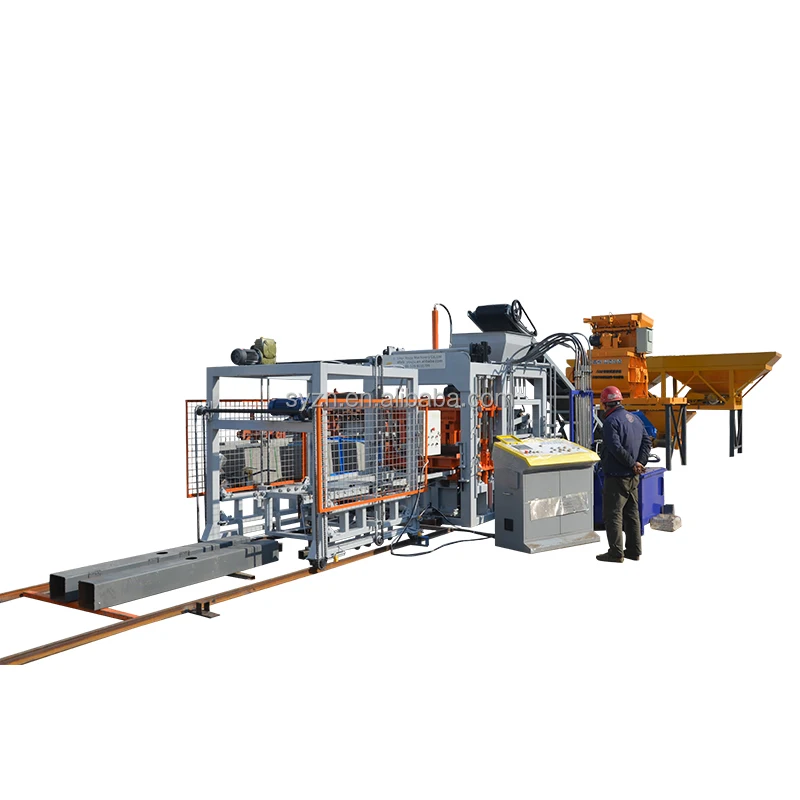
 High quality block machine