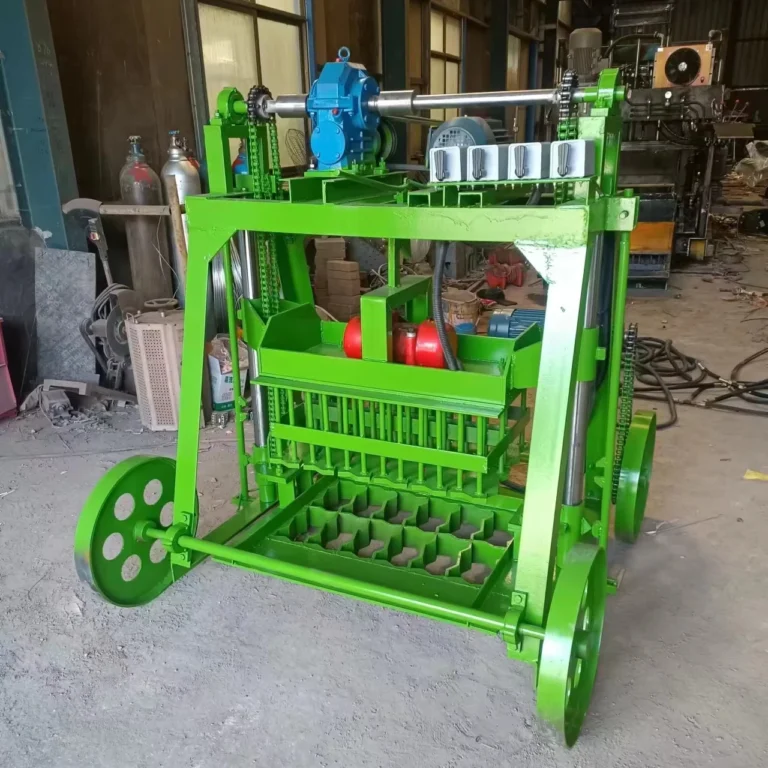
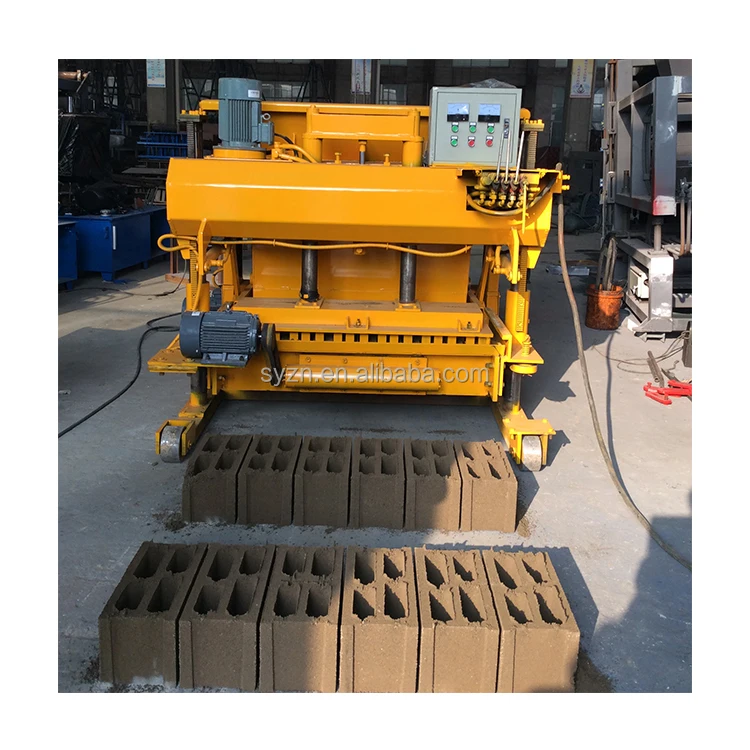
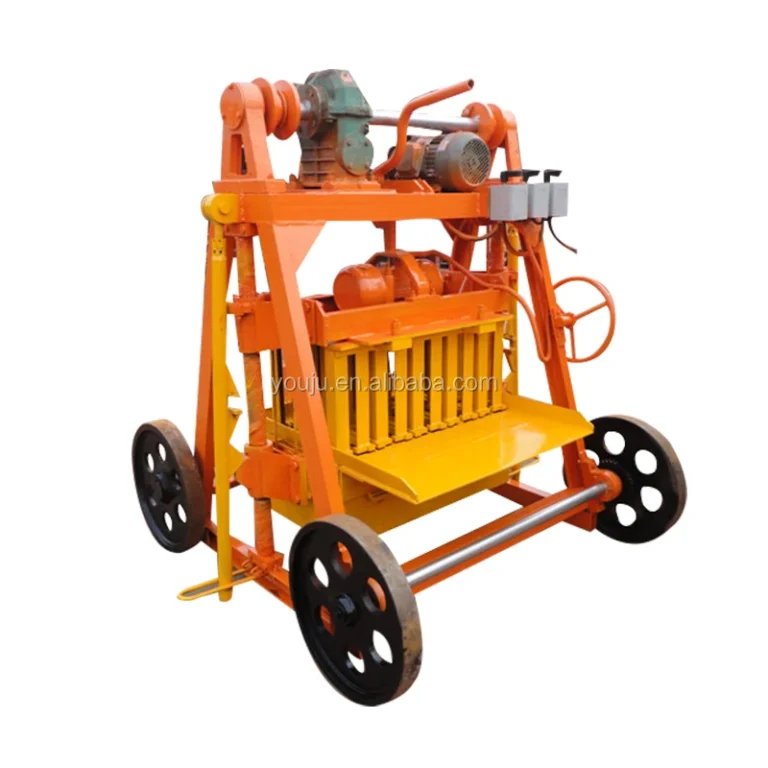
Mould-Matched Sizing — every QMJ4-45 capacity figure is tied to a specific hollow block dimension and an 8-hour shift, not a catalogue default that disappears on your first production day.
Technical Specifications
| Parameter |
Value |
| Model |
QMJ4-45 |
| Product Type |
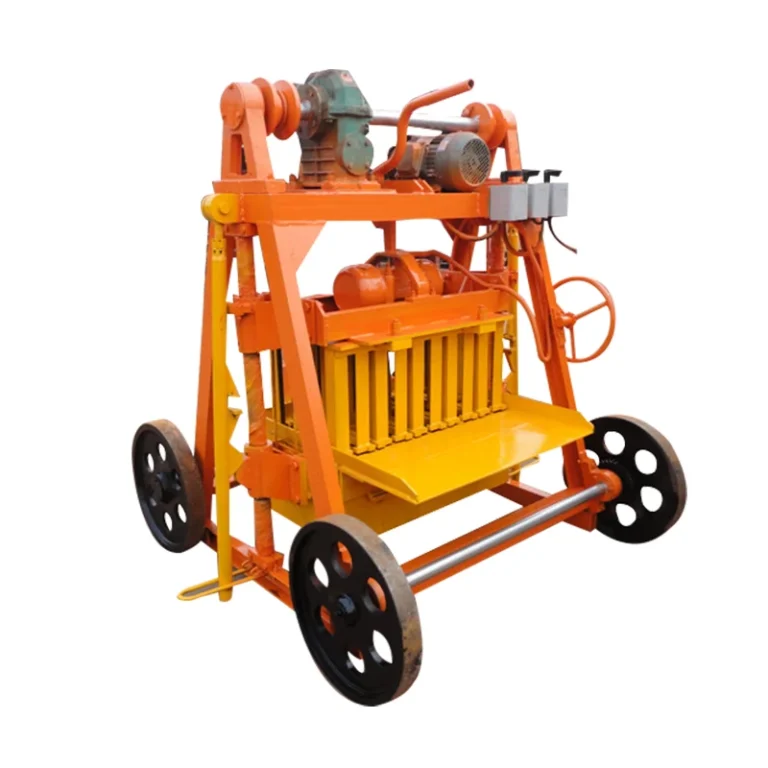
Mobile Egg Laying Block Making Machine |
| Molding Method |
Twice-vibration of molding core |
| Vibration Frequency |
2400 r/m |
| Hydraulic Method |
Mold vibration |
| Demolding Method |
Manual |
| Turning Method |
Manual |
| Total Power |
6 kW |
| Power Source |
Diesel / Petrol engine (buyer’s option) |
| Molding Cycle |
40–45 s |
| Automation Level |
Manual / egg-laying |
| Pallet Requirement |
None — blocks laid directly on ground |
| Hollow Block 400×200×200 mm |
4 pcs/mould, approx. 3000 pcs/day (basis: 8-hour shift) |
| Hollow Block 400×150×200 mm |
5 pcs/mould, approx. 3500 pcs/day (basis: 8-hour shift) |
| Hollow Block 400×120×200 mm |
6 pcs/mould, approx. 4500 pcs/day (basis: 8-hour shift) |
| Warranty |
One year for the whole machine |
Application Suitability
| Application |
Material or Output |
| On-site hollow block production for housing projects |
Cement, sand, crushed stone mixed locally |
| Garden wall and boundary fence block supply |
Standard aggregate with cement binder |
| Remote or rural building material retail |
Locally sourced sand, gravel, and cement |
| Small contractor self-supply on job sites |
Site-available aggregate avoiding transport of purchased blocks |
What "Approx. 3000 Blocks a Day" Actually Means on Site
Output only holds when the block format, cycle time, and shift length match the calculation basis.
Quoted capacity on a mobile egg laying block making machine for sale often assumes a format the buyer never intends to sell. A figure based on a 400×120×200 mm block inflates the number compared to the 400×200×200 mm block most markets actually move. When the mould does not match the calculation, daily production falls short from day one. [NEED_CITE: block format and cycle time assumptions in capacity quotations]

Where an Egg-Laying Design Earns Its Keep
A mobile egg laying block making machine for sale eliminates pallets entirely, which removes a significant line item from a first-time buyer’s budget. There is no pallet feeding station, no return conveyor, and no curing rack to build. The machine walks forward after each cycle and leaves the block on the ground surface, which means the only infrastructure you need is a flat, compacted area large enough to hold a day’s output until initial set.
This design suits contractors who need blocks at the build location but have no justification for a fixed plant. When the project ends, the machine loads onto a flatbed and moves to the next site. The absence of pallets also removes a common maintenance headache — warped or waterlogged boards that cause uneven block height and jam the stacker downstream. [NEED_CITE: pallet-free block production advantages for mobile and remote sites]
Engine Power and the Off-Grid Reality
The QMJ4-45 runs on a diesel or petrol engine rather than grid electricity, which opens up production in areas where three-phase supply is unavailable or unreliable. This matters for rural building material suppliers and remote construction camps where waiting for a grid connection would delay the project by weeks. Engine-powered operation does introduce fuel cost and engine maintenance into the daily routine, but it removes the single largest barrier to starting production in off-grid locations.
Choosing between diesel and petrol depends on local fuel availability, service support, and ambient temperature. Diesel engines generally tolerate continuous load better and offer longer service intervals, while petrol engines start more easily in cold conditions and may be cheaper to purchase initially. Confirming engine type at the order stage prevents a mismatch that would surface only when the machine arrives and the nearest diesel pump is an hour away. [NEED_CITE: diesel versus petrol engine selection for construction equipment in developing markets]
Vibration, Density, and What Twice-Vibration Changes
The QMJ4-45 uses twice-vibration of the molding core at 2400 r/m rather than a single-pass vibration. The first pass settles the aggregate into the mould cavity, and the second pass compacts it further before the mould lifts. This two-stage approach improves block density consistency across a shift, which directly affects compressive strength and the buyer’s ability to meet local building code requirements.
The 40–45 second molding cycle balances vibration time against output rate. A shorter cycle would increase throughput but risk under-compaction, especially with coarser aggregate. A longer cycle would improve density at the cost of daily volume. The manual demolding and turning steps add operator-dependent time that the quoted cycle does not always account for, so actual output depends on crew experience and rhythm. [NEED_CITE: vibration frequency and block compressive strength correlation in concrete masonry]
The Hidden Cost of Ordering Without Checking Local Aggregate
A machine configured for standard river sand may struggle with the volcanic ash, crusher dust, or clay-heavy material available at the buyer’s actual site. Sticky or overly fine aggregate can cling to the mould walls, producing blocks with torn faces and inconsistent dimensions. When the mix design does not match the machine’s vibration profile, the operator spends more time cleaning moulds than producing blocks, and waste material accumulates faster than usable output. [NEED_CITE: aggregate type and mould release performance in concrete block production]
Requesting a factory test with the buyer’s own material sample — or at minimum a detailed material data sheet — catches this mismatch before the machine ships. Without that step, the first production run becomes an expensive troubleshooting exercise conducted at the buyer’s site rather than in the factory where adjustments are straightforward.
Why Source This Machine Here
Block machinery is our single focus, so the QMJ4-45 is specified as part of a matched system including mould, engine, and spare parts rather than assembled from unrelated suppliers. Mould design covers the hollow block formats your market actually sells, with custom drawings available when standard widths do not match local demand. Configuration is set against your actual aggregate and mix design, not a catalogue default.
Automation level is selectable across the broader range, so a buyer starting with this manual unit can plan an upgrade path to semi-automatic or fully automatic operation as volume grows. Installation and commissioning support includes operator training so the crew understands the twice-vibration sequence and mould change procedure from the first shift. Wear parts and mould availability are confirmed at order stage, ensuring the first replacement shipment arrives with the machine. [NEED_CITE: single-focus block machinery supplier advantages for configuration matching]
Documentation & Verification
- Factory test record on your specified hollow block format before dispatch
- Mould drawing and dimension list matching your market’s block sizes
- Engine specification sheet confirming diesel or petrol type and rated output
- Operation and maintenance manual with mould change procedure illustrated
- Wear parts list and mould replacement schedule included in shipment documentation
Installation, Commissioning & Support
- Flat compacted ground area required; no foundation or curing rack construction needed
- Diesel or petrol engine confirmed to match local fuel supply before shipping
- Machine arrives assembled; operator training covers twice-vibration sequence and manual demolding
- Mould change across three hollow block widths demonstrated during commissioning visit
- Wear parts list reviewed and first replacement set identified at order stage
- One-year warranty covers full machine; engine serviced per manufacturer schedule
What to Share Before Requesting a Quotation
Provide the hollow block dimensions your market sells most, the aggregate type available at your site, and whether diesel or petrol fuel is easier to source locally. Share your target daily output and the number of operating hours per shift so the capacity calculation matches your actual schedule. If you have an existing mix design or a local building code strength requirement, include those details so the mould and vibration settings can be matched before the machine leaves the factory.
Frequently Asked Questions
Q: How is daily output calculated and which block format does each figure assume?
A: Each output figure is tied to a specific hollow block size and an 8-hour shift. The 400×200×200 mm format yields approximately 3000 pieces, the 400×150×200 mm yields approximately 3500, and the 400×120×200 mm yields approximately 4500. These assume a 40–45 second cycle and do not account for mould changes or breaks.
Q: What mould formats are available and how long does a mould change take?
A: Three hollow block widths — 120 mm, 150 mm, and 200 mm at 400 mm length and 200 mm height — are standard. Mould change is manual and takes one operator a portion of a shift to complete including alignment checks. Custom mould formats are available to buyer drawings when standard sizes do not match local demand.
Q: How does engine-powered operation affect maintenance compared to electric models?
A: Engine operation adds fuel consumption and periodic engine servicing to daily costs but removes dependence on grid electricity. Diesel engines handle continuous load well and suit warm climates; petrol engines start more easily in cold conditions. Engine maintenance follows the manufacturer’s schedule rather than the block machine warranty.
Q: Can this machine be upgraded later or should I plan for semi-automatic from the start?
A: The QMJ4-45 is a manual entry-tier unit with no upgrade path to automatic pallet feeding or stacking. Buyers expecting volume growth should consider semi-automatic models from the start. This machine suits contractors and entrepreneurs who need low-investment entry and will assess automation needs after establishing market demand.

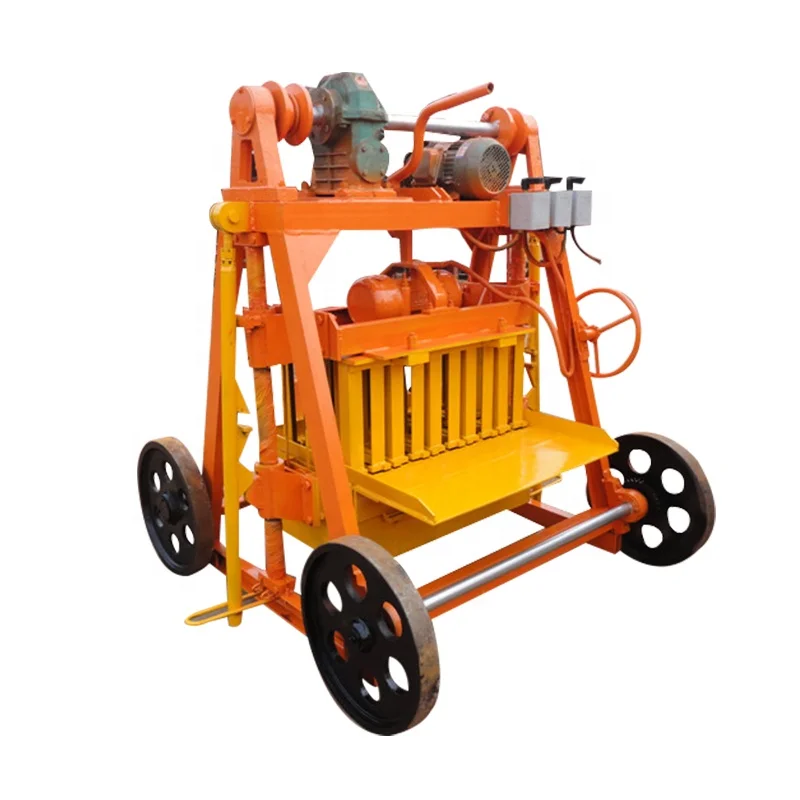
 Mobile block machine