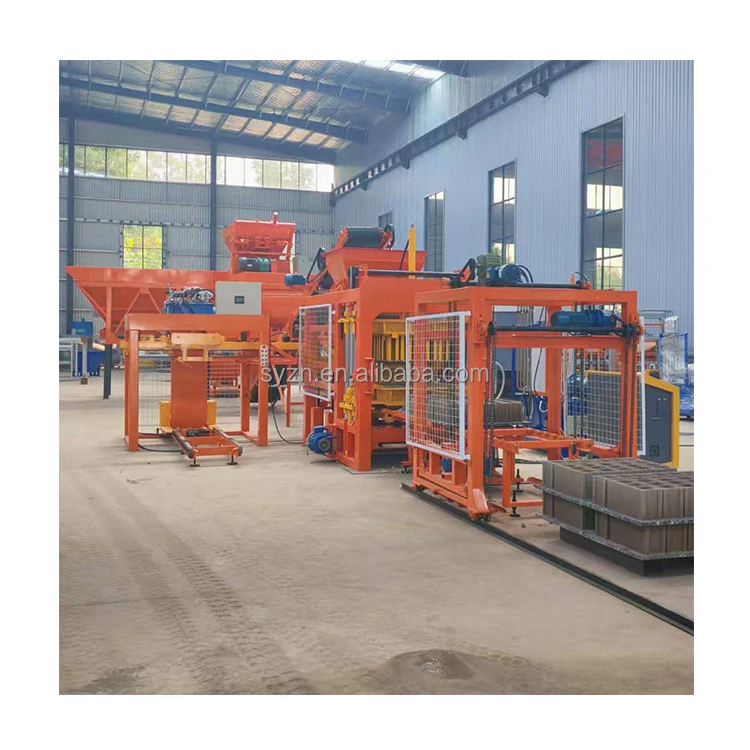
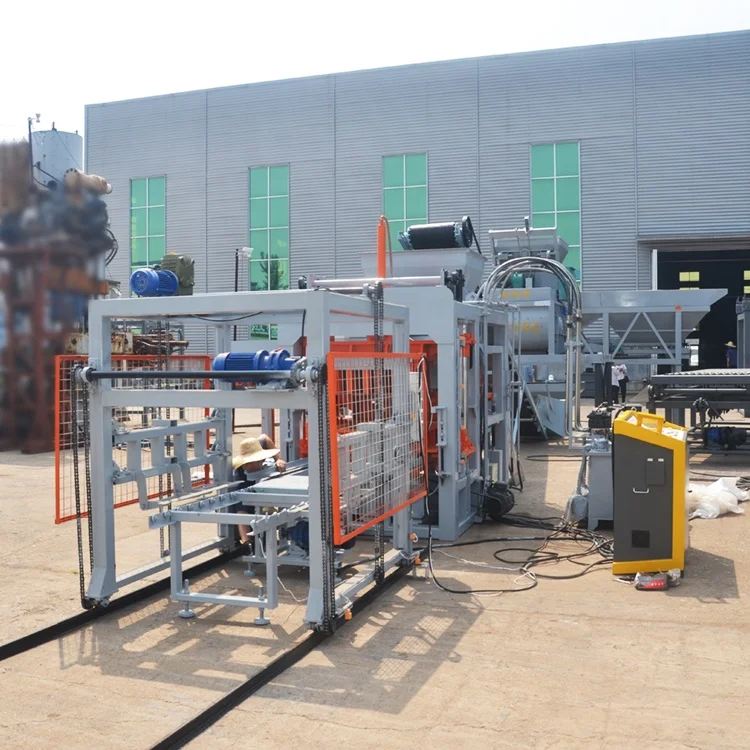
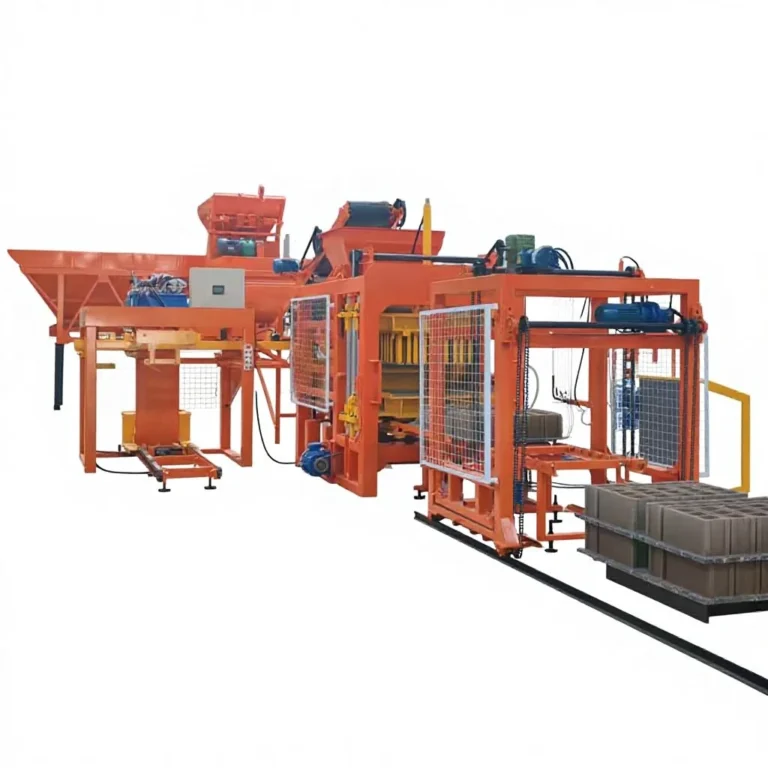
Matched System Design — machine, mould, pallet and handling specified together so the QT6-15 block line runs as one coordinated unit from raw feed to cured output.
Technical Specifications
| Parameter |
Value |
| Model |
QT6-15 |
| Product Type |
Concrete Block Making Machine |
| Overall Dimensions (L×W×H) |
8200 × 1700 × 2950 mm |
| Total Mass |
7 T |
| Vibration Form |
Platform Vibration |
| Vibration Frequency |
0–60 Hz |
| Vibration Force |
45 kN |
| Moulding Mode |
Automatic loading, vibration moulding |
| Demolding Method |
Hydraulic |
| Pallet Size |
880 × 850 mm |
| Molding Cycle |
15–20 s |
| Overall Power |
37 kW |
| Control System |
PLC with touch screen |
| Hydraulic System |
Independent integrated hydraulic station |
| Factory Area Required |
1200 m² |
| Output Capacity (Hollow block 400×200×200 mm) |
1080–1440 pcs/hour; 8640–11520 pcs/8hr |
| Output Capacity (Hollow block 400×150×200 mm) |
1440–1920 pcs/hour; 11520–15360 pcs/8hr |
| Output Capacity (Solid brick 240×115×53 mm) |
5760–7680 pcs/hour; 46080–61440 pcs/8hr |
| Output Capacity (Rectangular paver 200×100×60 mm) |
2160–2880 pcs/hour (basis: 20–25 s cycle); 17280–23040 pcs/8hr |
| Output Capacity (Zigzag paver 225×112.5×60 mm) |
2160–2880 pcs/hour (basis: 20–25 s cycle); 17280–23040 pcs/8hr |
| Compressive Strength of Blocks |
More than 15 MPa |
| Raw Material Adaptability |
Waste ash, slag, various aggregates |
| Voltage & Frequency |
(basis not stated in source — confirm target market standard) |
Application Suitability
| Application |
Material or Output |
| Hollow block production |
Crushed stone, cement, sand, and waste ash blends for bearing and non-bearing walls |
| Solid brick production |
Local aggregate and cement mixes for structural masonry |
| Rectangular paving brick |
Fine aggregate and cement for pedestrian and light-traffic surfaces |
| Zigzag paving brick |
Interlocking format for driveways and parking areas using locally sourced aggregate |
| Slag and ash utilization |
Industrial by-product incorporation into load-bearing and non-load-bearing block formats |
What "Pieces per Hour" Hides When You Compare Block Machine Tiers
Capacity numbers mean nothing unless the block format behind them is stated.
I have sat in project offices where a buyer signed for a Concrete Block Making Machine manufacturer quoted at a certain hourly output, only to discover on commissioning that the figure assumed a small solid brick while the buyer’s market demanded 200 mm hollow blocks. The real daily volume dropped to less than half the expectation. The QT6-15 output figures above each name the exact block dimensions and cycle time assumed, so you can compare tiers in our range without guessing. [NEED_CITE: common misunderstandings in block machine capacity quotations]

Where the QT6-15 Sits in the Full Range
The QT6-15 occupies the mid-to-high automatic tier. Below it, semi-automatic models suit first-time entrepreneurs running lower daily volumes with manual pallet handling. Above it, higher-capacity automatic lines serve plants that need continuous output across multiple shifts. This concrete block making machine gives buyers who are scaling up from a smaller press a realistic step without committing to a full high-capacity footprint.
Choosing Between Automatic, Semi-Automatic, and Mobile Within the Range
A construction contractor producing blocks on a single building site often benefits more from a mobile egg-laying machine than from any fixed-plant model. A building material distributor adding new formats to an existing catalogue, however, needs the pallet-based automation that the QT6-15 delivers. The decision is not about which tier is better in isolation but about matching the tier to the buyer’s actual production setting, daily volume, and available curing space. [NEED_CITE: selecting block machine tier based on production environment]
Reading the Specs That Actually Shape Daily Output
Platform vibration at 45 kN and an adjustable frequency range of 0–60 Hz mean the operator can tune the vibration profile to the specific mix design and block format being produced. Denser hollow blocks need higher force sustained over the full cycle, while thinner paving bricks require a shorter, sharper pulse. The independent integrated hydraulic station sits isolated from the main frame vibration and dust, reducing seal wear — a failure pattern I have seen stop an entire line for days when hydraulic components are mounted directly on the vibrating body. The 880 × 850 mm pallet size determines how many blocks press per cycle and must align with the curing rack dimensions and forklift capacity already in the plant. A mismatch here means double-handling cured blocks, adding labour and breakage that no cycle-time figure can offset.
The Cost of Skipping Configuration Detail Before Order
When voltage, frequency, and PLC display language are left unconfirmed, the machine arrives and sits idle until the correct electrical components are sourced locally or shipped. On a West African project I supported, a control panel wired for the wrong frequency burned out its first contactor within a week, and the replacement took nearly a fortnight to clear customs. Confirming these electrical details and the control language before production starts is a small step that prevents weeks of lost output. [NEED_CITE: commissioning delays caused by unconfirmed voltage and frequency]
Why Buyers Place the QT6-15 Order Here
Block machinery is our single focus, so the QT6-15 is never sold as a standalone press. The mould, pallet, and handling equipment are specified as one matched system against the buyer’s local aggregate and target block format. Mould design covers the formats the buyer’s market actually sells, including custom drawings when standard formats do not fit. Automation level is selectable — a buyer can start with semi-automatic pallet handling and add automatic stacking later without replacing the press. Installation and commissioning support includes operator training on the PLC touch screen, and a wear parts and mould list is bound into the contract so the first replacement cycle never catches the plant off guard.
Documentation & Verification
- Line layout and capacity calculation stating the block format assumed for each QT6-15 output figure
- Machine specification sheet with pallet size, vibration force, and hydraulic pressure matched to your mix
- Mould drawing and format list showing every block the QT6-15 can produce with its cycle time
- Voltage, frequency, and PLC display language confirmation record signed before production
- Factory test record run on your specified block format before dispatch
- Wear parts and mould list attached to the commercial contract
Installation, Commissioning & Support
- 1200 m² factory area with level concrete floor and drainage for the QT6-15 curing circuit
- 37 kW total power requiring a dedicated circuit breaker sized for motor starting surge
- Machine shipped in dismantled state with reassembly guided by numbered frame joints
- PLC touch screen parameters set to your block format and cycle time during commissioning
- Operator training covering mould change procedure, pallet loading, and fault diagnosis screen
- Sealed wear parts kit and spare hydraulic seals supplied for the first replacement interval
Before You Request a Quotation
Tell us which block formats your market sells, the daily volume you need for each format, and the raw materials available locally including aggregate type and cement source. Share your site voltage and frequency, the PLC language your operators read, and the dimensions of any existing curing area and forklift. With these details we can position the QT6-15 correctly within our full range and confirm whether an adjacent tier fits your project better.
Frequently Asked Questions
Q: How does the QT6-15 tier compare with smaller semi-automatic models in the range?
A: The QT6-15 delivers higher hourly output per block format and adds PLC-controlled automatic loading, reducing operator dependence. Semi-automatic tiers require manual pallet handling and suit lower daily volumes. If your target output falls between the two, the QT6-15 can be configured with partial automation and upgraded later without replacing the main press.
Q: What factory area does the QT6-15 need compared to larger automatic lines?
A: The QT6-15 requires approximately 1200 m² including space for raw material storage, the press, pallet circulation, and a curing zone. Higher-capacity tiers demand a larger curing circuit and wider pallet return conveyors. We provide a line layout showing the exact footprint before you commit to a tier.
Q: Can I start semi-automatic and upgrade to full automation later?
A: Yes. The QT6-15 frame and hydraulic station remain the same when you add automatic pallet feeding, stacking, or cubing modules later. The PLC touch screen accommodates the additional I/O points. We specify the upgrade path at the quotation stage so the initial wiring and mounting points are already in place.
Q: Which pallet size should I choose for the QT6-15?
A: The standard pallet is 880 × 850 mm, but the selection must match your existing curing racks and forklift tine spacing. A pallet that does not stack cleanly on your racks forces manual re-stacking after curing. We confirm pallet size and material against your site conditions before production begins.
Q: What is the investment difference between the QT6-15 and the next tier up?
A: The step up involves a larger pallet, higher vibration force, and a more extensive pallet circulation system, increasing both capital cost and factory area. The right choice depends on your daily output requirement per block format. We show the capacity comparison side by side so the decision rests on actual production need, not catalogue positioning.

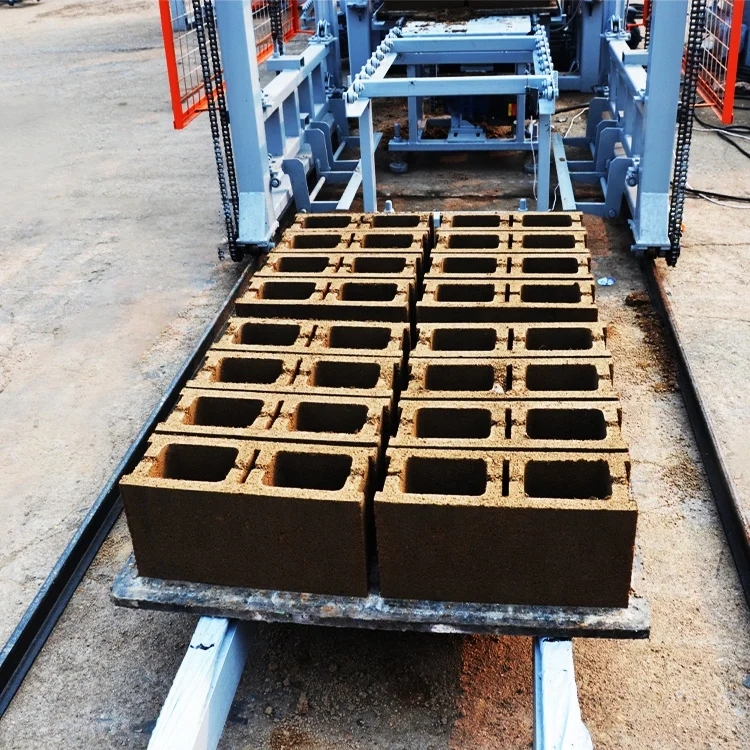
 High quality block machine