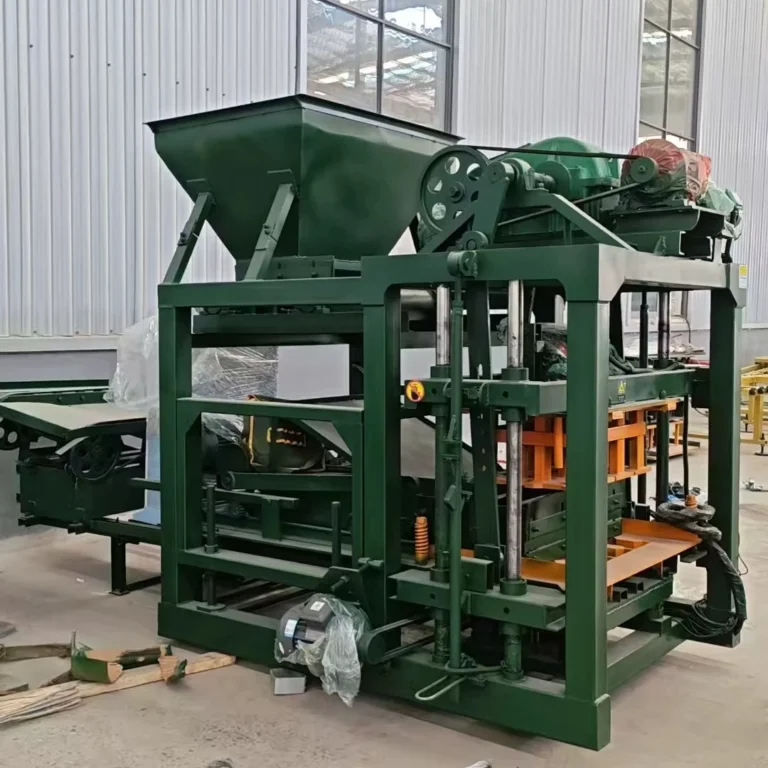
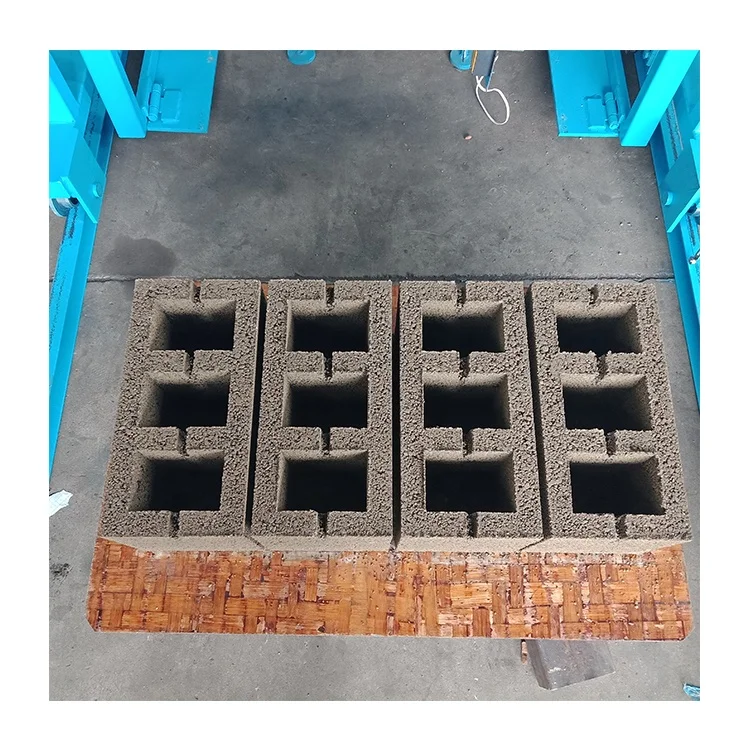
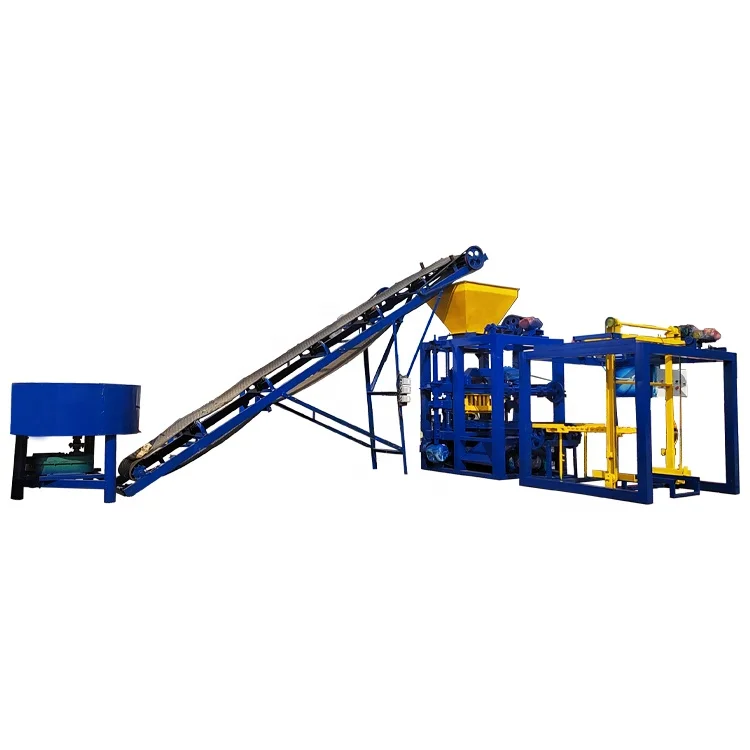
Matched System Sizing — the QT4-18 hydraulic block making machine manufacturer configures press, mould, pallet and handling together so capacity figures reflect your actual block format, not a catalogue default.
Technical Specifications
| Parameter |
Value |
| Model |
QT4-18 |
| Product Type |
Hydraulic Concrete Block Making Machine |
| Vibration Frequency |
0-60 Hz, adjustable |
| Vibration Form |
Platform vibration |
| Vibration Force |
45 kN |
| Pallet Size |
900 × 500 mm |
| Molding Cycle |
18-25 s |
| Demolding Method |
Hydraulic |
| Output (Hollow Block 400×200×200 mm) |
799 pcs/hour based on 18 s cycle, 4 pcs/mould |
| Output (Hollow Block 400×150×200 mm) |
999 pcs/hour based on 18 s cycle, 5 pcs/mould |
| Output (Solid Brick 240×115×52 mm) |
5,199 pcs/hour based on 18 s cycle, 26 pcs/mould |
| Automation Level |
Semi-automatic; electric and hydraulic system interlocked |
| Control System |
Shaft operation with data device for person-machine conversation |
| Mould Formats Supported |
Color face bricks, through-body environmental protection bricks, road curb rocks, hydraulic blocks, sod bricks |
| Voltage & Frequency |
To be confirmed before ordering |
| Rated Power |
To be confirmed |
| Overall Dimensions (L×W×H) |
To be confirmed |
| Net Weight |
To be confirmed |
| Hydraulic Pressure |
To be confirmed |
Application Suitability
| Application |
Material or Output |
| Hollow block production for building walls |
Cement, crushed stone, sand, fly ash aggregates |
| Paving brick manufacturing for roads and landscapes |
Color face bricks and through-body pavers from local aggregate |
| Solid and standard brick production |
Dense mix designs for structural or partition use |
| Curb stone and road edge block forming |
Heavy-section concrete with hydraulic block format moulds |
| Environmental protection and sod brick runs |
Porous mix designs for drainage and green infrastructure |
What the QT4-18 Hydraulic Block Making Machine Manufacturer Leaves Off the Brochure
Capacity only means something when you know which block format, mould cavity count and cycle time produced the number.
I have watched buyers sign contracts based on a single hourly figure, then discover on commissioning day that their primary product — say a 400×150×200 mm hollow block — runs a different cavity count and a longer cycle than the one the brochure assumed. The daily tally drops, the curing yard fills unevenly, and the shift ends with pallets still waiting. When sizing a QT4-18 hydraulic block making machine manufacturer line, the output table must state the format, the pieces per mould and the seconds per cycle for every product you intend to sell [NEED_CITE: block format assumptions behind quoted hourly capacity].

Placing the QT4-18 on the Full Machine Range
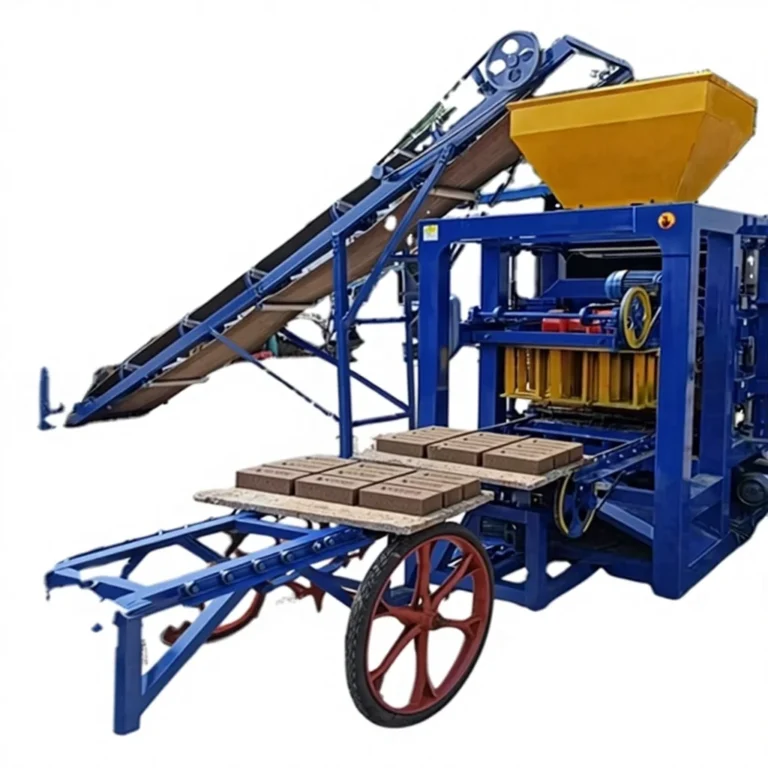
The QT4-18 sits in the mid-tier of a stationary block machine lineup that stretches from small workshop units to high-capacity automatic presses. Its 900 × 500 mm pallet and platform vibration system define a plant footprint that suits a first commercial block yard or a contractor producing on a housing project site. Buyers surveying the range can use this tier as a reference point before deciding whether to step up to a larger press or stay semi-automatic.
How Automation Level Shapes the Line Around the Press
This model ships as a semi-automatic press with electric-hydraulic interlock, meaning the operator initiates each cycle while the system guards against mis-steps between hydraulics and electrics. That baseline leaves room to add automatic pallet feeding, stacking and cubing later without replacing the press itself. A buyer who starts with manual pallet handling can move to a higher automation tier when local labour costs or daily volume demand it, keeping the QT4-18 as the core of a growing plant.
Reading the Specs That Actually Move the Block
Platform vibration at 0-60 Hz with 45 kN force is the pairing that consolidates the concrete mix inside the mould cavity; frequency controls how fast particles settle while force controls how tightly they pack. The 900 × 500 mm pallet size dictates the curing rack spacing and the forklift tine width you will use every day, so it must match your existing yard before the first pallet arrives. An 18-25 second moulding cycle range lets the operator lengthen the press time when the mix is stiff or shorten it when the aggregate is well-graded, balancing surface finish against throughput [NEED_CITE: vibration frequency and force matching to concrete aggregate gradation].
When the Wrong Pallet Size Derails the Curing Yard
A pallet that does not match the curing racks forces workers to restack blocks by hand before the concrete reaches initial set, cracking corners and slowing the next day’s run. A pallet that does not match the forklift means every load shift risks dropping a full rack. These mismatches show up only after the machine is bolted down and the first batch is in the yard, which is why pallet dimensions must be confirmed against site equipment before the order is placed [NEED_CITE: pallet and curing rack coordination in block plant layout].
Why Sourcing the Whole Line from One Maker Matters Here
Block machinery as a single focus means the QT4-18 press, its moulds, the 900 × 500 mm pallets and the handling stations are specified as one matched set rather than assembled from separate suppliers who each optimize for their own catalogue. Configuration is set against your actual mix design, local aggregate and target block format, not a default chart. Mould design covers the formats your market sells, and custom drawings are accepted when your product falls outside the standard range. Automation level is selectable, so the line can start semi-automatic and gain pallet feeding or stacking modules when output targets grow. Installation includes operator training on the exact press and mould set you received, not a generic manual.
Documentation & Verification
- Line layout with capacity calculation stating QT4-18 block format, mould cavity count and cycle time for each product
- Machine specification sheet confirming vibration force, pallet size and hydraulic demolding as one matched set
- Mould drawing and format list issued with the quotation, not after shipment
- Voltage, frequency and PLC display language confirmed in writing before production begins
- Factory test record run on your specified block format and mix proportions
- Wear parts and mould list detailing replacement intervals for hydraulic seals and vibration components
Installation, Commissioning & Support
- Foundation pad leveled to the QT4-18 footprint with anchor bolt pockets matching the base plate drawing
- Dedicated power circuit sized for the confirmed rated power and local voltage before the press is energized
- Machine dismantled for container loading and reassembled on site with alignment checks on the vibration platform
- First-cycle parameter setting covering vibration frequency, hydraulic pressure and molding cycle for your mix
- Operator training on the person-machine control interface, mould change sequence and daily greasing points
- Spare hydraulic seals, vibration motor brushes and pallet wear strips shipped with the initial mould set
What to Send with Your First Enquiry
Tell me the block formats you sell today and the ones you plan to add, the daily volume you need for each, and the aggregate sources within hauling distance of your site. Confirm the voltage and frequency at your meter, the language your operators read on a control screen, and the curing yard area and forklift you already have. With that, I can map the QT4-18 hydraulic block making machine manufacturer output against your real product mix instead of a brochure figure.
Frequently Asked Questions
Q: How is the QT4-18 hourly output calculated for each block format?
A: Every output figure states the block dimensions, the number of cavities in the mould, and the cycle time assumed. For example, 799 hollow blocks per hour is based on a 400×200×200 mm block, four cavities per mould, and an 18-second cycle. If your target format or cycle time differs, the hourly figure shifts accordingly.
Q: Where does the QT4-18 sit on the automation ladder, and can it be upgraded?
A: It ships as a semi-automatic press with electric-hydraulic interlock, meaning the operator initiates cycles while the system prevents mis-sequencing. Automatic pallet feeding, stacking and cubing modules can be added later without replacing the press, letting the line grow with your volume.
Q: How do I match the 900 × 500 mm pallet to my curing yard and forklift?
A: Confirm the rack slot width and depth in your existing curing area, and measure the fork tine spacing on the lift truck you will use. The pallet must clear both with enough margin for safe handling. If your yard or forklift uses a different standard, discuss pallet resizing before the order is finalized.
Q: When must voltage, frequency and PLC language be confirmed?
A: These must be locked in writing before the machine enters production. Voltage and frequency depend on your site transformer, and the PLC display language must match what your operators read. Late changes after wiring is complete add rework time and delay commissioning.
Q: Which mould formats are standard, and can I order custom designs?
A: The standard range covers color face bricks, through-body environmental protection bricks, road curb rocks, hydraulic blocks and sod bricks. If your market demands a format outside this list, custom moulds can be designed and built to your drawings, with cavity count and cycle time recalculated for the new dimensions.

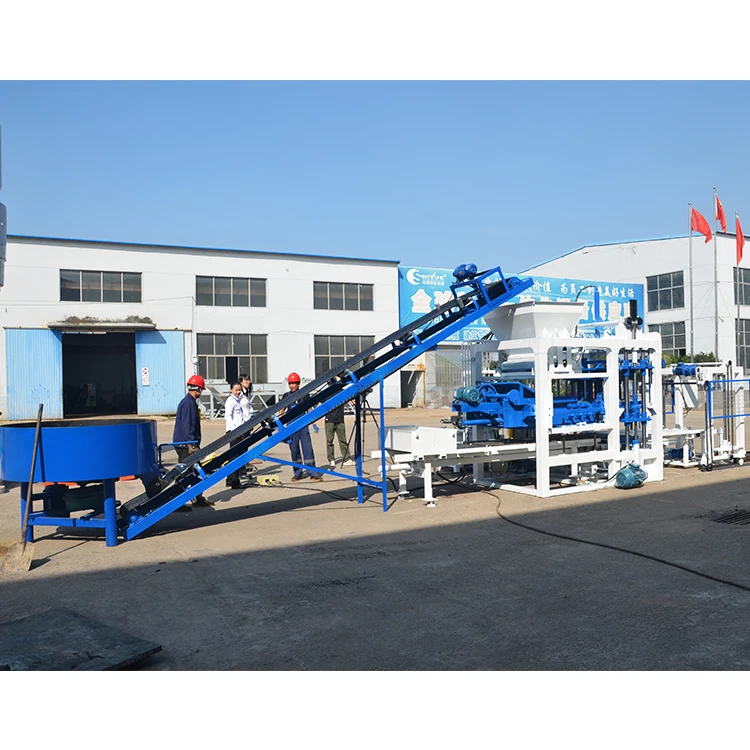
 Stationary block machine