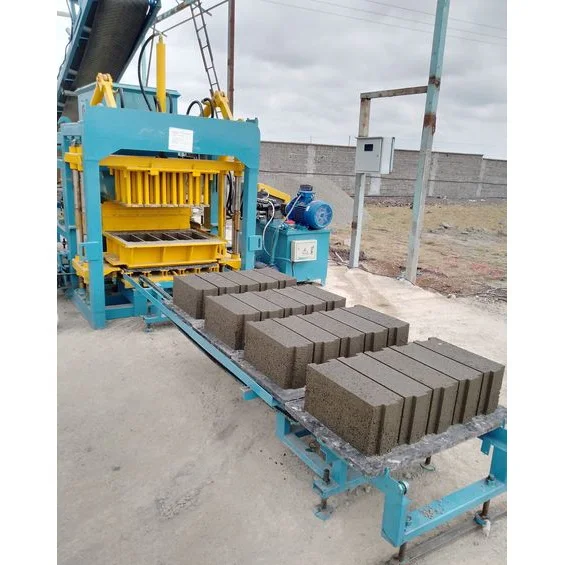
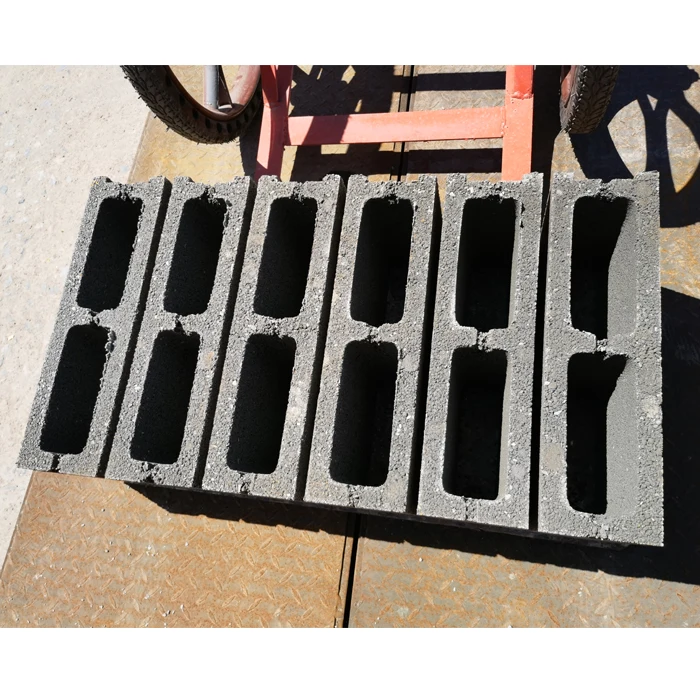
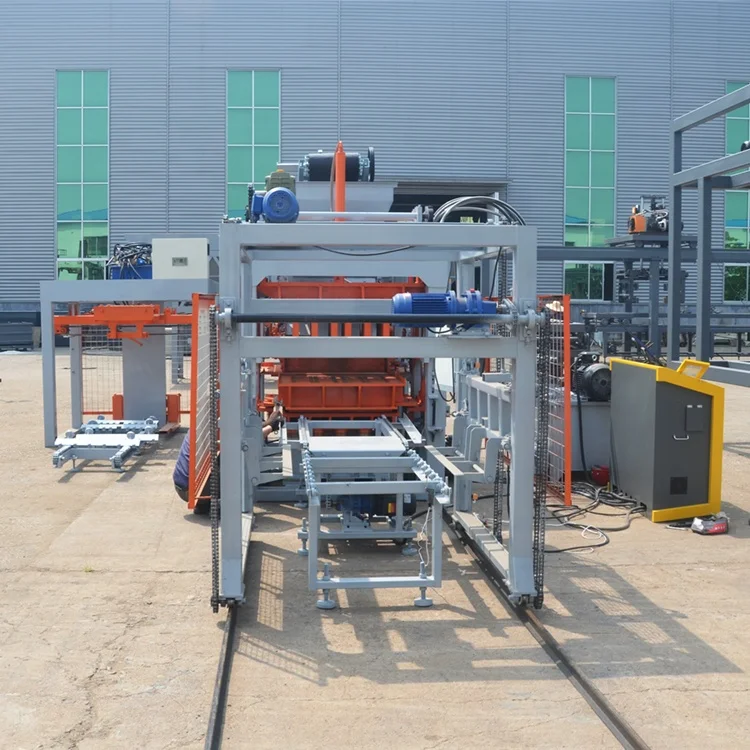
System-Matched Configuration — every QT18-15 line is specified as a complete press, mould, pallet and handling package rather than a standalone machine pulled from a catalogue.
Technical Specifications
| Parameter |
Value |
| Model |
QT18-15 |
| Product Type |
Automatic Hydraulic Concrete Block Making Machine |
| Overall Dimensions (L×W×H) |
9350 × 2520 × 2950 mm |
| Net Weight |
18 T |
| Rated Power |
90 kW |
| Voltage |
380V or customized to target market frequency |
| Control System |
PLC with configurable display language |
| Demoulding Method |
Hydraulic |
| Pallet Size |
1350 × 1350 × 30 mm |
| Output Capacity |
4320 pcs/h based on 400×200×200 mm hollow block, 18 pcs/mould |
| Output Capacity |
5760 pcs/h based on 400×150×200 mm hollow block, 24 pcs/mould |
| Daily Output |
34560 pcs/day based on 400×200×200 mm hollow block, 8-hour shift |
| Daily Output |
46080 pcs/day based on 400×150×200 mm hollow block, 8-hour shift |
| Vibration System |
Four external vibration motors |
| Upper Mould Synchronization |
Dual-side synchronous gear, four-point stabilization |
| Material Feeder |
European design with turning arm cylinder |
| Vibration Damping |
Airbag system with adjustable air pressure |
| Automation Level |
Automatic (line handling scope to be confirmed per layout) |
| Certification |
ISO 9001:2008, CE |
| Warranty |
1 year |
Application Suitability
| Application |
Material or Output |
| High-capacity hollow block plants |
Crushed stone, sand, cement and fly ash mixes on 1350×1350 mm pallets |
| Large-scale solid block production |
Dense aggregate blends requiring full hydraulic compaction pressure |
| Paver and kerbstone manufacturing |
Fine-graded face mix with pigmented concrete for surface finish |
| Infrastructure project supply |
Multi-format output switching between hollow and solid block on one press line |
What "4320 Pieces per Hour" Actually Means on the QT18-15
Every capacity number on this page is tied to a specific block size and mould cavity count.
I once had a buyer quote a competitor’s catalogue figure against our proposal and wonder why the numbers looked different. The answer is almost always the block format. A QT18-15 automatic block machine manufacturer quoting cycles per hour on a small solid brick will produce a very different daily tonnage than the same machine running 400×200×200 mm hollow blocks. The real question is never "how many pieces per hour" in the abstract — it is how many of your block, with your mix, on your shift schedule [NEED_CITE: block format impact on real daily output].

Where the QT18-15 Sits in the Full Machine Range
The QT18-15 occupies the high-output tier of the automatic block machine range. Buyers surveying options for a first plant or a replacement press will find smaller semi-automatic models below it for lower daily volumes and mobile egg-laying units for on-site production without a fixed curing yard. This model is built for operations that need sustained throughput on standard hollow and solid block formats across full production shifts.
Matching the Press to the Buyer’s Actual Output Tier
Choosing the right tier starts with daily dispatch volume, not peak cycle rate. A block plant shipping multiple truckloads per day on hollow block formats needs the pallet size and automation level that the QT18-15 automatic block machine manufacturer configuration provides. Smaller plants serving local masonry contractors may be better served by a mid-range press with lower capital outlay and simpler pallet handling, even though the per-cycle speed is lower.
How Hydraulic Pressure and Vibration Shape Block Density
The QT18-15 uses hydraulic demoulding paired with four external vibration motors to compact concrete into the mould cavity. Hydraulic pressure determines how tightly the upper head presses the mix while vibration force liquefies the material so it fills every corner of the mould. When these two forces are correctly matched to the buyer’s aggregate gradation and cement content, the resulting block reaches target compressive strength consistently across the pallet [NEED_CITE: relationship between hydraulic pressure, vibration force and block compressive strength]. The airbag vibration damping system allows the operator to adjust amplitude for different block types — a hollow block needs different vibration energy than a dense solid block or a pigmented paver. The dual-side synchronous gear on the upper mould keeps pressure distribution even across all 18 or 24 cavities, preventing density variation between corner blocks and centre blocks.
The Cost of Skipping the Raw Material Conversation
I learned this the hard way early in my career. A buyer in West Africa ordered a large-capacity hydraulic press based on sample output figures, but nobody asked for a local aggregate report before production. When the machine arrived, the local sand had a clay content far above what the vibration parameters were set for. The blocks came out weak, the cycle had to be lengthened to compensate, and actual daily output dropped sharply. Now I ask every buyer for a material report before finalising the QT18-15 configuration — the mix design drives vibration tuning, feeder adjustment and even the mould surface treatment [NEED_CITE: aggregate clay content effect on concrete block strength].
Why Buyers Source This Machine Through a Single-System Supplier
The QT18-15 is specified as a complete matched system: press, mould, pallet and handling line are configured together so cycle times align at every station. Configuration is set against the buyer’s actual mix design and target block format, not a catalogue default that may never match real production conditions. Moulds are designed for the specific formats the buyer’s local market demands, including custom drawings when standard cavity layouts do not fit. The automation level is selectable so a plant can start with semi-automatic pallet handling and upgrade to full stacking and cubing later without replacing the press. Installation support includes operator training on the exact block formats the line will run, so the crew is producing saleable product from the first week.
Documentation & Verification
- Line layout showing pallet flow from press through curing rack to cubing station
- Capacity calculation sheet stating block format and cavity count for each output figure
- Voltage, frequency and PLC display language confirmation signed before production
- Factory test record with measured cycle times on buyer’s specified block format
- Mould drawing package with cavity dimensions and wear part list for reorder
Installation, Commissioning & Support
- Foundation plan sized to the 9350×2520 mm footprint and 18 T operating weight
- Dedicated 90 kW supply circuit with voltage and frequency matched to local grid standard
- Machine shipped in dismantled modules for container loading with reassembly on site
- First-run parameter tuning on buyer’s actual aggregate mix and target block format
- Operator training covering mould change procedure, PLC navigation and daily maintenance checkpoints
- Wear parts and mould cavity insert list provided for local procurement planning
What to Prepare Before Requesting a Quotation
Send the target block formats with dimensions, expected daily dispatch volume and the number of production shifts planned. Include a local aggregate sieve analysis and cement type so vibration and feeder settings can be pre-configured. Confirm the site voltage, frequency and preferred PLC display language to avoid commissioning delays after the QT18-15 arrives.
Frequently Asked Questions
Q: How is output capacity verified and what block format is each number based on?
A: Every capacity figure published for the QT18-15 states the exact block dimensions and mould cavity count it assumes. The 4320 pieces per hour figure is based on 400×200×200 mm hollow blocks at 18 cavities per mould, while 5760 pieces per hour assumes 400×150×200 mm blocks at 24 cavities. Daily output figures assume an eight-hour shift and must be adjusted for actual shift length.
Q: What voltage and frequency options are available and how is PLC language confirmed?
A: The QT18-15 ships at 380V as standard but voltage and frequency are configurable to match the buyer’s local grid. PLC display language is confirmed in writing before production begins so the operator interface arrives in the correct language, eliminating relabelling or reprogramming during commissioning.
Q: Which block formats can the QT18-15 run and what is the cycle time per format?
A: The machine runs hollow blocks, solid blocks, pavers, kerbstones and interlocking bricks on 1350×1350 mm pallets. Cycle time varies by format, mix design and target block density. Exact cycle times are measured during factory testing on the buyer’s specified formats and recorded in the test report shipped with the machine.
Q: What automation level does the line include?
A: The QT18-15 is supplied as an automatic press with PLC control. The scope of pallet feeding, automatic stacking and cubing is configured per line layout based on the buyer’s plant footprint and labour plan. A semi-automatic start with manual pallet handling is available, with upgrade paths to full automation later.
Q: How are pallet size and material chosen for the buyer’s site?
A: The standard 1350×1350×30 mm pallet is matched to the mould cavity layout. Pallet material — bamboo, steel or composite — is selected based on the buyer’s curing method, forklift capacity and curing rack dimensions so pallets move smoothly from press to yard without handling bottlenecks.

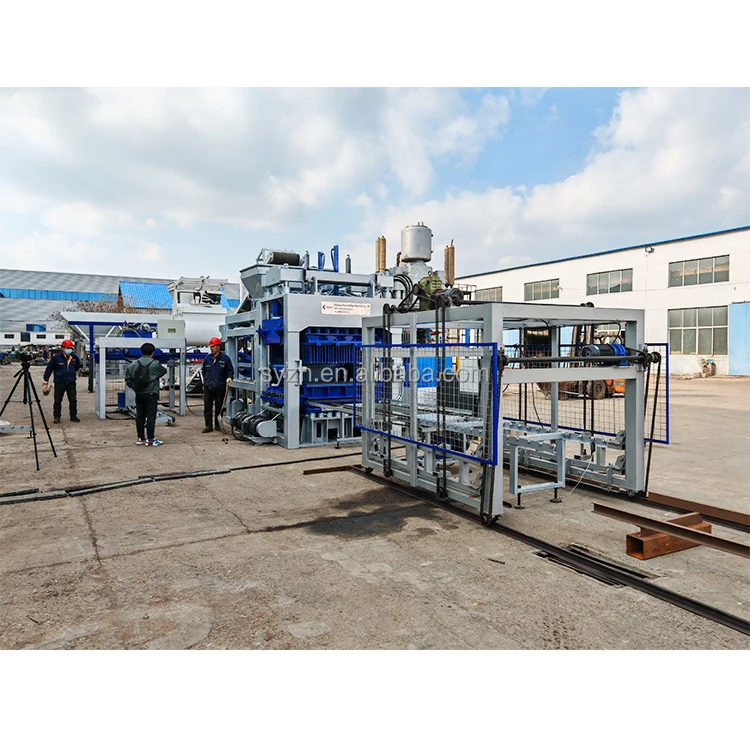
 High quality block machine