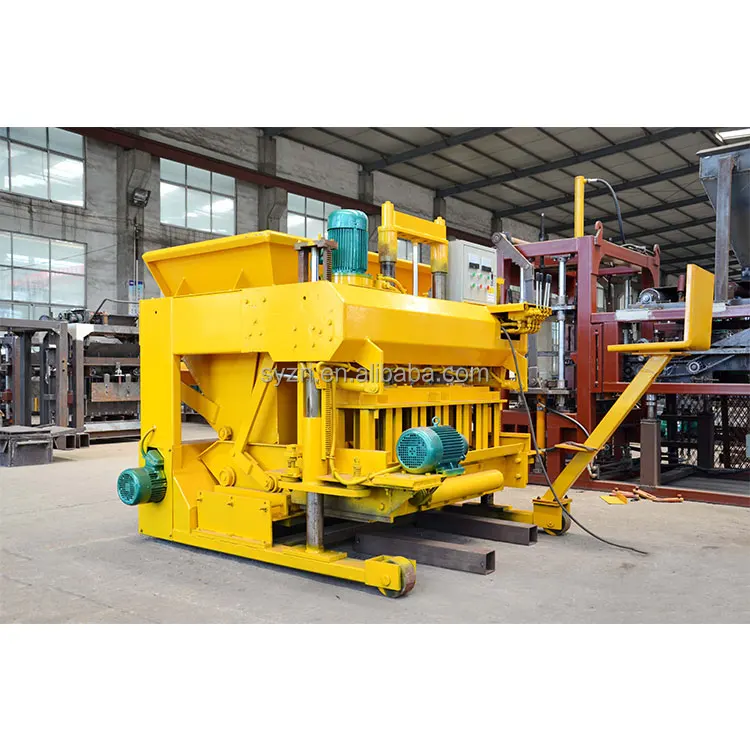
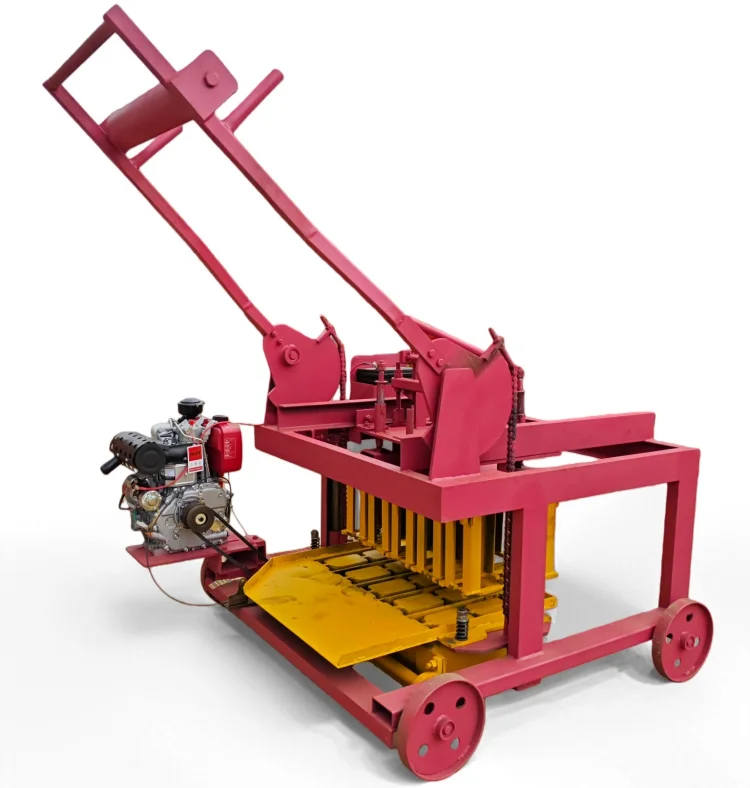
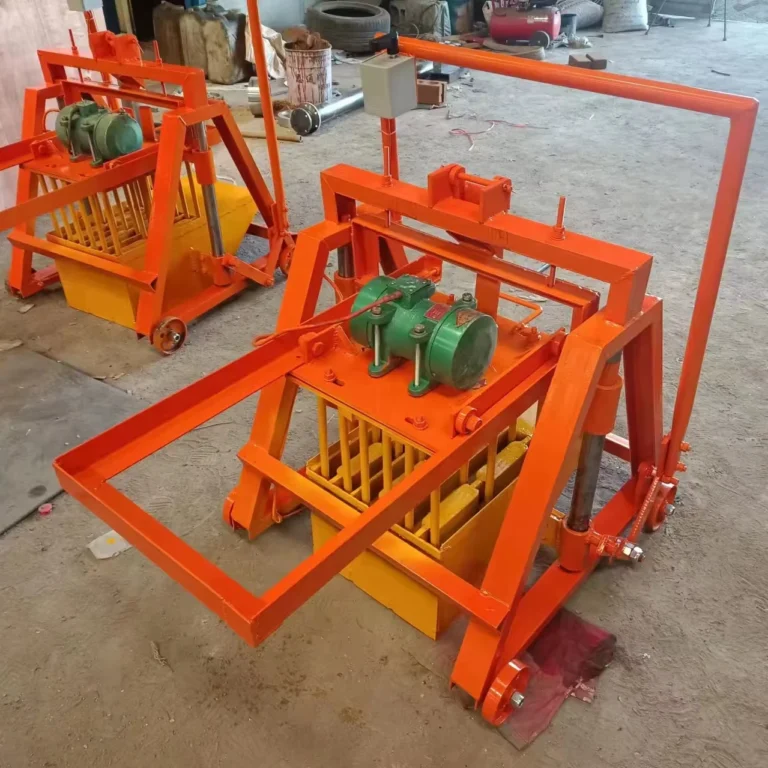
Specified as a matched system — the QMY4-30 mobile block machine, its moulds, pallets and handling are configured together against your local aggregate rather than sourced from separate catalogues.
Technical Specifications
| Parameter |
Value |
| Model |
QMY4-30 |
| Product Type |
Mobile Egg-Laying Concrete Block Making Machine |
| Rated Power |
5 kW |
| Molding Cycle Time |
30 seconds |
| Overall Dimensions (L×W×H) |
1200 × 1200 × 1100 mm |
| Net Weight |
950 kg |
| Acceptable Raw Materials |
Cement, sand, crushed stones, slag |
| Mould Format Capability |
Hollow block and solid brick via changeable moulds |
| Output Capacity (400×200×200mm hollow block, 4 pcs/mould) |
480 pcs/hour |
| Output Capacity (400×150×200mm hollow block, 5 pcs/mould) |
600 pcs/hour |
| Output Capacity (400×100×200mm hollow block, 7 pcs/mould) |
840 pcs/hour |
| Daily Output (400×200×200mm hollow block, 8 hrs) |
3840 pcs |
| Daily Output (400×150×200mm hollow block, 8 hrs) |
4800 pcs |
| Daily Output (400×100×200mm hollow block, 8 hrs) |
6720 pcs |
| Automation Level |
Manual / mobile egg-laying type |
| Pallet Size |
(basis to be confirmed) |
| Hydraulic Pressure |
(basis to be confirmed) |
| Vibration Force |
(basis to be confirmed) |
| Voltage & Frequency |
(basis to be confirmed) |
| Control System |
(basis to be confirmed) |
| Mould Change Time |
(basis to be confirmed) |
Application Suitability
| Application |
Material or Output |
| On-site housing project production |
Hollow blocks from cement, sand and locally sourced crushed stone |
| First-time block plant with no fixed factory |
Solid bricks and hollow blocks on a prepared concrete floor |
| Small workshop supplying local building merchants |
Standard 400×200×200mm hollow blocks using crusher dust and slag |
| Contractor producing kerb or partition blocks on a development site |
Format changeovers between hollow and solid using the same base mix |
What "480 Blocks per Hour" Actually Means for a Mobile Block Machine Manufacturer
Capacity numbers are only real when you know which block format they assume.
Catalogues routinely quote the highest cycle rate a press can achieve, then leave the buyer to discover during commissioning that their best-selling format produces far fewer pieces per shift. With this mobile block machine manufacturer range, every throughput figure is anchored to a specific mould size — 400×200×200mm at four pieces per cycle, 400×150×200mm at five, or 400×100×200mm at seven. When a contractor in West Africa planned their site layout around a generic "thousands per day" claim, the mismatch only surfaced after the first week of production [NEED_CITE: importance of format-specific capacity declarations for mobile block presses]. Tying output to a named format removes that gap before the machine ships.

Where the QMY4-30 Sits on the Investment Ladder
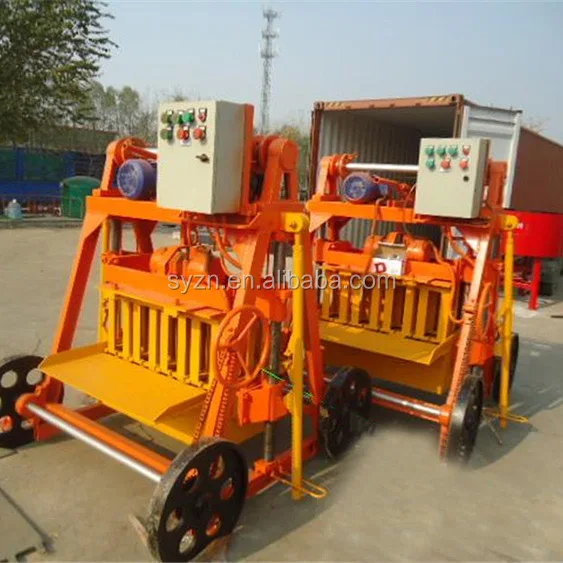
The mobile block machine manufacturer range is structured in tiers, and the QMY4-30 is the entry point for buyers who want production capability without pouring a fixed foundation. It produces blocks by laying them directly onto a level concrete slab — the machine moves forward after each cycle, leaving the freshly pressed blocks to cure in place. For a contractor already mobilised on a housing site, that mobility eliminates the need for a separate factory building, pallet return conveyor, and curing racks. Once project volumes grow or a buyer begins supplying merchants across a region, stepping up to a semi-automatic or fully automatic tier adds pallet handling and stacking while the original machine can still serve as a backup or site-specific unit.
Footprint and Mobility in Practice
At 1200 × 1200 × 1100 mm and 950 kg, the QMY4-30 is sized to be moved by a standard site forklift or a small loader, and it fits within the internal width of a standard shipping container for export [NEED_CITE: container loading dimensions for compact block machines]. A lighter machine in this class would struggle to generate the mass needed for consistent vibration, while a heavier one loses the site-mobility advantage. The compact frame also means the operator works in a tighter loop — mixing, feeding, and pressing happen within a few steps, which matters when daily output depends on manual material handling rather than conveyors.
Reading the Specs That Shape Block Quality
The 30-second cycle time governs how many presses an operator can complete, but the real determinant of block strength is how vibration force and the operator’s mix design interact with local aggregate. Sand with a high clay content absorbs water differently and dampens vibration transmission, which can leave blocks friable even when the cycle count looks healthy [NEED_CITE: effect of aggregate clay content on vibration-formed block strength]. The five-kilowatt rated power is modest, reflecting the fact that the QMY4-30 does not drive hydraulic clamps or conveyor motors — all energy goes into the vibration motor and travel mechanism. Mould changeover is manual, so buyers planning to run multiple formats should factor in the time and labour needed to swap moulds between production runs, rather than assuming instant flexibility. Raw material flexibility across cement, sand, crushed stone and slag means the machine will accept whatever is locally available, but the exact proportions still need on-site trials to dial in.
The Cost of Skipping the Mix Trial
Buyers who order a mobile egg-laying machine on cycle time alone often discover after arrival that their local sand source contains too much fines, producing blocks that crack during handling or fail compression tests on site. The fix is never a machine adjustment alone — it requires reformulating the mix and sometimes sourcing a different aggregate fraction. When this happens, weeks of production are lost while the operator experiments, and the daily output that looked viable on paper collapses. Specifying the machine against a sample of the buyer’s actual raw materials before shipment prevents this, but only if the buyer provides those samples early in the inquiry stage [NEED_CITE: consequences of commissioning block machines without local aggregate testing].
Why Procurement Starts Here
Block machinery is our single focus, so the QMY4-30, its moulds and any supporting pallets are specified as one matched set rather than assembled from separate suppliers. Every configuration is set against the buyer’s actual mix design, local aggregate, and the block formats that sell in their market, not against a catalogue default. Mould design covers the standard hollow and solid formats, and custom drawings are accepted when a buyer’s market demands non-standard dimensions. The automation level is selectable across the range, meaning a buyer can start with the manual QMY4-30 and move to a semi-automatic press later without replacing the knowledge base their operators have already built. Installation and commissioning support includes on-site operator training so the team knows how to adjust vibration and mix ratios when the aggregate source changes.
Documentation & Verification
- Line layout showing the QMY4-30 operating area with curing space marked per block format
- Machine specification sheet confirming voltage, frequency and control language for your destination
- Mould drawing and format list detailing included hollow and solid block dimensions
- Factory test record on your specified mix before dispatch
- Packing photographs and customs documentation support for export shipment
Installation, Commissioning & Support
- Requires a level concrete slab of sufficient area to lay 3840 blocks per shift for 400×200×200mm format curing
- Electrical supply matching the confirmed voltage and frequency, with a dedicated circuit for the 5 kW rated load
- Machine arrives assembled; operator needs training on manual feed rhythm and mould release timing
- First-run commissioning includes vibration adjustment matched to your local sand and crushed stone sample
- Mould and wear parts list provided so replacements can be ordered before the first changeover is due
- Daily maintenance covers vibration motor inspection and mould surface cleaning between format runs
Before You Request a Quote
To match the QMY4-30 to your site, share the block formats you plan to sell, your target daily output, and the source of your sand and aggregate — including any lab test results if available. Confirm the local voltage and frequency, the control language your operators will need, and whether you already have a concrete slab or need guidance on preparing the production area. If you have existing handling equipment such as mixers or wheelbarrows, note those so the line layout accounts for your current workflow.
Frequently Asked Questions
Q: How do I verify the real daily output of the QMY4-30?
A: Every capacity figure we publish is tied to a specific block format. For a 400×200×200mm hollow block at four pieces per mould, the machine produces 480 pieces per hour, or 3840 in an eight-hour shift. Switch to a 400×150×200mm format at five pieces per mould and hourly output rises to 600. We provide a written capacity calculation with your quotation that names the exact format assumed.
Q: Where does the QMY4-30 fit compared to semi-automatic and automatic machines?
A: The QMY4-30 is the manual, mobile entry point — it lays blocks directly on a concrete slab with no pallet return system. Semi-automatic tiers add pallet feeding and fixed-plant operation, while fully automatic lines include stacking and cubing. Starting here keeps capital low, and you can step up later as your market grows.
Q: What voltage, frequency, and control language will be confirmed before shipment?
A: These are confirmed during the quotation stage, not assumed. We document the exact voltage and frequency for your site, along with the language for any control interface, so there are no delays during commissioning after the machine arrives.
Q: Can I upgrade from the QMY4-30 to a higher automation tier later?
A: Yes. The range is structured so operators trained on the QMY4-30 already understand mix handling, cycle rhythm and mould changes. When you move to a semi-automatic or automatic press, that knowledge transfers directly, and the original machine can stay in use on a secondary site.
Q: What mould formats are included, and can I order custom block sizes?
A: The QMY4-30 ships with moulds for standard hollow block and solid brick formats. If your market sells non-standard dimensions, we accept custom mould drawings and will provide a format list and drawing for approval before production.

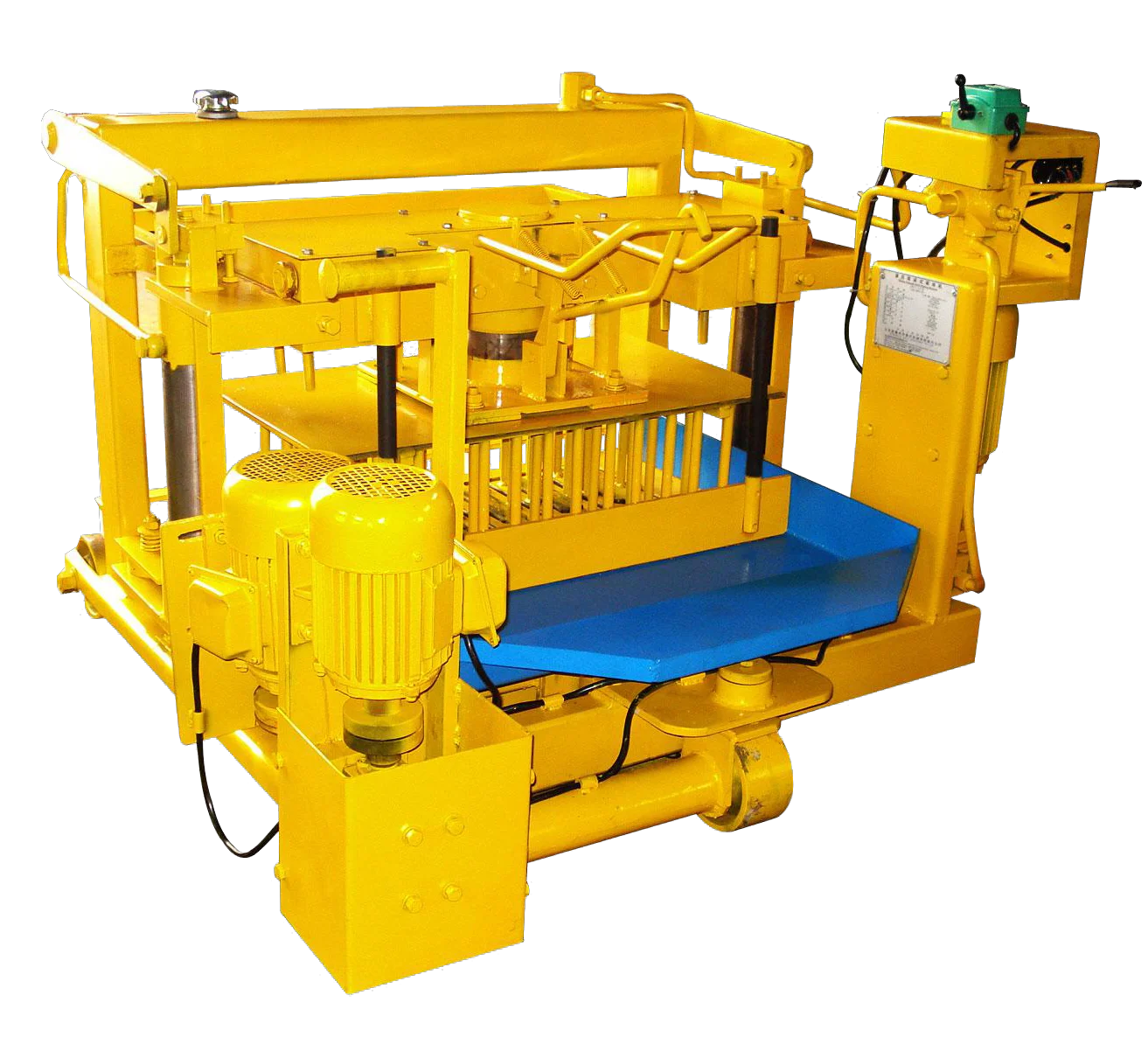
 Mobile block machine