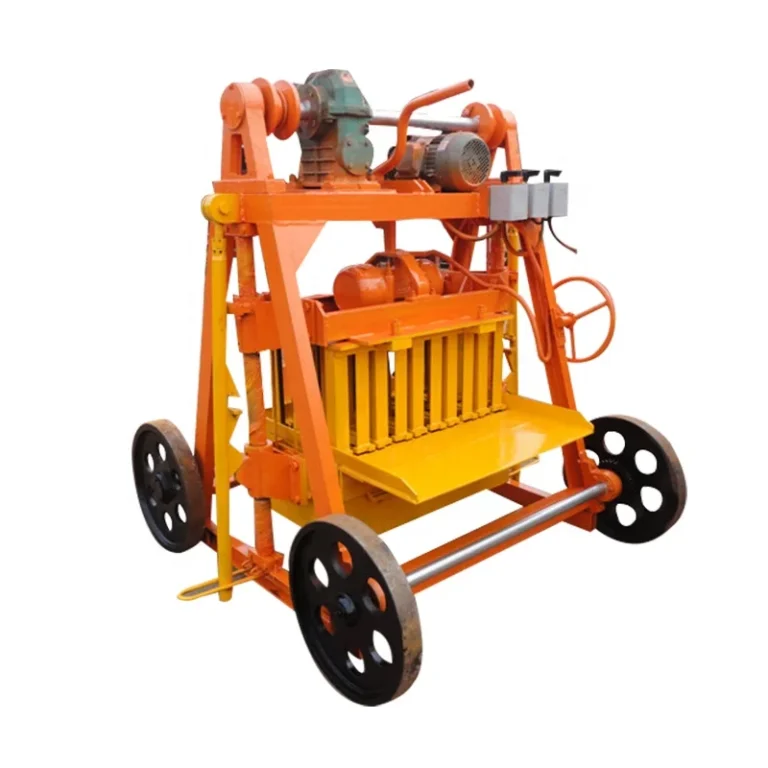
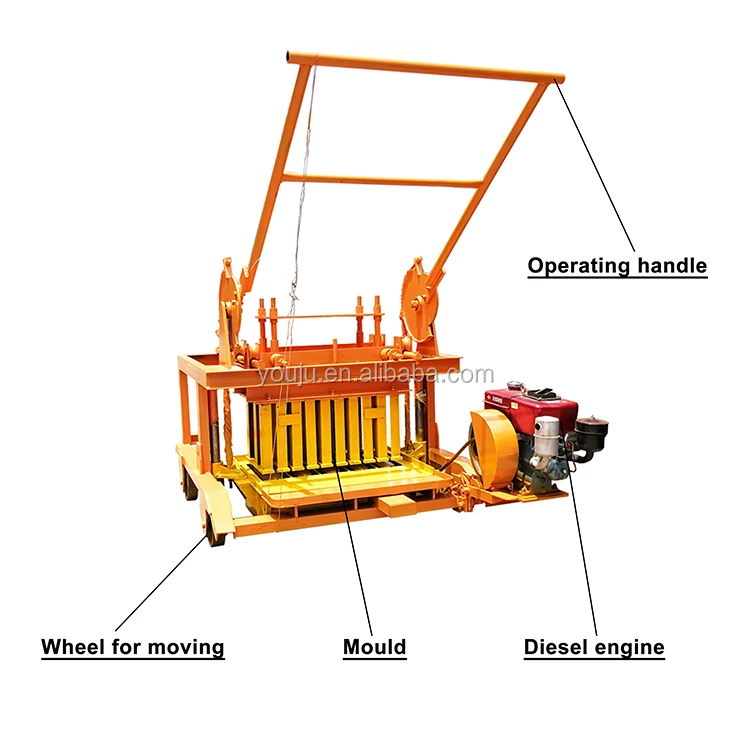
Configuration Set Against Your Mix Design — Every QMY4-30 we ship is adjusted for the buyer’s actual aggregate, cement ratio, and target block format rather than leaving the site crew to guess settings on arrival.
Technical Specifications
| Parameter |
Value |
| Model |
QMY4-30 |
| Product Type |
Mobile Concrete Block Making Machine |
| Rated Power |
5 kW |
| Molding Cycle Time |
30 seconds |
| Overall Dimensions (L×W×H) |
1200 × 1200 × 1100 mm |
| Net Weight |
950 kg |
| Automation Level |
Manual / Mobile egg-laying type |
| Pallet Requirement |
Not applicable — produces directly on ground |
| Mould Format |
Changeable for hollow block and solid brick |
| Output Capacity |
480 pcs/hour based on 400×200×200 mm hollow block, 4 pcs/mould |
| Output Capacity |
600 pcs/hour based on 400×150×200 mm hollow block, 5 pcs/mould |
| Output Capacity |
840 pcs/hour based on 400×100×200 mm hollow block, 7 pcs/mould |
| Daily Output (8 h) |
3,840 pcs based on 400×200×200 mm hollow block |
| Daily Output (8 h) |
4,800 pcs based on 400×150×200 mm hollow block |
| Daily Output (8 h) |
6,720 pcs based on 400×100×200 mm hollow block |
| Raw Materials |
Cement, sand, crushed stones, slag |
| Voltage & Frequency |
Configurable — confirm local supply before order |
| Control System |
(basis to be confirmed) |
| Hydraulic Pressure |
(basis to be confirmed) |
| Vibration Force |
(basis to be confirmed) |
| Warranty |
One year |
Application Suitability
| Application |
Material or Output |
| On-site hollow block production at building projects |
Cement, sand, crushed stone mix laid directly on prepared ground |
| Small-scale solid brick manufacturing |
Cement and sand or slag blend with changeable mould |
| Housing development block supply |
Standard 400×200×200 mm hollow blocks at 4 pcs per cycle |
| Contractor-run yard producing multiple formats |
Swapping moulds between 400×150×200 mm and 400×100×200 mm hollow blocks |
| First-time block plant with minimal infrastructure |
5 kW power draw suits sites with limited electrical supply |
What "Pieces per Hour" Actually Means on a Mobile Block Machine
The number only holds if you know which block format, mould cavity count, and cycle time it was measured against.
I have watched buyers receive a mobile block machine and spend the first week disappointed because the brochure figure assumed a smaller block they were not even planning to produce. One West African contractor expected several thousand large hollow blocks per shift based on a headline capacity, only to learn the quoted figure applied to a thinner partition block. The QMY4-30 is no exception — every output number above ties back to a specific dimension and mould cavity count, so you can match it to the product your market actually buys. [NEED_CITE: block format and cycle time assumptions in capacity quotations]

Placing the QMY4-30 in the Full Machine Range
The QMY4-30 sits at the entry-level of our mobile block machine range. It is an egg-laying type unit that moves along the ground, leaving freshly pressed blocks behind without pallets. For buyers surveying options, this is the lowest-investment starting point — no curing racks, no pallet return system, no fixed plant footprint. When daily volume grows beyond what a single operator can manage on foot, the next step is a semi-automatic stationary press with pallet handling, and eventually a fully automatic line with stacking and cubing.
Why Mould Changeability Matters Before You Commit
A mobile block machine manufacturer who quotes only one block format is leaving money on the table for your yard. The QMY4-30 accepts changeable moulds, so the same frame can press hollow blocks in at least three standard sizes and solid bricks. That flexibility only pays off if the mould change itself is practical on a job site — no heavy overhead crane, no half-day teardown. We supply the mould drawings and format list up front so you can verify which block sizes match your local demand before the machine is built. [NEED_CITE: common hollow block dimensions sold in developing construction markets]
Reading the Numbers That Actually Govern Block Quality
Rated power of 5 kW tells you the machine can run from a small diesel generator set, which matters on remote sites with no grid connection. The 30-second molding cycle is the pacing constraint — it determines how many times per hour the mould fills, presses, and releases. Overall dimensions of 1200 × 1200 × 1100 mm and a 950 kg net weight mean the unit can be loaded onto a flatbed truck and moved between sites without special rigging. Raw material compatibility with cement, sand, crushed stones, and slag covers the aggregates most buyers can source locally, but the vibration force and hydraulic pressure settings must match the specific mix to achieve consistent density. A lean mix with coarse aggregate demands different pressing energy than a rich mix with fine sand, and getting that wrong produces blocks that crumble at the edges or fail a drop test.
What Happens When the Mix Does Not Match the Machine
I once walked a site where the owner blamed the block machine for weak output, but the real problem was local sand with high clay content that the vibration setting could not consolidate properly. Blocks came out of the mould with soft corners and the crew scrapped nearly half the day’s run. On a mobile hollow block machine for sale at this investment level, there is no automated batching system to compensate — the operator controls the mix, and the machine has to handle whatever arrives in the hopper. Confirming your local aggregate gradation and adjusting vibration force before commissioning avoids that costly trial-and-error period. [NEED_CITE: effect of aggregate clay content on concrete block compressive strength]
Why Buyers Source the QMY4-30 Through Our Line
Block machinery is our single focus, so the machine, mould, and any supporting handling equipment are specified as one matched set rather than assembled from unrelated suppliers. We configure the QMY4-30 against the buyer’s actual mix design and target block format, not a catalogue default. Mould design covers the formats the buyer’s market sells, and custom drawings are available when a local standard falls outside the usual range. The automation level is selectable — start with manual egg-laying operation now and move to a semi-automatic stationary line later without changing your product range. Installation support includes on-site commissioning and operator training so the crew is confident before the first production shift.
Documentation & Verification
- Line layout showing ground preparation area for egg-laying production
- Capacity calculation sheet stating the block format behind each output figure
- Mould drawing and format list for every supplied cavity size
- Voltage and control language confirmation record before shipment
- Factory test record on buyer’s specified block format before dispatch
- Wear parts and mould list with part numbers for reordering
Installation, Commissioning & Support
- Level ground with compacted surface required for egg-laying operation of the 1200 × 1200 mm frame
- 5 kW power supply on a dedicated circuit matching confirmed voltage and frequency
- Machine arrives assembled — unload from flatbed and position on production ground
- First-run commissioning covers vibration force adjustment to the buyer’s mix design
- Operator training on mould change procedure and 30-second cycle pacing
- Wear parts list supplied with part numbers for the first replacement cycle
- One-year warranty with technical guidance available during the guarantee period
What to Share Before Requesting a Quotation
Tell us the block formats your local market buys most — dimensions, hollow or solid, and any non-standard sizes. Confirm the aggregates available near your site, including sand gradation and whether crushed stone or slag is the coarse fraction. Let us know your site voltage and frequency so the motor and control panel arrive ready to connect.
Frequently Asked Questions
Q: How is daily output calculated for the QMY4-30 and which block format does each figure assume?
A: Each output figure ties to a specific block dimension and mould cavity count. For example, 3,840 pieces per eight-hour shift assumes 400×200×200 mm hollow blocks at four pieces per mould with a 30-second cycle. Switching to a smaller block increases the number because more cavities fit in the same mould frame.
Q: What block sizes and mould options can the QMY4-30 produce?
A: The machine accepts changeable moulds for hollow blocks and solid bricks. Standard cavity plates cover 400×200×200 mm, 400×150×200 mm, and 400×100×200 mm hollow blocks. Custom mould drawings are available for formats that fall outside these three sizes.
Q: What voltage and frequency options are available, and how are they confirmed?
A: Voltage and frequency are configurable to match the buyer’s local supply. We confirm the exact rating, phase, and control panel display language before production begins so the machine is ready to connect on arrival without rewiring or component swaps.
Q: Where does the QMY4-30 fit in the full machine range and what is the upgrade path?
A: The QMY4-30 is the entry-level mobile egg-laying unit. When volume grows, the next step is a semi-automatic stationary press with pallet feeding and manual stacking, followed by a fully automatic line with pallet return, automatic stacking, and cubing.
Q: What raw material mix does the QMY4-30 need for consistent block strength?
A: The machine handles cement, sand, crushed stones, and slag. Consistent strength depends on matching vibration force and hydraulic pressure to the specific aggregate gradation and cement ratio. We review the buyer’s local material before setting the press parameters.

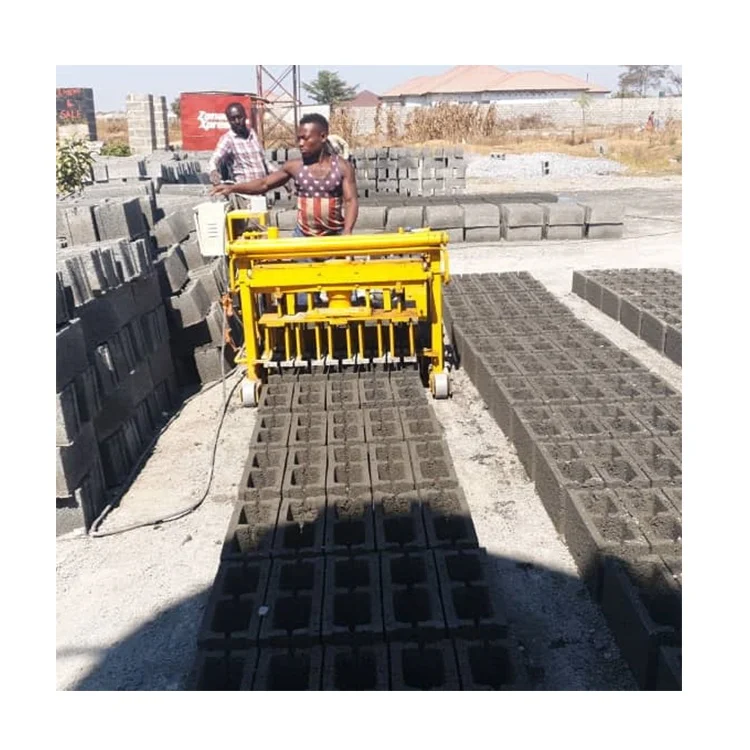
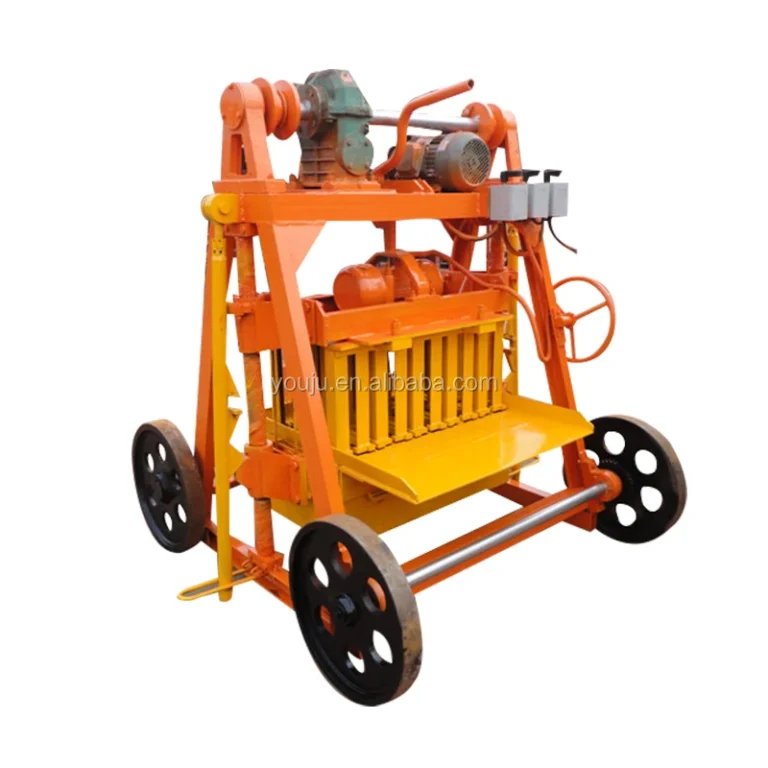 Mobile block machine