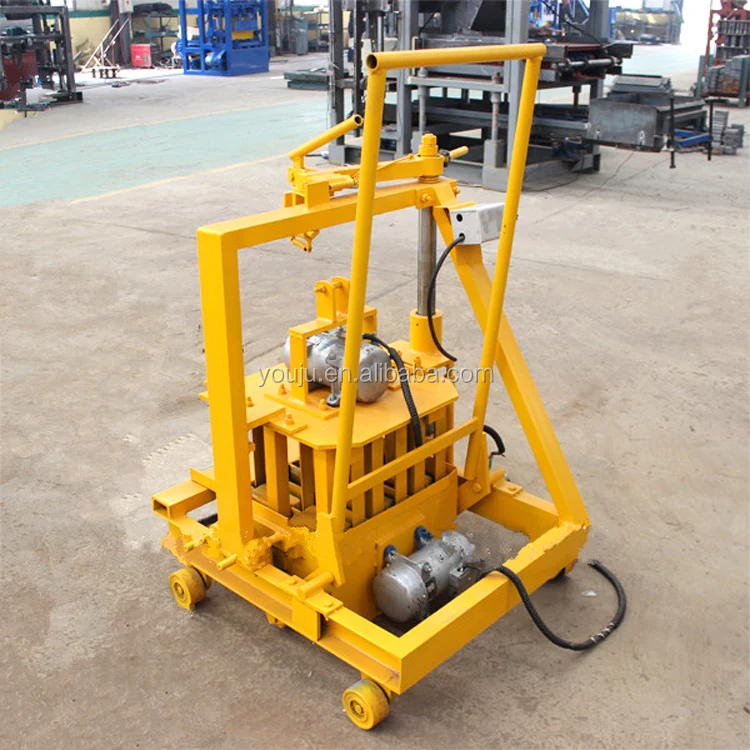
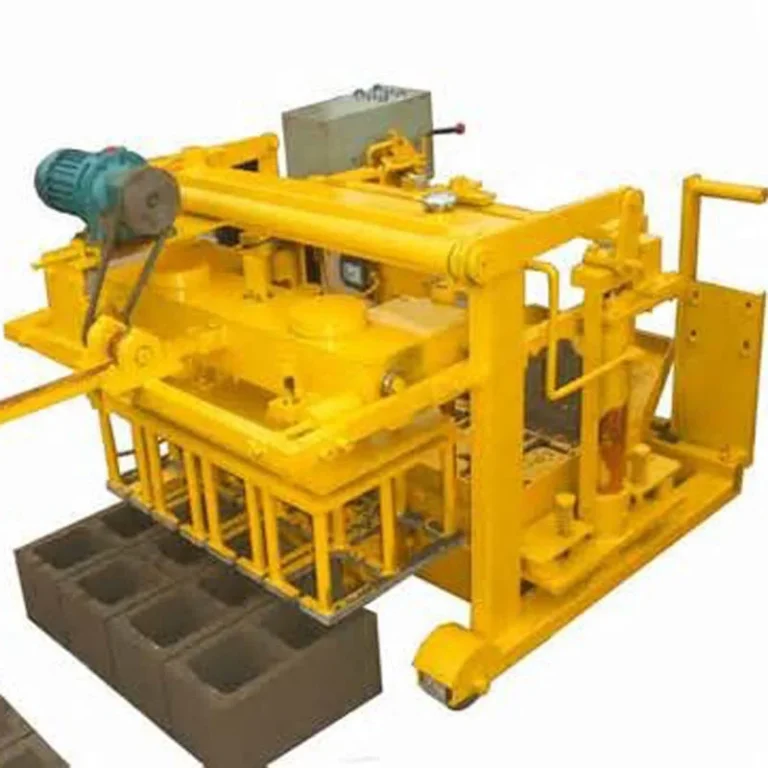
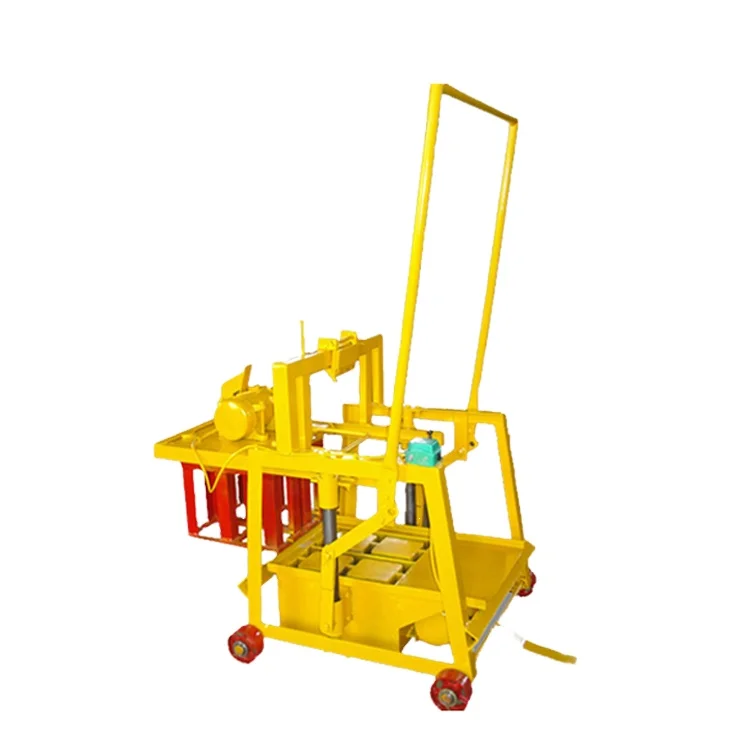
Matched System Design — The QMR4-45 is specified alongside its mixer, trolley and mould options as one coordinated mobile block making machine manufacturer package, so capacity and power are calculated together rather than quoted as isolated press figures.
Technical Specifications
| Parameter |
Value |
| Model |
QMR4-45 |
| Product Type |
Mobile Block Making Machine |
| Overall Dimensions (L×W×H) |
1100 × 950 × 2100 mm |
| Net Weight |
810 kg |
| Molding Cycle |
30–45 s |
| Power Source Options |
Diesel engine / Petrol engine / Electric motor |
| Output Capacity |
2,560 pcs/day (basis not stated in source — confirm block format, material and thickness) |
| Compatible Mould Formats |
Paver brick, hollow block, concrete block, solid brick, fly ash brick |
| Pallet Requirement |
None — egg-laying design |
| Included Basic Equipment |
JZC350 Diesel Concrete Mixer or JQ350 Diesel Concrete Mixer with Electric Generating Unit; Trolley |
| Warranty |
1 Year |
Application Suitability
| Application |
Material or Output |
| On-site hollow block production for building contractors |
Crushed stone, sand, cement mixes laid directly on prepared ground |
| Solid brick runs for small masonry projects |
Fly ash blends or river sand with cement binder |
| Paver brick batches for walkways and yards |
Fine aggregate with pigment-loaded face mix |
| First-production trials by new block entrepreneurs |
Any locally sourced aggregate matched to available mould format |
| Remote site work without grid access |
Diesel-powered mixer feeding the mobile press on compacted soil |
What "2,560 Pieces per Day" Actually Depends On
Capacity only means something once the block format, mix design and mould are named.
Catalogue sheets for entry-level machines often quote a single daily figure that assumes the smallest, thinnest brick the frame can produce. When a buyer switches to a standard 400×200×200 mm hollow block, the cycle still takes 30–45 seconds but each cycle yields fewer units per mould impression, so real daily volume drops noticeably. A mobile block making machine manufacturer should supply a capacity table that lists output for every mould format the buyer intends to run, not a single headline number. I have seen site supervisors plan their curing area around the catalogue figure and run out of space for the actual hollow block run because the true output per mould was never confirmed [NEED_CITE: block format and cycle time capacity calculation standards].

Where the QMR4-45 Sits in the Range
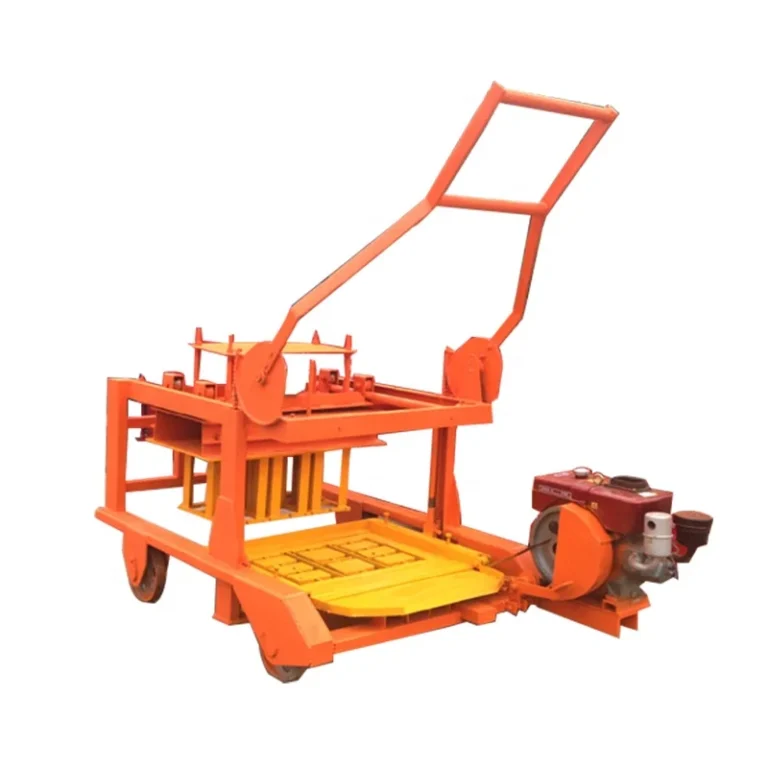
This model occupies the entry tier of the SHIYUE mobile block machine range. It is designed for buyers who need production on a building site or a small yard without investing in fixed foundations, pallets or a curing rack system. The egg-laying principle means the press forms blocks directly on the ground and moves forward, leaving the fresh units to cure in place. For a contractor who already has a slab of compacted earth and a diesel mixer, the QMR4-45 removes nearly every infrastructure cost that a static plant would demand.
Pallet-Free Operation and What It Removes
Because the machine lays blocks on the ground, there are no pallets to purchase, rotate, store or replace. Pallet cost is a recurring expense in static plants that first-time buyers tend to underestimate. Eliminating pallets also removes the pallet feeding station, the return conveyor and the de-stacker, which keeps the total system weight at 810 kg and allows two operators to relocate the unit around a site. The trade-off is that ground flatness and surface preparation become part of the production process rather than something the machine handles internally [NEED_CITE: ground preparation requirements for egg-laying block machines].
Reading the Specs That Matter
The 30–45 second molding cycle is the window from hopper fill to press release. For a standard hollow block, the longer end of that range is typical because the vibration must consolidate a deeper cavity. The three power source options — diesel, petrol and electric — are not merely a fuel choice; they determine whether the machine can operate on a remote road project with no grid or on a yard with stable three-phase supply. Selecting electric but arriving at a site with only single-phase power is a mistake I have watched delay commissioning by weeks while a transformer is sourced. The included JZC350 or JQ350 mixer is sized to feed one QMR4-45 continuously, so adding a second press later means adding a second mixer rather than overloading the first. Mould change on this frame is manual, and buyers who plan to run multiple formats should confirm the changeover time per mould before committing to a tight production schedule.
The Hidden Cost of Skipping Voltage Confirmation
Ordering the electric variant without confirming site voltage and frequency is the single most common cause of idle machines on arrival. A 380 V motor shipped to a 440 V site will either trip immediately or burn out within days. Re-winding or replacing the motor on-site adds cost, and the downtime stalls the entire construction schedule. Even the PLC or relay panel language matters — an operator who cannot read the control display will revert to manual timing, which defeats the consistency the machine was designed to deliver [NEED_CITE: industrial motor voltage and frequency compatibility standards].
Why Source This Machine Here
Block machinery is our single focus, so the QMR4-45 is not paired with a generic mixer from a separate supplier; the JZC350 or JQ350 is matched to the press cycle so material arrives at the hopper without bottlenecks. Configuration is set against the buyer’s local aggregate and target block format, not a catalogue default. Moulds are designed and supplied in-house for the formats the buyer’s market actually sells, including custom drawings if a non-standard paver shape is needed. The automation level is selectable — a buyer can start with this mobile unit and move up to a semi-automatic or fully automatic static line later, with pallets and handling added at that stage. Installation support covers the first production run on the buyer’s ground, not just a drop-off at the gate.
Documentation & Verification
- Capacity calculation sheet stating block format, size and mix assumed for each mould
- Machine specification sheet confirming selected power source and site voltage match
- Mould drawing and format list for every brick type included in the order
- Factory test record with cycle timing on the buyer’s chosen block format before dispatch
- Operation and maintenance manual covering mould change, lubrication and ground prep steps
- Packing photographs and customs documentation support for export shipment
Installation, Commissioning & Support
- Ground must be compacted and level within tolerance for the 1100 × 950 mm machine footprint
- Electric variant requires confirmed three-phase voltage and dedicated circuit breaker before dispatch
- Machine ships assembled; trolley and mixer are bolted on-site by two operators
- First-run commissioning includes cycle timing adjustment to the buyer’s specific mix design
- Operator training covers mould change procedure and daily vibration plate inspection
- Wear parts list and mould inventory supplied with recommended reorder intervals
What to Prepare Before You Enquire
To configure the QMR4-45 correctly, share the block formats your market sells, the local aggregate you can source, and whether your site has grid power or requires diesel operation. Tell us the available ground area for production and curing so we can confirm whether the egg-laying cycle fits your layout.
Frequently Asked Questions
Q: How is the 2,560 pcs/day capacity calculated, and which block format does it assume?
A: The figure is based on a specific mould and cycle time that the source document does not state. Before ordering, request a capacity breakdown that lists daily output for each block format you plan to produce, including hollow, solid and paver, so you can plan curing space accurately.
Q: Diesel, petrol or electric — which power source fits my site conditions?
A: If your site has stable three-phase grid power at the correct voltage and frequency, electric is the lowest running cost option. Remote or off-grid sites where only fuel is available should use the diesel variant with the included JZC350 mixer and generating unit.
Q: What block formats and mould sizes are available for the QMR4-45?
A: The machine accepts moulds for hollow block, solid brick, paver brick, concrete block and fly ash brick. Custom mould drawings can be produced for non-standard shapes if the buyer provides dimensional specifications and target market requirements.
Q: What ground preparation does the mobile machine need to produce quality blocks on-site?
A: The surface must be compacted, level and free of loose debris so blocks cure without tilting or cracking. A concrete slab or well-rolled hardcore base gives the most consistent results, and the area must extend far enough to hold a full day’s output before blocks are moved.
Q: Where does the QMR4-45 sit in the full SHIYUE block machine range, and what is the upgrade path?
A: It is the entry-level mobile unit for buyers who need on-site production without fixed infrastructure. The upgrade path moves to semi-automatic static lines with pallet systems and then to fully automatic plants with stacking and cubing, depending on output growth.

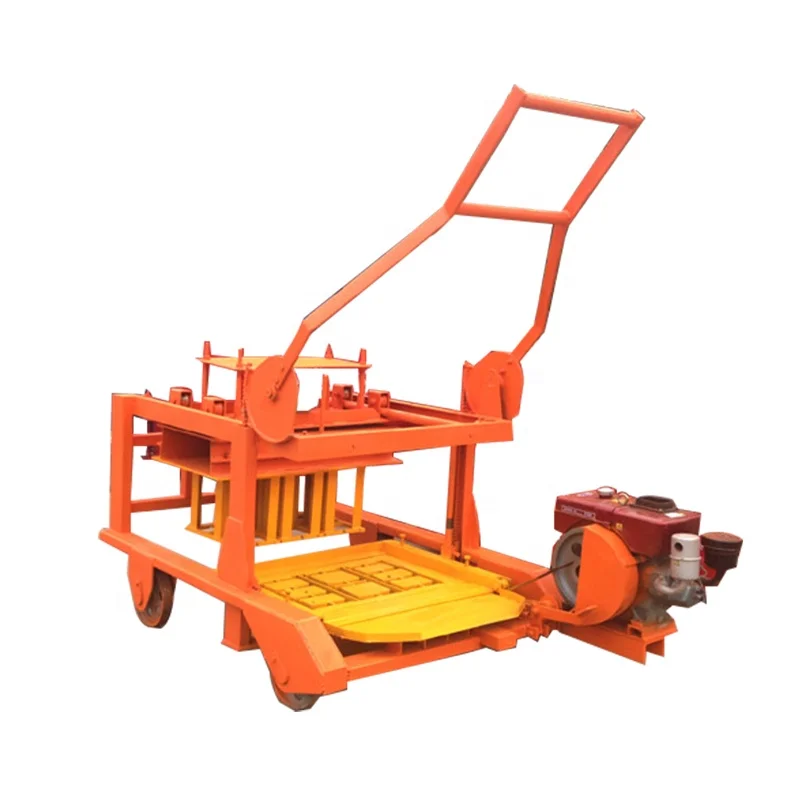
 Mobile block machine