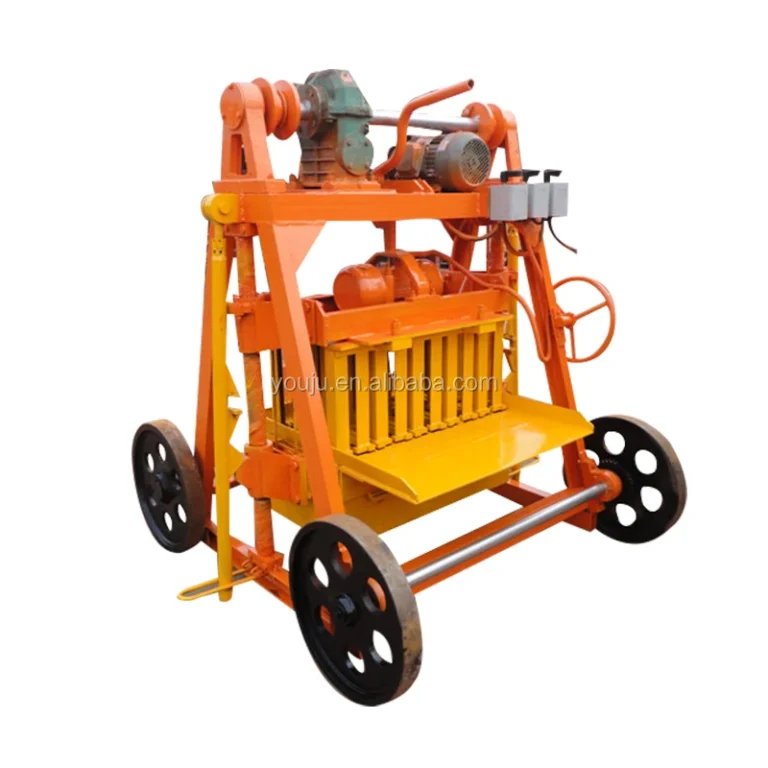
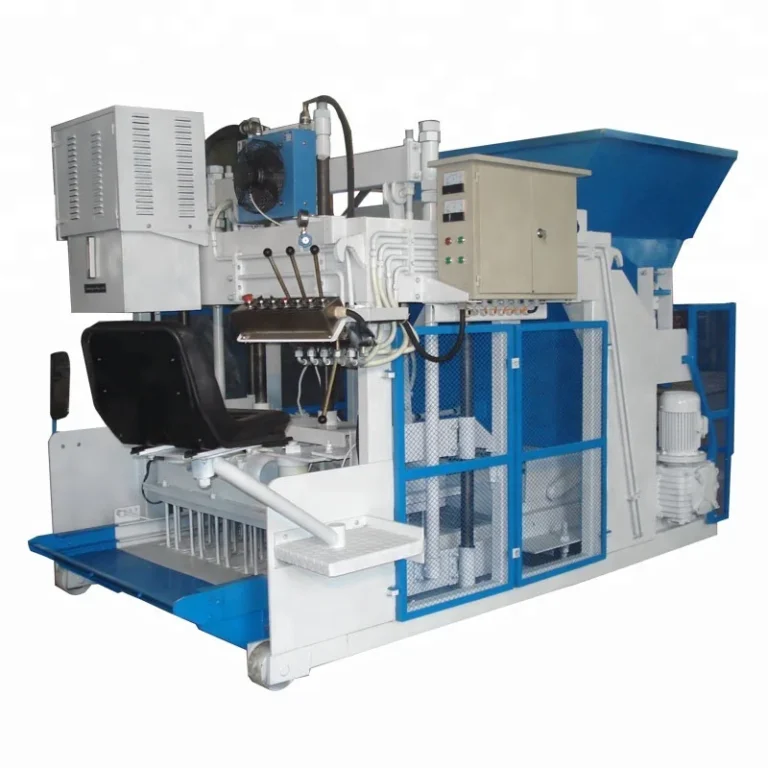
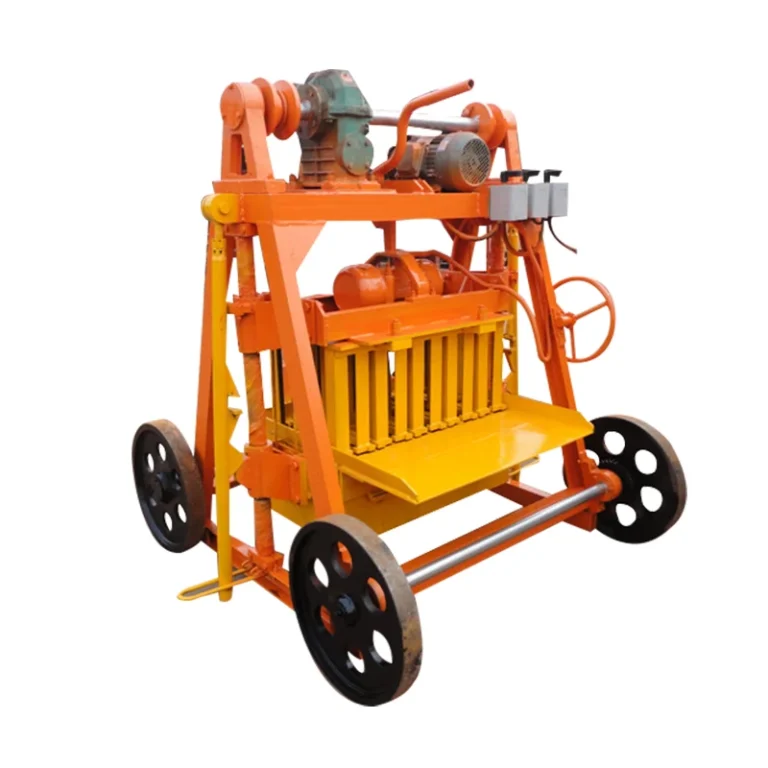
Single Focus Design — machine, mould, pallet and handling specified as one matched system rather than assembled from separate suppliers, applied here to a diesel mobile unit where on-site conditions vary daily.
Technical Specifications
| Parameter |
Value |
| Model |
QMR4-45 |
| Product Type |
Mobile Diesel Block Making Machine |
| Power Source |
Diesel Engine |
| Rated Power |
8 hp |
| Vibration Force |
60 KN |
| Molding Form |
Vibration and Pressure |
| Molding Cycle |
45s (basis not stated in source — confirm block format / material / thickness) |
| Total Weight |
800 kg |
| Overall Dimensions |
2420 × 1320 × 1650 mm |
| Pallet Requirement |
None (egg-laying type, blocks laid directly on ground) |
| Basic Equipment Included |
JZC350 or JQ350 Diesel Concrete Mixer; Trolley |
| Automation Level |
Manual operation |
| Stacking Method |
Manual |
| Mould Compatibility |
Hollow block, solid brick, paver brick, fly ash brick, concrete block |
Application Suitability
| Application |
Material or Output |
| On-site hollow block production for housing projects |
Crushed stone, cement, sand, water |
| Remote construction sites without grid electricity |
Local aggregate with diesel-powered mixing and pressing |
| Small-scale brick yard startup |
Solid brick and paver formats from fly ash or cement mixes |
| Development contractor producing blocks locally |
Concrete block and kerbstone from available regional sand and gravel |
What the "45-Second Cycle" Actually Means on Your Site
A cycle time only translates to daily output when the block format, mix design, and ground conditions are confirmed together.
Many mobile block machine buyers receive a cycle figure and multiply it across an eight-hour shift, only to find real production falls short once the mixer cannot keep pace, the ground is uneven, or the local sand has high clay content that weakens the block. I once spent weeks with a Middle East contractor whose QMR4-45 was producing blocks at roughly half the expected volume because the local sand carried a heavy clay fraction that demanded longer vibration and a tighter mould gap. The machine was not at fault — the specification had never been matched to the material [NEED_CITE: local aggregate testing standards for concrete block production].

Where the QMR4-45 Sits in the Range
The QMR4-45 occupies the entry tier of the mobile block machine manufacturer range, sitting below the semi-automatic stationary plants that require pallets, curing racks, and a prepared concrete floor. Buyers who choose this tier are typically working on a single building site or a remote housing project where laying blocks directly on cleared ground is the only practical option. The diesel engine removes the dependency on grid power, which matters when you are producing on a plot that has not yet been connected to utilities.
Mobility Versus Output — the Honest Trade-Off
A mobile egg-laying machine produces fewer blocks per shift than a stationary press of comparable vibration force because every cycle includes the time to push the unit forward and level it on the ground. The 60 KN vibration force is sufficient for standard hollow block and solid brick formats, but thicker paver blocks may require a longer cycle or a second pass to reach target density. The trade-off is straightforward: you accept a lower shift volume in exchange for zero pallet investment, no curing rack infrastructure, and the ability to produce exactly where the blocks will be used [NEED_CITE: mobile versus stationary block press output comparison].
Reading the Specification Sheet Against Your Material
The 8 hp diesel engine drives both the vibration motor and the hydraulic pressure system through a belt arrangement, which means engine load fluctuates with each moulding cycle. The 60 KN vibration force is generated at the mould table, and its effectiveness depends on how well the mix flows into the mould cavity — a dry, well-graded aggregate will compact faster than a wet or poorly graded one. The 45-second cycle figure assumes a standard hollow block; a 400 × 200 × 200 mm block may hold that cycle, while a thinner paving block could compress it and a taller kerbstone could extend it. Ground bearing capacity also matters: soft soil will cause the machine to settle unevenly, producing blocks of inconsistent height across a single run.
When the Wrong Mixer Choice Cuts Your Shift Short
The QMR4-45 ships with either a JZC350 or JQ350 diesel mixer. Choosing between them is not a trivial detail: a drum mixer like the JZC350 handles stiff concrete well but takes longer per batch, while a pan mixer like the JQ350 turns out a more uniform mix faster but demands more maintenance on its blades. If the mixer cannot deliver a fresh batch before the press completes its current cycle, the operator stands idle and the shift volume drops. I have seen contractors pair the machine with a smaller mixer to save on initial cost, only to realise the bottleneck had simply moved from the press to the mixer [NEED_CITE: batch mixer sizing for small block plants].
Why Source This Tier From a Dedicated Block Machinery Supplier
Block machinery is the single product focus here, which means the QMR4-45 is not one item in a general machinery catalogue but part of a system where the mould, the mixer, and the trolley are specified to work together. Moulds are built to the block formats your local market actually sells, and custom drawings are accepted when standard formats do not match. The specification process starts with your target block size and local aggregate before the quotation is issued, so the cycle time and daily output are stated against your real conditions rather than a catalogue default. Voltage and control language are confirmed before production, and a factory test record on your chosen block format accompanies the shipment.
Documentation & Verification
- Machine specification sheet confirming vibration force, diesel engine rating, and overall dimensions
- Mould drawing and format list matching the block types your market requires
- Capacity calculation stating the block format and mix assumed for the 45-second cycle
- Factory test record on your specified block format before dispatch
- Operation and maintenance manual with diesel engine service intervals
Installation, Commissioning & Support
- Level compacted ground required across the production area to maintain consistent block height from the 800 kg unit
- Diesel fuel supply and engine oil checked before first start of the 8 hp engine
- Mixer positioned within trolley reach so loaded batches feed the mould hopper without delay
- Vibration frequency and mould gap adjusted on-site to match your local aggregate and target block density
- Mould change procedure demonstrated with your chosen format, including bolt pattern and alignment pins
- Wear parts list provided for mould liners, vibration springs, and mixer blades with recommended replacement intervals
What to Prepare Before Requesting a Quotation
Share your target block dimensions and daily volume requirement so the mould configuration and mixer pairing can be sized accordingly. Provide a sample or description of your local sand and aggregate — particularly clay content and maximum particle size — because this directly affects vibration time and block strength. Confirm whether you need an electric generating unit alongside the diesel mixer, and state the language you want on any control labels so commissioning is not delayed after arrival.
Frequently Asked Questions
Q: How is the QMR4-45 daily output calculated, and which block format is assumed?
A: The 45-second cycle is a reference figure that must be confirmed against your specific block size, mix design, and ground conditions. Daily output also depends on mixer batch time and operator workflow. A capacity calculation stating the assumed format is provided with every quotation so you know the basis before committing.
Q: Where does the QMR4-45 sit versus semi-automatic and automatic tiers?
A: It is the entry-tier mobile option, producing blocks directly on the ground without pallets or curing racks. Semi-automatic and automatic tiers use stationary presses with pallet handling, stacking, and higher shift volumes. The QMR4-45 suits site contractors and first-time buyers who prioritise low investment and on-site flexibility over maximum throughput.
Q: What site footprint and ground conditions does the mobile machine require?
A: The machine measures 2420 × 1320 × 1650 mm and needs a flat, compacted area to travel across while laying blocks. Soft or uneven ground causes inconsistent block height. The production area must be large enough for the machine path, mixer placement, and block curing space, with no overhead obstructions below 1650 mm clearance.
Q: Is the diesel engine the only power option, or can an electric configuration be specified?
A: The QMR4-45 is configured with a diesel engine for sites without grid electricity. An electric generating unit can be included in the basic equipment package to power auxiliary components. For sites with reliable grid access, a fully electric stationary model from the same range may offer higher output and should be evaluated alongside.
Q: What mould formats are available, and can custom moulds be supplied?
A: Standard moulds cover hollow block, solid brick, paver brick, fly ash brick, and concrete block. Custom moulds are built to buyer drawings when the local market requires formats outside the standard range. Mould change time and bolt patterns are confirmed during specification so format switching does not consume excessive shift time.

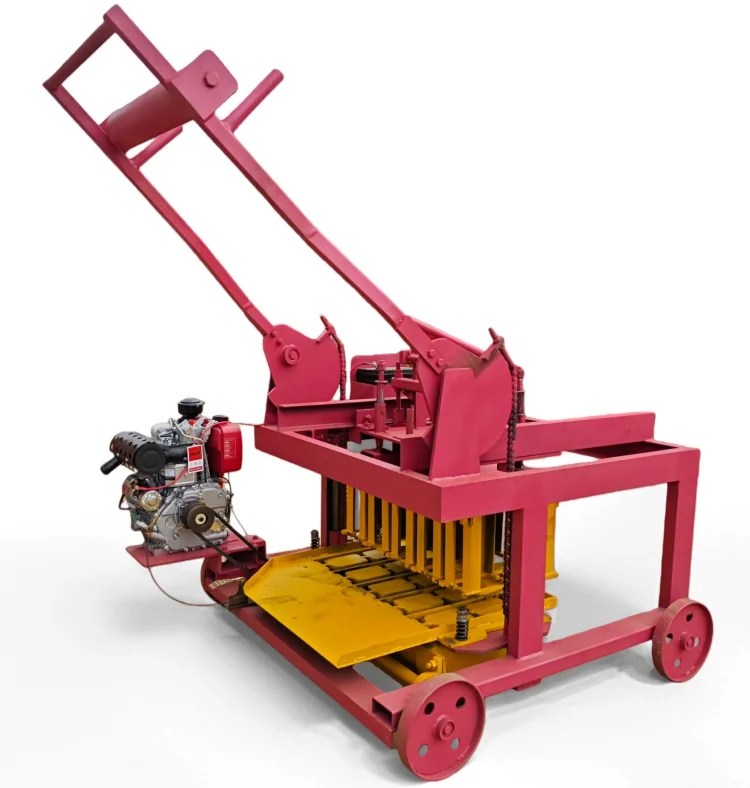
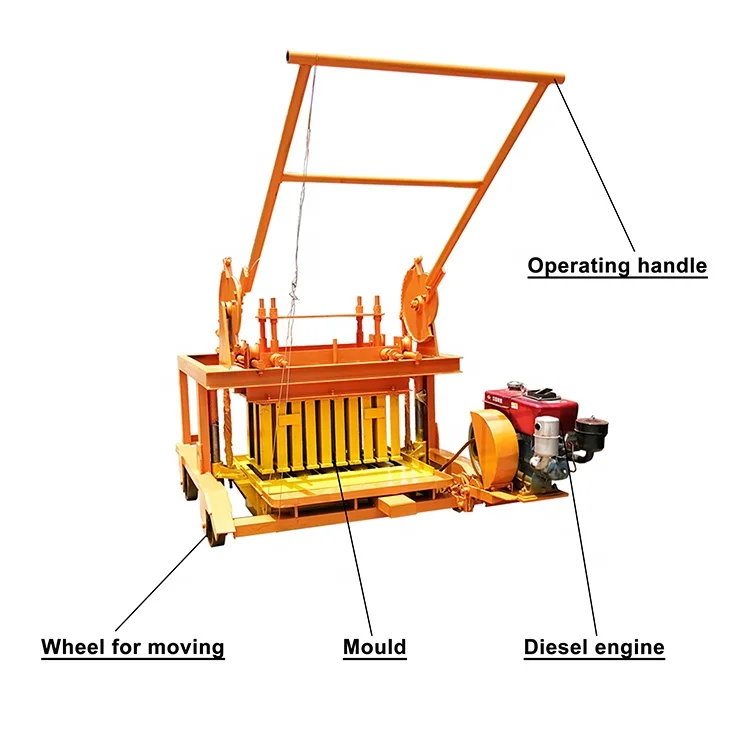 Mobile block machine