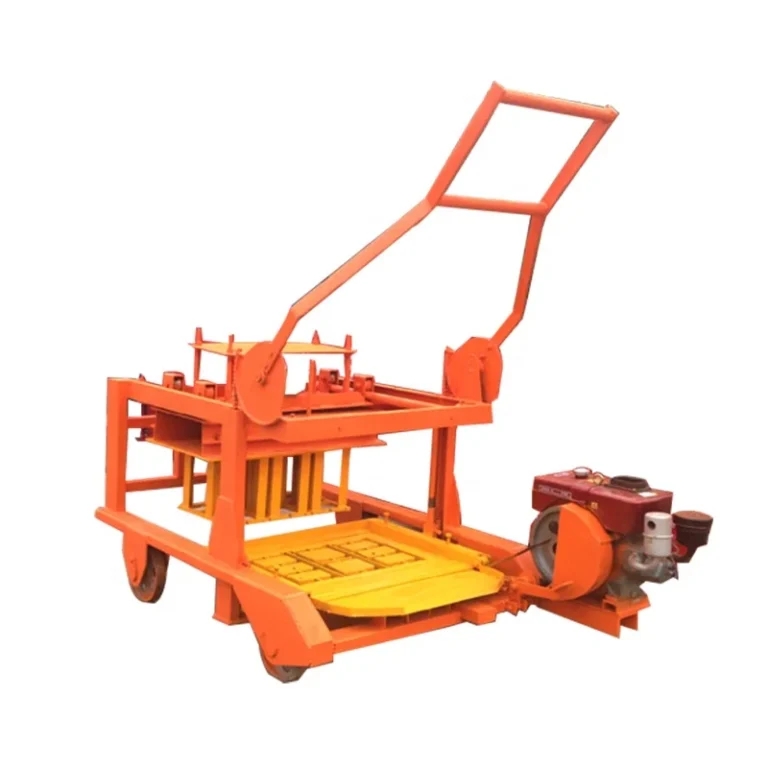
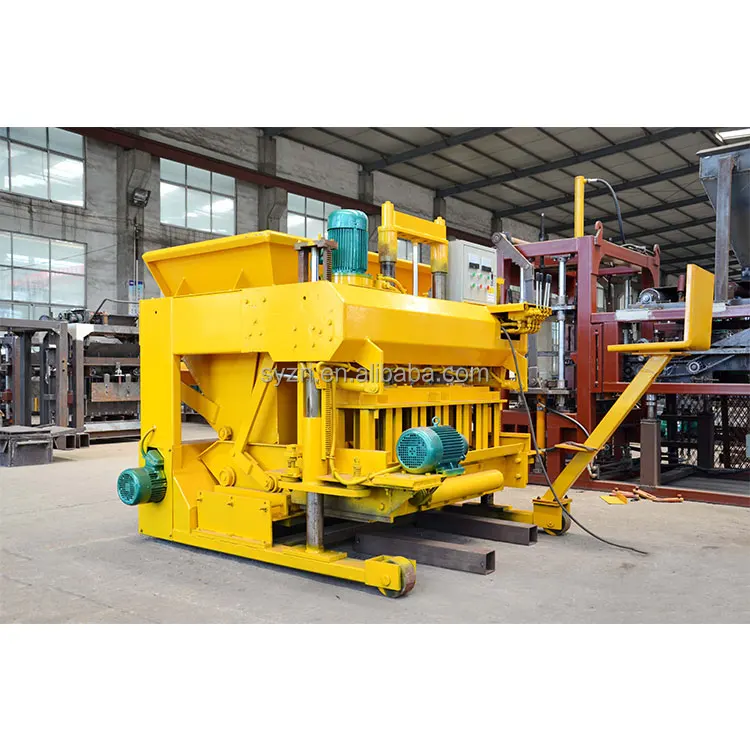
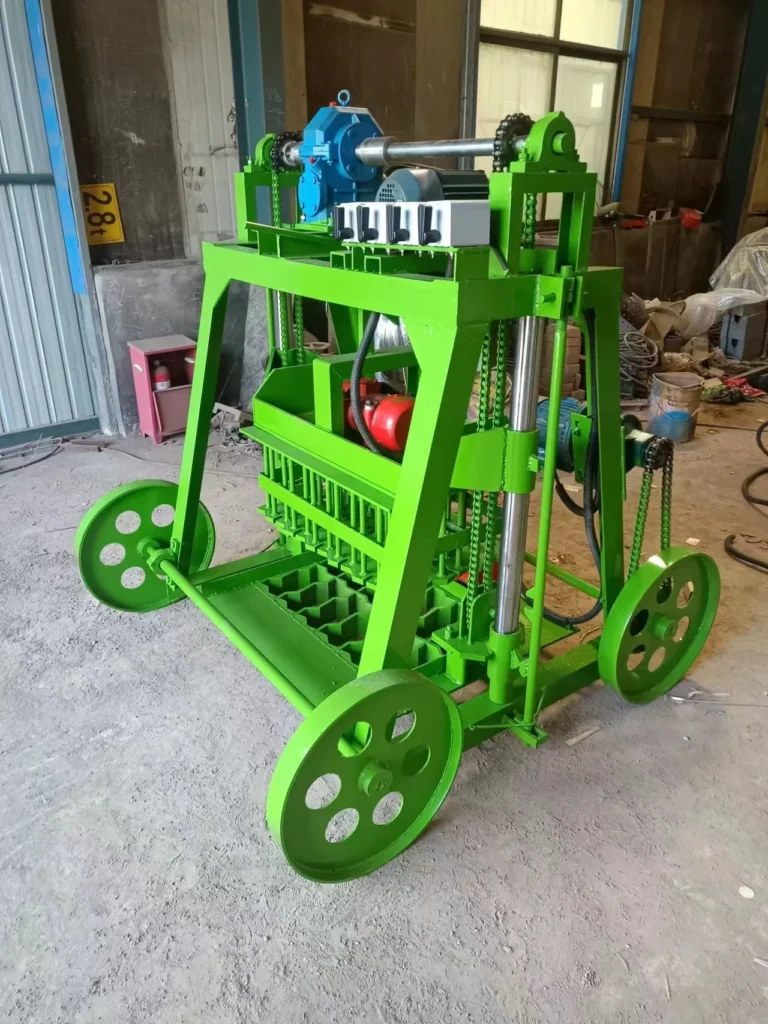
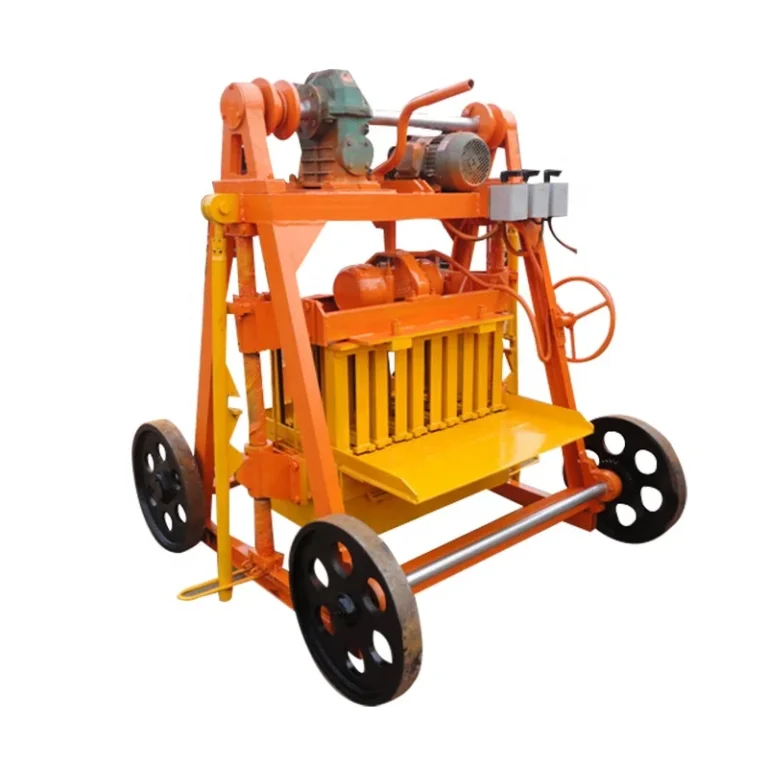
Complete mobile block machine range from entry-level egg layer to higher-output models, positioned by investment and site footprint
Technical Specifications
| Parameter |
Value |
| Model |
QMJ4-45 |
| Product Type |
Mobile Egg Laying Block Making Machine |
| Molding Capacity |
4 pcs/mold (basis to be confirmed) |
| Molding Cycle |
45 s |
| Vibration Method |
Mold vibration |
| Vibration Frequency |
2400 r/m |
| Demold Method |
Manual |
| Turning Method |
Manual |
| Total Power |
6 kW |
| Power Source |
Diesel / Petrol engine |
| Pallet Requirement |
None (egg laying on ground) |
| Automation Level |
Manual |
| Productivity (400×200×200 mm hollow block) |
4 pcs/mould, 40-45 s cycle, 3000 pcs/day (8 hours) |
| Productivity (400×150×200 mm hollow block) |
5 pcs/mould, 40-45 s cycle, 3500 pcs/day (8 hours) |
| Productivity (400×120×200 mm hollow block) |
6 pcs/mould, 40-45 s cycle, 4500 pcs/day (8 hours) |
Application Suitability
| Application |
Material or Output |
| On-site hollow block production at existing cement working sites |
Concrete mixes using local sand, gravel, and cement |
| Small-scale block plants without fixed production lines |
Standard and custom hollow block formats |
| Construction contractors producing blocks directly at project locations |
Diesel-powered operation where grid electricity is unavailable |
Why Daily Output Figures Can Mislead a Buyer
The capacity of a mobile block machine manufacturer must be stated against a specific block format, otherwise the daily tonnage is just a guess.
Quoted output often assumes a standard 400×200×200mm block, but most sites actually produce a mix of 150mm and 120mm partitions. When the format changes, the mould cavity count changes, and so does the hourly yield. Buyers working to a project deadline often find their real daily total falls short of the quoted figure because the machine was sized for a block they rarely make. [NEED_CITE: concrete block format demand by regional construction market]
Matching the Machine Tier to the Project Scale
The QMJ4-45 sits at the entry-level of our mobile egg-laying range. It is designed for buyers setting up their first on-site production without the capital outlay for a fixed plant and pallet circuit. The manual demold and turning keep the operation simple, while the diesel or petrol engine removes dependence on grid power at remote project locations. This mobile block machine manufacturer configuration is about removing infrastructure barriers, not maximizing automation.
Pallet-Free Operation and Site Footprint
Egg-laying machines produce blocks directly on the ground, which eliminates the need for a pallet return system, curing racks, and the forklift traffic that a fixed line requires. The trade-off is that the site must have a large, flat, and cured concrete floor area ready to receive the freshly pressed blocks. The footprint of the QMJ4-45 is just the machine itself and the operator’s walking path, making it a viable mobile block machine manufacturer solution for tight urban sites or temporary project yards. [NEED_CITE: site preparation requirements for egg laying block machines]
The Physics of Mold Vibration and Block Density
The 2400 r/m mold vibration is the core of the forming process. In a manual egg-laying machine, the vibration must be intense enough to compact the concrete mix into the mould cavity in a 40-45 second cycle, but controlled enough that the machine does not "walk" across the site floor. The twice-vibration molding core improves density by settling the aggregate in two stages, which is critical when using local sands that may have inconsistent moisture or clay content. The 6 kW total power is sufficient to drive this vibration and the manual hydraulic assist without requiring a heavy-duty generator.

The Hidden Cost of Ignoring Local Aggregate
The most common failure point for entry-level mobile machines is not mechanical, but material. If the local sand has a high silt content or the gravel is poorly graded, the 45-second cycle will not produce a block with sufficient green strength to survive the egg-laying drop. The operator will be forced to increase the cement content to compensate, which destroys the project’s margin. We always recommend a trial run with the buyer’s actual aggregate before the machine leaves the factory, so the vibration frequency and cycle time can be adjusted to the specific mix design. [NEED_CITE: effect of aggregate gradation on concrete block compressive strength]
Why Sourcing the Complete System Matters
We focus exclusively on block machinery, which means the QMJ4-45 is not an assembled collection of generic parts. The moulds are designed to match the machine’s vibration profile, and the diesel engine is sized to the 6 kW demand. When a buyer needs a custom block format for a local housing project, we design the mould to the buyer’s drawing and test it on our factory floor. The documentation package includes a capacity calculation that states the exact block format and cycle time, so the buyer can plan their project timeline with confidence. [NEED_CITE: CE machinery directive requirements for industrial equipment]
Documentation & Verification
- Line layout and capacity calculation stating the block format assumed for each productivity figure
- Machine specification sheet confirming vibration frequency, power source, and molding cycle per format
- Mould drawing and format list showing available block sizes and mould change procedure
- Factory test record on the buyer’s specific block format before dispatch
- Operation and maintenance manual with wear parts and mould list
- CE declaration where applicable and customs documentation support
Installation, Commissioning & Support
- Site must have a flat, cured concrete floor area for egg-laying operation, typically 500+ square meters for 8-hour shifts
- Diesel or petrol engine is supplied with the machine; fuel and oil are buyer’s responsibility
- Machine is shipped as a single skid-mounted unit; no dismantling required for container loading
- Commissioning involves leveling the machine, testing the vibration motor, and running the first mould cycle
- Operator training covers manual demold technique, mould change procedure, and daily greasing points
- One-year warranty on core components; wear parts list provided for local sourcing
Moving to the Next Tier: When to Consider Semi-Automatic
The QMJ4-45 is the starting point. If the buyer’s project requires consistent daily output across multiple block formats, or if the site labor cost makes manual turning prohibitive, the next step is a semi-automatic stationary machine with a pallet feeder and stacker. That tier introduces PLC control and a fixed curing rack system, which increases the investment but removes the operator from the heaviest part of the cycle. The inquiry should state the target daily output per format, the local voltage and frequency, and the available site footprint, so we can position the buyer correctly on the range.
Frequently Asked Questions
Q: How is the daily output calculated for the QMJ4-45, and which block format does each figure assume?
A: The 3000, 3500, and 4500 pcs/day figures are calculated for an 8-hour shift using the 400×200×200mm, 400×150×200mm, and 400×120×200mm hollow block formats respectively. Each figure assumes a 40-45 second molding cycle and includes time for manual turning and walking the machine. Output will vary if the local mix design requires a longer cycle to achieve sufficient green strength.
Q: Is the diesel engine included with the machine, or must I source it locally?
A: The QMJ4-45 can be supplied with a matched diesel or petrol engine as part of the 6 kW total power package. This removes the risk of sourcing an under-sized engine locally that cannot sustain the 2400 r/m vibration demand. We confirm the engine specification and fuel type during the quotation stage to ensure it meets the site’s operating conditions.
Q: What site preparation is needed for egg-laying operation without pallets?
A: The site requires a large, flat, and fully cured concrete floor area to receive the freshly pressed blocks. The floor must be level to prevent the blocks from tilting during the egg-laying drop, which can damage the green block. The area must also be accessible for the operator to walk the machine backward after each cycle, and for a forklift to collect the cured blocks later.
Q: Where does the QMJ4-45 sit in the range compared to higher-output mobile or semi-automatic models?
A: It is the entry-level model for buyers setting up a first on-site production with limited capital and no fixed plant infrastructure. Higher-output mobile models add larger moulds and faster cycles, while semi-automatic models introduce pallet feeding and stacking to reduce manual labor. The choice depends on the project’s daily output requirement per block format and the available site labor.
Q: What block formats and mould sizes are available for the QMJ4-45?
A: The standard range includes 400×200×200mm, 400×150×200mm, and 400×120×200mm hollow blocks, with mould cavity counts of 4, 5, and 6 respectively. Custom moulds can be designed to buyer drawings for solid blocks, paving blocks, or interlocking formats. The mould change is manual and typically takes less than one shift to complete, including the test cycle.

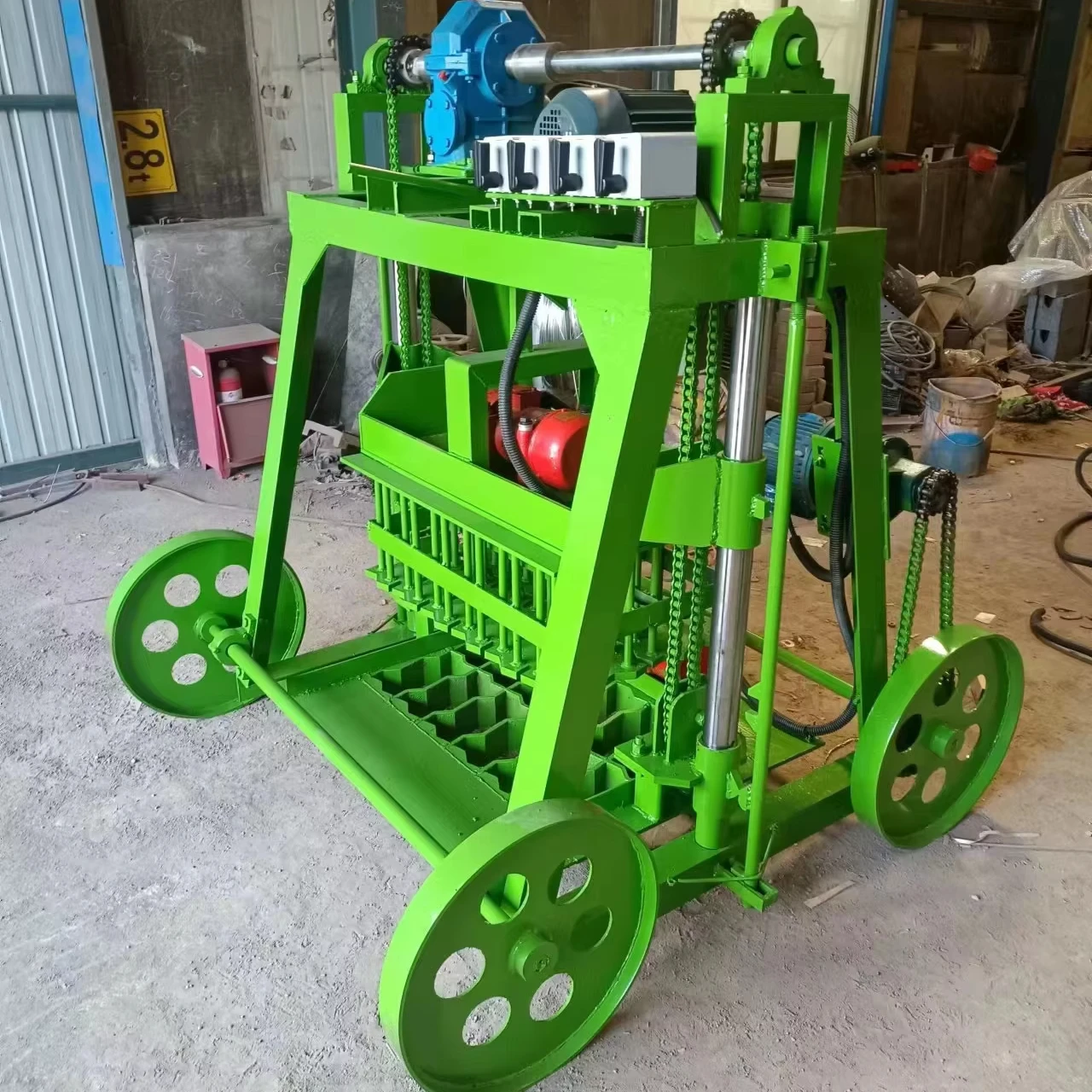
 Mobile block machine