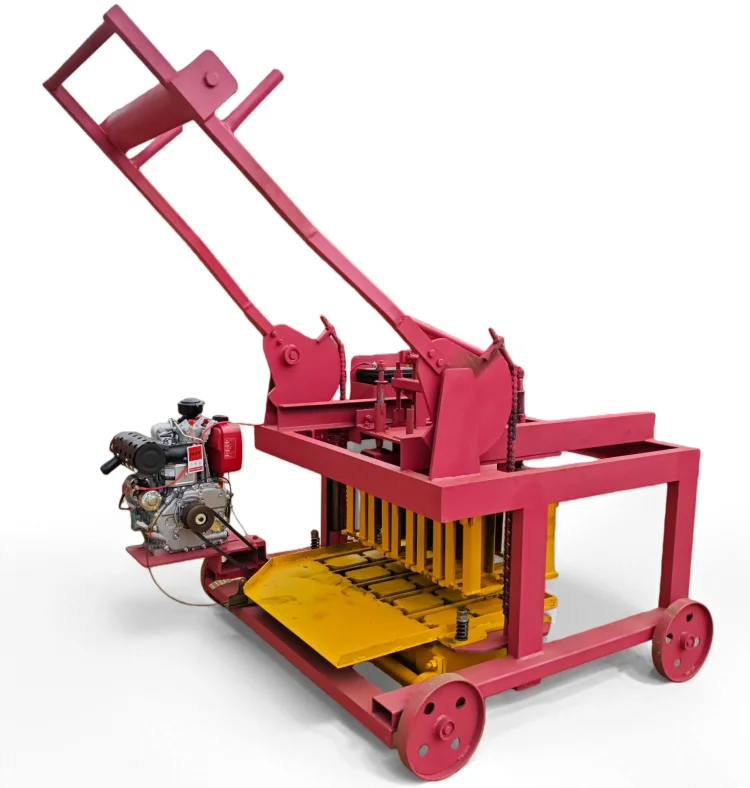
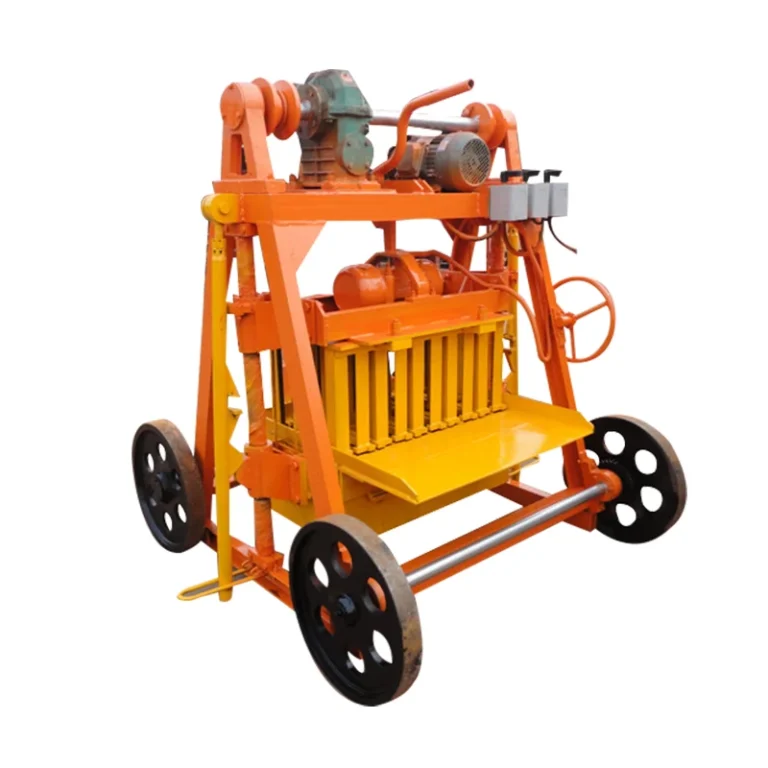
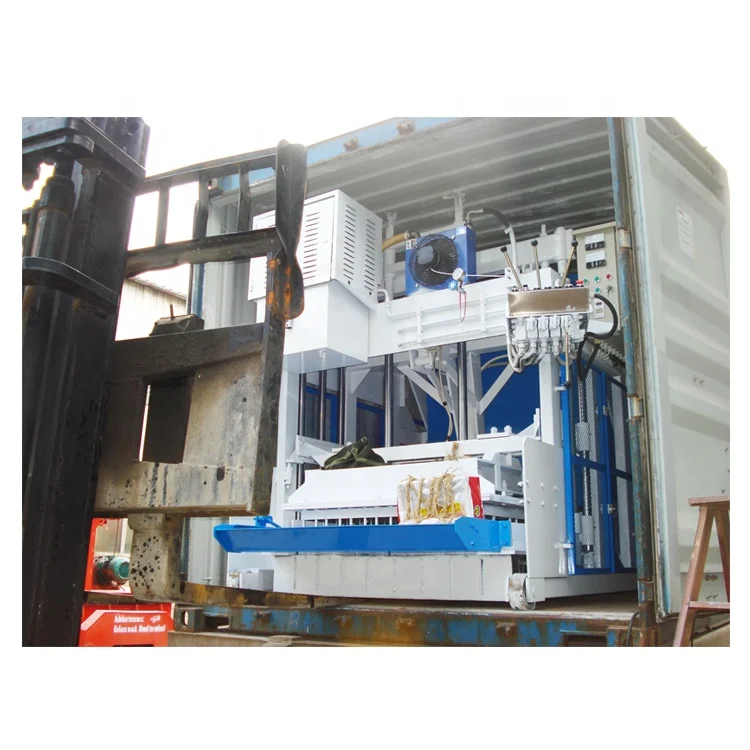
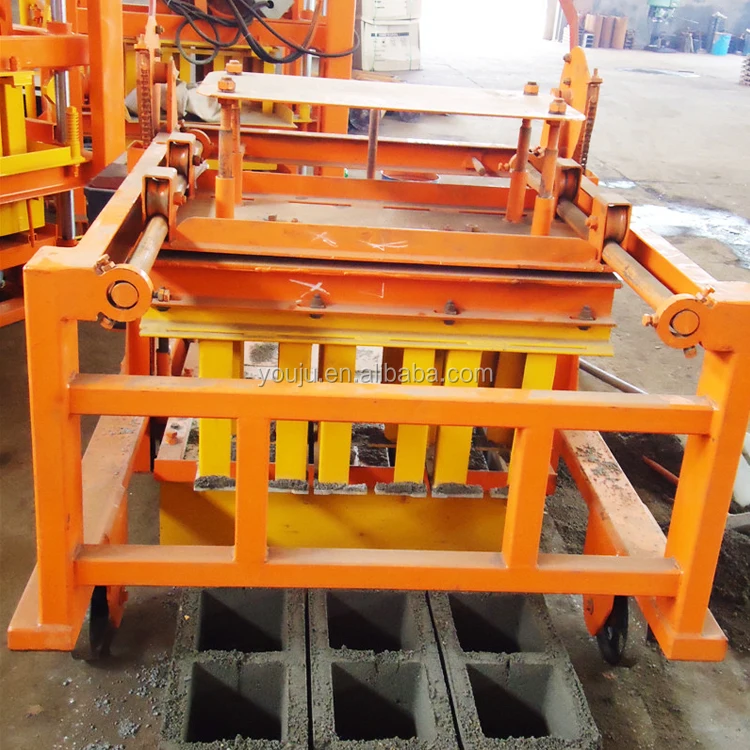
Mobile block machine — the complete output tier range from hand-pushed egg-laying units to pallet-based hydraulic presses, helping buyers place themselves on the scale before narrowing down.
Technical Specifications
| Parameter |
Value |
| Model |
QMJ2-45 |
| Product Type |
Mobile Cement Brick Machine |
| Machine Type |
Hand-pushed / Egg-laying (Pallet-less) |
| Molding Cycle |
25-30s |
| Output (400x200x200mm Hollow Block) |
160 pcs/h, 1280 pcs/8hr (basis: 2 pcs/mould) |
| Output (400x150x200mm Hollow Block) |
240 pcs/h, 4800 pcs/8hr (basis: 3 pcs/mould) |
| Output (400x100x200mm Hollow Block) |
320 pcs/h, 2560 pcs/8hr (basis: 4 pcs/mould) |
| Pallet Requirement |
None (pallet-less design) |
| Labor Requirement |
1-3 workers |
| Power Source |
Electric (No diesel engine required) |
| Mould Change |
Supported |
| Mobility |
Hand-pushed, free movement |
| Space Requirement |
Small footprint |
| Standards |
ISO9001:2000, CE |
Application Suitability
| Application |
Material or Output |
| On-site concrete block production |
Cement, sand, and crushed stone mixes for immediate site use |
| Remote area building material supply |
Hollow and solid block formats where logistics prevent pallet delivery |
| Small-scale masonry manufacturing |
Low-volume runs for local contractors and housing projects |
| First-plant block entrepreneurs |
Entry-level setup without curing rack or pallet handling investment |
What "Pieces per Hour" Leaves Out When Sizing a Mobile Block Machine
The quoted cycle time only holds if the mix design and ground conditions match the machine’s vibration profile.
I have watched operators push a machine across soft sand, losing half a shift to re-levelling the ground before each row. A mobile block machine manufacturer will quote you a molding cycle of 25-30 seconds, but that figure assumes a flat, hardened surface and a mix with the right moisture content to hold shape once the mould lifts. When the local aggregate carries too much clay or the sand is unwashed, the block slumps before it cures, and the real output drops far below the stated capacity [NEED_CITE: on-site aggregate testing standards for block production].

Understanding the Entry-Level Tier on the Range
A mobile block machine at this tier sits at the bottom of the investment scale. The QMJ2-45 eliminates the need for pallets, curing racks, and automatic stacking systems that define higher tiers. The trade-off is that output is limited by how fast workers can push the unit forward, lay the next row, and mix the next batch of concrete. This tier suits a buyer who has land, labor, and a local market but not the capital for a fixed plant.
Where the Range Steps Up
The next tier introduces pallet-based semi-automatic machines, where a stationary press feeds blocks onto pallets that move through a curing area. That step increases output but adds the cost of hundreds of pallets, a pallet return system, and a covered curing space. The mobile block machine range lets a buyer start here and move up only when market demand justifies the added infrastructure [NEED_CITE: block plant capacity planning by investment tier].
Reading the Cycle Time Against Your Block Format
The 25-30 second molding cycle applies per mould drop, but the actual pieces per hour depend entirely on which block format you run. With the 400x200x200mm hollow block, each drop produces 2 pieces, yielding 160 per hour. Switch to the 400x100x200mm format and the same cycle produces 4 pieces per drop, reaching 320 per hour. The vibration force and hydraulic pressure remain constant across formats, so block density stays consistent — only the count changes. Mould change on this unit is manual, meaning format flexibility comes at the cost of a short production pause each time you swap [NEED_CITE: vibration force and block density correlation].
The Cost of Skipping the Ground Preparation Step
A mobile block machine lays directly onto the earth or a concrete slab. If the surface is uneven, the machine tilts during vibration, producing blocks with inconsistent height and weak corners. I have seen crews spend more time raking and compacting the ground between passes than actually running the machine. The hidden cost is not the machine itself but the labor hours lost to surface preparation that a fixed-plant buyer never faces [NEED_CITE: ground preparation requirements for egg-laying block machines].
Why a Single-Focus Supplier Matters at This Tier
Block machinery is the only product line here, which means the machine, mould, and any supporting mixer are specified as a matched set rather than assembled from separate vendors. Configuration starts with the buyer’s actual mix design and local aggregate, not a catalogue default. Mould design covers the formats the buyer’s market sells, including custom drawings if needed. Voltage, frequency, and PLC language are confirmed before production. Installation support includes operator training so the crew understands why mix moisture and ground flatness matter as much as the machine itself [NEED_CITE: CE machinery directive requirements for industrial equipment].
Documentation & Verification
- Line layout and capacity calculation stating the 400x200x200mm hollow block basis
- Mould drawing and format list covering all three hollow brick sizes
- Voltage and control language confirmation sheet before production starts
- Factory test record on the buyer’s specified block format before dispatch
- CE declaration covering the complete machine and vibration motor
- Operation and maintenance manual with mould change procedure
Installation, Commissioning & Support
- Flat hardened ground or concrete slab required for consistent egg-laying operation
- Single-phase or three-phase electric supply based on confirmed voltage and frequency
- Machine arrives fully assembled; push into position and connect power
- First-run test with buyer’s actual mix to verify block density and cycle time
- Operator training on mould change, vibration timing, and mix moisture adjustment
- Mould wear parts list and replacement schedule provided at handover
What to Send Before Requesting a Quote
Tell the supplier which block format your market buys most, the daily volume you need to hit, and what your local sand and aggregate look like — river sand, crushed stone, or a blend, and whether it is washed. Confirm your site voltage and frequency, and whether you already have a mixer or need one matched to the QMJ2-45 cycle. If you plan to move the machine between sites, mention the ground conditions at each location.
Frequently Asked Questions
Q: How do I verify the actual daily output of this mobile block machine?
A: Confirm which block format the capacity figure assumes. The QMJ2-45 produces 160 pieces per hour of 400x200x200mm hollow blocks but 320 pieces per hour of 400x100x200mm blocks. Ask for a written capacity calculation that states the mould configuration, cycle time, and working hours so you can match it against your project demand.
Q: What ground conditions does an egg-laying machine need to produce consistent blocks?
A: The surface must be flat and hard enough to support the machine weight without sinking during vibration. A concrete slab is ideal, but compacted gravel can work if re-levelled regularly. Soft or uneven ground causes tilted blocks with weak edges and wastes labor on constant surface correction.
Q: How does local aggregate affect block strength on a mobile machine?
A: Unwashed sand with high clay content reduces cement bonding, producing blocks that crumble before curing. Share your aggregate source and a sample with the supplier so the mix design and vibration settings are matched to your material, not a generic default.
Q: How long does a mould change take and what tools are needed?
A: Mould change on the QMJ2-45 is manual and typically takes one worker a short pause to unbolt the current mould and fit the replacement. Confirm the format list and mould drawing before ordering so you receive the correct sizes for your market.

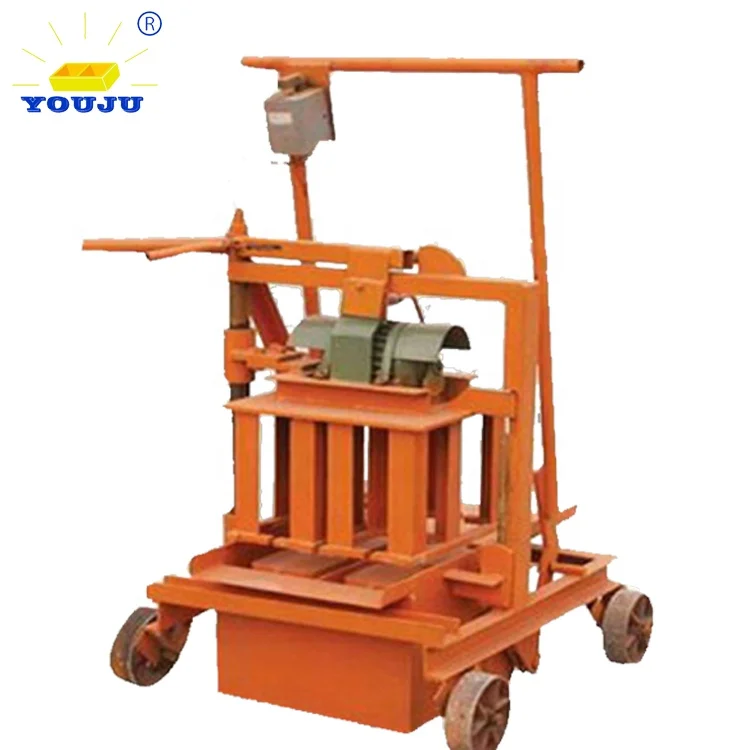
 Mobile block machine