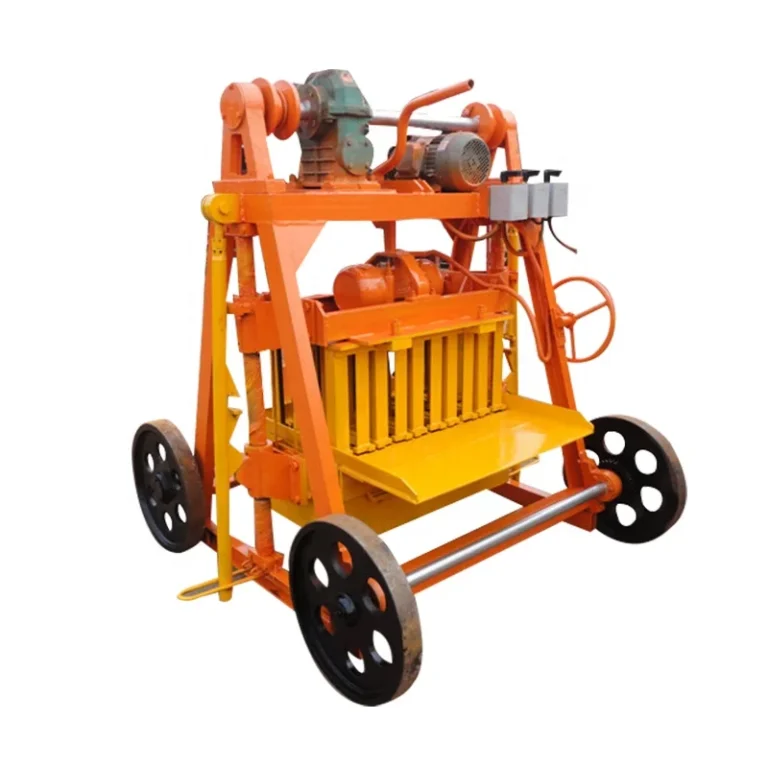
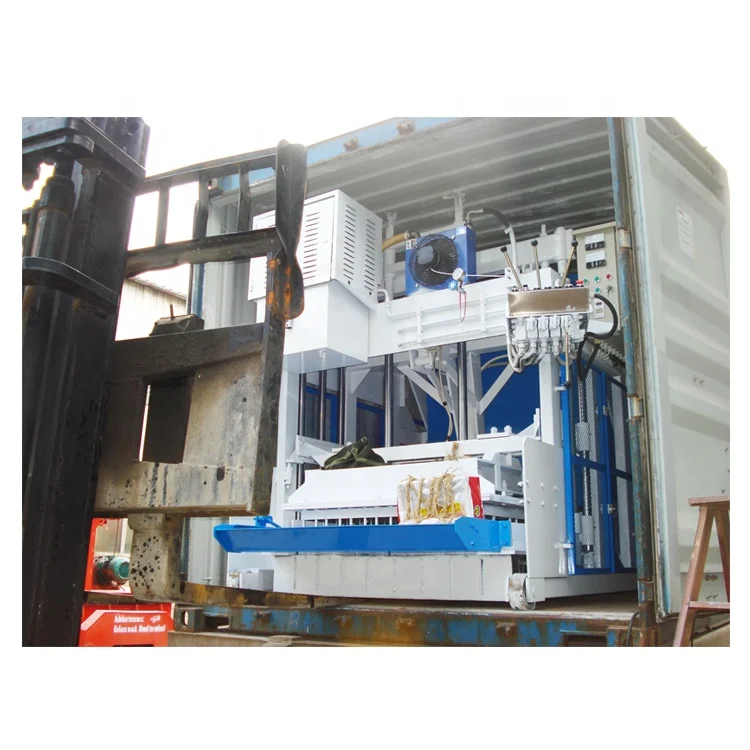
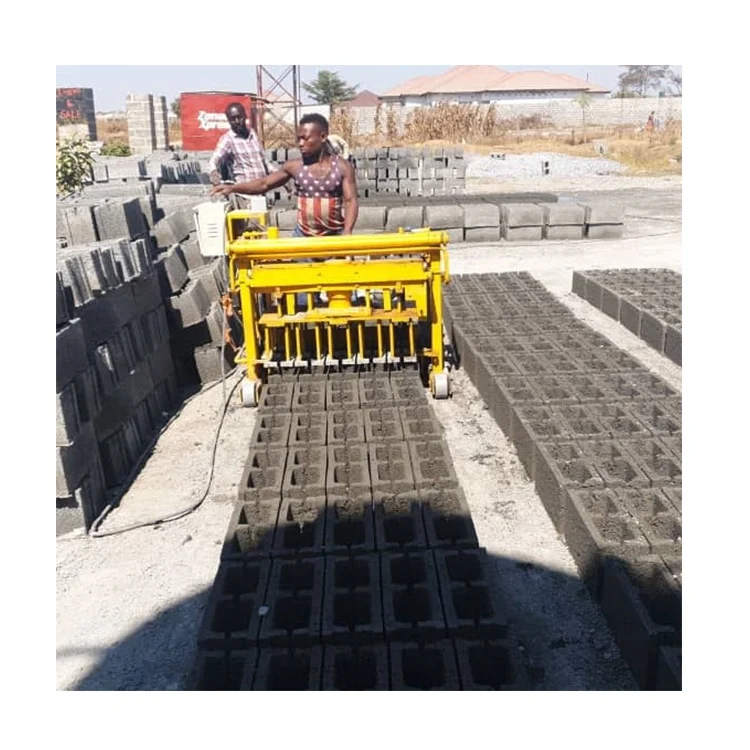
Palletless mobile design — the QMY4-30 lays blocks directly on the ground, eliminating pallets and curing racks so contractors can start producing hollow blocks on-site with minimal infrastructure.
Technical Specifications
| Parameter |
Value |
| Model |
QMY4-30 |
| Product Type |
Mobile Hydraulic Block Making Machine |
| Hydraulic Method |
Mould vibration |
| Demolding Method |
Hydraulic |
| Molding Cycle |
25–30 seconds |
| Total Power |
5.95 kW |
| Pallet Requirement |
Palletless (egg-laying / mobile type) |
| Output Capacity |
480 pcs/h (based on 400×200×200 mm hollow block, 4 pcs/mould) |
| Output Capacity |
600 pcs/h (based on 400×150×200 mm hollow block, 5 pcs/mould) |
| Output Capacity |
840 pcs/h (based on 400×100×200 mm hollow block, 7 pcs/mould) |
| Daily Output |
3,840 pcs/8 hr (based on 400×200×200 mm hollow block) |
| Daily Output |
4,800 pcs/8 hr (based on 400×150×200 mm hollow block) |
| Daily Output |
6,720 pcs/8 hr (based on 400×100×200 mm hollow block) |
| Automation Level |
Manual operation with hydraulic assist |
| Stacking Method |
Blocks cured in place (mobile egg-laying) |
| Standards |
ISO 9001:2000, CE |
Application Suitability
| Application |
Material or Output |
| On-site housing project block production |
Hollow blocks in 100 mm, 150 mm, 200 mm thickness from local aggregate and cement |
| Remote infrastructure sites (mountain, desert, coastal) |
Palletless production where transporting pallets and curing racks is impractical |
| First block plant with minimal capital |
Hollow blocks produced directly on a prepared ground slab |
| Contractor self-supply for masonry work |
Multiple hollow block formats from a single mobile press |
What "840 Pieces per Hour" Actually Means on a Job Site
Every output figure for this mobile block machine for sale is tied to a specific block format and mould cavity count — never a bare cycle rate.
Capacity numbers printed on a brochure mean little when the block format behind them is left unstated. A machine that cycles in 30 seconds might quote a high hourly number based on a small solid brick, while the 200 mm hollow block you actually need cuts that figure nearly in half. I have watched crews plan an entire project timeline around a single headline number, only to find the format they sell daily delivers half the expected volume. The QMY4-30 states three distinct capacities, each linked to a defined hollow block size and cavity count, so buyers compare against their real product mix [NEED_CITE: block format assumptions in capacity quotations].

Positioning the QMY4-30 Within the Mobile Tier
The QMY4-30 occupies the mid-range of the mobile block machine range, bridging the gap between small manual egg-layers and larger semi-automatic stationary lines. Its hydraulic demolding combined with mould-box vibration places it above purely manual machines that rely on gravity release, while the palletless design keeps it firmly in the mobile category. Buyers evaluating this mobile block machine for sale are typically weighing the trade-off between output flexibility and the capital cost of a fixed plant with pallet circulation.
Where a Mobile Press Outperforms a Fixed Line
On remote or difficult-terrain sites — mountainous housing developments, desert infrastructure camps, coastal reclamation projects — the cost of building a curing yard, laying pallet return conveyors, and transporting racks can eclipse the machine price itself. The QMY4-30 eliminates that infrastructure entirely. Blocks are laid directly on a level ground slab and cured in place, meaning the only preparation needed is a flat, compacted surface and a water source for curing. That operational simplicity is what makes the mobile tier the right choice when a stationary plant is either too expensive to set up or physically impossible to install [NEED_CITE: site preparation comparison for mobile versus stationary block production].
Reading the Specification Sheet Against Your Block Format
The 25–30 second moulding cycle applies across all three listed hollow block formats, but the output varies because cavity count changes with block thickness. A 200 mm hollow block uses a 4-cavity mould yielding 480 pieces per hour; switching to a 100 mm block fills the same mould area with 7 cavities, raising output to 840 pieces per hour. The 5.95 kW total power is split between the hydraulic pump and the vibration motor, which together determine compaction density and demolding integrity. Hydraulic pressure and vibration force must be matched to your local aggregate — lightweight volcanic stone demands different settings than dense river gravel, and running default parameters on an unfamiliar material risks cracked or under-compacted blocks. Confirming hydraulic pressure rating and vibration force in kN before shipment prevents this mismatch.
The Cost of Skipping the Aggregate Test
Specifying a mobile press without testing local raw material first is one of the most common mistakes I see on Latin American job sites. A crew in Colombia once planned an entire social-housing timeline around brochure output, only to discover that local volcanic aggregate was significantly lighter than the standard test mix, causing incomplete compaction and block cracking at default vibration settings. Production stalled while new parameters were established. The hidden cost was not the machine — it was the idle crew, the delayed pour schedule, and the rework on walls already laid with substandard units [NEED_CITE: aggregate density impact on vibration compaction settings].
Why Source the QMY4-30 Through This Range
Block machinery is a single-focus operation here, so the QMY4-30 is specified alongside its moulds and supporting equipment as one matched system rather than assembled from separate suppliers. Configuration starts from the buyer’s actual block format and local aggregate, not a catalogue default. Mould design covers the hollow block thicknesses the buyer’s market actually sells, with custom drawings available for non-standard formats. The mobile tier sits within a broader range that extends upward to semi-automatic and fully automatic lines, meaning a buyer who starts with a QMY4-30 can later add a stationary plant from the same supplier without relearning a new control ecosystem. Factory testing is run with the buyer’s specified block format before dispatch, not a generic test block.
Documentation & Verification
- Capacity calculation sheet stating each hollow block format and cavity count behind every output figure
- Machine specification sheet confirming hydraulic pressure and vibration force ratings
- Mould drawing and format list for 100 mm, 150 mm, and 200 mm hollow blocks
- Voltage and frequency confirmation document signed before production begins
- Factory test record showing actual cycle time on the buyer’s chosen block format
Installation, Commissioning & Support
- A level, compacted concrete slab is required as the egg-laying surface; no pallet system or curing rack infrastructure needed
- Power supply must match the 5.95 kW total load; voltage and frequency confirmed before the machine leaves the factory
- Machine arrives as a single mobile unit; wheels and handle allow repositioning across the production slab
- First-run commissioning includes vibration frequency and hydraulic pressure adjustment to the buyer’s local aggregate
- Operator training covers mould change procedure, cycle timing, and daily hydraulic fluid inspection
Preparing Your Inquiry
To match the right mobile press to your project, share the hollow block formats you sell, your target daily output per format, and the local aggregate type available on-site. Include your site voltage and frequency, along with whether you need a manual or PLC-assisted control panel. If you are comparing mobile versus semi-automatic options, describe your curing area dimensions so the appropriate tier can be recommended.
Frequently Asked Questions
Q: How is output capacity verified and what block format does each figure assume?
A: Each capacity number is tied to a specific hollow block dimension and mould cavity count. The 480 pcs/h figure assumes a 400×200×200 mm block with 4 cavities; 600 pcs/h assumes 400×150×200 mm with 5 cavities; 840 pcs/h assumes 400×100×200 mm with 7 cavities. All figures are based on a 25–30 second moulding cycle.
Q: What voltage and frequency options are available for my market?
A: Voltage and frequency are confirmed during the quotation stage to match the buyer’s local grid. Because the QMY4-30 draws 5.95 kW total, confirming the correct motor winding before production avoids commissioning delays and protects the hydraulic pump motor from under-voltage damage on arrival.
Q: What mould formats can the QMY4-30 accept?
A: The machine accepts moulds for hollow blocks in 100 mm, 150 mm, and 200 mm thickness, all at 400 mm length and 200 mm height. Custom moulds can be designed to buyer drawings for formats outside these three standard sizes.
Q: What site preparation does a mobile egg-laying machine require?
A: The production surface must be a flat, compacted concrete slab free of debris. No pallets, curing racks, or pallet-return conveyors are needed. A water source nearby is required for block curing after the machine lays each row.
Q: How do I decide between a mobile machine and a semi-automatic stationary line?
A: Mobile machines suit remote sites, first-time plants, or contractors producing blocks directly on a project. Semi-automatic lines suit buyers needing higher daily volumes with consistent pallet-based curing. The decision starts with your target format, required daily output, and available site area.

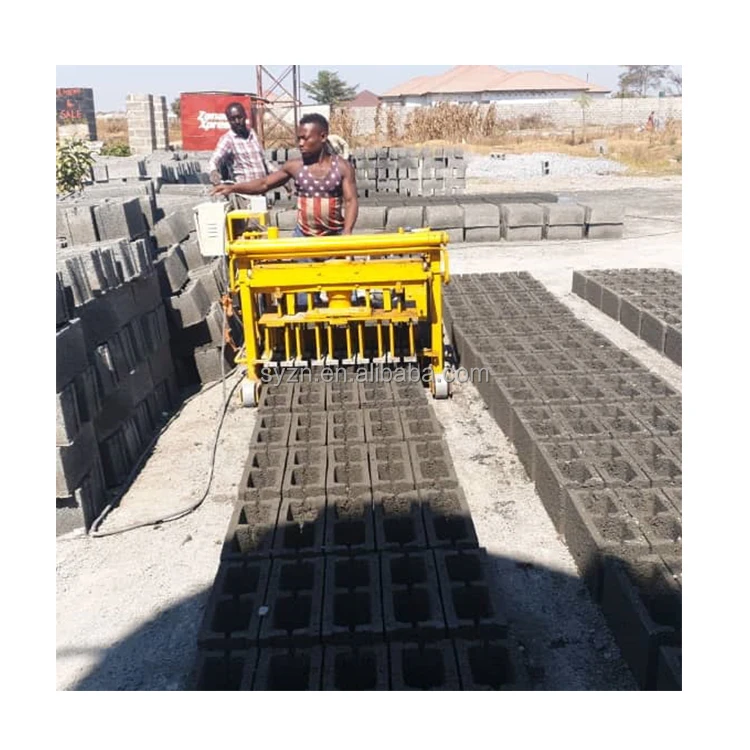
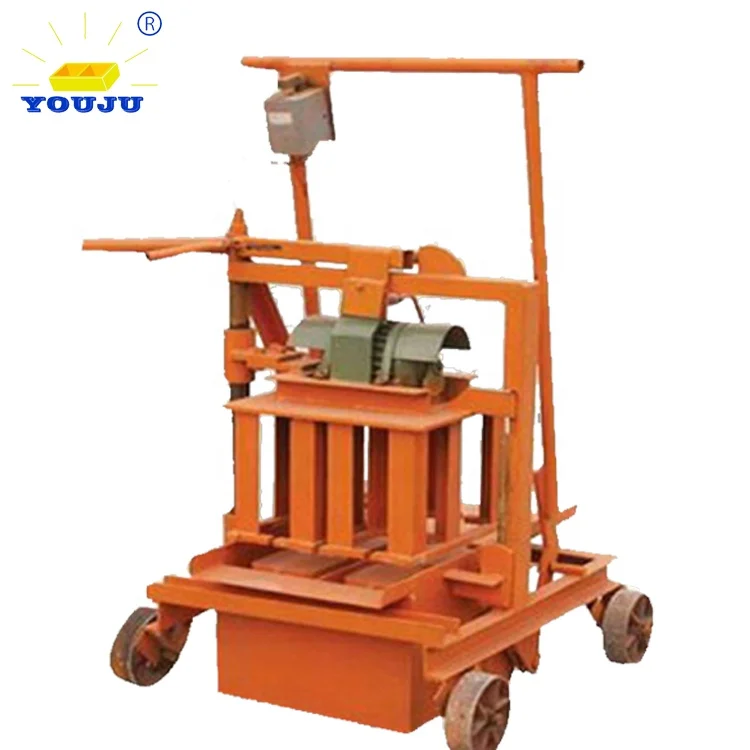 Mobile block machine