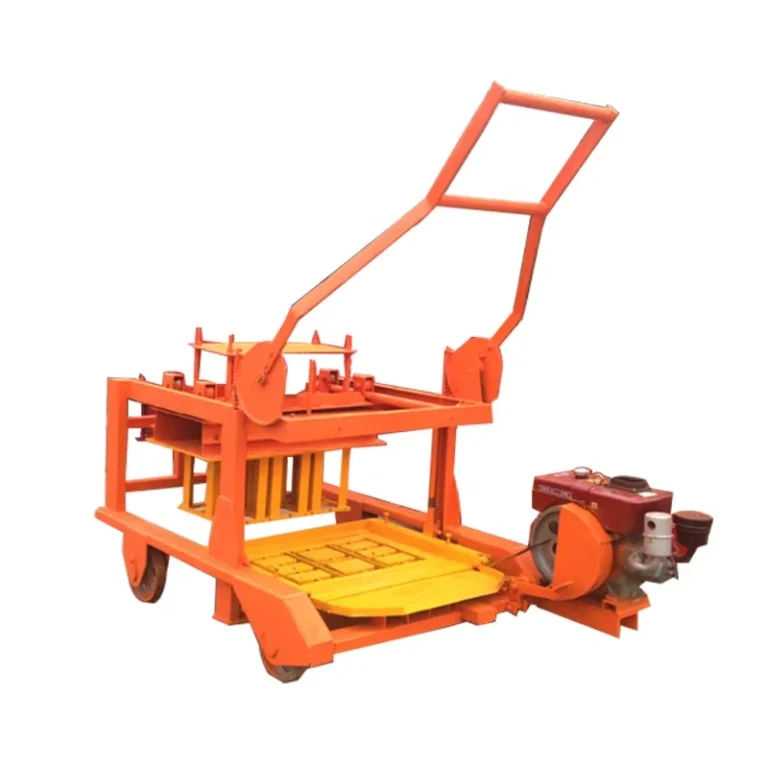
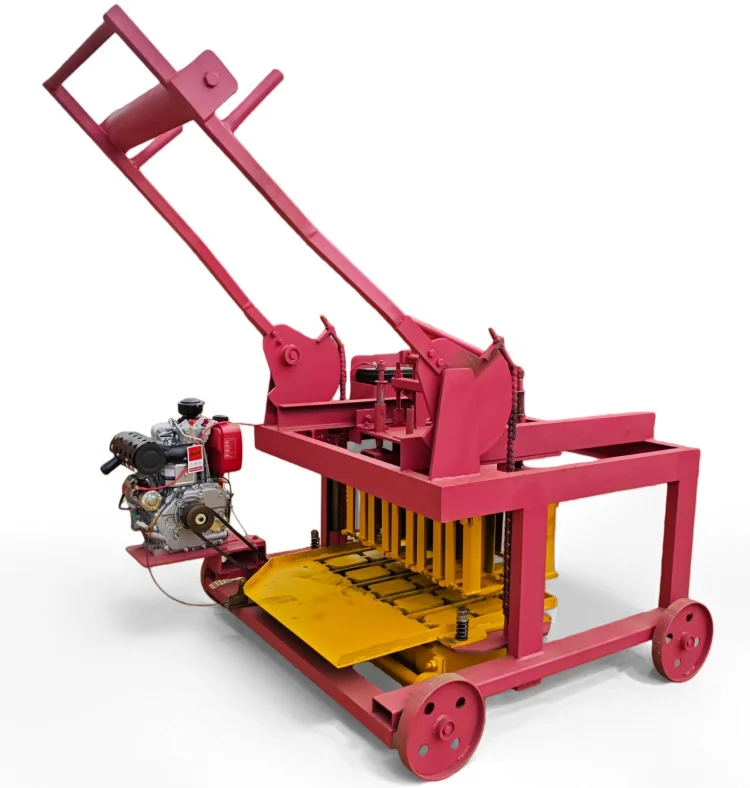
Matched to your raw materials — We adjust the QMJ2-45 setup based on your local aggregate and mix composition, not a factory default, because the right machine means nothing if it cannot handle what is actually available on your site.
Technical Specifications
| Parameter |
Value |
| Model |
QMJ2-45 |
| Product Type |
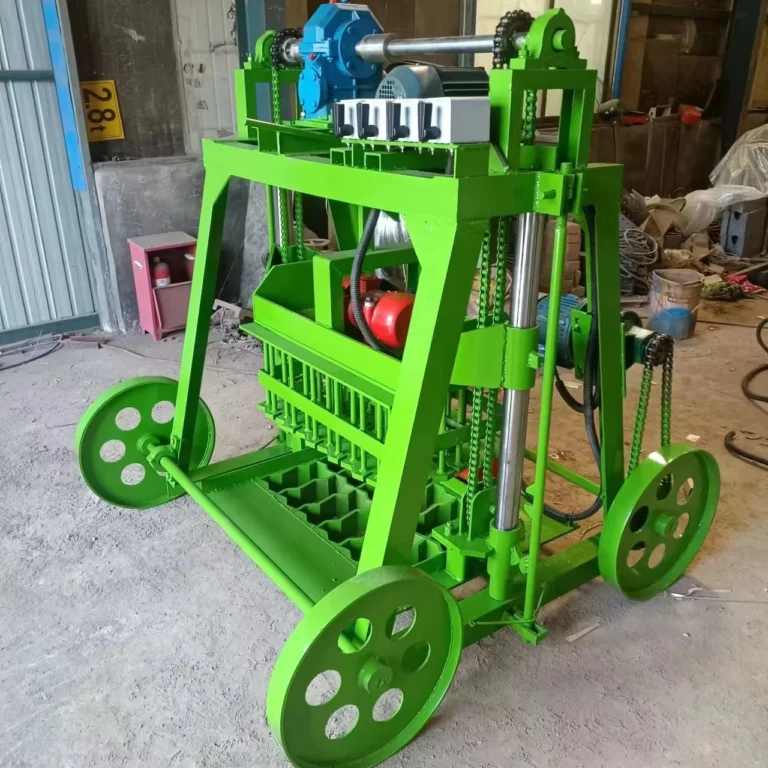
Mobile Concrete Block Making Machine |
| Machine Type |
Hand-pushed, egg-laying (pallet-free) |
| Operation |
Manual |
| Workers Required |
1 to 3 |
| Mould Change |
Supported, manual swap |
| Cycle Time |
25-30 seconds per moulding cycle |
| Output (400×200×200 mm hollow block) |
2 pcs/mould, approx. 160 pcs/h, approx. 1280 pcs/8hr (basis: stated cycle time) |
| Output (400×150×200 mm hollow block) |
3 pcs/mould, approx. 240 pcs/h (basis: stated cycle time; 8-hour total to be confirmed) |
| Output (400×100×200 mm hollow block) |
4 pcs/mould, approx. 320 pcs/h, approx. 2560 pcs/8hr (basis: stated cycle time) |
| Pallets Required |
No (blocks laid directly on ground) |
| Power Source |
Manual operation, no electrical dependency |
| Control System |
None |
| Overall Dimensions |
Not stated in source |
| Net Weight |
Not stated in source |
| Certification |
ISO9001:2000, CE (current validity to be confirmed) |
Application Suitability
| Application |
Material or Output |
| On-site hollow block production |
Concrete mix using local sand, crushed stone, or volcanic ash |
| First-time block plant setup |
Hollow blocks in three standard sizes without fixed-plant infrastructure |
| Remote or off-grid construction |
Pallet-free production where electricity and pallets are unavailable |
| Small workshop block making |
Limited-space hollow block runs for building material distributors |
What "160 Blocks per Hour" Actually Means for the QMJ2-45
The capacity figure only holds when tied to a specific block format.
A mobile block making machine for sale might be advertised with a single hourly output, but that number shifts depending on which mould is installed. With the 400×200×200 mm hollow brick mould, the QMJ2-45 completes two blocks per cycle. Swap to the 100 mm wide mould and you get four per cycle. The cycle time stays roughly the same, so the hourly rate changes with the format. [NEED_CITE: how block format affects real daily output in egg-laying machines]
From the workshop floor, I have seen buyers plan production around the highest number in the catalogue, then discover their market mostly buys the larger format. The result is a gap between expected and actual output that only appears after commissioning.

Where the QMJ2-45 Fits in the Range
The QMJ2-45 occupies the entry point of the mobile block making machine for sale range. It is a hand-pushed, pallet-free machine that lays blocks directly on the ground. There is no batching system, no conveyor, and no stacking automation. This makes it suitable for buyers who need to produce blocks with minimal capital outlay and zero fixed infrastructure.
Moving Up from Manual Egg-Laying
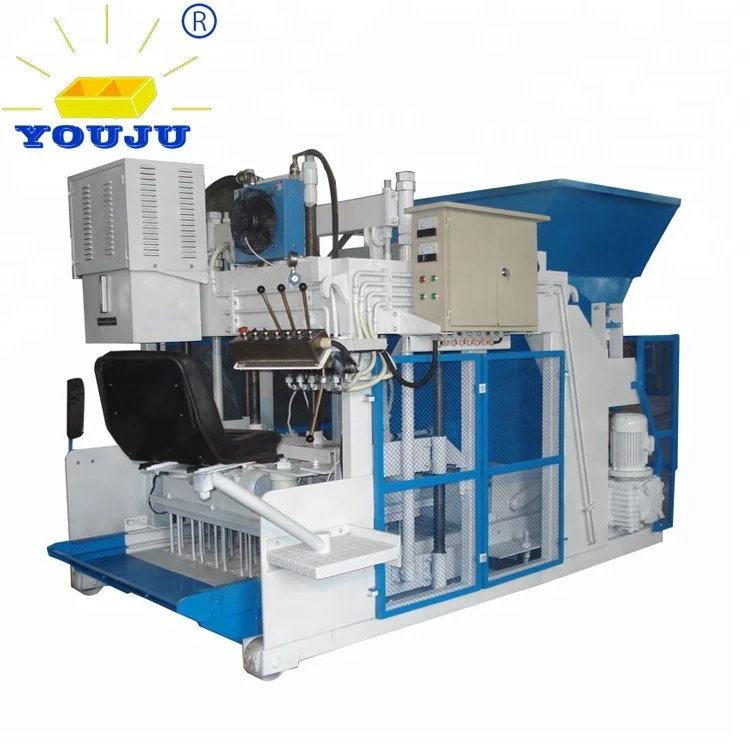
If your project requires consistent daily volume, the next step is a semi-automatic mobile line where a mixer feeds the hopper and pallets move through a simple curing rack. The QMJ2-45 sits below that tier. It trades throughput for simplicity — one to three workers, no power connection, and a footprint limited only by the flat ground you have available. [NEED_CITE: manual versus semi-automatic mobile block machine investment tiers]
Reading the Cycle Time Against Your Mix
The 25-30 second cycle assumes a mix that flows and compacts under manual vibration. Heavier aggregate or a stiffer mix will extend the cycle, especially if workers need extra time to fill the mould evenly. The rated output figures assume this base cycle holds. In practice, the actual rate depends on how well your local sand, cement ratio, and aggregate size match the machine’s manual compaction method.
The Cost of Skipping the Mix Conversation
When a machine arrives configured for a standard river-sand mix and your site uses volcanic ash or crusher dust, the block density and surface finish will not meet local standards. Adjusting the vibration time and mix moisture on-site takes days of trial runs, and during that period output drops well below the quoted capacity. [NEED_CITE: impact of local aggregate on block strength in manual machines]
Why Source the Machine and Moulds Together
The QMJ2-45 supports three hollow brick formats through mould changes. When the machine and its moulds come from one source, the mounting points, vibration transmission, and block dimensions are verified as a matched set before shipping. Sourcing the press separately from the moulds introduces fit and finish risks that show up as inconsistent block edges and extended mould-change times.
Our single-focus approach means the QMJ2-45 and its moulds are specified against your target block format and local material, not pulled from a general catalogue. Mould drawings are confirmed before production so the block sizes match what your market actually buys. Automation is not applicable here, but the path from this manual unit to a semi-automatic line is designed in, so an upgrade does not mean starting over.
Documentation & Verification
- Capacity sheet listing output per block format, not a single aggregate figure
- Mould drawings confirming the three hollow brick dimensions before production
- Factory test record run on your specified block format before dispatch
- Packing photographs showing the machine and moulds loaded for shipment
- CE declaration and ISO certificate with current issue dates for customs clearance
Installation, Commissioning & Support
- Flat, level ground required; no concrete foundation needed for the hand-pushed QMJ2-45
- No electrical connection required, removing voltage and frequency confirmation from setup
- Machine arrives assembled; moulds ship separately and bolt on at site
- First-run guidance covers mix consistency and cycle pacing with your local aggregate
- Operator training on mould change procedure and daily wear-part inspection
- Mould and mechanical wear parts list supplied for first replacement planning
What We Need to Size This Right
To match the QMJ2-45 to your project, share the block formats your local market sells most, the type of aggregate you have access to, and whether your site has flat ground available for egg-laying production. If you are comparing this against a semi-automatic option, let us know your target daily volume and worker availability so we can position the QMJ2-45 accurately in the range.
Frequently Asked Questions
Q: How is hourly capacity calculated, and which block format does each figure assume?
A: The capacity figures for the QMJ2-45 are based on a 25-30 second moulding cycle. With the 400×200×200 mm hollow block mould, two blocks are produced per cycle, yielding approximately 160 pieces per hour. The 400×100×200 mm mould produces four per cycle at approximately 320 per hour. Always confirm which format the output figure refers to.
Q: What block formats can the QMJ2-45 produce, and how long does a mould change take?
A: The machine supports three standard hollow brick sizes: 400×200×200 mm, 400×150×200 mm, and 400×100×200 mm. Mould change is manual and involves unbolting the current mould and fitting the replacement. The time depends on operator experience, and training covers this procedure during commissioning.
Q: Does this machine require pallets, power supply, or a fixed production area?
A: No. The QMJ2-45 is a pallet-free egg-laying design. It lays blocks directly on flat ground and is hand-pushed, so it needs no electrical power, no pallets, and no fixed factory space. This makes it suitable for remote sites and temporary job locations where infrastructure is limited.
Q: Where does the QMJ2-45 sit compared to semi-automatic mobile machines?
A: It is the entry-level option in the mobile block making machine for sale range. Semi-automatic models add a mixer, powered pallet handling, and higher daily output. The QMJ2-45 trades automation for lower investment and simpler operation, making it suited to first-time plant operators and small-scale production.
Q: What mould and wear-part support is available after the first replacement?
A: A wear parts and mould list is supplied with the machine, identifying components that will need periodic replacement. Moulds are produced to the same drawings as the originals, ensuring continued fit and block dimension consistency when the first replacement cycle arrives.

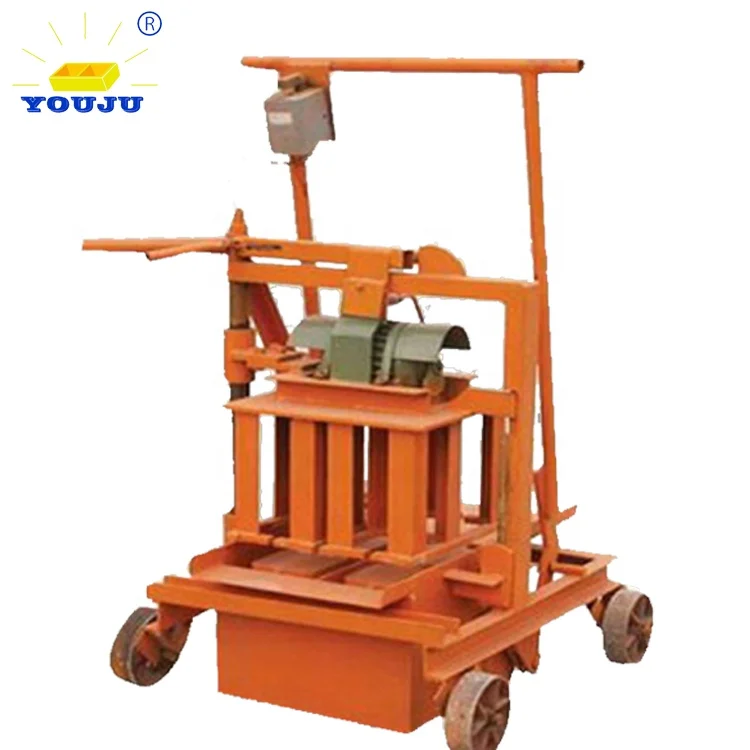
 Mobile block machine