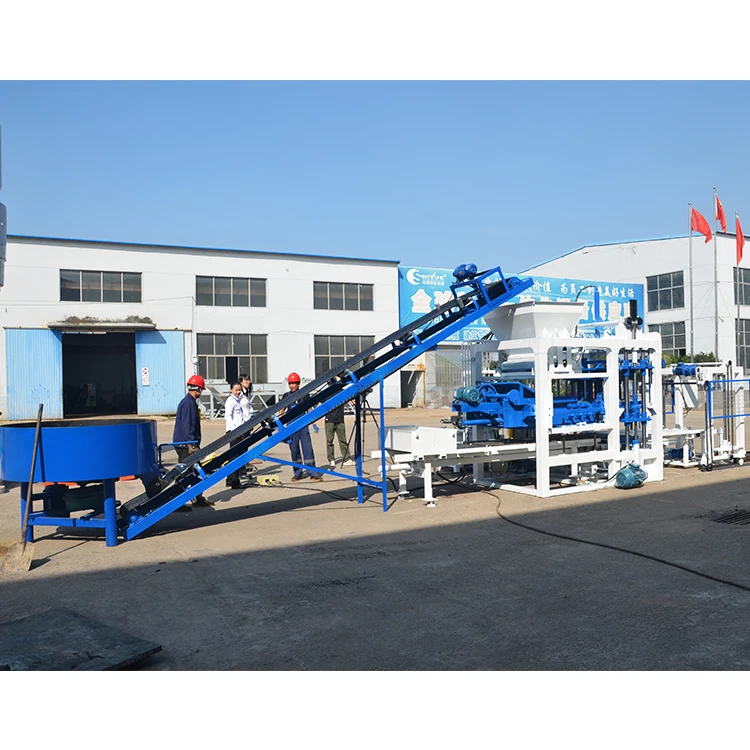
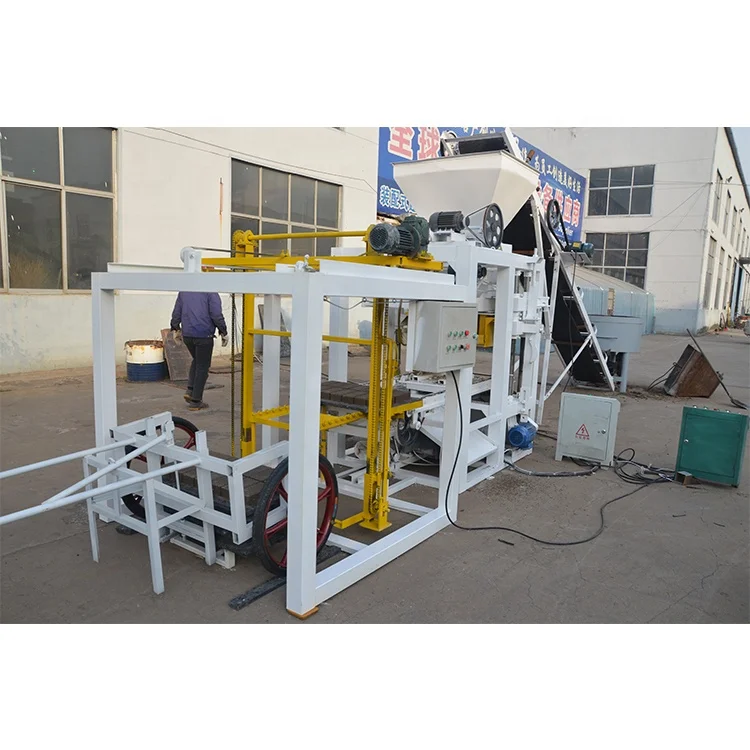
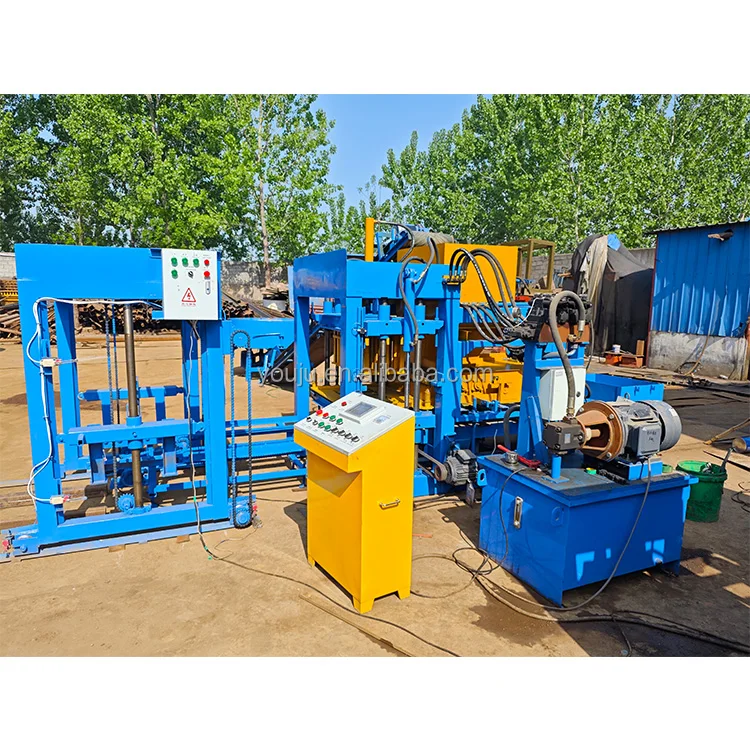
Fully Automatic Tier for Scaling Plants — the QT8-15 sits at the high-capacity end of our stationary block machine range, matched to plants that need continuous output beyond workshop volume.
Technical Specifications
| Parameter |
Value |
| Model |
QT8-15 |
| Product Type |
Hydraulic Interlocking Block Making Machine |
| Overall Dimensions (L×W×H) |
8300×1860×3000 mm |
| Total Mass |
9 T |
| Overall Power |
55.5 kW |
| Rated Pressure |
21 MPa |
| Main Vibration Form |
Platform Vibration |
| Vibration Frequency |
2800~4500 r/min |
| Vibration Force |
60 kN |
| Pallet Size |
950×900 mm |
| Moulding Cycle |
15-25 s |
| Demoulding Method |
Hydraulic |
| General Water Consumption |
12 T/Day |
| Factory Area |
600 m² |
| Control System |
PLC aptitude control with human-machine interface |
| Feeding System |
Semi-closed screen reticular rotational forced feeding unit |
| Applied Products |
Concrete blocks, hollow/solid blocks, pavers, interlocking blocks, curbstone, colored pavers (basis not stated in source) |
| Raw Materials |
Crushed stone, sand, cement, dust, fly ash, gravel, slag |
| Automation Level |
Fully automatic |
Application Suitability
| Application |
Material or Output |
| Hollow block production for building walls |
Crushed stone, sand, cement, fly ash |
| Solid block manufacturing for load-bearing structures |
Gravel, sand, cement mix |
| Interlocking paver production for driveways and walkways |
Colored concrete mix with fine aggregate |
| Curbstone and kerb production for road edges |
High-strength concrete with coarse gravel |
| Porous block output for drainage applications |
Open-graded aggregate with reduced cement binder |
What "Cycle Time 15-25 Seconds" Actually Means for Your Daily Output
The moulding cycle only becomes a real capacity figure once you name the block format it assumes.
A QT8-15 block machine manufacturer quoting 15 to 25 seconds per cycle is stating a mechanical range. If your market buys interlocking pavers, the cycle will sit at the upper end because the thin, intricate mould requires longer vibration to fill completely. Switch to a standard hollow block and the press completes its cycle faster. Buyers who skip this step end up with a machine that cannot deliver the daily volume they planned their curing yard around [NEED_CITE: block format impact on cycle time calculation].
Where the QT8-15 Sits in the Full Machine Range
The QT8-15 occupies the high-output automatic tier within our stationary block machine lineup. Below it, semi-automatic models require manual pallet handling and suit smaller plants or first-time investors testing a local market. Above it, larger lines add multi-layer curing racks and automatic cubing for industrial-scale supply contracts. The QT8-15 bridges these two worlds: fully automatic pressing and feeding, with the option to add stacking automation later as demand grows.
Matching Automation Level to Your Labour Reality
A fully automatic block making machine like the QT8-15 removes the operator from the press cycle entirely. The PLC controls feeding, vibration, pressing, and demoulding in sequence. What the operator still handles depends on how the rest of the line is configured — pallet return, block stacking, and curing rack movement can remain manual or be automated. Choosing the right level at the outset avoids paying for automation you do not yet need while leaving room to add it when your sales volume justifies the investment [NEED_CITE: automation upgrade path in block plants].
How Hydraulic Pressure and Vibration Force Shape Block Density
The 21 MPa rated pressure and 60 kN vibration force on the QT8-15 work together to compact the concrete mix inside the mould box. Vibration settles the aggregate into the mould cavities; hydraulic pressure then squeezes out air voids. If your local sand contains high clay or silt content, the mix retains more water and resists compaction — the same pressure and vibration settings that produce strong blocks with clean river sand will yield weaker, crumbly blocks with unwashed pit sand. Adjusting vibration frequency within the 2800–4500 r/min range helps compensate, but only if the issue is caught during configuration, not after the machine arrives on site.
The pallet size of 950×900 mm determines how many blocks are pressed per cycle and must align with the curing racks and forklifts you already have or plan to buy. A pallet that is too wide for your curing chamber means rebuilding the racks; one that is too narrow wastes press capacity every cycle.

When the Wrong Feeding System Cancels Out a Good Press
The semi-closed screen reticular rotational forced feeding unit on the QT8-15 distributes concrete evenly across the mould box before pressing begins. Uniform feeding matters most with interlocking paver moulds, where thin protrusions must fill completely or the block demoulds with broken corners. If the feeding system is mismatched to a cohesive mix — one high in fly ash or clay — material bridges inside the feed hopper, and the mould fills unevenly cycle after cycle. The press may be capable of consistent output, but inconsistent feeding defeats it before the vibration even starts [NEED_CITE: forced feeding performance with high-fines aggregate].
Why Sourcing from a Single-Focus Manufacturer Matters
Block machinery is our single product focus, which means the QT8-15 press, its mould, the pallet, and the handling equipment are specified as one matched system rather than assembled from separate suppliers. Configuration is set against your actual mix design and local aggregate, not a catalogue default. Moulds are designed for the block formats your market sells, and custom drawings are supported. Automation level is selectable, so you can start with the QT8-15 in its standard fully automatic press configuration and add stacking or cubing stations as your output grows. Documentation covers the complete line layout with capacity calculation that states the block format assumed.
Documentation & Verification
- Line layout and capacity calculation stating the block format used for QT8-15 output figures
- Machine specification sheet confirming voltage, frequency, and PLC display language
- Mould drawing and format list covering every block type in your purchase scope
- Pallet specification matched to the 950×900 mm size and your curing rack dimensions
- Factory test record demonstrating cycle time and block density before dispatch
- Operation and maintenance manual with wear parts list for the QT8-15 hydraulic and vibration systems
Installation, Commissioning & Support
- Foundation must support the 9 T total mass and dynamic vibration loads across the 8300 mm machine length
- Electrical supply must deliver 55.5 kW with voltage and frequency confirmed against the PLC and motor nameplates before wiring
- Machine ships partially dismantled for container loading; reassembly on site aligns the press frame, feeding unit, and pallet feeder
- Commissioning includes setting vibration frequency within the 2800–4500 r/min range to match your specific mix and block format
- Operator training covers PLC human-machine interface navigation, mould change procedure, and daily greasing of the hydraulic demoulding system
- Wear parts supply covers vibration springs, hydraulic seals, and mould liners specific to the QT8-15
What We Need from You to Size the Line Correctly
To recommend the right configuration around the QT8-15, we need the block formats you plan to sell, your target daily output per format, the source and type of your local sand and aggregate, your available factory floor area, and your site voltage and frequency. Share these details and we will return a line layout that shows realistic capacity per block type rather than a single unqualified number.
Frequently Asked Questions
Q: How does the QT8-15 output capacity compare to smaller semi-automatic and larger automatic models in the range?
A: The QT8-15 sits in the high-capacity automatic tier, above semi-automatic models that require manual pallet handling and below full-line systems with automatic stacking and cubing. Actual daily output depends entirely on the block format produced. We provide a capacity calculation that states the assumed format so you can compare tiers on equal terms.
Q: What plant footprint does the QT8-15 require versus other tiers?
A: The press itself measures 8300×1860×3000 mm, and the recommended factory area is 600 m² including space for raw material storage, mixing, and wet block curing. Smaller semi-automatic models need less floor space, while larger lines with automatic rack handling require more. We confirm the layout against your actual site dimensions before production.
Q: Which block formats can the QT8-15 produce, and how does format choice affect realistic daily output?
A: The QT8-15 produces hollow blocks, solid blocks, interlocking pavers, curbstones, and colored pavers through mould changes. Cycle time ranges from 15 to 25 seconds, and the exact position within that range depends on the mould geometry and your mix design. We state the cycle time and daily output for each format you intend to run.
Q: What automation level does the QT8-15 provide, and is there an upgrade path?
A: The QT8-15 is a fully automatic press with PLC-controlled feeding, vibration, pressing, and hydraulic demoulding. Pallet return, stacking, and cubing can be added as separate stations either at initial purchase or later. This lets you start with the press automation and expand the line as your sales volume grows.
Q: How do voltage, frequency, and PLC language get confirmed before the machine ships?
A: We confirm your site voltage and frequency during the quotation stage and record them on the machine specification sheet. The PLC display language is agreed at the same time. A factory test is run with these settings before dispatch, and the test record is included in your documentation package.

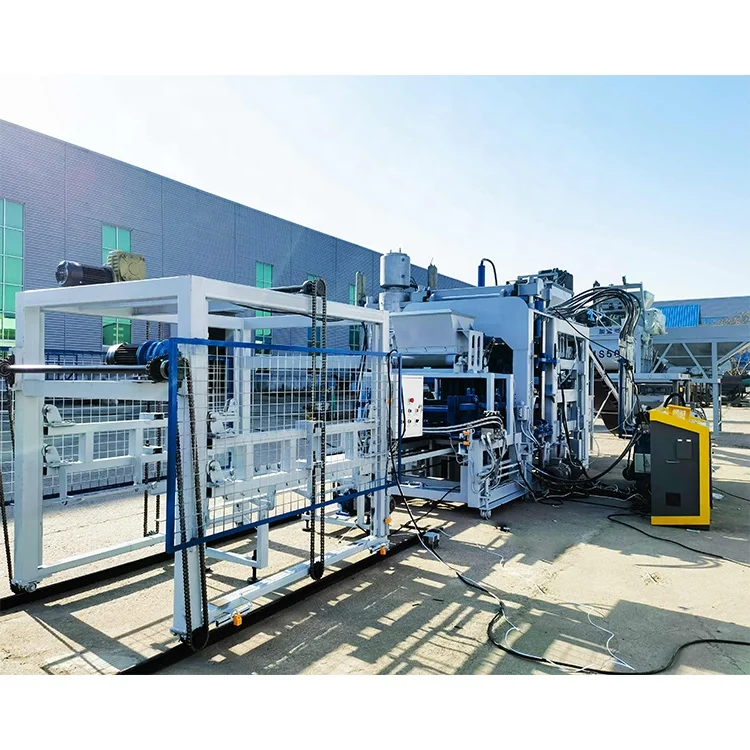 Stationary block machine