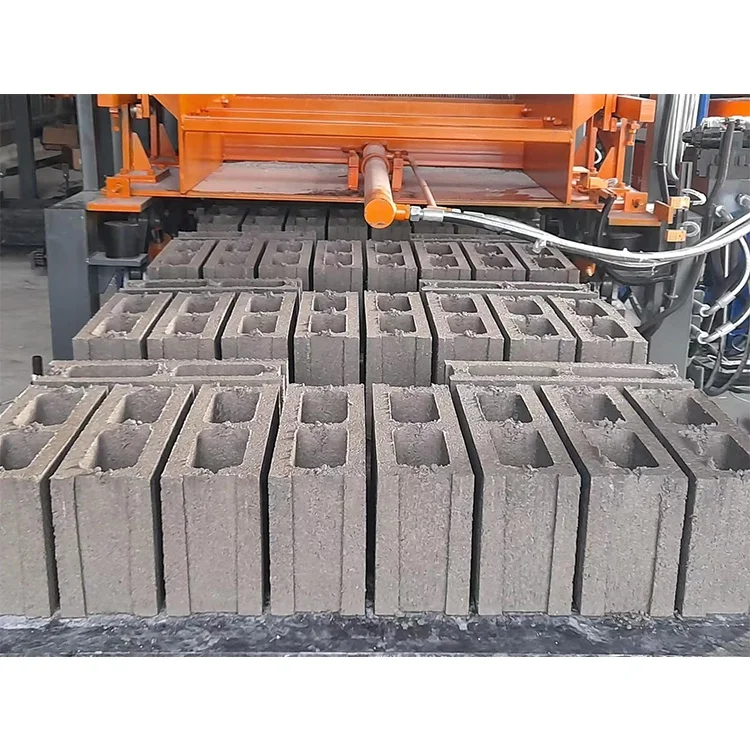
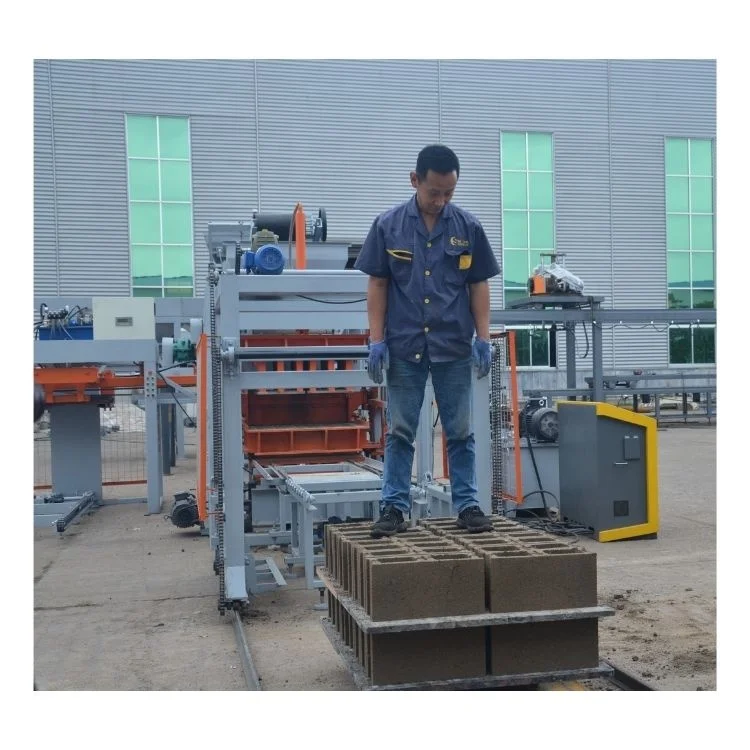
Matched System Supply — Every QT6-15 block machine, mould, pallet and handling unit is specified as one coordinated set, so cycle times balance across stations and the press never waits for upstream feeding or downstream stacking to catch up.
Technical Specifications
| Parameter |
Value |
| Model |
QT6-15 |
| Product Type |
Automatic Hydraulic Concrete Block Making Machine |
| Overall Dimensions (L×W×H) |
8200×1700×2950 mm |
| Vibration Frequency |
0-60 Hz (adjustable) |
| Vibration Form |
Platform Vibration |
| Vibration Force |
45 kN |
| Moulding Mode |
Automatic loading, vibration moulding |
| Pallet Size |
880×850 mm |
| Molding Cycle |
15-20 s (basis not stated in source — confirm block format and material) |
| Demolding Method |
Hydraulic |
| Overall Power |
37 kW |
| Total Mass |
7 T |
| Control System |
PLC with touch screen HMI |
| Hydraulic System |
Independent integrated hydraulic station |
| Output (Hollow block 400×200×200 mm) |
8640-11520 pcs/8hr (based on 6 pcs/mould, 15-20s cycle) |
| Output (Hollow block 400×150×200 mm) |
11520-15360 pcs/8hr (based on 8 pcs/mould, 15-20s cycle) |
| Output (Solid brick 240×115×53 mm) |
46080-61440 pcs/8hr (based on 32 pcs/mould, 15-20s cycle) |
| Output (Rectangular paver 200×100×60 mm) |
17280-23040 pcs/8hr (based on 21 pcs/mould, 20-25s cycle) |
| Output (Zigzag paver 225×112.5×60 mm) |
17280-23040 pcs/8hr (based on 15 pcs/mould, 20-25s cycle) |
| Block Compressive Strength |
>15 MPa |
| Factory Area Required |
1200 m² |
| Fault Diagnosis |
Built-in fault diagnosis system |
| Safety Logic |
Interlock control circuit |
| Raw Material Adaptability |
Waste ash, slag, various aggregates |
Application Suitability
| Application |
Material or Output |
| Hollow block production for residential and commercial walls |
Crushed stone, sand, cement, fly ash blends |
| Solid brick manufacturing for load-bearing structures |
Dense aggregate and cement mixes |
| Rectangular and interlocking paving block production |
Fine aggregate with pigment layers for surface finish |
| Kerbstone and multi-cellular brick forming |
Coarse aggregate with higher cement ratios |
| On-site block production for housing project contractors |
Locally sourced sand, gravel and cement |
Why "Pieces per Hour" Means Nothing Without the Format Attached
Capacity is only meaningful when tied to a specific block format, mould cavity count and cycle time.
Most block machine quotations lead with a single throughput figure, leaving out which block size that number assumes. I have seen buyers on Middle East project sites take delivery of a mid-tier machine expecting 10,000 hollow blocks daily, only to discover the quoted capacity was based on a smaller solid brick format they never intended to produce. The actual output for their 400×200×200 mm hollow block — with local aggregate containing higher clay content and longer vibration times needed for proper compaction — fell considerably short. [NEED_CITE: aggregate moisture and clay content effect on concrete block vibration cycle time] When you evaluate the QT6-15 block machine manufacturer options, insist that every capacity figure in the proposal states the exact format, mould cavity count and cycle time it assumes.

Where the QT6-15 Sits in the Full Machine Range
The Shiyue lineup spans from small semi-automatic machines for workshop-scale output up through high-capacity fully automatic lines with integrated stacking and cubing. The QT6-15 block machine occupies the mid-tier automatic position — buyers who have outgrown entry-level semi-automatic plants but are not yet ready for the footprint and investment of a top-tier line find their starting point here.
This positioning matters because it defines what supporting equipment makes sense alongside the press. A first-time block plant entrepreneur might pair the QT6-15 with manual pallet handling and a simpler batching setup, then add automatic pallet feeding and stacking as volumes grow. A construction contractor producing blocks on-site for a single large project might specify the full automatic configuration from day one, since the production run justifies the complete supporting line.
Matching Automation Level to Your Actual Operation
Automation on a block line is not a single yes-or-no choice — it is a spectrum from manual pallet handling at one end to fully automatic stacking, curing rack handling and cubing at the other. The QT6-15 supports configuration anywhere along that spectrum, and the right position depends on your labour availability, production volume and whether you plan to scale later. [NEED_CITE: automation level selection criteria for concrete block production plants]
The PLC-controlled process with touch screen HMI handles the core pressing cycle — automatic material loading, vibration sequence, hydraulic demolding and fault diagnosis — regardless of how much surrounding automation you select. This means a buyer can start with the QT6-15 in a semi-automatic supporting layout and later add automatic pallet feeding, stacking and cubing stations without replacing the press itself.
Reading the Specs That Actually Determine Block Quality
The relationship between vibration force and hydraulic pressure is where block strength is won or lost. The QT6-15 delivers 45 kN of vibration force through platform vibration at an adjustable 0-60 Hz, working alongside the independent integrated hydraulic station to compact the mix and then demould cleanly. If vibration force is high but hydraulic pressure is mismatched, blocks crack on release; if pressure is adequate but vibration insufficient for the aggregate gradation, blocks remain under-compacted and fail compressive strength targets.
The 880×850 mm pallet size is another specification that reaches beyond the press itself. This pallet dimension must match the curing racks and forklift tine spacing already in your facility — or planned for your new plant layout. Buyers who overlook this find themselves either replacing an entire curing rack system or manually repalletising every block after pressing.
The independent integrated hydraulic station sits isolated from the main vibration and dust environment, which matters for seal and valve longevity. In dusty block production environments, hydraulic contamination is a leading cause of unplanned downtime. The QT6-15’s separated station reduces that risk, keeping the hydraulic circuit cleaner over longer production runs.
What Happens When Machine Configuration Ignores Local Conditions
Choosing a pallet size without checking your existing curing racks and forklifts creates a bottleneck that has nothing to do with the press itself. I have visited plants where brand-new block machines sat partly idle because the pallets could not fit the curing chamber shelving, forcing workers to stack wet blocks on the floor and lose days of curing space.
Equally, specifying voltage and PLC display language after the machine is already in production causes commissioning delays at the destination. A machine wired for the wrong frequency or displaying fault codes in a language the operators cannot read sits idle while electricians and translators are sourced locally. [NEED_CITE: industrial machinery voltage and frequency compatibility for export markets]
What Distinguishes This Supply Approach
The QT6-15 block machine manufacturer configuration is set against your actual mix design, local aggregate characteristics and target block formats rather than pulled from a catalogue default. This means the vibration frequency range, hydraulic pressure setting and mould cavity count are chosen together based on what you will actually produce.
Machine, mould, pallet and handling equipment are specified as one matched system from a single source, eliminating the coordination gaps that appear when these components come from separate suppliers. Mould design covers the formats your market actually sells, including custom drawings when standard formats do not match local building codes or contractor preferences.
The automation level is selectable, so a buyer starting with limited capital can begin with manual pallet handling and add automatic stacking and cubing later without changing the core press. Installation, commissioning and operator training are included so the line reaches stable production with your team running it.
Documentation & Verification
- Line layout and capacity calculation stating exact block format for each output figure
- Machine specification sheet confirming voltage, frequency and PLC display language
- Mould drawing and format list matching the block types your market sells
- Factory test record with pallet specification and hydraulic and electrical schematics
- Packing photographs and customs documentation support for destination port
Installation, Commissioning & Support
- 1200 m² factory area requirement confirmed against your site plan before dispatch
- 37 kW total power requirement with dedicated circuit and correct voltage configuration
- Machine dismantled for container loading and reassembled with alignment checks on-site
- PLC touch screen HMI commissioned with display language set to operator preference
- Mould change procedure trained so format switches do not consume an entire shift
- Wear parts and mould list provided with recommended replacement intervals
What to Include in Your Inquiry
To receive a configuration proposal rather than a generic catalogue page, share the block formats your market actually sells, the daily output you need per format, and your local aggregate source and typical mix design. Confirm your site voltage, frequency and preferred PLC display language. If you have existing curing racks or forklifts, provide the pallet dimensions they accept so the QT6-15 pallet specification is matched before production begins.
Frequently Asked Questions
Q: How do I verify the real daily output of this block machine for my specific format and aggregate?
A: Request a line layout and capacity calculation document that states the exact block format, mould cavity count and cycle time assumed for every output figure. Provide your local aggregate type, gradation and typical mix design so the manufacturer can adjust vibration time estimates before quoting. Compare the document’s format-specific figures against your daily production target rather than a single headline number.
Q: Where does this model fit compared to smaller semi-automatic and larger high-capacity machines in the range?
A: It occupies the mid-tier automatic position — above entry-level semi-automatic machines in output and automation, below the highest-capacity fully automatic lines in footprint and investment. This makes it suitable for buyers who have outgrown workshop-scale production but do not yet need the volume a top-tier line delivers. The automation level around the press is configurable either direction.
Q: What voltage, frequency and PLC language options are confirmed before production begins?
A: These are confirmed during the sales process before the machine enters production. Provide your destination market voltage and frequency, and specify the preferred PLC display language for your operators. The machine specification sheet in the documentation package records all confirmed electrical and control parameters so there are no surprises during commissioning.
Q: What plant footprint and utility connections does the QT6-15 production line require?
A: The stated factory area requirement is 1200 m² for the complete line including material storage, pressing, pallet circulation and curing zones. Total power is 37 kW requiring a dedicated circuit at the confirmed voltage and frequency. Share your site dimensions and available power supply early so the line layout can be adapted to your actual building envelope.
Q: Can I start with a semi-automatic supporting layout and upgrade automation later?
A: Yes. The PLC-controlled core press remains the same regardless of surrounding automation level. You can begin with manual pallet handling and basic batching, then add automatic pallet feeding, stacking and cubing stations as your production volume and capital allow. The upgrade path is planned at the initial configuration stage so structural and electrical provisions are built in from the start.

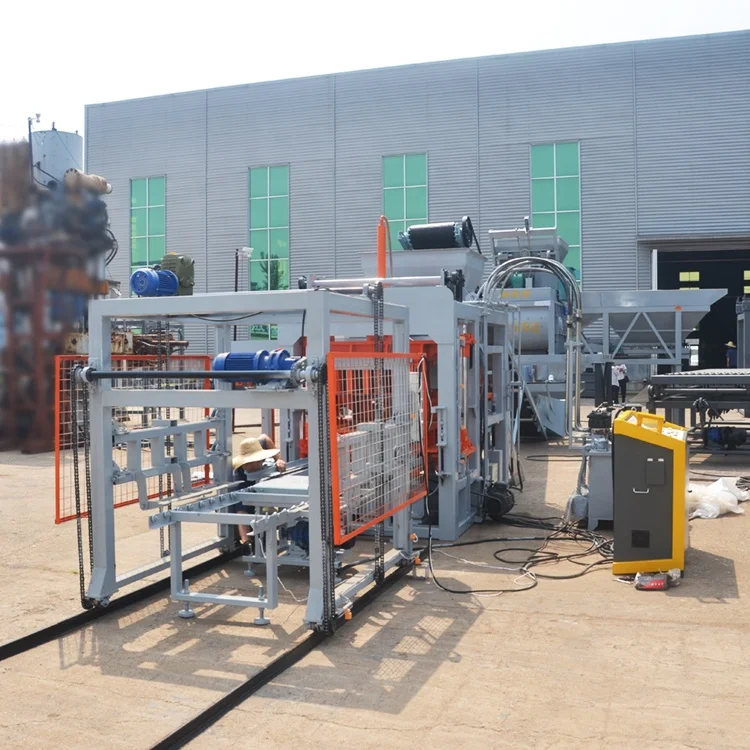
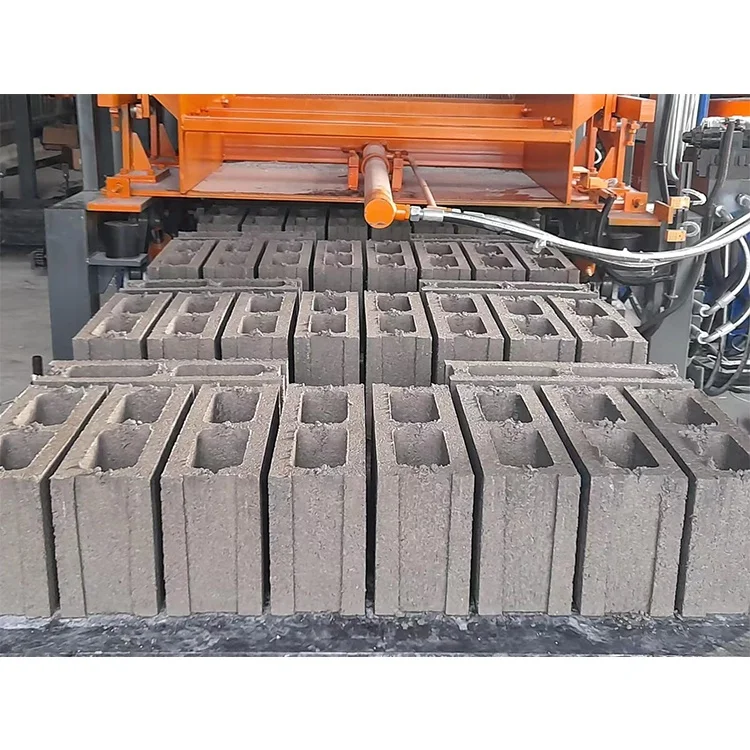 High quality block machine