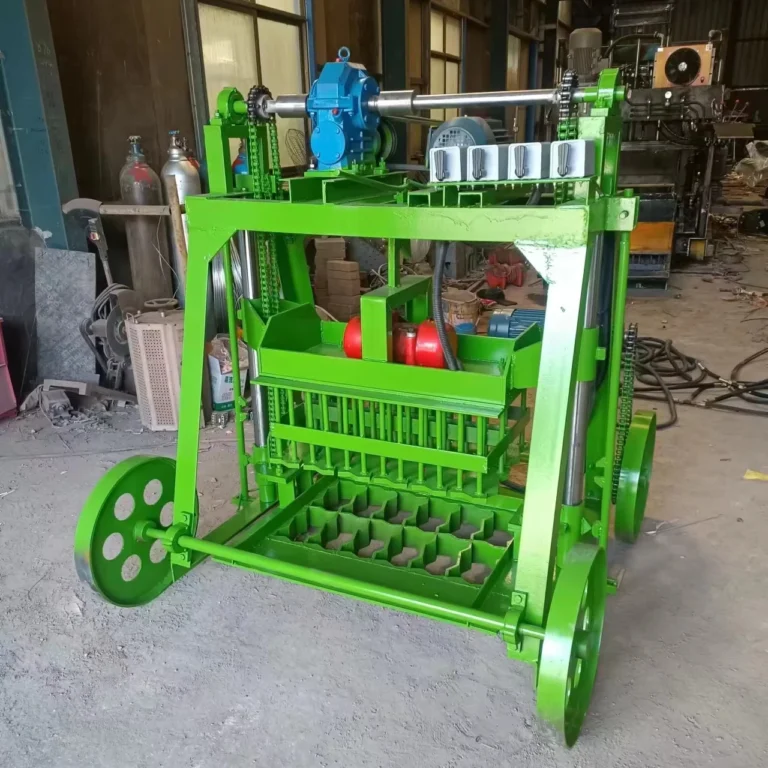
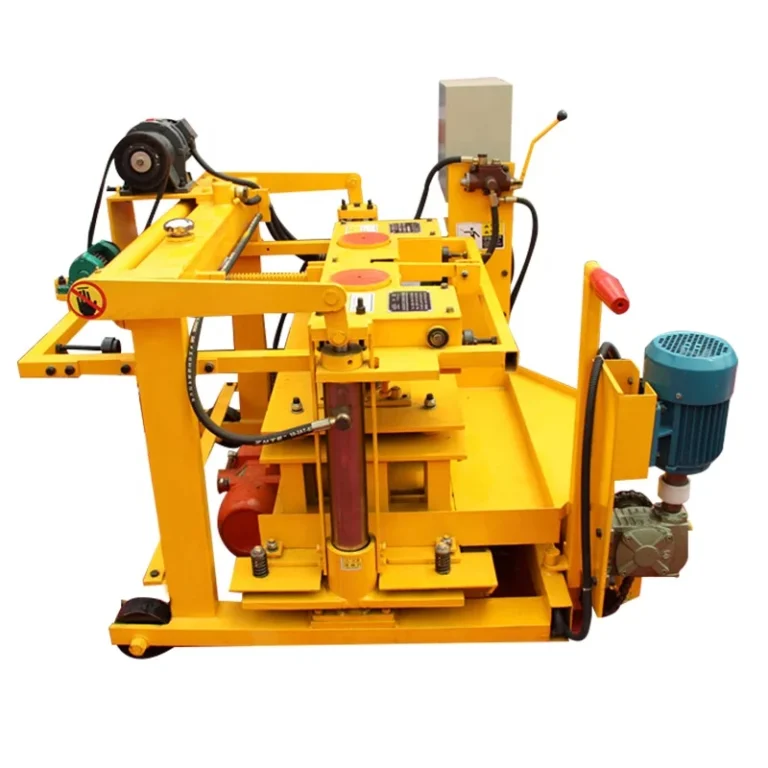
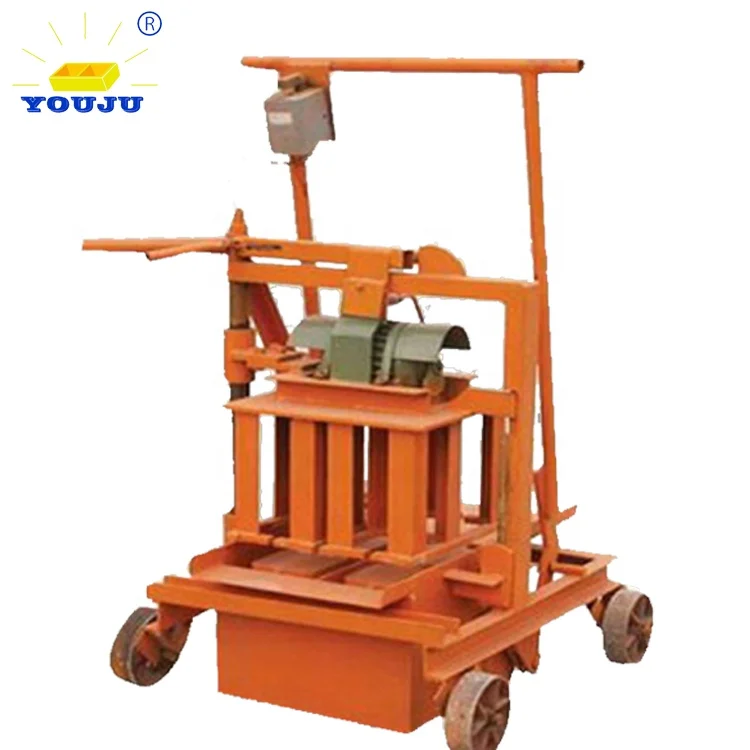
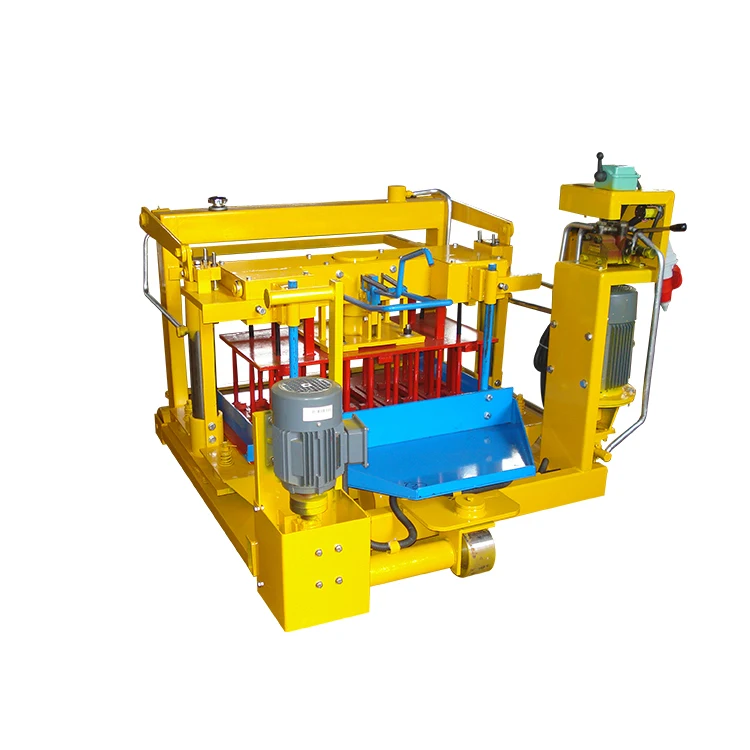
Configuration Matched to Your Mix Design — every QMJ2-45 mobile block machine is set up around your actual aggregate and block format, not a catalogue default, helping you place yourself on the full machine range before committing capital.
Technical Specifications
| Parameter |
Value |
| Model |
QMJ2-45 |
| Product Type |
Mobile Block Making Machine |
| Machine Type |
Mobile / egg-laying |
| Pallet Requirement |
No pallets required |
| Power Source |
Diesel engine |
| Operation Mode |
Manual mobile |
| Labour Requirement |
1 to 3 workers |
| Mould Change |
Supported for multiple hollow brick formats |
| Cycle Time |
25–30 s |
| Output Capacity |
160 pcs/h (basis: 400×200×200 mm hollow brick) |
| Output Capacity |
240 pcs/h (basis: 400×150×200 mm hollow brick) |
| Output Capacity |
320 pcs/h (basis: 400×100×200 mm hollow brick) |
| Daily Output (8 h) |
1,280 pcs (basis: 400×200×200 mm hollow brick) |
| Daily Output (8 h) |
2,560 pcs (basis: 400×100×200 mm hollow brick) |
| Daily Output (8 h) |
4,800 pcs (basis: 400×150×200 mm hollow brick) |
| Hydraulic Pressure |
Engine-driven hydraulic system |
| Control System |
Manual operation |
| Certification |
ISO 9001:2000, CE |
Application Suitability
| Application |
Material or Output |
| On-site hollow brick production without a fixed plant |
Crushed stone, cement, desert sand blends |
| Small-scale block production in limited space |
Concrete mixes with locally sourced aggregate |
| Construction sites requiring mobile block making |
Standard cement and sand mortar mixes |
| Areas without reliable electric power supply |
Any mix compatible with engine-driven vibration |
Why "Pieces per Hour" Can Mislead a First-Time Buyer
Capacity only means something when the block format is named beside it.
A mobile block making machine manufacturer quoting a single hourly number without specifying which hollow brick size that figure assumes will leave buyers guessing. When I was commissioning egg-laying machines across Gulf project sites, contractors repeatedly told me their previous machine never hit the promised output — almost always because the quoted rate assumed the smallest brick in the mould catalogue. The QMJ2-45 produces 160 pieces per hour on a 400×200×200 mm hollow brick, yet the same machine reaches 320 pieces per hour on a 400×100×200 mm unit. Both figures are real; neither is the full picture on its own. Stating capacity per format removes that ambiguity before a purchase order is signed. [NEED_CITE: block format assumptions in capacity quotations]

Where the QMJ2-45 Sits on the Full Range
The QMJ2-45 occupies the entry tier of a complete block machine line-up that extends from small egg-laying units through semi-automatic static presses to high-capacity fully automatic lines. Buyers surveying options for a first or replacement machine can use this model to understand what a no-pallet, engine-driven mobile platform delivers before deciding whether to step up to a pallet-based stationary press. The investment level is the lowest in the range, and the plant footprint is effectively the ground you drive it across.
What Mobile Gives You — and What It Asks in Return
Egg-laying machines trade the speed and consistency of a fixed line for portability and independence from grid power. The QMJ2-45 lays blocks directly onto a flat concrete floor and moves forward after each cycle, so curing area and production area are the same surface. That eliminates pallets, pallet feeders, and curing rack systems entirely. What it asks in return is a level, well-compacted casting floor and a willingness to accept longer mould-change intervals compared to a hydraulic static press. [NEED_CITE: floor preparation standards for mobile block production]
Reading the Specs That Actually Matter
Cycle time of 25–30 seconds sets the rhythm of the casting floor; any delay in feeding concrete or moving the machine between cycles pushes real output below the rated figure. The diesel engine removes dependence on site voltage, which matters on remote construction projects where generator capacity is shared with welding sets and lighting. Vibration force and hydraulic pressure work together to compact the mix inside the mould — too little vibration on a high-fines desert sand and the block will crumble on demould, while excessive pressure on a lean mix can cause lamination. Labour requirement of one to three workers assumes one operator on the handlebars, one feeding the hopper, and one finishing the freshly laid row.
The Cost of Skipping the Mix-Matching Step
Choosing a mobile machine on brochure output alone, then feeding it an aggregate the vibration system was not set up for, leads to blocks that chip during handling or fail compressive strength tests. I have watched an entire week’s production on a Gulf site get rejected because the sand was finer than the machine was originally tuned for, and the contractor had to absorb both the material waste and the schedule delay. Re-tuning vibration and pressure after arrival is possible but adds days of downtime that a simple pre-shipment sample test would have avoided. [NEED_CITE: aggregate grading effects on block compressive strength]
Why Buyers Place Repeat Orders Here
Block machinery is the single focus of Shandong Shiyue Intelligent Machinery, so the QMJ2-45 is specified as part of a matched system rather than assembled from unrelated suppliers. Machine configuration is set against the buyer’s actual mix design and target block format, not pulled from a generic catalogue. Mould design covers the hollow brick sizes the buyer’s market actually sells, with custom drawings available for non-standard formats. Automation level is selectable across the range, so a buyer starting with the QMJ2-45 can move to a semi-automatic or automatic tier later without abandoning the supplier relationship. Installation support includes on-site operator training matched to local workforce skill levels.
Documentation & Verification
- Line layout and capacity calculation stating block format assumed for each output figure
- Machine specification sheet with hydraulic and vibration values matched to your mix
- Mould drawing and format list confirming included and optional hollow brick sizes
- Factory test record on your specified aggregate before dispatch
- Operation and maintenance manual in your preferred language
- CE declaration and ISO 9001:2000 documentation package
Installation, Commissioning & Support
- Flat, compacted concrete floor of adequate area for daily casting and curing cycle
- Diesel fuel supply and daily engine maintenance schedule briefed on arrival
- Machine delivered fully assembled; only mould installation required on site
- First-day commissioning covers cycle timing, vibration setting, and mix adjustment
- Operator training on manual steering, hopper feeding, and mould change procedure
- Wear parts list for mould liners and hydraulic seals with recommended stock levels
Before You Request a Quote
To size the QMJ2-45 correctly against your project, share the hollow brick dimensions your market demands, the daily piece count you need, and a description of the aggregate you can source locally. Let us know the ground conditions where casting will take place and whether a diesel or electric variant suits your site better.
Frequently Asked Questions
Q: How is QMJ2-45 hourly capacity calculated and which block format does it assume?
A: Every capacity figure on this page is tied to a specific hollow brick dimension. The 160-piece hourly rate applies to 400×200×200 mm blocks, while smaller formats yield higher counts within the same cycle time. No single "up to" number is used, so you can plan daily throughput around the exact format you intend to produce.
Q: Where does this mobile machine sit in the range compared to semi-automatic and automatic tiers?
A: The QMJ2-45 is the entry point — lowest capital, smallest footprint, no pallets. Semi-automatic static presses add pallets and higher output; automatic lines add stacking and cubing. Buyers often start here to validate market demand before moving up.
Q: What plant footprint and ground conditions does the QMJ2-45 require?
A: There is no fixed plant. You need a level, compacted concrete floor large enough for one day’s casting plus curing. The machine moves along the floor as it lays, so production and curing share the same surface.
Q: Can I upgrade from QMJ2-45 to a higher-tier machine later without replacing moulds?
A: Mould formats can be designed to carry across tiers, so the hollow brick sizes you establish with the QMJ2-45 may be compatible with future semi-automatic or automatic presses in the same range, subject to pallet size confirmation.
Q: What mould formats are included as standard and which require custom design?
A: Standard moulds cover common hollow brick sizes listed in the format table. Any dimension outside that list is treated as a custom mould, drawn to your specifications and quoted separately before production begins.

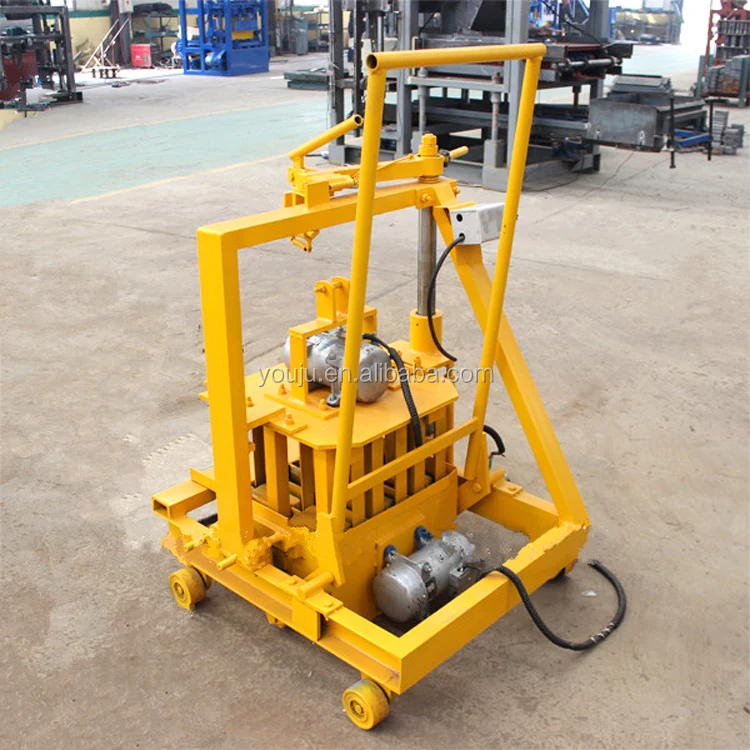
 Mobile block machine