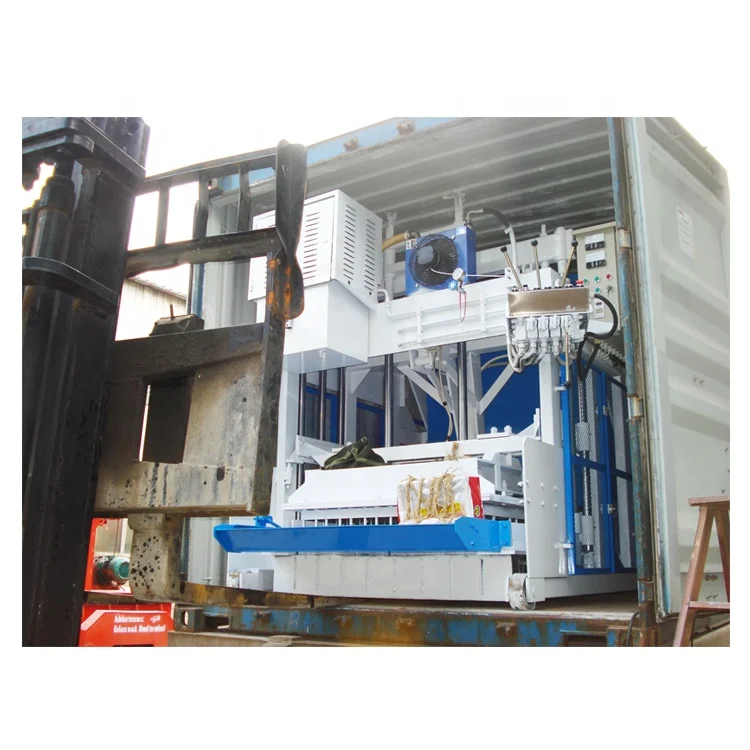
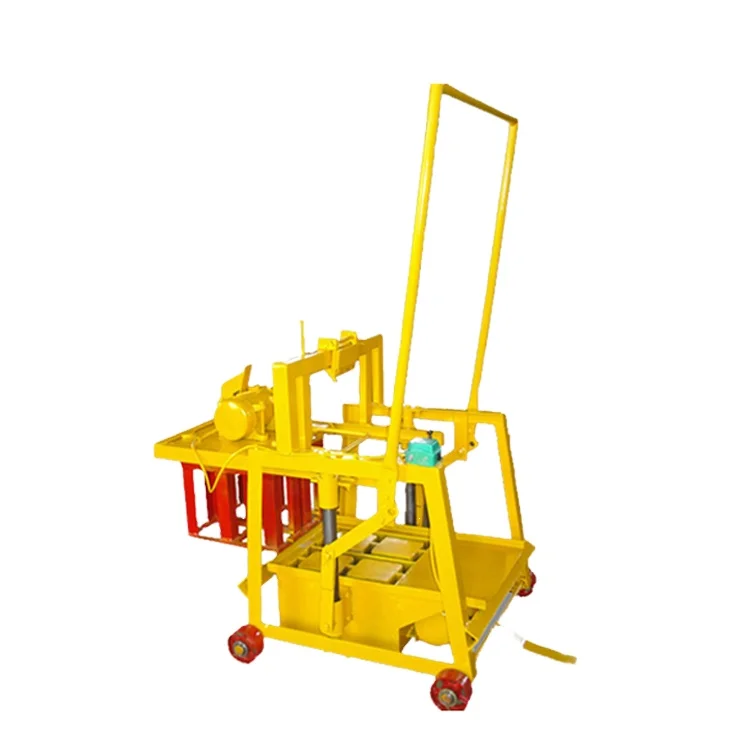
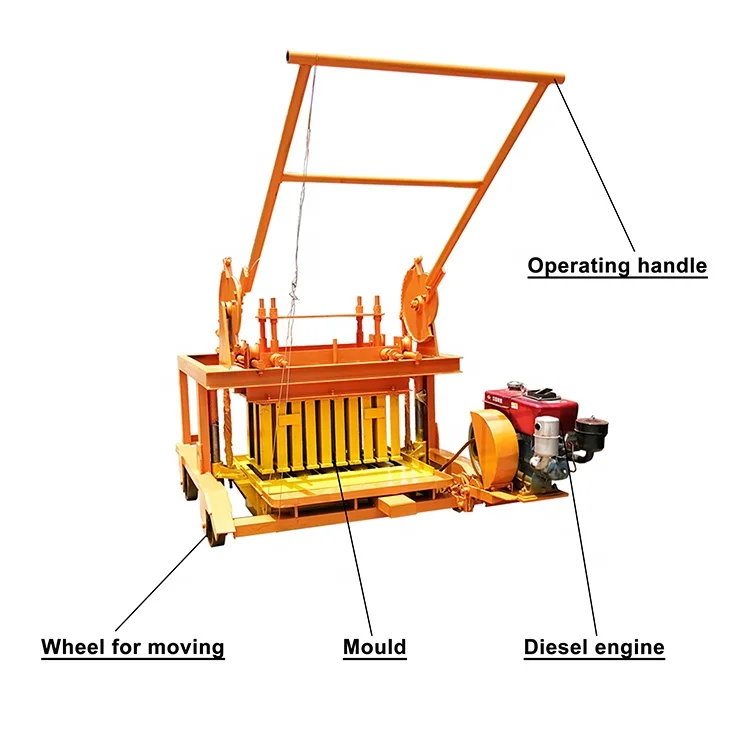
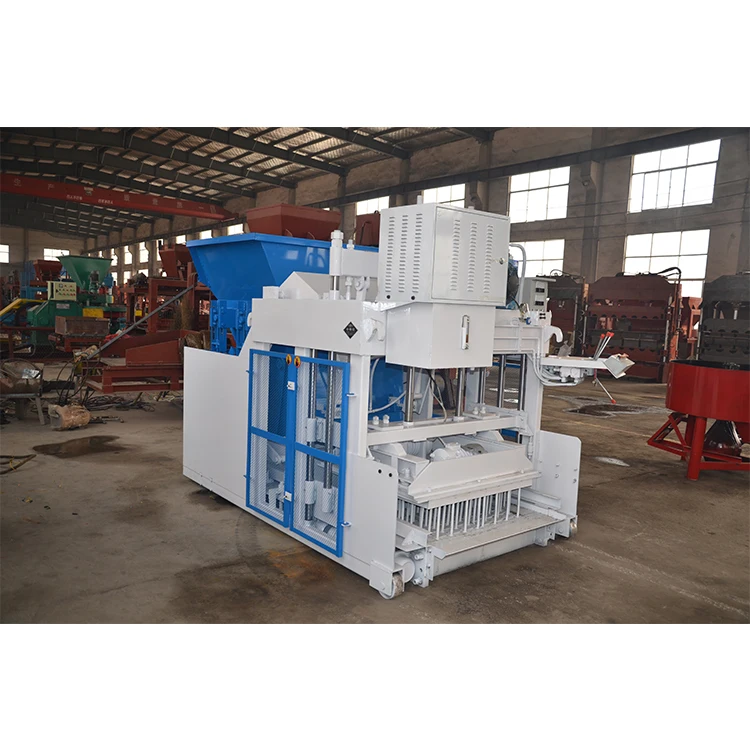
Single-Focus Block Machinery — every QMJ2-45 mobile block making machine for sale is configured as one matched system of press, mould and pallet handling, not assembled from separate suppliers.
Technical Specifications
| Parameter |
Value |
| Model |
QMJ2-45 |
| Product Type |
Hand-pushed Mobile Concrete Block Making Machine |
| Machine Type |
Manual mobile (egg-laying), hand-pushed |
| Pallet Requirement |
No pallets required |
| Power Source |
Electric motor (specification to be confirmed per market) |
| Control System |
Manual operation |
| Automation Level |
Manual |
| Labor Requirement |
1 to 3 workers |
| Mould Change |
Interchangeable moulds for different hollow brick formats |
| Cycle Time |
25-30 seconds per mould |
| Mould Format Output A |
400×200×200 mm hollow brick — 2 pcs/mould, ~1,280 pcs/8hr (basis: 25-30s cycle) |
| Mould Format Output B |
400×150×200 mm hollow brick — 3 pcs/mould (source lists 4,800 pcs/8hr — basis to be confirmed) |
| Mould Format Output C |
400×100×200 mm hollow brick — 4 pcs/mould, ~2,560 pcs/8hr (basis: 25-30s cycle) |
| Certification |
ISO9001:2000, CE |
Application Suitability
| Application |
Material or Output |
| Small-scale on-site hollow brick production |
Crushed stone, sand, cement, water |
| Construction sites without fixed plant infrastructure |
Hollow bricks in 400×200×200 / 400×150×200 / 400×100×200 mm formats |
| Low-investment block production in areas without reliable grid |
Standard concrete mix compatible with locally sourced aggregate |
| Entrepreneurs setting up a first small block operation |
Multiple hollow brick formats from a single machine via mould swap |
What "1,280 Blocks per Day" Leaves Out When Sourcing a Mobile Block Making Machine for Sale
Capacity figures without a stated block format are meaningless on a hand-pushed egg-laying unit.
A mobile block making machine for sale is often advertised with a single headline output number, but that number only holds true for one specific brick size and one specific cycle time. When the format changes, the pieces-per-mould count changes, and the daily total can shift significantly. On the QMJ2-45, the 400×200×200 mm format yields two pieces per mould cycle, while the 400×100×200 mm format yields four — yet both share the same 25-30 second cycle. Buyers who do not pin down which format the quoted output assumes will find their real daily production falling short once they switch to the size their market actually demands [NEED_CITE: capacity calculation standards for manual block machines].

Where This Hand-Pushed Unit Sits in the Full Machine Range
The QMJ2-45 occupies the entry tier of the block machine lineup. It requires no pallets, no fixed foundation, and no batching plant, which places it below semi-automatic and fully automatic lines in both investment and output. For buyers surveying options for a first or replacement machine, it serves as the baseline from which every higher tier is measured. Understanding its manual cycle and limited format range helps a buyer decide whether current volume justifies stepping up to a stationary press with pallet handling.
Footprint and Site Conditions That Make or Break the Decision
This egg-laying design produces blocks directly on the ground, so the curing area must be flat, firm, and large enough to hold an entire shift’s output spread across the floor. Unlike pallet-based systems where blocks stack vertically on racks, here every block occupies ground space until it cures. The compact size of the QMJ2-45 lets it operate in constrained site conditions, but the curing area it demands is often larger than buyers initially plan for [NEED_CITE: curing area requirements for egg-laying block machines]. Confirming available floor space against the chosen block format’s daily volume prevents a situation where production has to stop because there is nowhere left to lay fresh blocks.
Reading the Spec Sheet Against Your Local Mix and Aggregate
The 25-30 second cycle time assumes a concrete mix that flows into the mould cleanly and holds shape once the mould lifts. Local aggregate grading, cement content, and water ratio all affect whether the block stands or slumps on a pallet-free machine. The QMJ2-45 has no automated batching system to compensate for an inconsistent mix, so the operator must maintain proportioning by hand. Vibration force on this manual unit is modest compared to hydraulic stationary presses, which means the mix must be designed for lower compaction energy. Matching the mix to the machine’s forming method is a prerequisite for block strength, not an optional refinement.
The Hidden Cost of Skipping the Electrical Confirmation
Confirming voltage, frequency, and motor specification after the machine has arrived is a recurring source of project delay. On a hand-pushed mobile block making machine for sale, the motor drives vibration and any mismatch with the local three-phase supply means the machine sits idle while a transformer or replacement motor is sourced. One early shipment I was involved with reached an African site with a motor rated for a frequency the local grid did not supply, and the contractor spent two weeks reconfiguring the distribution cabinet before the first block was produced. Locking down electrical parameters before production starts is non-negotiable, even on a machine this simple [NEED_CITE: voltage and frequency standards by export market].
Why Buyers Source This Mobile Tier Here
The QMJ2-45 is specified as one system — press, mould set, and recommended mix — rather than a standalone press with separate mould sourcing left to the buyer. Mould design covers the hollow brick formats the buyer’s market actually sells, with custom drawings available when standard formats do not match local demand. Configuration is set against the buyer’s local aggregate and target block format, not pulled from a catalogue default. The automation level is selectable across the range, so a buyer starting with this manual unit has a clear upgrade path to semi-automatic or full automatic lines when volume grows. Installation guidance and operator training are included, which matters on a manual machine where technique directly affects block consistency.
Documentation & Verification
- Capacity calculation sheet stating output per block format and cycle time
- Mould drawing and format list confirming exact brick dimensions supplied
- Voltage, frequency, and motor specification confirmation before production
- Factory test record on the ordered block format before dispatch
- Operation and maintenance manual with wear parts list
Installation, Commissioning & Support
- Flat, firm ground surface required for egg-laying production across the full curing area
- Motor specification locked to local voltage and frequency before motor is fitted
- Mould set assembled and tested on the ordered hollow brick format at the factory
- Operator training covers mix proportioning, cycle rhythm, and mould change procedure
- Wear parts list provided so first replacement order can be planned before stock runs out
What to Include in Your Inquiry
Provide the hollow brick format your market sells, the daily volume you need from a single shift, and the concrete aggregate available locally. Confirm the electrical supply at your site — voltage, frequency, and phase — so the motor and control box are matched before the machine enters production. If you are comparing this manual tier against a semi-automatic line, share your current curing area dimensions so we can calculate whether the ground space supports the output you are targeting.
Frequently Asked Questions
Q: How is output capacity calculated for each block format on the QMJ2-45?
A: Each format has a different pieces-per-mould count. The 400×200×200 mm format produces two pieces per cycle, the 400×150×200 mm format produces three, and the 400×100×200 mm format produces four. All share a 25-30 second cycle time. Daily output depends on shift length and operator pace, so we provide a capacity calculation sheet that states the assumed format, cycle time, and shift hours.
Q: What electrical supply does the QMJ2-45 require?
A: The machine runs on an electric motor whose voltage, frequency, and phase must match the buyer’s local supply. These parameters are confirmed before production begins. Supplying the exact site voltage and frequency in your inquiry prevents a situation where the machine arrives with a motor that cannot connect to the available power.
Q: Which block formats can I produce, and how long does a mould change take?
A: The QMJ2-45 supports hollow brick formats including 400×200×200 mm, 400×150×200 mm, and 400×100×200 mm through interchangeable moulds. Mould change is manual and can be completed within a short pause in production. Custom mould drawings are available if your market requires a format outside the standard range.
Q: Can I start with the QMJ2-45 and upgrade to an automatic line later?
A: Yes. This manual mobile unit sits at the entry point of the range. When production volume outgrows the hand-pushed cycle and ground-curing method, you can move to a semi-automatic or fully automatic stationary line with pallet handling and stacking. The mould format knowledge and mix design work you do on this machine carries forward to the next tier.
Q: What installation support and operator training are included?
A: The machine is shipped ready to operate after motor connection. We provide guidance on ground preparation, curing area layout, and first-run mix proportioning. Operator training covers the manual cycle rhythm, mould change procedure, and daily maintenance checks so your team can produce consistent blocks from the first shift.

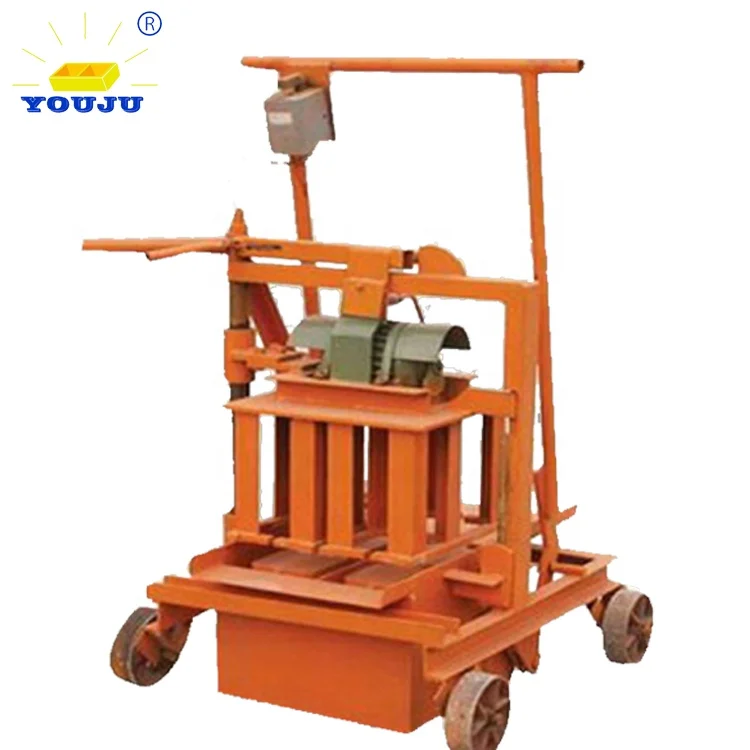
 Mobile block machine