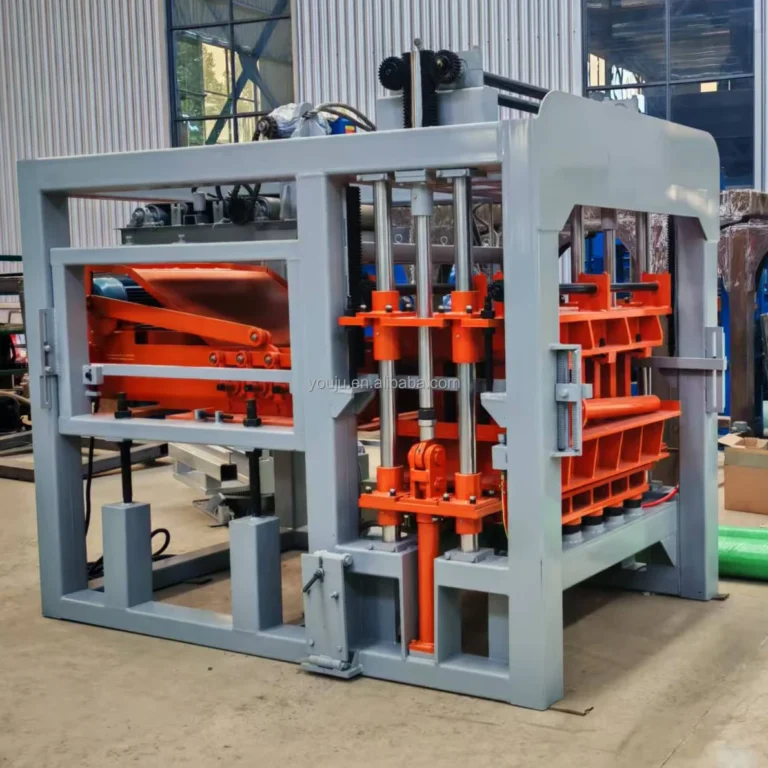
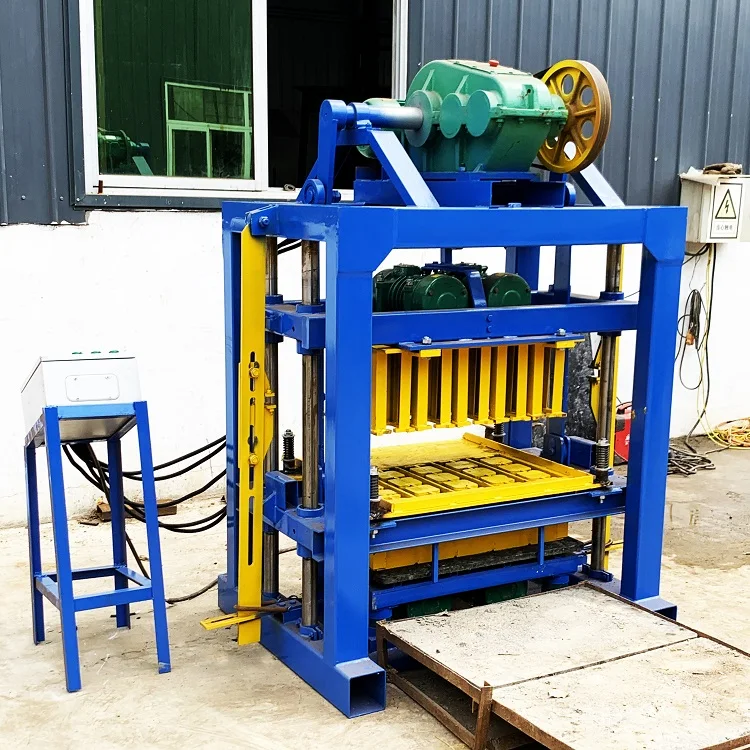
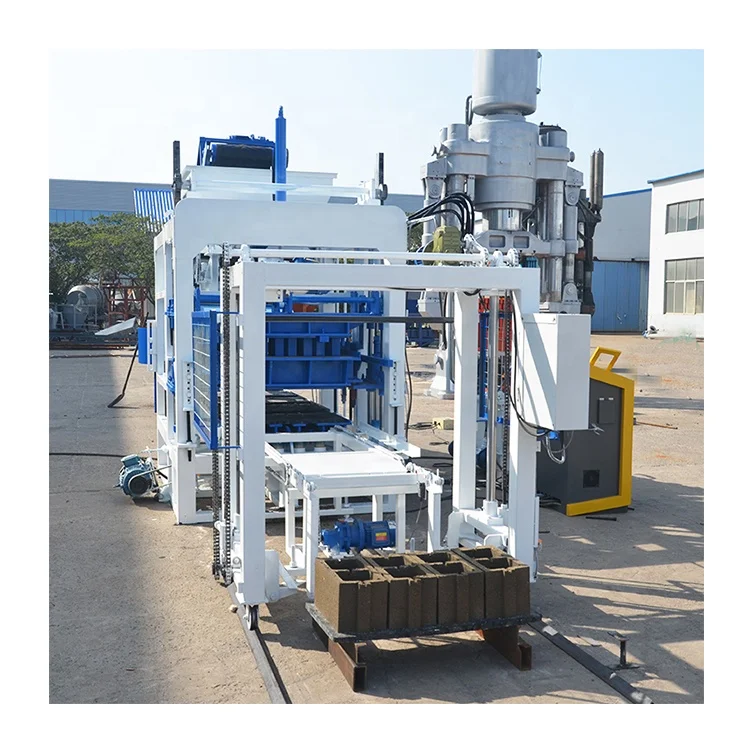
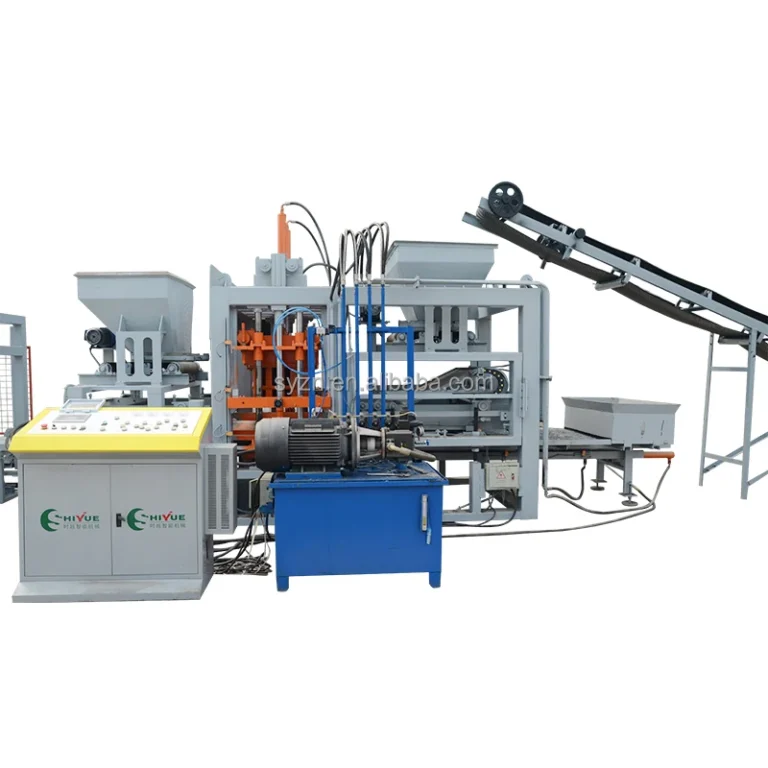
Matched System Configuration — every QT8-15 stationary block machine is specified alongside its moulds, pallets, and handling equipment as one coordinated production line rather than a standalone press.
Technical Specifications
| Parameter |
Value |
| Model |
QT8-15 |
| Product Type |
Stationary Concrete Block Making Machine |
| Overall Dimensions (L×W×H) |
8300 × 1860 × 3000 mm |
| Total Mass |
9 T |
| Rated Pressure |
21 MPa |
| Main Vibration Form |
Platform Vibration |
| Vibration Frequency |
2800–4500 r/min |
| Vibration Force |
60 kN |
| Pallet Size |
950 × 900 mm |
| Molding Cycle |
15–25 s (basis not stated in source — confirm block format and material) |
| Overall Power |
55.5 kW |
| General Water Consumption |
12 T/Day |
| Factory Area |
600 m² |
| Demolding Method |
Hydraulic |
| Feeding System |
Semi-closed screen reticular rotational forced feeding |
| Control System |
PLC with human-machine interface (HMI dialogue) |
| Automation Level |
Fully automatic |
| Voltage & Frequency |
Configurable — confirm before quotation |
| Certification |
CE (verify per unit) |
Application Suitability
| Application |
Material or Output |
| Hollow and solid block production plants |
Crushed stone, sand, cement, fly ash, gravel |
| Paver and interlocking brick lines |
Colored concrete mixes, fine aggregate blends |
| Kerbstone and curb production |
Dense concrete with coarse aggregate |
| On-site construction block manufacturing |
Local aggregate and cement sourced per region |
| Building material distributor stock programs |
Multiple formats from a single pallet size |
What the Headline Capacity Figure Leaves Out
Many quotations list a single cycles-per-hour number for a stationary block machine manufacturer without stating which block format, wall thickness, or material mix that number assumes, leaving buyers to discover on commissioning day that their real daily output falls well short of projections.
Cycle time means nothing until the block format and mix design are pinned down.
When a buyer receives a capacity quote based on a thin solid paver but intends to run 200 mm hollow blocks, the actual molding cycle stretches considerably longer. The vibration frequency must be adjusted for the heavier, deeper cavity, and the hydraulic pressure needs to hold the taller green block together during demolding. I have watched projects stall because the line was sized on a best-case format while the commercial plan depended on a slower, heavier product. The QT8-15 molding cycle of 15–25 s is a range, not a guarantee — the exact figure depends on the format, aggregate grading, and moisture content you will actually run. [NEED_CITE: relationship between block cavity depth and vibration cycle time]

Positioning Within the Full Machine Range
The QT8-15 occupies the mid-to-high output tier among our stationary block machine lineup. Buyers evaluating their first plant typically compare it against smaller semi-automatic models where pallet handling remains manual and daily output is governed by labor availability rather than press speed. At this tier, the fully automatic control architecture means the press cycle, material feeding, and pallet movement are all coordinated through the PLC, removing the operator from the timing loop.
For established producers running a smaller automatic line, the step up to the QT8-15 brings a larger pallet size at 950 × 900 mm, which directly translates into more block surface area per cycle. The decision between staying at a lower tier or moving to this model usually comes down to whether the curing yard and forklift fleet can absorb the higher wet-block throughput that the larger pallet delivers.
How the Stations Connect Across the Line
A stationary block machine manufacturer must specify not only the press but also how raw material feeding, pallet circulation, and stacking integrate around it. The QT8-15 overall power draw of 55.5 kW covers the press itself; the mixer, conveyor, and any automatic stacker each add their own electrical load. When the total connected load is calculated for the site transformer, every station must be included or the commissioning electrician faces an unwelcome surprise. [NEED_CITE: electrical load calculation for concrete block production lines]
The semi-closed screen reticular forced feeding unit on this model distributes material across the mould cavity before each press stroke. If the upstream mixer discharges inconsistently, the feeder cannot compensate, and block weight drifts from cycle to cycle. Line planning means matching the mixer batch size and discharge rate to the QT8-15 cycle so the feeder hopper never runs empty mid-stroke.
Pressure, Vibration, and What They Mean for Block Density
The rated hydraulic pressure of 21 MPa and platform vibration force of 60 kN work together to compact the concrete mix inside the mould box. Higher vibration frequency — adjustable between 2800 and 4500 r/min — suits finer aggregates and thinner paver formats, while the lower end of the range gives coarser hollow block mixes time to settle under pressure. If the vibration force is too low for a given aggregate size, voids remain in the block wall and compressive strength drops below the target grade.
The pallet size of 950 × 900 mm determines how many blocks are formed per cycle and must match the curing rack spacing and the forklift tine width already in use at the plant. Specifying a pallet dimension that conflicts with existing handling equipment forces a capital outlay on new racks and trucks that was never part of the project budget. The 600 m² factory area figure covers the press zone and immediate pallet circulation — the curing yard, raw material stockpile, and finished goods storage sit outside that envelope and must be planned separately.
When the Wrong Configuration Reaches the Site
A machine wired for 380 V/50 Hz arriving at a 440 V/60 Hz project site cannot be energized until the variable frequency drives and motor contactors are replaced or reconfigured — a delay that idles the entire line including the curing system and stacking equipment downstream. I have seen this exact mismatch hold up a housing project for weeks while replacement electrical panels were shipped internationally. [NEED_CITE: voltage and frequency standards by export market]
Equally costly is selecting a mould set based on catalogue photos rather than the formats the local market actually buys. If the QT8-15 arrives with hollow block moulds but the region demands interlocking pavers, the machine sits idle while new mould tooling is designed, manufactured, and shipped. The mould format list and drawings must be reviewed against market demand before the order is confirmed, not after the container is loaded.
Why Source the QT8-15 Through This Range
Block machinery is our single focus, which means the QT8-15 press, its moulds, pallets, and supporting conveyors are specified as one matched system rather than assembled from unrelated suppliers who each point blame at the other when a fault appears. Every configuration is set against your actual mix design and local aggregate — not pulled from a default catalogue page that assumes materials you cannot source.
Mould design covers the formats your market sells, including custom profiles drawn to your specifications. The automation level is selectable: a buyer can begin with semi-automatic pallet handling and add an automatic stacker and cubing system as volumes grow, without replacing the press itself. Installation support includes on-site commissioning and operator training so the first production run happens with someone who knows the machine standing beside your crew. [NEED_CITE: CE machinery directive requirements for industrial equipment]
Documentation & Verification
- Line layout showing QT8-15 station positions and pallet flow path with format-specific capacity notes
- Machine specification sheet confirming pallet size, vibration force, and hydraulic pressure against your mix
- Mould drawing set and format list reviewed before order confirmation
- Voltage, frequency, and PLC display language written into the purchase contract
- Factory test record captured on your target block format before container loading
- Packing photographs and customs documentation prepared per destination country requirements
Installation, Commissioning & Support
- Foundation pad poured to level tolerance for the 8300 × 1860 mm QT8-15 footprint with embedded anchor points
- Dedicated electrical circuit sized for 55.5 kW press load plus all upstream and downstream stations
- Machine shipped partially dismantled for container loading; reassembly supervised on site by our technician
- PLC HMI language set and all sensor calibrations verified during first production run on your block format
- Operator training covers mould change procedure, vibration frequency adjustment, and daily greasing points
- Wear parts list and hydraulic seal kit supplied with first shipment to cover initial operating period
What to Include in Your Inquiry
To configure the QT8-15 correctly for your project, we need to know the block formats you intend to produce and the daily volume target for each. Share your local aggregate type and any existing mix design data so the vibration and pressure settings can be matched before the machine enters production. Confirm your site voltage, frequency, and preferred PLC display language so the electrical package is built right the first time. If you have existing pallets, curing racks, or forklifts on site, provide their dimensions so the pallet specification aligns with your handling equipment.
Frequently Asked Questions
Q: How is the QT8-15 output capacity verified for each block format?
A: Capacity is calculated per format, not as a single headline number. The molding cycle of 15–25 s is a range that narrows once your specific block dimensions, wall thickness, and aggregate mix are confirmed. We provide a written capacity calculation document that states which format each output figure assumes, so there is no ambiguity when the line starts production.
Q: Where does the QT8-15 sit compared to smaller automatic and semi-automatic tiers?
A: The QT8-15 is in the mid-to-high output tier with a 950 × 900 mm pallet and fully automatic PLC control. Smaller tiers use smaller pallets and may rely on manual pallet handling. The choice depends on your daily volume target, available curing area, and whether you plan to add automatic stacking and cubing from the start or phase it in later.
Q: What plant footprint does a complete QT8-15 stationary line require?
A: The press zone and immediate pallet circulation need approximately 600 m², but the total site must also accommodate raw material storage, a curing yard sized for your daily output and curing duration, and finished goods stacking space. We provide a line layout drawing that maps every station so you can plan the full site before the foundation is poured.
Q: Can I start with semi-automatic handling and upgrade later?
A: Yes. The QT8-15 press and control system support a phased automation path. You can begin with manual pallet handling at the offbear end and add an automatic stacker and cubing system as production volumes justify the investment, without replacing the core machine or PLC platform.
Q: How are voltage and PLC language confirmed before the machine ships?
A: Your site voltage, frequency, and preferred HMI display language are documented in the purchase contract before production begins. The electrical panel is built and tested at those exact values during the factory acceptance test, so the machine powers on correctly when it arrives at your site.

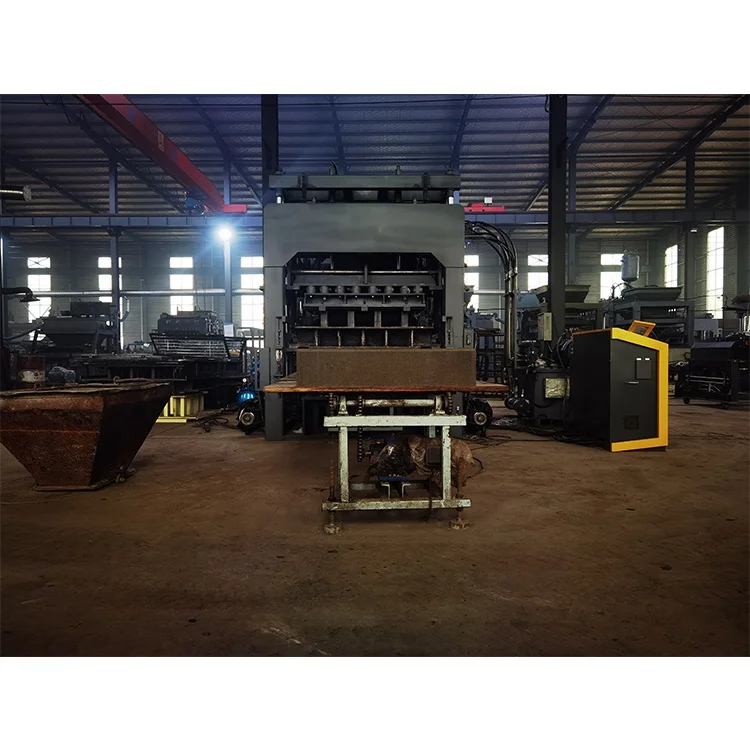
 Stationary block machine