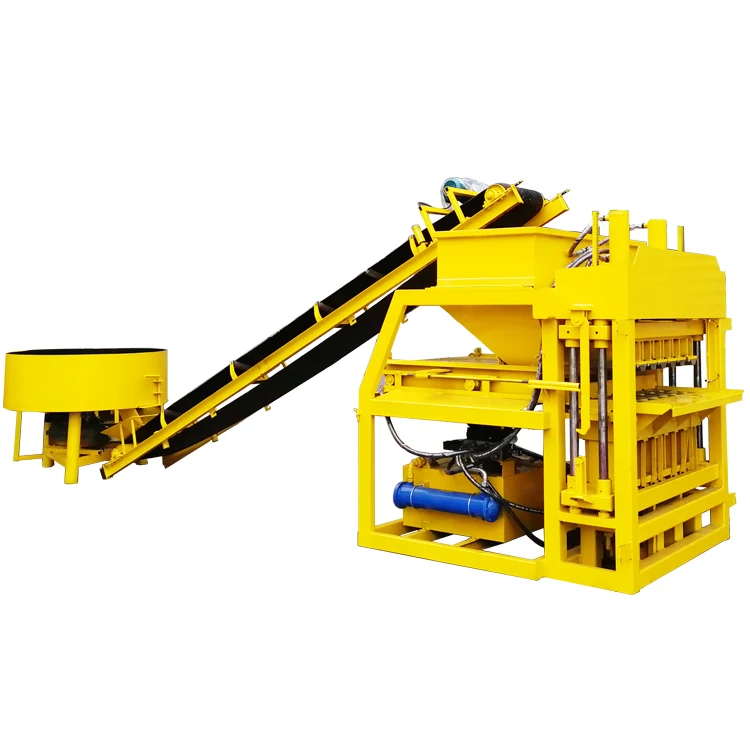
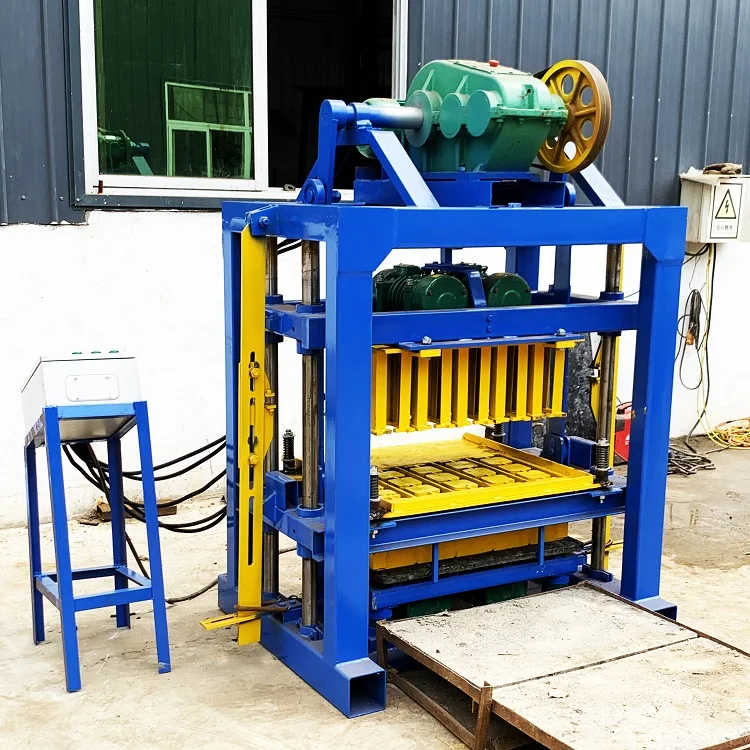
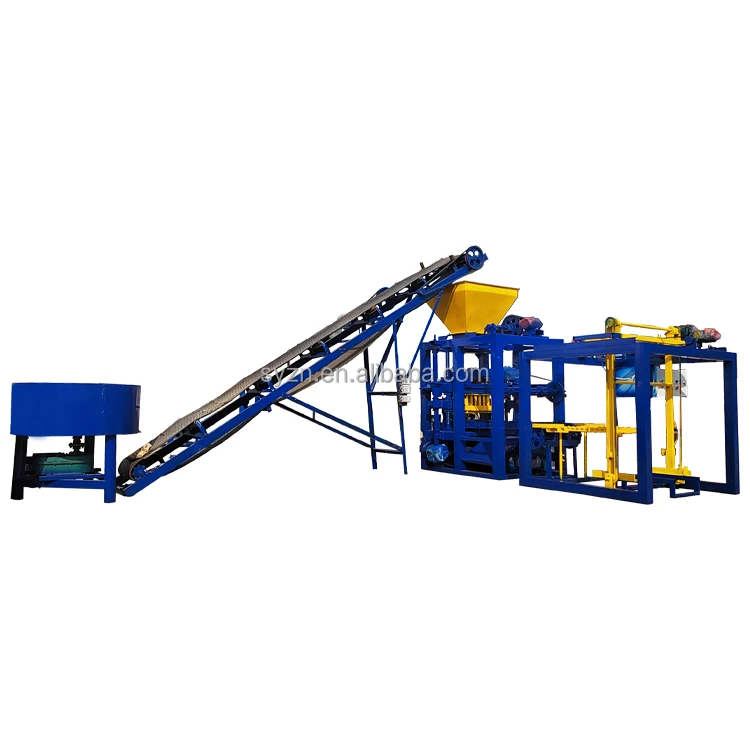
Configured As One System — the QTJ4-40 manual block making machine, mould, pallet and handling are matched as a single package rather than sourced from separate vendors.
Technical Specifications
| Parameter |
Value |
| Model |
QTJ4-40B2 |
| Product Type |
Manual Concrete Block Making Machine |
| Overall Dimensions (L×W×H) |
1350 × 1460 × 1800 mm |
| Net Weight |
1000 kg |
| Rated Power |
9.5 kW |
| Voltage & Frequency |
Configurable to buyer’s local supply (basis to be confirmed before production) |
| Control System |
Manual process |
| Vibration Frequency |
2800 r/min |
| Standard Mould Format |
390 × 190 × 190 mm, 4 pcs/mould |
| Workers Required |
3–5 |
| Automation Level |
Manual / Semi-automatic |
| Assembly State |
Fully assembled at factory |
| Warranty |
1 year |
| Output Capacity |
Varies by block format and mix design (basis to be confirmed) |
| Pallet Size |
Matched to mould format and curing layout (basis to be confirmed) |
| Cycle Time |
Dependent on block format and operator workflow (basis to be confirmed) |
| Certification |
CE (verify for specific model) |
Application Suitability
| Application |
Material or Output |
| Hollow block production for residential and commercial masonry |
Crushed stone, river sand, cement, and water |
| Solid block manufacturing for load-bearing walls |
Local aggregate blended with Portland cement |
| On-site block production for housing developments |
Site-sourced gravel and sand with cement binder |
| Small-scale block plant start-ups |
Locally available masonry aggregates |
What the "Pieces per Hour" Figure Never Tells You
Capacity means nothing unless you know which block format it assumes.
I have watched buyers compare two manual block making machines on paper, pick the one with the higher cycle count, and then wonder why their daily pallet count falls short once production starts. The reason is almost always the same: the quoted figure was based on a small solid block, while the buyer planned to run 390 × 190 × 190 mm hollow blocks that need longer vibration and curing. When a supplier quotes a manual block making machine for sale without naming the reference format, the number is essentially decorative. [NEED_CITE: block format impact on realistic daily output]
Where the QTJ4-40 Fits in the Stationary Range
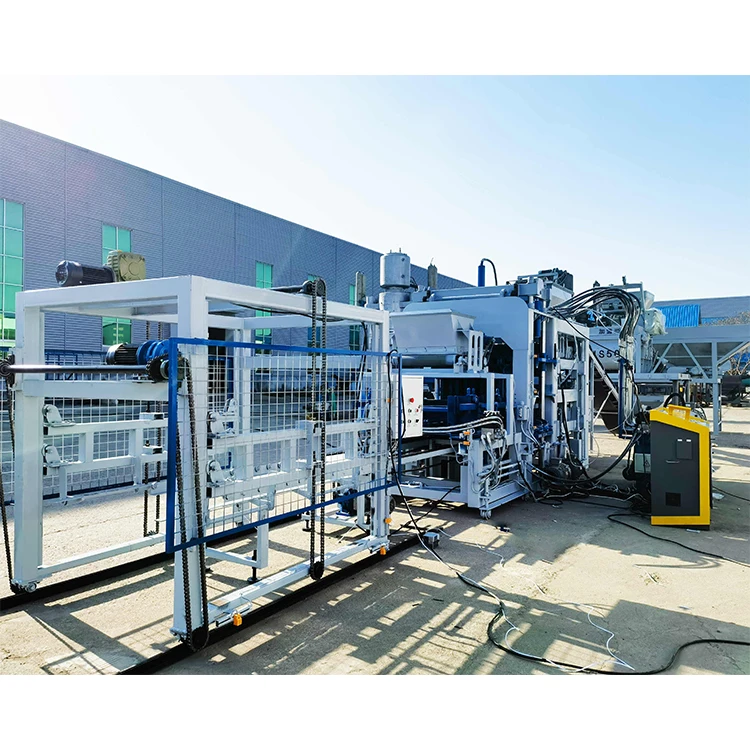
The QTJ4-40 sits at the entry-to-mid tier of our stationary block machine lineup. It is built for buyers who need a reliable manual block making machine for hollow block production without the capital outlay of a fully automatic line. The compact footprint means it fits inside a standard workshop or under a simple rain shelter on a construction site.
Semi-Automatic Operation with a Clear Upgrade Path
Starting with manual operation keeps the initial investment low and the learning curve gentle for first-time plant operators. The machine’s frame and vibration platform are designed so that pallet feeding and stacking can be added later as semi-automatic modules. This means the QTJ4-40 block machine manufacturer supplies a platform that grows with your output needs rather than forcing a full replacement. [NEED_CITE: semi-automatic to automatic upgrade paths in block production]
How Vibration, Pressure, and Mould Format Interact
The 2800 r/min vibration motor is tuned to compact concrete evenly inside the 390 × 190 × 190 mm mould cavity. At this frequency, the aggregate particles settle into a dense matrix that gives hollow blocks the wall strength masonry standards require. The rated 9.5 kW power drives both the vibration motor and the hoist mechanism, so the electrical supply must be stable at the configured voltage. Mould format directly dictates how many blocks drop per cycle — four pieces of 390 × 190 × 190 mm hollow blocks per mould is the baseline, but switching to a smaller solid block mould increases the piece count per cycle while reducing the per-block mass that the vibration must consolidate.

The Hidden Cost of Skipping the Voltage Conversation
A 9.5 kW motor draws significant current, and if the local supply is 220 V/60 Hz while the machine was wired for 380 V/50 Hz, the motor will not start — or worse, it will start and burn out within minutes. I once saw a shipment sit on a dock for nearly a month while the buyer sourced a step-up transformer because the voltage was never confirmed before production. That delay cost more than the transformer itself. Voltage, frequency, and control panel language must be locked down before the QTJ4-40 leaves the factory floor. [NEED_CITE: voltage and frequency standards by export market]
Why Procurement Starts with the Block, Not the Machine
The QTJ4-40 is specified around the buyer’s actual target block format and local aggregate, not pulled from a catalogue default. Mould drawings are provided before production so the buyer can verify dimensions match local market demand. Pallet size is chosen to fit the buyer’s existing curing area and forklift, avoiding a mismatch that leaves wet blocks stacked by hand. The vibration motor and power rating are matched to the mix design the buyer can actually source, preventing costly material substitutions after arrival. Installation support includes operator training on the specific mould and cycle sequence, not a generic handover.
Documentation & Verification
- Line layout showing capacity calculation for the exact block format you will produce
- Machine specification sheet confirming vibration frequency and power matched to your mould
- Mould drawing and format list for dimensional verification against local masonry standards
- Voltage, frequency, and control language confirmation recorded before production begins
- Factory test record on your specified block format before dispatch
Installation, Commissioning & Support
- Foundation pad must support the 1000 kg operating weight plus dynamic vibration load of the QTJ4-40
- Dedicated electrical circuit rated for the 9.5 kW motor at the confirmed local voltage and frequency
- Machine arrives fully assembled; only mould mounting and pallet alignment required on site
- First-run commissioning includes vibration tuning to the buyer’s specific aggregate and cement ratio
- Operator training covers manual cycle sequence, mould change procedure, and daily maintenance checks
- Wear parts list and mould inventory provided for the first replacement cycle
Before You Send an Inquiry
Tell us the block format your market buys most, the daily output you need to hit, and the aggregate you have available locally. Confirm your site voltage and frequency so the motor and control panel are wired correctly from day one. If you already have pallets, forklifts, or a curing yard, share those dimensions so the handling layout fits what is already on the ground.
Frequently Asked Questions
Q: What block format is the stated capacity based on, and how does output change if I switch moulds?
A: Every capacity figure we quote names the exact block format it assumes. If you switch from a 390 × 190 × 190 mm hollow block mould to a smaller solid block mould, the piece count per cycle rises but the per-block mass drops. We provide a revised capacity calculation for each format you plan to run so your daily target stays realistic.
Q: How do I confirm voltage, frequency, and control language before shipment?
A: During the inquiry stage we ask for your local supply voltage, frequency, and preferred panel language. These details are written into the production order and verified during the factory test. The QTJ4-40 manual block making machine ships only after the electrical configuration matches your site conditions.
Q: Can I start with manual operation and add automation later?
A: Yes. The QTJ4-40 frame and vibration platform are designed to accept pallet feeding and stacking modules as your output grows. You can begin with the manual block making machine for sale configuration and upgrade to semi-automatic operation without replacing the core machine.
Q: What mould formats are available, and can you produce a custom mould?
A: The standard mould produces four 390 × 190 × 190 mm hollow blocks per cycle. We also supply solid block, paving block, and interlocking brick moulds sized to your market. If you need a non-standard format, send us your drawing and we will engineer a mould to match your dimensions.
Q: How does the QTJ4-40 footprint compare to larger models in your range?
A: At 1350 × 1460 × 1800 mm and 1000 kg, the QTJ4-40 fits a small workshop or on-site production area. Higher-tier automatic machines require a longer line layout with dedicated mixing, pallet return, and stacking zones. The QTJ4-40 block machine manufacturer keeps the footprint compact so first-time plant operators can start production quickly.

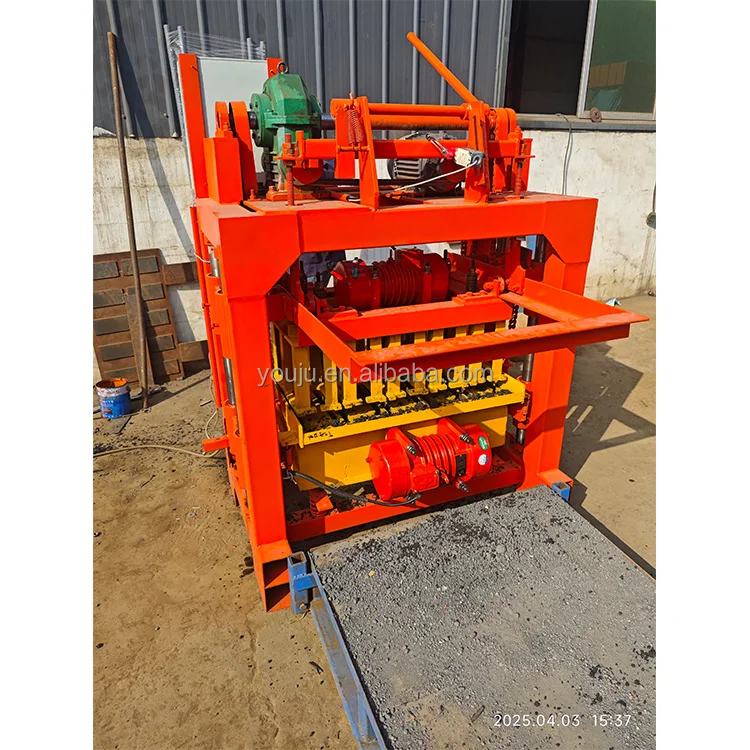
 Stationary block machine