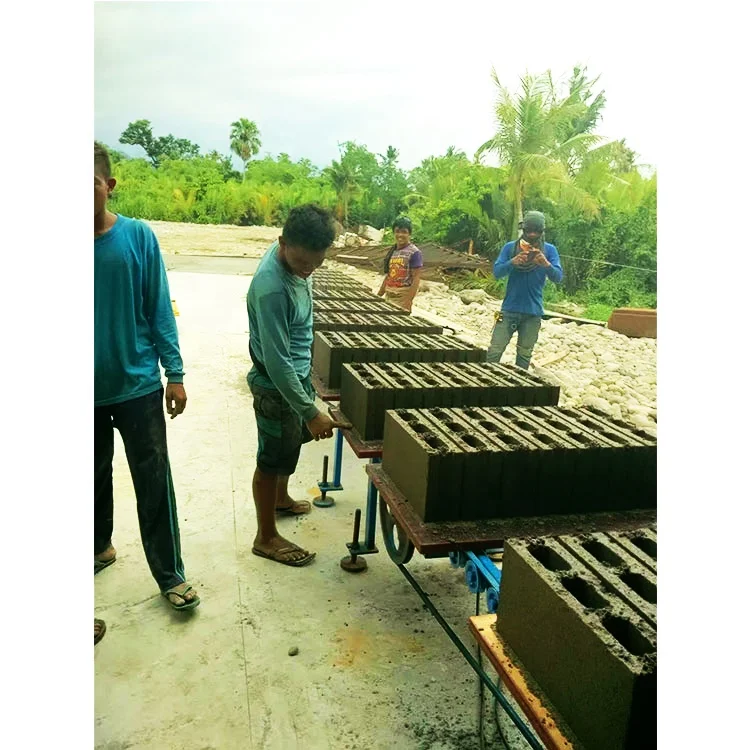
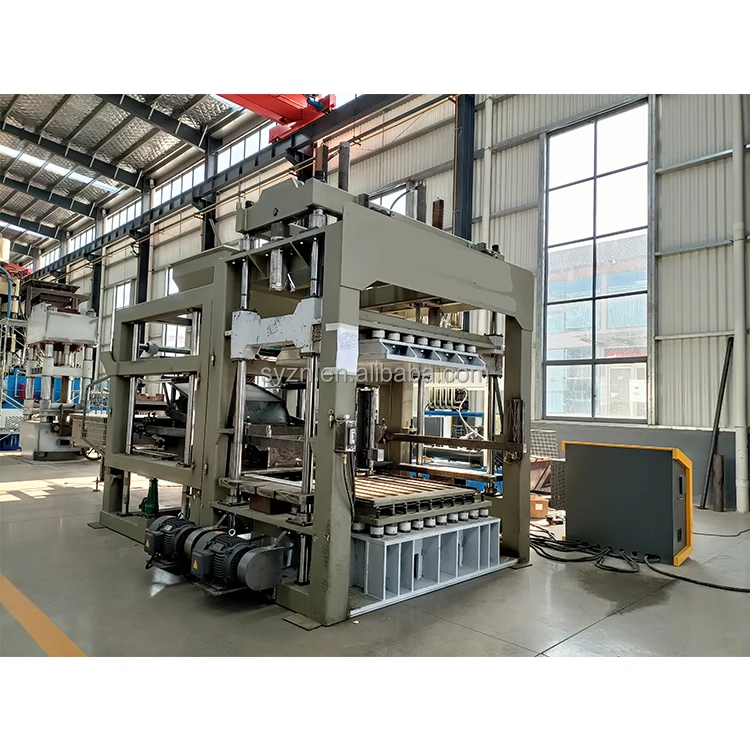
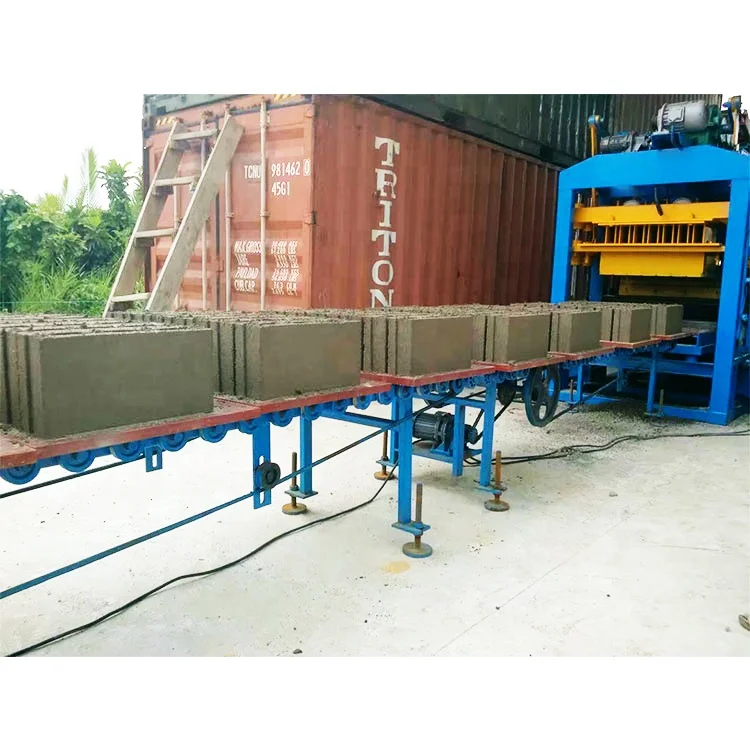
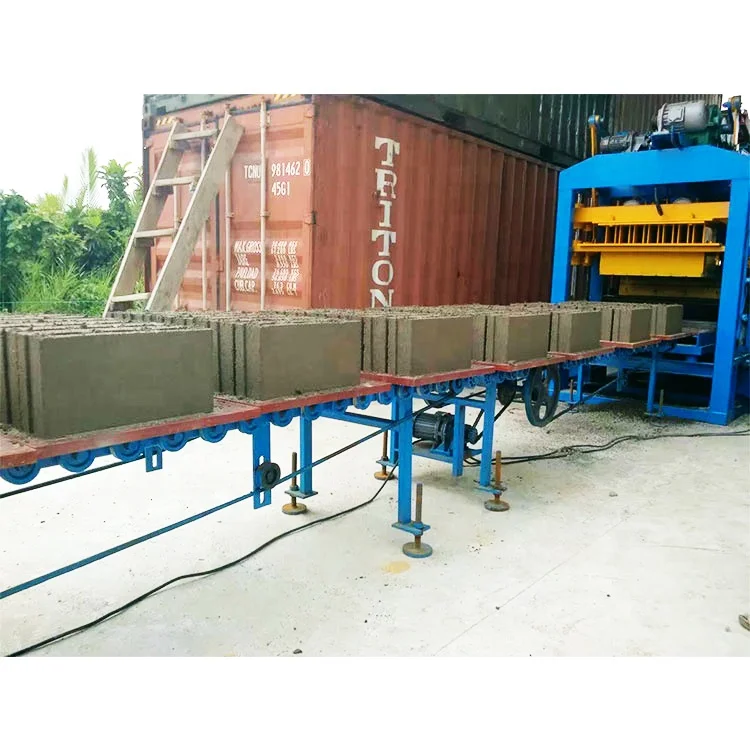
Matched System Supply — The QTJ4-25 is specified as one integrated press, mould, pallet and handling package rather than assembled from unrelated component suppliers, keeping cycle times and curing logistics aligned from day one.
Technical Specifications
| Parameter |
Value |
| Model |
QTJ4-25 |
| Product Type |
Semi-Automatic Concrete Block Making Machine |
| Overall Dimensions (L×W×H) |
6400×1500×2700 mm |
| Molding Cycle |
25 s |
| Vibration Frequency |
2800–5100 r/min |
| Exciting Force |
60 kN |
| Total Power |
17.9 kW |
| Mixer Model |
JQ350 |
| Pallet Size |
850×550×20 mm |
| Net Weight |
2500 kg |
| Applied Products |
Concrete hollow blocks (8 inch, 6 inch), solid bricks |
| Raw Materials |
Crushed stone, sand, cement, dust, fly ash |
| Output Capacity (Hollow Block 390×190×190 mm) |
4 pcs/mould, 480 pcs/h, 3800 pcs/8hr |
| Output Capacity (Hollow Block 400×150×200 mm) |
5 pcs/mould, 600 pcs/h, 4800 pcs/8hr |
| Output Capacity (Solid Brick 240×115×53 mm) |
18 pcs/mould, 2100 pcs/h, 17000 pcs/8hr |
| Hydraulic System |
Equipped with hydraulic station for high pressure and stable operation |
| Automation Level |
Semi-automatic (vertical vibration and upper mould compression vibration) |
| Assembly State |
Nude packing in 20GP container |
Application Suitability
| Application |
Material or Output |
| Hollow block production for residential walls |
Crushed stone, sand, cement mix yielding 8-inch and 6-inch hollow blocks |
| Solid brick manufacturing for load-bearing structures |
Cement and fly ash blends forming standard 240×115×53 mm bricks |
| On-site contractor block production |
Local aggregate and cement for housing and development project supply |
| Small-to-medium block plant startup |
Semi-automatic operation with room to add handling and stacking automation later |
What "3800 Blocks per Shift" Actually Means on the QTJ4-25
Capacity figures only hold weight when the block format behind them is named.
A Semi-Automatic Block Machine for sale listing that quotes a single daily output number without naming the mould format leaves buyers guessing. In practice, a machine pressing 390×190×190 mm hollow blocks produces far fewer units per shift than the same press running 240×115×53 mm solid bricks — the mould cavity count and cycle behavior differ substantially. I have watched contractors in West Africa take delivery of a machine expecting one throughput level, only to find their actual market format cut that number significantly [NEED_CITE: block format impact on real daily output in semi-automatic plants]. Stating the format alongside the figure is the only honest way to plan a production schedule.

Where the QTJ4-25 Sits Across the Shiyue Range
The QTJ4-25 occupies the semi-automatic tier, positioned between entry-level mobile egg-laying machines and fully automatic lines with robotic stacking and cubing. For a buyer surveying the complete Shiyue block machine range, this model represents a deliberate middle step: it delivers a fixed press with consistent vibration and hydraulic pressure while keeping capital outlay manageable. A Semi-Automatic Block Machine for sale at this tier suits entrepreneurs funding their first plant or contractors who need reliable daily output without the footprint and electrical demand of a high-capacity automatic line.
Understanding the Upgrade Path Before You Commit
Choosing semi-automatic now does not lock a buyer into manual pallet handling forever. The Shiyue range is structured so that automation stations — automatic pallet feeding, stacking, and cubing — can be added as separate modules once production volume justifies the investment. This matters because many first-time plant owners in South Asia and sub-Saharan Africa start with a limited curing yard and a small crew, then expand within twelve to eighteen months. Knowing the Semi-Automatic Block Machine for sale today can accept those add-on stations later protects the initial capital spent on the host press and moulds [NEED_CITE: typical automation upgrade timeline for block plants in emerging markets].
Reading the Numbers That Shape Block Quality
The 60 kN exciting force combined with a vibration frequency range of 2800–5100 r/min determines how densely the concrete mix is compacted inside the mould cavity. Higher density means greater block strength, but only if the vibration profile matches the local aggregate gradation and cement ratio — a mix heavy in fine dust behaves very differently from one built on clean crushed stone. The 25-second molding cycle gives the vibration and hydraulic compression enough dwell time to settle the material fully before the mould lifts. Pallet size at 850×550×20 mm must align with the curing racks and forklift tine spacing the buyer already has on site; a mismatch here causes handling bottlenecks that no amount of press speed can fix. The 17.9 kW total power draw, including the JQ350 mixer, dictates the transformer capacity and dedicated circuit requirements at the plant.
When a Mismatched Configuration Derails Commissioning
A machine set up for a clean silica sand mix will underperform when the buyer’s local quarry supplies high-clay aggregate. The vibration force and hydraulic pressure that produce strong blocks with one material profile may leave blocks friable and undersized with another. I have seen situations in Mozambique and Pakistan where the commissioning technician spent days adjusting parameters because the original configuration assumed materials the buyer simply could not source [NEED_CITE: aggregate variability impact on block strength consistency in semi-automatic plants]. Voltage and control language mismatches cause their own delays — a PLC display in a language the operators cannot read turns routine fault diagnosis into guesswork, and wrong frequency ratings damage motors before the warranty period ends.
Why Source This Machine Through Shiyue
Block machinery is the single focus here, which means the QTJ4-25 press, its moulds, pallets, and supporting handling equipment are specified as one matched system. The configuration is set against the buyer’s actual mix design and local aggregate, not pulled from a catalogue default. Mould design covers the formats the buyer’s market actually sells, with custom drawings available when standard cavity layouts do not fit. The automation level is selectable, so starting semi-automatic and upgrading later is a planned path, not an afterthought. Installation and commissioning support includes operator training on the specific controls and maintenance intervals of this machine [NEED_CITE: manufacturer commissioning support scope for exported block machinery].
Documentation & Verification
- Line layout and capacity calculation stating the exact block format assumed for each output figure
- Machine specification sheet with vibration force and hydraulic pressure matched to your mix design
- Mould drawing and format list covering every cavity layout available for the QTJ4-25
- Pallet specification confirming size, material options, and compatibility with your curing infrastructure
- Voltage, frequency, and control language confirmation recorded before production begins
- Factory test record documenting actual cycle performance before container loading
Installation, Commissioning & Support
- Foundation pad must accommodate the 6400×1500 mm footprint and 2500 kg static load with level tolerance
- Dedicated electrical circuit sized for 17.9 kW total draw including JQ350 mixer motor startup surge
- Machine arrives nude-packed in a 20GP container requiring on-site reassembly of hopper and frame
- First-run commissioning covers vibration frequency tuning and hydraulic pressure calibration to your mix
- Operator training addresses mould change procedure, daily lubrication points, and pallet inspection routines
- Wear parts and mould replacement list provided with part numbers for reorder scheduling
Preparing a Productive Inquiry
Buyers evaluating the QTJ4-25 should share the specific block formats their market demands, the local aggregate type and gradation available, and the daily output target tied to a named mould size. Providing site voltage and frequency, along with the curing area dimensions and forklift specifications already in use, allows the pallet and line layout to be configured correctly before the quotation stage.
Frequently Asked Questions
Q: How is the QTJ4-25 output verified per block format, and what do the capacity figures assume?
A: Each output figure on this page is tied to a specific mould cavity count and block dimension — 480 pieces per hour assumes the 390×190×190 mm hollow block at four cavities, while 2100 pieces per hour assumes the 240×115×53 mm solid brick at eighteen cavities. These figures assume a 25-second molding cycle and consistent material feed. Real daily throughput depends on crew speed, pallet circulation, and curing logistics.
Q: Where does the QTJ4-25 sit in the Shiyue machine range, and what is the upgrade path?
A: This model occupies the semi-automatic tier, offering a fixed press with hydraulic and vibration systems without the full automatic stacking and cubing line. Buyers can add automatic pallet feeding, stacking, and cubing modules later as production volume grows, using the same host press and mould set as the foundation.
Q: What voltage, frequency, and control language options are confirmed before shipment?
A: Voltage and frequency must be confirmed against the buyer’s local supply before production begins, as motor winding and transformer specifications are set at the factory. The control system display language is also locked in at this stage to ensure operators can read fault codes and parameter menus during commissioning.
Q: Which mould formats are available for the QTJ4-25, and how long does a mould change take?
A: Standard moulds cover 8-inch and 6-inch hollow blocks, solid bricks, and selected paver formats. Custom mould designs are available to buyer drawings. Mould change involves unbolting the cavity set, swapping the upper and lower mould halves, and recalibrating vibration — a process that typically occupies part of a shift depending on crew familiarity.
Q: What pallet material and quantity are recommended for the QTJ4-25?
A: The 850×550×20 mm pallet size is fixed, but material choice between fiber glass and local wooden pallet depends on the buyer’s curing environment and handling equipment. Sufficient pallet quantity must circulate between the press and curing racks to prevent the machine from waiting on empty pallets — a calculation based on curing time and daily output target.

 High quality block machine