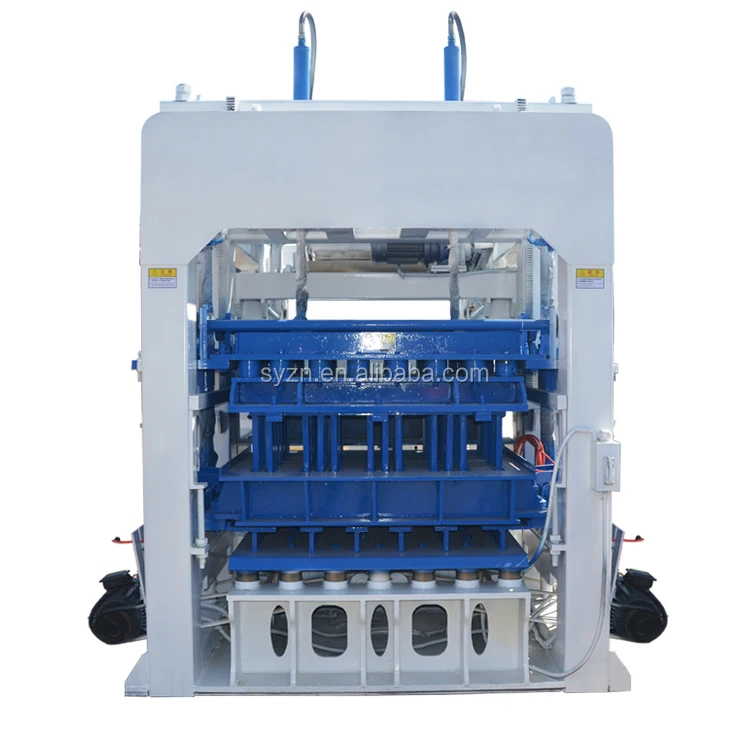
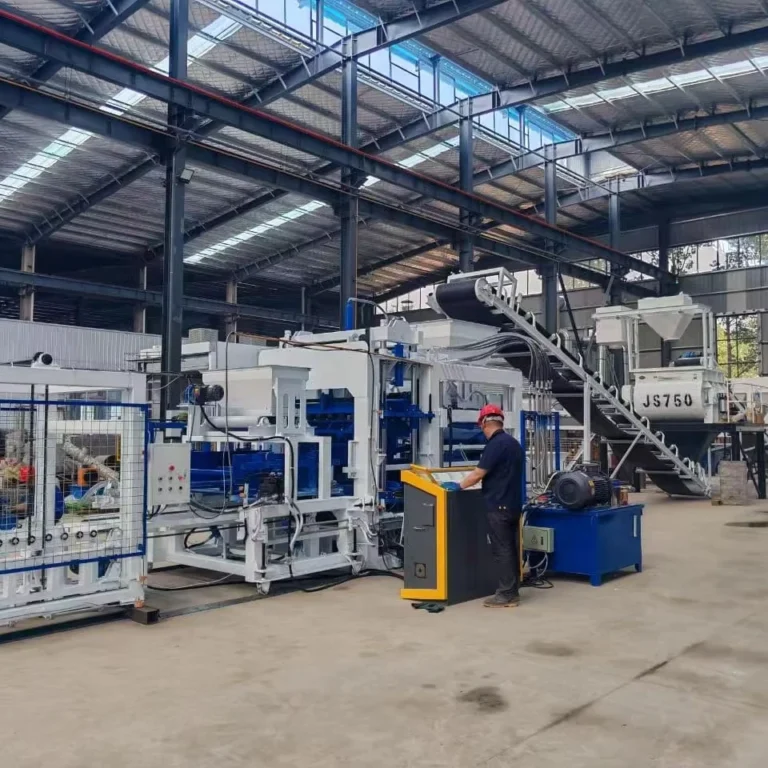
Complete Line Matching — The QTJ4-25 is specified as one system with its pallet size, vibration force, and mould formats aligned, so buyers avoid assembling mismatched stations from separate suppliers.
Technical Specifications
| Parameter |
Value |
| Model |
QTJ4-25 |
| Product Type |
Automatic Concrete Block Making Machine |
| Overall Dimensions |
3000×1800×2680 mm |
| Vibration Force |
60 kN |
| Main Vibration Form |
Platform Vibration |
| Vibration Frequency |
2800–4500 r/min |
| Pallet Size |
850×480 mm |
| Molding Cycle |
25 s |
| Overall Power |
16.58 kW |
| Total Mass |
3.5 T |
| Demolding Method |
Mechanical |
| Guide Column |
Four-column, overlong guide, chrome-plated surface |
| Steel Material |
National standard manganese steel |
| Raw Materials |
Crushed stone, sand, cement, fly ash, gravel, slag |
| Output Capacity |
4640 pcs/day (based on 400×200×200 mm hollow block, 4 pcs/mould, 8-hour shift) |
| Output Capacity |
11200 pcs/day (based on 240×115×90 mm porous brick, 9 pcs/mould, 8-hour shift) |
| Output Capacity |
26400 pcs/day (based on 240×115×53 mm solid brick, 21 pcs/mould, 8-hour shift) |
| Factory Area |
300 m² |
| Automation Level |
Semi-automatic (mechanical demolding, manual pallet handling implied) |
| Control System |
(basis to be confirmed) |
| Voltage & Frequency |
(basis to be confirmed) |
| Hydraulic Pressure |
(basis to be confirmed) |
Application Suitability
| Application |
Material or Output |
| Hollow block production |
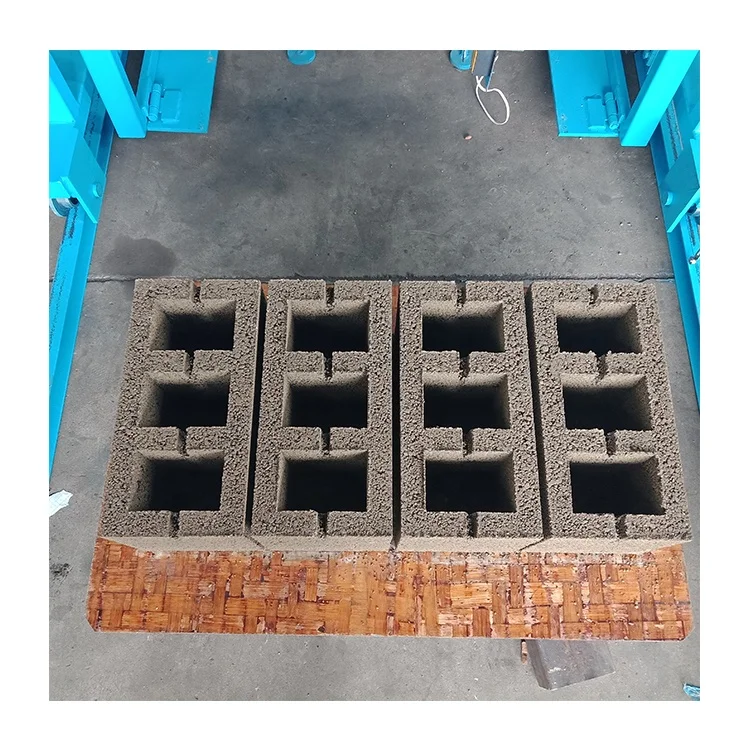
Crushed stone, sand, cement producing 400×200×200 mm blocks |
| Solid brick manufacturing |
Sand, cement, fly ash forming 240×115×53 mm standard bricks |
| Paver and interlocking block production |
Colored concrete mixes for curbstone and interlocking formats |
| Porous brick production |
Lightweight aggregate blends for 240×115×90 mm permeable bricks |
| On-site construction block making |
Local aggregate and cement for project-site hollow block supply |
What "25 Seconds per Cycle" Actually Means for Your Daily Output
Cycle time only translates to real production when tied to a specific block format and mould cavity count.
Many buyers receive quotations stating a cycle time or theoretical hourly output without the seller disclosing which block size that figure assumes. A 25-second cycle with four hollow blocks per mould yields a very different daily total than the same cycle with twenty-one solid bricks per mould. I once watched a buyer sign off on a machine rated at thousands of pieces per shift, only to discover the number was based on a small solid brick his market did not purchase [NEED_CITE: block format assumptions in capacity quotations]. The QTJ4-25 capacity figures here are each anchored to a named format, mould cavity count, and an eight-hour shift so the automatic block machine manufacturer quotation can be compared honestly against local demand.

Where the QTJ4-25 Fits Within the Full Machine Range
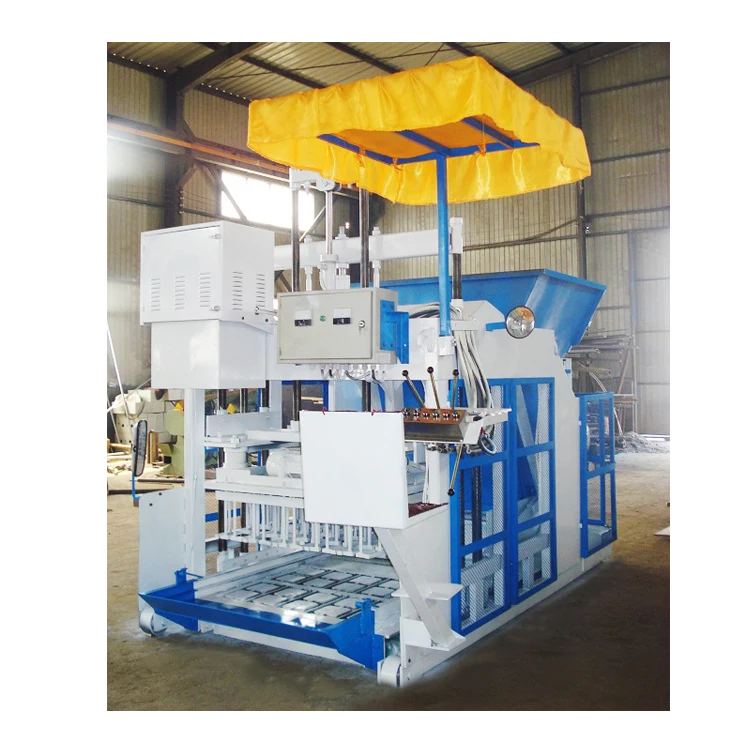
This machine occupies the entry-to-mid investment tier, positioned between mobile egg-laying units that need no fixed plant and fully automatic lines with pallet feeders, stackers, and cubing systems. Buyers surveying their first block plant or replacing an ageing single-machine setup find it a practical starting point. The automatic block machine manufacturer range uses this model as the baseline from which automation levels and output tiers scale upward.
Semi-Automatic Operation and the Upgrade Path Ahead
The mechanical demolding system and manual pallet handling keep initial investment moderate while leaving room for future automation additions. A buyer can begin with hand-fed pallets and manual stacking, then introduce an automatic pallet feeder and stacker as volume grows. This staged approach avoids over-investing before market demand justifies it [NEED_CITE: phased automation adoption in block plants]. The compact 300 m² factory area requirement means the line fits within a modest workshop, leaving space for curing racks and raw material storage.
Vibration Force, Pallet Size, and Guide Column Alignment
The 60 kN vibration force works with the platform vibration form to compact concrete across the 850×480 mm pallet area. The vibration frequency range of 2800–4500 r/min allows adjustment for different aggregate sizes — coarser crushed stone generally responds better at the lower end while finer sand and fly ash mixes benefit from higher frequencies. The four-column chrome-plated guide system with overlong guide design keeps the mould box aligned throughout each press stroke, reducing uneven block density that shows up as weak corners after curing. Manganese steel construction in the frame absorbs repeated vibration loading without fatigue cracking over extended shifts.
When Pallet Size and Automation Level Are Chosen Wrong
A pallet specified without checking the buyer’s existing curing rack spacing forces the plant to rebuild curing areas or buy new forklifts. Manual pallet handling on a machine intended for higher output creates a bottleneck where the press waits for the operator to remove finished blocks. I have seen plants lose an entire shift’s production because the pallet material warped under local humidity, jamming the feed cycle [NEED_CITE: pallet material failure in tropical climates]. Voltage and control language left unconfirmed before shipment delay commissioning by weeks while panels are rewired or displays replaced.
Why Source This Machine Through a Matched-Line Approach
Every station from raw material feeding through curing rack handling is specified against the same production target, so cycle times between the mixer, press, and stacking area do not leave the QTJ4-25 waiting idle. Mould formats are chosen based on the block shapes the buyer’s local market actually purchases, not a default catalogue list. Machine configuration accounts for the buyer’s real aggregate and mix design rather than a standard laboratory recipe. Voltage, frequency, and PLC display language are confirmed before production starts, not discovered at uncrating. Installation includes operator training on the specific mould change procedure and maintenance intervals for this machine class.
Documentation & Verification
- Line layout showing QTJ4-25 placement with 300 m² factory area and curing zone allocation
- Capacity calculation sheet listing output per block format with mould cavity count stated
- Mould drawing package for each included format with dimensional tolerances
- Pallet specification sheet matched to 850×480 mm size and buyer’s curing rack spacing
- Voltage and control language confirmation record signed before production begins
- Factory test record run on buyer’s specified block format before dispatch
Installation, Commissioning & Support
- Foundation plan prepared for 3000×1800 mm footprint and 3.5 T operating mass
- Power supply sized for 16.58 kW total load with dedicated circuit breaker
- Machine arrives partially assembled; guide columns and vibration platform bolted on site
- Commissioning includes vibration frequency tuning across 2800–4500 r/min for local aggregate
- Operator training covers mechanical demolding sequence and 25-second moulding cycle timing
- Wear parts list identifies chrome-plated guide column and manganese steel components for reorder
What to Share When Requesting a Quotation
Provide the block formats your market purchases most, along with target daily output for each. Share a sample or lab report of your local aggregate so the vibration frequency and mix ratio can be set before the machine ships. Confirm your site voltage, frequency, and preferred control display language to avoid rewiring delays. Let us know the curing area dimensions and forklift capacity you already have so pallet size and handling equipment are matched from the start.
Frequently Asked Questions
Q: How is the QTJ4-25 daily output verified, and which block format does each number assume?
A: Each output figure is tied to a specific block dimension, mould cavity count, and an eight-hour shift. For example, 4640 pieces per day assumes 400×200×200 mm hollow blocks at four per mould. No single headline number is used across formats, so buyers can match the calculation to the product their market actually demands.
Q: Where does the QTJ4-25 sit compared to fully automatic and mobile models in the range?
A: It occupies the entry-to-mid tier between mobile egg-laying machines that need no fixed plant and fully automatic lines with pallet feeders and stackers. Buyers starting their first plant or replacing a single machine find it a practical baseline, with automation additions available as volume grows.
Q: What voltage and frequency options are available, and how is the control language confirmed?
A: Voltage and frequency are configured to the buyer’s site supply, and the control display language is confirmed in writing before production begins. This prevents commissioning delays caused by panel rewiring or display replacement after the machine arrives on site.
Q: What plant footprint and utility setup does the QTJ4-25 require for installation?
A: The machine requires approximately 300 m² including raw material storage and curing rack space. A dedicated power circuit must handle 16.58 kW, and the foundation must support 3.5 T operating mass across the 3000×1800 mm footprint.
Q: Which moulds are included, and can custom formats be added later?
A: Standard moulds cover hollow block, solid brick, paver, interlocking block, and curbstone formats. Custom mould designs can be produced to buyer drawings, and the four-column guide system accommodates mould changes across these formats without press modification.

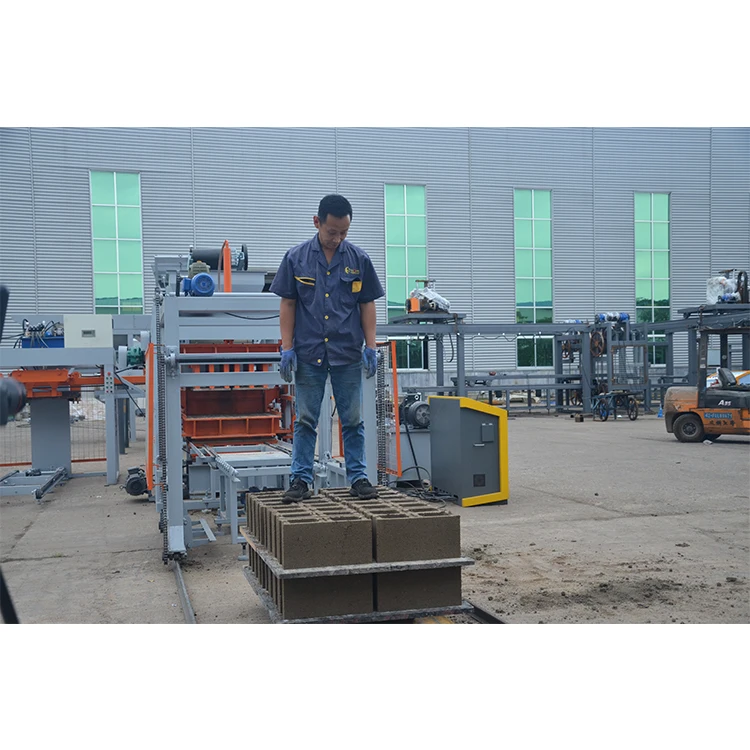 Automatic block machine