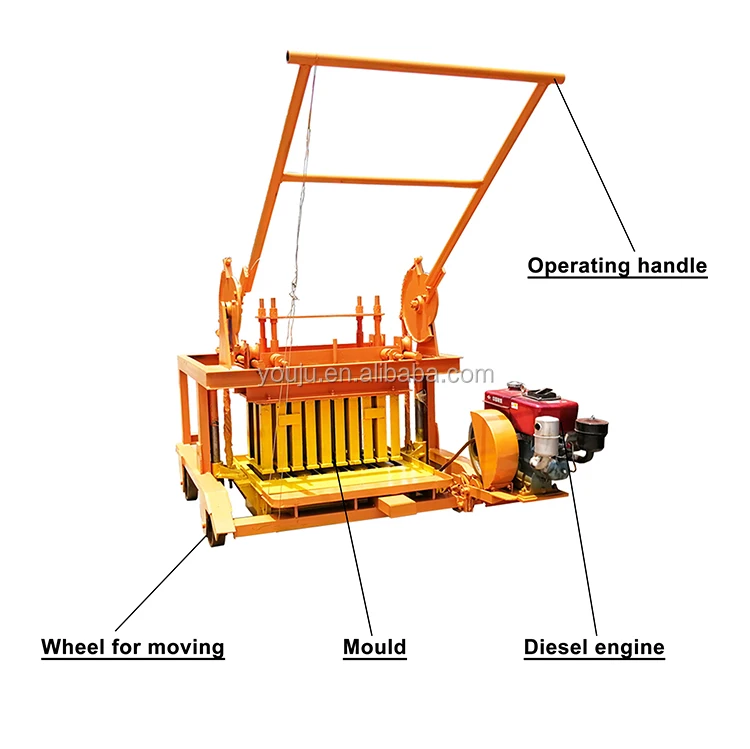
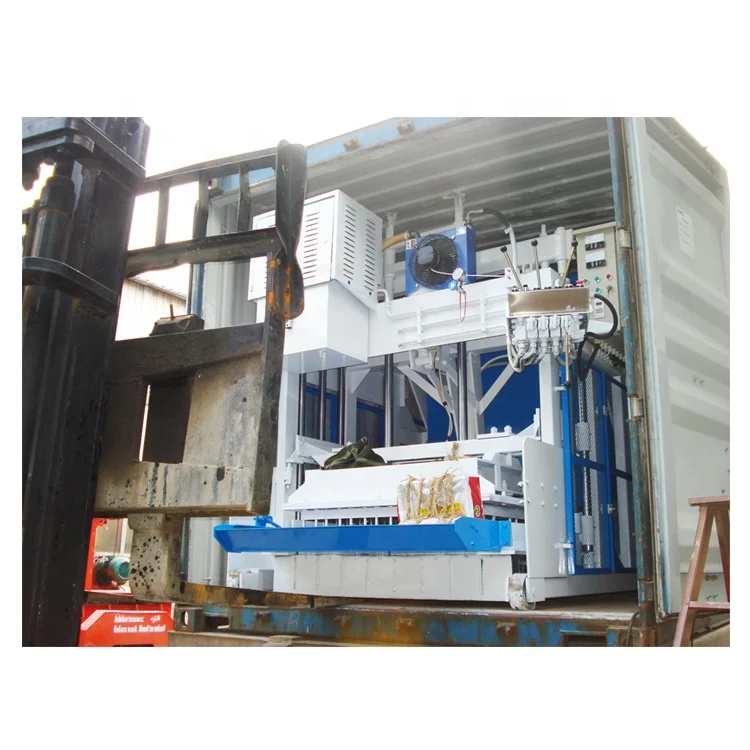
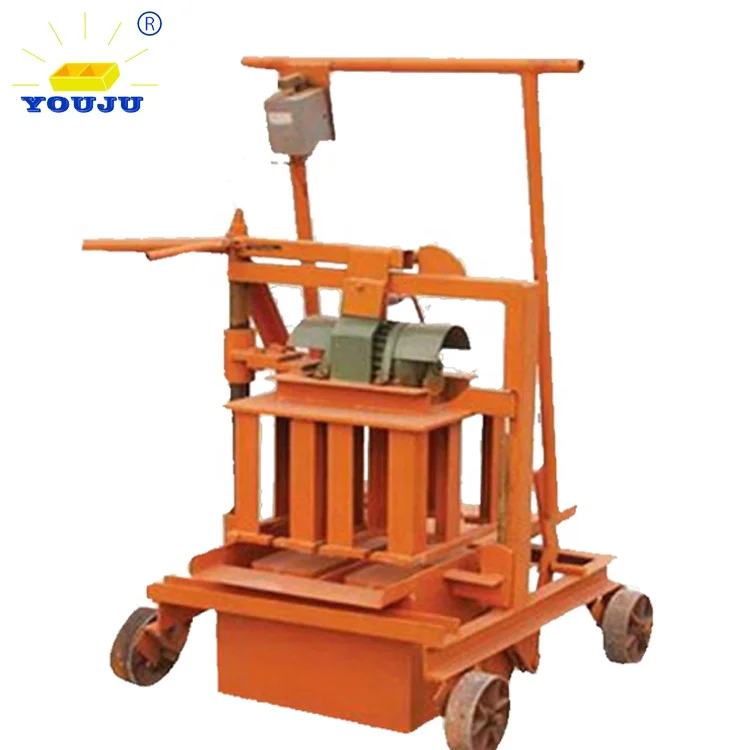
Matched system design — the QMY4-30 mobile block machine is specified as one unit with its moulds and ground-curing workflow, not pieced together from separate suppliers.
Technical Specifications
| Parameter |
Value |
| Model |
QMY4-30 |
| Product Type |
Mobile Block Making Machine |
| Overall Dimensions (L×W×H) |
1300 × 1500 × 1000 mm |
| Net Weight |
950–1000 kg |
| Vibration Force |
28.6 kN |
| Excitation Frequency |
4500 r/min |
| Total Power |
5.95 kW |
| Hydraulic Method |
Mold Vibration |
| Automation Level |
Manual |
| Machine Type |
Mobile / Egg-laying |
| Voltage & Frequency |
380V ±10% (basis to be confirmed for target market) |
| Output Capacity |
Approximately 3000 pcs/day (basis not stated in source — confirm block format, material, and thickness) |
Application Suitability
| Application |
Material or Output |
| On-site hollow block production |
Concrete, river sand, gravel, and cement |
| Solid brick manufacturing for housing projects |
Fly ash, cinder, and cement blends |
| Curb stone and kerb production for road works |
Crushed stone aggregate with cement binder |
| Small-scale block plant for first-time entrepreneurs |
Coal gangue, industrial waste residue, and cement |
| Remote construction site block supply |
Locally sourced sand and gravel with Portland cement |
What "3000 Pieces per Day" Actually Means on a Mobile Block Making Machine for Sale
The number only matters once you know which block format it was measured against.
Most quotations list a daily output figure without stating whether it was based on a 400×200×200 mm hollow block, a solid paving brick, or a smaller format entirely. When the machine arrives and you start running the hollow blocks your market actually buys, the real count can fall well short of what the brochure promised. I have watched contractors in Southeast Asia plan an entire project timeline around a capacity number that turned out to assume a format they never intended to produce [NEED_CITE: block format assumptions in capacity quotations].
With the QMY4-30, the first question we answer is which block your buyers want, then we calculate cycle time and daily output against that specific format.

Where the QMY4-30 Sits in the Full Machine Range
The QMY4-30 occupies the entry point of the mobile block machine lineup. It is built for buyers who need to produce blocks directly on a construction site or in a small yard without investing in a fixed plant, pallets, or curing racks. The egg-laying design means the machine moves forward on its own wheels, laying each block directly onto a flat ground surface. This removes the entire pallet handling and stacking infrastructure that larger stationary machines require.
For a first-time block producer or a contractor working a single housing development, this Mobile Block Making Machine for sale keeps the initial setup simple and the capital requirement low.
How Mobile Egg-Laying Changes Your Site Layout
With a stationary press, you need a pallet circulation system, a stacking station, and a covered curing area with racks. The QMY4-30 eliminates all of that. You prepare a flat, level concrete floor or compacted ground, and the machine lays blocks in rows as it travels. Curing happens right where the blocks are placed, typically under wet burlap or plastic sheeting.
This approach trades the speed of an automatic line for a dramatically smaller footprint and lower infrastructure cost. For remote project sites in Cambodia, the Philippines, or similar regions, where transporting finished blocks from a distant plant adds significant expense, producing on-site with a mobile unit makes practical sense [NEED_CITE: logistics cost reduction through on-site block production].
Vibration Force, Power Draw, and What They Mean for Block Density
The 28.6 kN vibration force at 4500 r/min is the core compaction mechanism on the QMY4-30. Unlike larger machines that combine hydraulic pressure with table vibration, this unit relies on mold vibration alone. That means the mix design must be correct — too wet and the blocks slump before the cement sets, too dry and the vibration cannot consolidate the material fully.
The total power of 5.95 kW is modest, which matters on sites where generator capacity or grid supply is limited. A standard three-phase supply at 380V is required, but the low draw means a mid-range diesel generator can often handle the machine along with a small mixer. The vibration frequency and force together determine how well the concrete fills the mold cavity and how dense the finished block becomes. Getting this right for your local aggregate — whether river sand, crushed stone, or fly ash — is where on-site adjustment during commissioning becomes critical.
The Cost of Skipping the Ground Preparation Step
A mobile egg-laying machine depends entirely on the surface it travels across. If the ground is uneven, blocks will crack under their own weight before curing begins. If the soil is soft, the machine sinks and the blocks tilt. I have seen operators spend weeks troubleshooting block breakage that had nothing to do with the mix or the machine — the ground simply was not level within the tolerance the process requires [NEED_CITE: ground flatness requirements for egg-laying block machines].
Skipping proper ground preparation also affects machine travel. The QMY4-30 moves on its own wheels, and an uneven surface causes inconsistent travel speed, which changes the spacing between blocks and makes curing coverage uneven.
Why Sourcing This Mobile Block Making Machine for Sale Here Makes Sense
Block machinery is our single focus, so the QMY4-30 is supplied as a matched system — machine, mould, and ground-curing guidance together, not separate purchases from different vendors.
We configure the mould to the block formats your market actually sells, including custom drawings if your region uses a non-standard size.
The automation level is manual by design, keeping maintenance straightforward and spare parts minimal for first-time operators.
Installation support includes on-site commissioning where we adjust vibration time and cycle settings against your actual raw material, not a factory default.
Voltage, frequency, and any control language requirements are confirmed before production, so there are no surprises when the machine arrives at your port.
Documentation & Verification
- Line layout showing ground area required for QMY4-30 travel and curing rows
- Machine specification sheet with confirmed vibration force and power ratings
- Mould drawing and format list for the block types you intend to produce
- Voltage and frequency confirmation matched to your local electrical grid
- Factory test record on your specified block format before dispatch
Installation, Commissioning & Support
- Flat concrete ground or compacted surface required across the full travel and curing area
- Three-phase 380V ±10% supply with dedicated circuit for the 5.95 kW total power draw
- Machine arrives assembled; only mould installation and electrical connection needed on site
- First-run commissioning includes vibration time and cycle adjustment against your local aggregate
- Operator training covers mould change procedure and daily vibration motor inspection
- Wear parts list provided with mould and vibration components identified for local sourcing
What We Need to Quote You Accurately
Tell us which block formats your market buys — hollow, solid, or curb stone — and the dimensions you need. Share your local raw material type and whether you have a three-phase power supply available on site. Let us know the daily output target so we can confirm whether the QMY4-30 matches your volume or whether a higher-tier unit in the range would be more appropriate.
Frequently Asked Questions
Q: How is the daily output capacity verified and which block format does it assume?
A: The quoted capacity of approximately 3000 pieces per day has not been tied to a specific block format in the available documentation. We calculate realistic output based on the exact hollow block, solid brick, or curb stone dimensions you need, factoring in your mix design, curing time, and working hours per shift.
Q: What voltage and frequency options are available for different markets?
A: The standard specification lists 380V ±10%, but we confirm voltage and frequency requirements before production to match your country’s electrical standards. If your site runs on a generator, we also verify that the 5.95 kW draw is compatible with your available power source.
Q: Which block formats can one QMY4-30 produce and how long does mould change take?
A: The machine supports hollow blocks, solid bricks, and curb stones through mould changes. The mould is bolted to the vibration table, and a swap typically requires basic hand tools. We provide a format list with your quotation so you know exactly which moulds are included.
Q: What site conditions are needed for mobile egg-laying operation?
A: You need a flat, level, and firm ground surface across the area where blocks will be laid and cured. The surface must support the machine weight of approximately 950–1000 kg without settling. Adequate space for curing rows and access for watering is also required.
Q: What is included in the quotation versus what costs extra?
A: The quotation covers the QMY4-30 machine, the moulds specified for your block formats, and a wear parts list. Items such as a concrete mixer, raw material stockpiles, and curing covers are typically sourced locally. We confirm the full scope in writing before you commit.

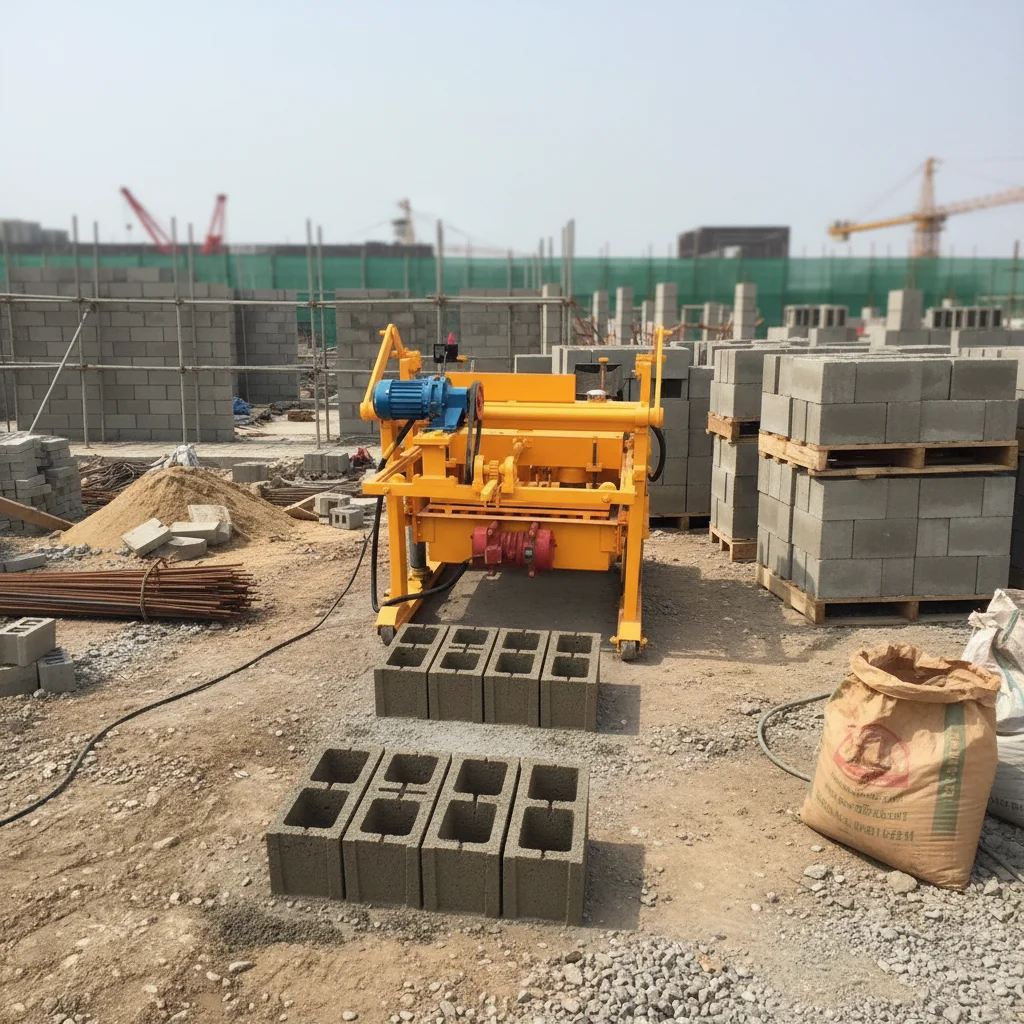
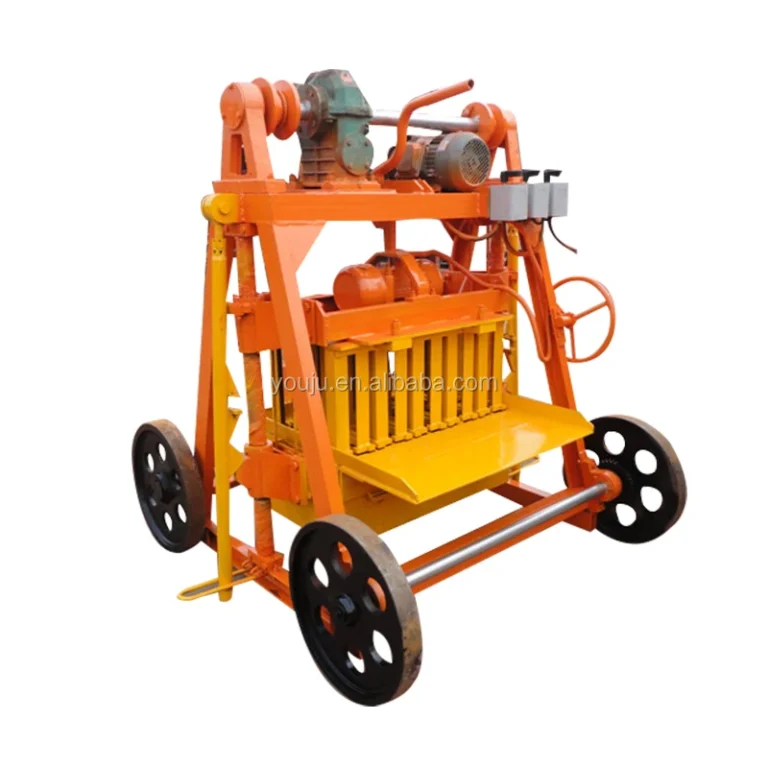 Mobile block machine