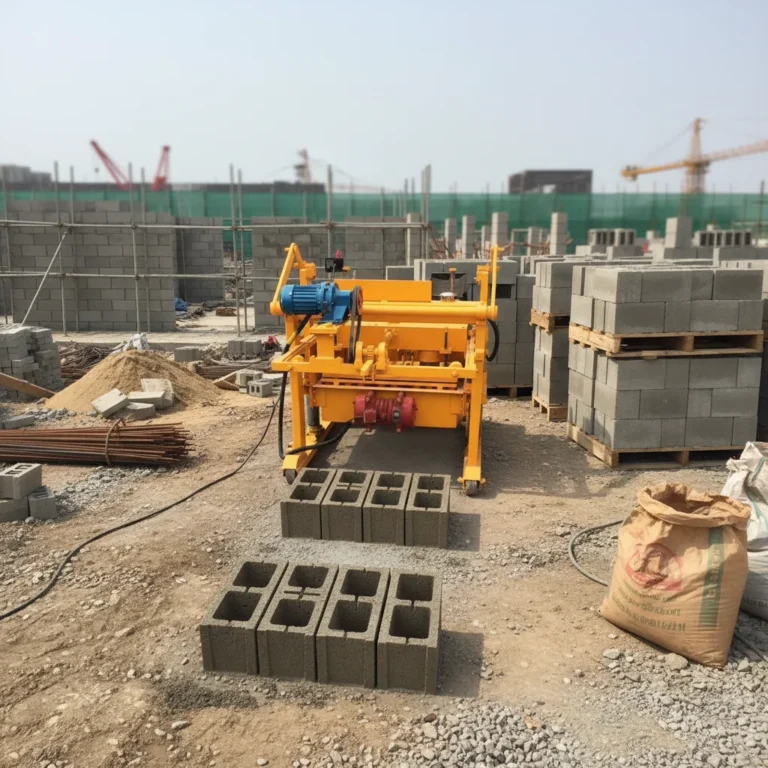
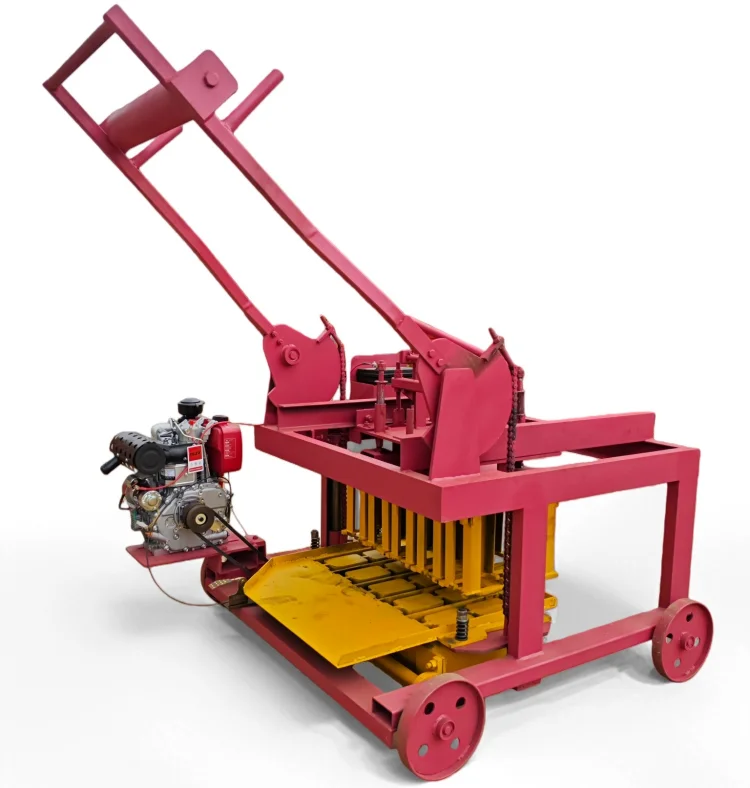
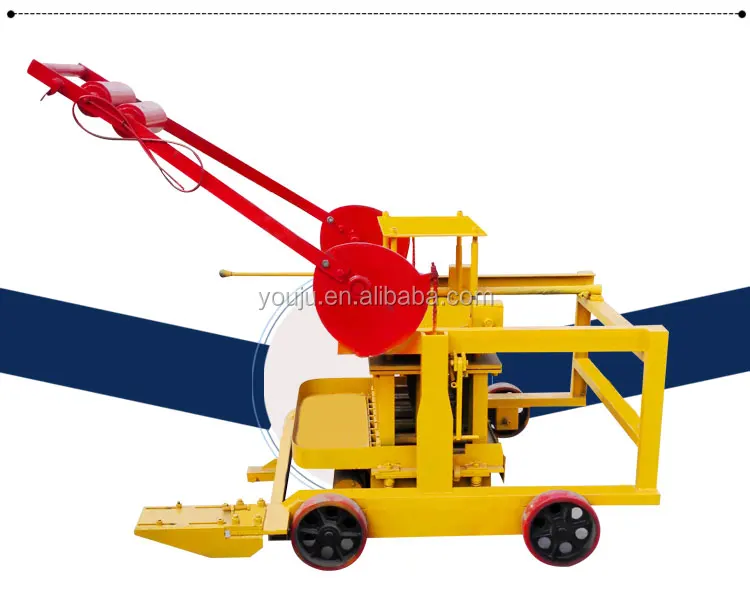
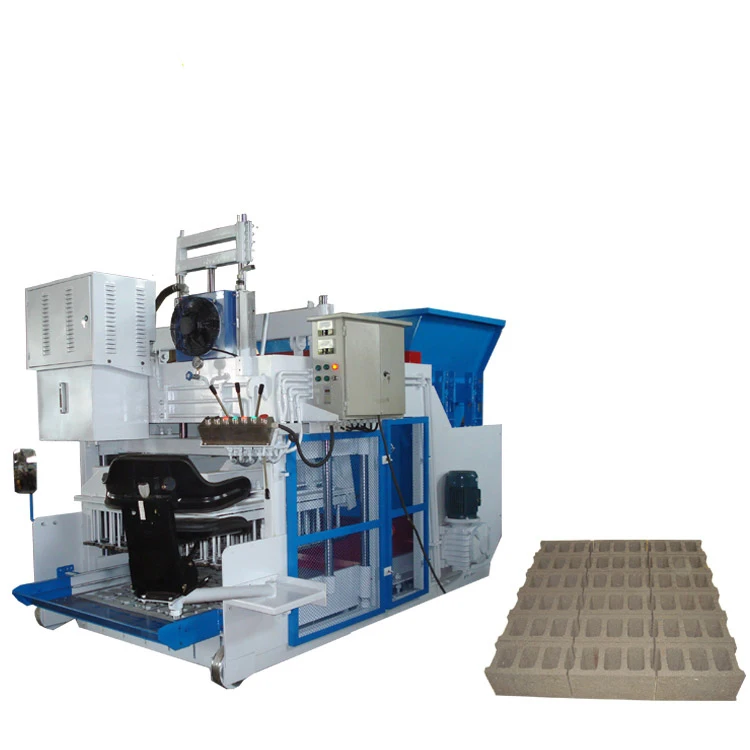
Single-focus block machinery engineering — every output figure for the QMJ2-45 is tied to a named hollow brick format so buyers know exactly what to expect before the machine leaves our Linyi workshop.
Technical Specifications
| Parameter |
Value |
| Model |
QMJ2-45 |
| Product Type |
Mobile Concrete Block Making Machine |
| Machine Type |
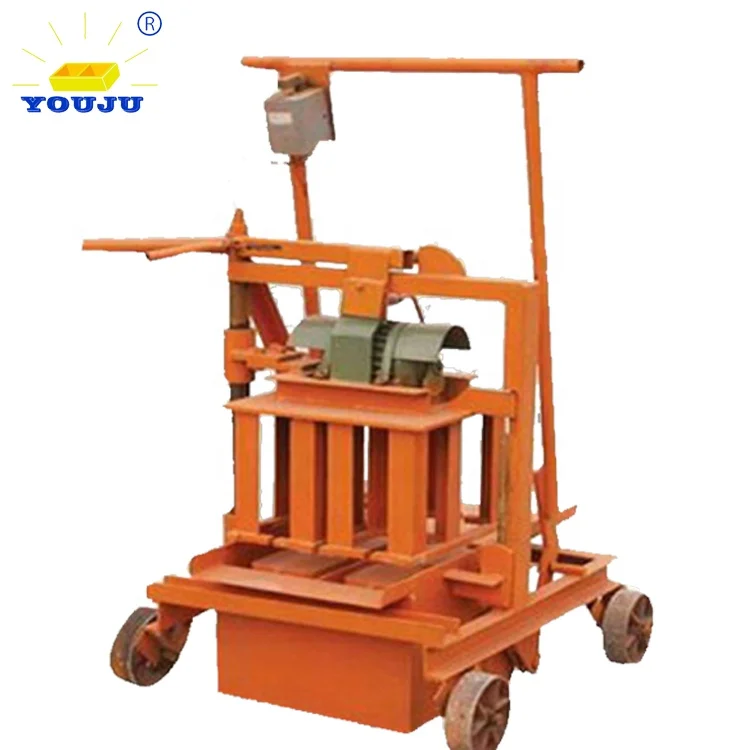
Hand-pushed mobile egg-laying block machine |
| Pallet Requirement |
No pallets required |
| Control System |
Manual operation |
| Mould Change |
Moulds changeable to produce different hollow brick formats |
| Mould Format Options |
400×200×200 mm / 400×150×200 mm / 400×100×200 mm hollow brick |
| Cycle Time |
25–30 s per mould |
| Output Capacity (400×200×200 mm, 2 pcs/mould) |
160 pcs/h |
| Output Capacity (400×150×200 mm, 3 pcs/mould) |
240 pcs/h |
| Output Capacity (400×100×200 mm, 4 pcs/mould) |
320 pcs/h |
| Daily Output, 8 hr (400×200×200 mm) |
1,280 pcs |
| Daily Output, 8 hr (400×100×200 mm) |
2,560 pcs |
| Labor Requirement |
1–3 workers |
| Power Source |
Basis not stated in source — confirm motor rating and type |
| Voltage & Frequency |
Basis not stated in source — confirm site supply |
| Assembly State |
Fully assembled, mobile on-site use |
| Mobility |
Hand-pushed, free movement without fixed plant |
| Certification |
ISO 9001:2000, CE |
Application Suitability
| Application |
Material or Output |
| Small-scale on-site concrete block production |
Cement, sand, crushed stone, lightweight aggregate |
| Construction contractor producing hollow blocks at project sites |
Hollow bricks 400×200×200 mm and smaller formats |
| Entrepreneur establishing a first block plant |
Minimal-footprint hollow block output with 1–3 workers |
| Remote or infrastructure-limited production environments |
Pallet-free egg-laying on compacted ground or concrete slab |
What "320 Pieces per Hour" Actually Means on Your Site
Every capacity figure for the QMJ2-45 mobile block making machine for sale is stated against a specific hollow brick dimension — no blank "up to" claims.
Capacity sheets that quote a single hourly number without naming the block format are a recurring source of buyer disappointment. When the QMJ2-45 mobile block machine manufacturer rate is 320 pieces per hour, that figure applies to the 400×100×200 mm hollow brick at 4 pieces per mould. Switch the mould to the 400×200×200 mm format and the same cycle time yields 160 pieces per hour — half the headline number, yet the machine is performing exactly as designed [NEED_CITE: block format impact on quoted cycle capacity]. A technical buyer sizing equipment for a housing project needs the output tied to the format the local market actually buys, not the smallest brick the mould can produce.

Where the QMJ2-45 Sits in the Full Machine Range
The QMJ2-45 occupies the entry tier of our block machine lineup — a hand-pushed, pallet-free mobile unit built for buyers who need to produce hollow bricks directly on a building site or in a small yard without investing in fixed foundations, pallet circuits, or stacking infrastructure. Above it, semi-automatic machines add pallet feeding and vibration tables for higher daily volumes, while fully automatic lines integrate batching, stacking, and cubing for continuous plant operation. The mobile block machine manufacturer range is structured so that a buyer can start here and step up to a stationary line when market demand justifies the capital outlay, without replacing the knowledge gained from running a simpler machine first.
Pallet-Free Egg-Laying and What It Removes from Your Budget
Egg-laying design means the QMJ2-45 deposits each moulded block directly onto the ground and moves forward under hand pressure, leaving the block to cure in place. This eliminates the entire pallet loop — no pallet purchase, no pallet return conveyor, no pallet cleaning station, and no forklift traffic moving loaded pallets to a curing yard. For a first-time block plant or a contractor producing on a remote project site, the capital that would otherwise go into hundreds of production pallets and the handling equipment around them stays in the buyer’s pocket [NEED_CITE: pallet cost share in small block plant setup]. The trade-off is a flat, compacted production surface and enough open ground for the blocks to cure undisturbed, which is a site planning question rather than a machine cost question.
Reading the Specs That Matter for Hollow Block Density
Cycle time on the QMJ2-45 mobile block making machine for sale is listed at 25–30 seconds per mould, but that number only translates into acceptable block strength when the operator’s mix design and local aggregate grading are matched to the manual compaction the machine delivers. Unlike hydraulic-vibration presses, a hand-pushed egg-laying machine relies on the weight of the concrete column and the operator’s technique to consolidate the mix inside the mould box. Coarse, poorly graded aggregate or a mix that is too dry will leave honeycomb voids and low compressive strength; a mix that is too wet will slump when the mould lifts. Sending a sample of the buyer’s local sand, stone, and cement for trial runs allows the mould gap and cycle rhythm to be adjusted before dispatch, so the blocks produced on arrival meet the strength class the project specifies.
The Hidden Cost of Skipping the Voltage Question
A mobile block machine may appear simple enough to plug in and run, yet voltage and frequency mismatches still account for a significant share of commissioning delays on export orders. If the QMJ2-45 arrives at a site where the grid supply differs from the motor rating — or where a small diesel generator is the only power source — the motor will either fail to start under load or run hot enough to shorten its winding life [NEED_CITE: voltage mismatch impact on industrial motor lifespan]. Confirming the buyer’s available supply, including whether it is single-phase or three-phase and what the sustained voltage range is during peak demand, allows the correct motor to be fitted at the factory rather than replaced on site weeks after arrival.
Why Source the QMJ2-45 from a Single-Focus Block Machinery Builder
Block machines, moulds, pallets, and handling equipment are specified here as one matched system rather than assembled from separate suppliers — for the QMJ2-45, that means the mould format options, the hand-push frame geometry, and the ground-clearance tolerances are developed together so the block releases cleanly without pallet support. Configuration is set against the buyer’s actual mix design and target block format, not a catalogue default, which is why raw material samples are tested before the machine ships. Mould design covers the hollow brick dimensions the buyer’s market sells, and custom mould drawings are available when a project specifies a non-standard format. Automation level is selectable across the range, so a buyer starting with the QMJ2-45 can move to a semi-automatic line later without changing suppliers or relearning the equipment philosophy.
Documentation & Verification
- Line layout and capacity calculation stating the hollow brick format assumed for each output tier
- Machine specification sheet confirming motor rating, voltage, and frequency matched to buyer site
- Mould drawing and format list showing available hollow brick dimensions and change procedure
- Factory test record on buyer’s submitted raw material sample before dispatch
- CE declaration and ISO 9001:2000 documentation where applicable to destination market
Installation, Commissioning & Support
- Operates on a flat, compacted ground surface or concrete slab — no fixed foundation bolts required for the QMJ2-45
- Confirm site voltage and phase before dispatch so the correct motor is fitted at the factory
- Machine ships fully assembled; only the mould box guard and handle may need field fitting
- First-run parameter setting covers mix consistency, cycle rhythm, and mould release technique
- Operator training addresses mould change between the three hollow brick formats and daily cleaning
- Wear parts list identifies mould liner and scraper edges as the primary consumable items
What to Include in Your Inquiry
To size the QMJ2-45 correctly for your operation, share the hollow brick dimensions your market demands, the daily volume you need to sustain, and a description of the local sand, aggregate, and cement you plan to use. Let us know the power supply available on site — voltage, phase, and frequency — so the motor can be matched before production. If the machine will serve a remote project with limited curing space, describe the ground conditions and available area so we can advise on the production layout.
Frequently Asked Questions
Q: How is the output capacity of the QMJ2-45 verified and what block format does each figure assume?
A: Each hourly output figure is tied to a specific hollow brick dimension and mould cavity count. The 320-piece rate applies to the 400×100×200 mm format at 4 pieces per mould, while the 400×200×200 mm format yields 160 pieces per hour. Factory test records confirm cycle time against the buyer’s submitted material sample.
Q: Where does the QMJ2-45 sit in the full machine range compared to semi-automatic and automatic tiers?
A: The QMJ2-45 is the entry-tier hand-pushed mobile unit, positioned below semi-automatic machines that add pallet circuits and vibration tables, and below fully automatic lines with batching and stacking. Buyers start here when site conditions or capital budgets rule out a fixed plant, then move up as demand grows.
Q: What voltage, frequency, and power source does the machine require, and can it be configured for my country’s grid?
A: The motor rating is confirmed after the buyer provides site voltage, phase, and frequency details. This ensures the correct motor is fitted at the factory rather than replaced after arrival. Diesel generator supply is also workable if the sustained output matches the motor starting current.
Q: What plant footprint and ground conditions are needed to operate this mobile machine on-site?
A: The QMJ2-45 needs a flat, compacted surface or a concrete slab for block deposition, plus open curing area proportional to daily output. No fixed foundation or building is required, but the ground must be level enough for the hand-pushed frame to move without tilting the fresh block.
Q: What is the upgrade path from this hand-pushed machine to a semi-automatic or fully automatic line?
A: Moving to a semi-automatic tier adds pallet feeding, vibration pressing, and pallet return for higher volumes. A fully automatic line further integrates batching, stacking, and cubing. Mould format knowledge gained on the QMJ2-45 carries over, and the same supplier supports the transition with matched equipment.

 Mobile block machine