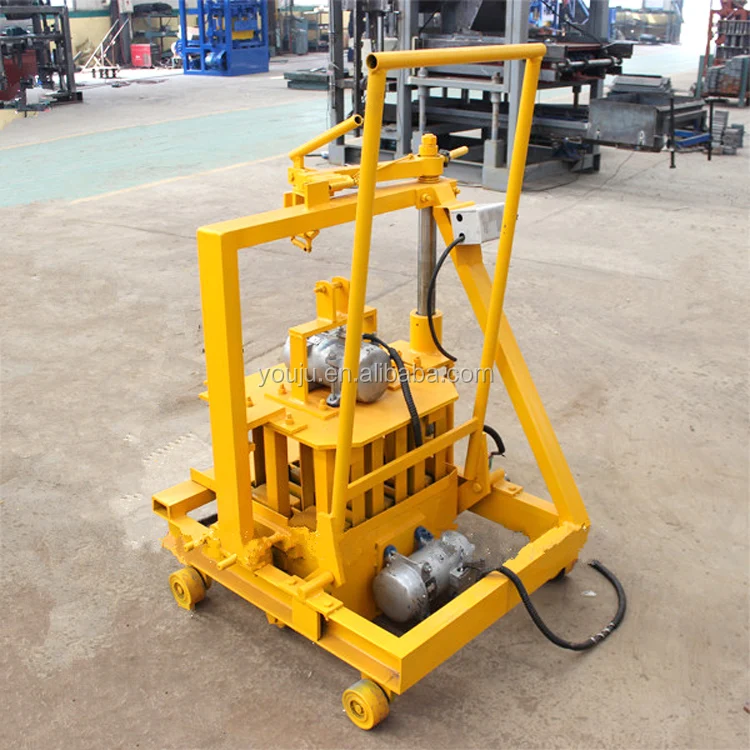
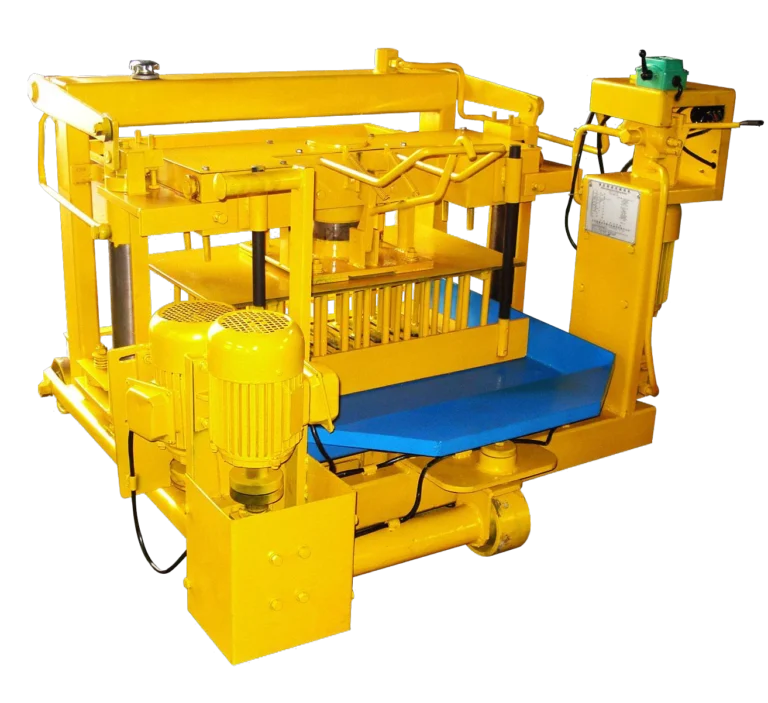
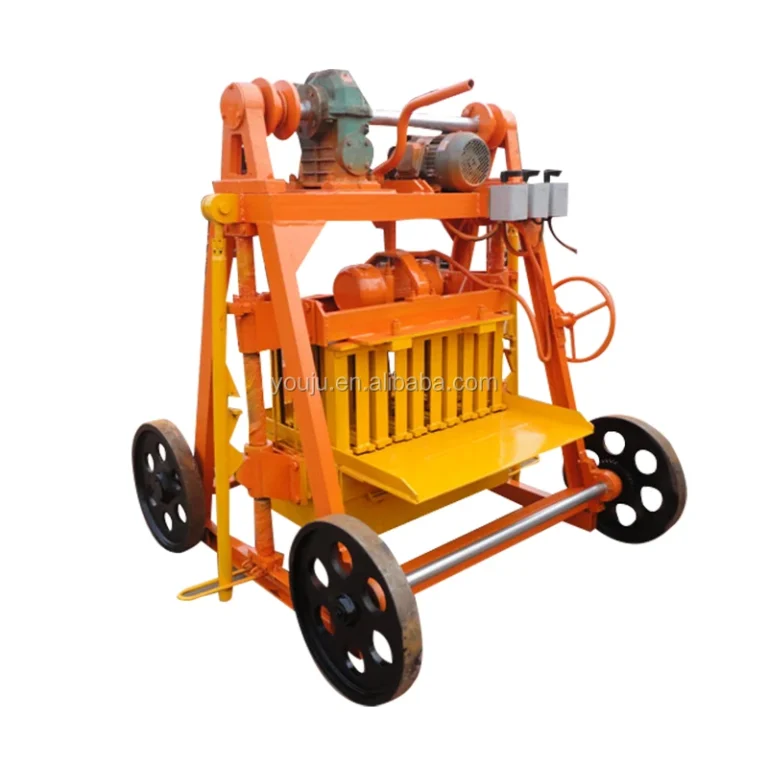
Matched System Configuration — Block machine, mould, pallet, and handling are specified as one integrated system based on your actual mix design and site conditions, eliminating the guesswork of assembling from separate suppliers.
Technical Specifications
| Parameter |
Value |
| Model |
QMR4-45 |
| Product Type |
Mobile Concrete Block Making Machine |
| Overall Dimensions (L×W×H) |
1100 x 950 x 2100 mm |
| Net Weight |
810 kgs |
| Molding Cycle |
30-45 s |
| Power Source Options |
Diesel / Petrol Engine / Electric |
| Output Capacity |
2560 pcs/day (basis not stated in source — confirm block format / material / thickness) |
| Pallet Requirement |
No pallet required |
| Basic Equipment |
JZC350 Diesel Concrete Mixer or JQ350 Diesel Concrete Mixer (Electric Generating Unit); Trolley |
| Mould Formats |
Paver brick, hollow block, concrete block, solid brick, fly ash brick |
| Automation Level |
Manual / egg-laying mobile type |
| Mobility |
Moveable on-site without fixed plant |
| Warranty |
1 Year |
Application Suitability
| Application |
Material or Output |
| On-site housing projects |
Hollow blocks from local crushed stone and cement |
| Remote construction sites |
Solid bricks using diesel power in off-grid areas |
| Small-scale masonry supply |
Paver bricks from sand, fly ash, and cement mixes |
| Entrepreneur starter plants |
Concrete blocks with minimal fixed investment |
| Contractor self-production |
Interlocking bricks produced adjacent to the build location |
What "No Pallet Required" Actually Means for Your Budget
The QMR4-45 eliminates pallet purchase, pallet handling labor, and curing rack construction from your total project cost.
Many buyers receive quotations that cover the press alone, only to discover that pallet handling, stacking, and curing infrastructure are missing from the scope. [NEED_CITE: typical pallet costs for small block plants] With this mobile block machine manufacturer approach, the egg-laying design places each block directly onto the ground surface, which means you avoid the recurring expense of replacing worn pallets and the capital outlay for curing racks. The machine moves forward after each cycle, leaving the freshly formed block in place to cure naturally.

Positioning the QMR4-45 Within the Mobile Tier
The QMR4-45 occupies the entry point of our mobile block machine range, intended for buyers who need production capability without committing to a fixed plant layout. This mobile block machine manufacturer category serves contractors who want to produce directly where the building goes up, relocating the press as the project footprint expands. The 810 kg mass and compact 1100 x 950 mm footprint allow the unit to be moved by a small crane or forklift between production zones.
Matching Power Source to Site Reality
The triple power-source configuration — diesel, petrol, or electric — exists because job sites vary enormously in utility availability. A remote housing development with no grid connection requires the diesel variant paired with the included JZC350 mixer, while an urban infill project with stable power benefits from electric drive for lower operating cost. [NEED_CITE: fuel consumption comparison for small diesel versus electric block machines] Confirming which power source fits your site conditions before shipment prevents commissioning delays that arise when a machine arrives configured for a voltage or frequency your site cannot supply.
Reading the Numbers That Matter
The 30-45 second molding cycle determines how quickly the press completes one press-and-release sequence, but actual daily throughput depends on operator speed in repositioning the machine and feeding fresh mix. The 2560 pcs/day figure requires confirmation against your specific block format, wall thickness, and mix design before it can be treated as a planning number. Vibration force combined with the hydraulic pressure applied during molding determines block density and compressive strength — a mix that works in one region’s sand may produce weak blocks in another region’s volcanic ash, as I learned on a site in Indonesia where the local aggregate required three days of ratio adjustment to stabilize output quality. The included diesel mixer ensures consistent feed material reaches the hopper at the right moisture content.
The Cost of Skipping the Mix Conversation
Buyers who select a machine without disclosing their local aggregate type often face inconsistent block strength once production begins. The vibration settings calibrated at the factory assume a standard sand-and-cement mix; when the actual material arrives with different particle size distribution or moisture retention, blocks crack during curing or crumble during handling. [NEED_CITE: common causes of block density inconsistency in mobile machines] This problem compounds because the egg-laying design places blocks on uneven ground, where density variation shows up as differential settling and breakage before the blocks are ever moved.
Why Procurement Lands Here
Block machinery as a single focus means the QMR4-45 press, its moulds, the mixer, and the trolley are specified as a matched set rather than sourced independently. Configuration is set against your actual mix design and local aggregate, not a catalogue default — when you tell us what sand is available in your region, the vibration and pressure settings are adjusted accordingly. Mould design covers the formats your market actually sells, from hollow blocks to pavers, and custom mould drawings are available when standard sizes do not match your project specifications. The automation level remains selectable, so you can begin with manual egg-laying operation and evaluate whether a semi-automatic line suits your future volume. Installation support and operator training ensure your crew understands mould change procedures, mix ratios, and daily maintenance routines before the first production run.
Documentation & Verification
- Line layout showing daily capacity calculated per your confirmed block format
- Machine specification sheet with power source variant clearly marked
- Mould drawing and format list detailing included and optional block sizes
- Voltage and control language confirmation for electric-drive variants
- Factory test record using your specified mix design before dispatch
- Operation and maintenance manual with wear parts list for ongoing supply
Installation, Commissioning & Support
- Level compacted ground required across the production area for consistent block placement
- Diesel variant requires fuel storage positioned for safe mixer and engine refill
- Electric variant needs dedicated circuit matching confirmed voltage and frequency
- Machine arrives assembled with mixer; connect power or fuel and begin production
- On-site operator training covers mould change, mix ratio, and daily lubrication points
- Wear parts list and mould inventory provided for first replacement ordering cycle
Moving Forward With an Inquiry
Provide the block format you intend to produce, your target daily volume, and the type of sand or aggregate available locally. Share your site power availability — whether grid-connected or diesel-only — and the curing area dimensions you have planned. These details allow configuration of the correct power variant, mixer pairing, and mould set for the QMR4-45.
Frequently Asked Questions
Q: How is the 2560 pcs/day capacity calculated and for which block format?
A: That figure appears in the source documentation without a stated block format, wall thickness, or mix design assumption. Before treating it as a planning number, we calculate realistic daily output based on your specific block size, the 30-45 second molding cycle, operator repositioning time, and your local material characteristics to give you an honest capacity estimate.
Q: Which power source — diesel, petrol or electric — fits my site conditions?
A: Diesel suits remote or off-grid construction sites where no electrical supply exists. Petrol works for smaller intermittent production. Electric drive lowers operating cost where stable grid power is available, but voltage and frequency must be confirmed before shipment to match your local standard and avoid commissioning delays.
Q: What block formats and mould sizes are available for the QMR4-45?
A: Standard mould formats include paver brick, hollow block, concrete block, solid brick, and fly ash brick. Custom mould design to buyer drawings is available when your market requires sizes outside the standard range. The format list and mould drawing are provided before production so you can verify dimensions.
Q: Does the machine need pallets, a curing area, or a fixed foundation?
A: No pallets are required — the egg-laying design places blocks directly on the ground. No fixed foundation is needed because the machine moves across the production area. You need a level, compacted ground surface large enough for the blocks to cure in place before collection.
Q: What is included in the basic equipment package and what is optional?
A: The basic package includes the QMR4-45 press, either a JZC350 diesel concrete mixer or JQ350 diesel mixer with electric generating unit, and a trolley for material transport. Additional moulds for different block formats and spare wear parts are available as optional additions to your order.

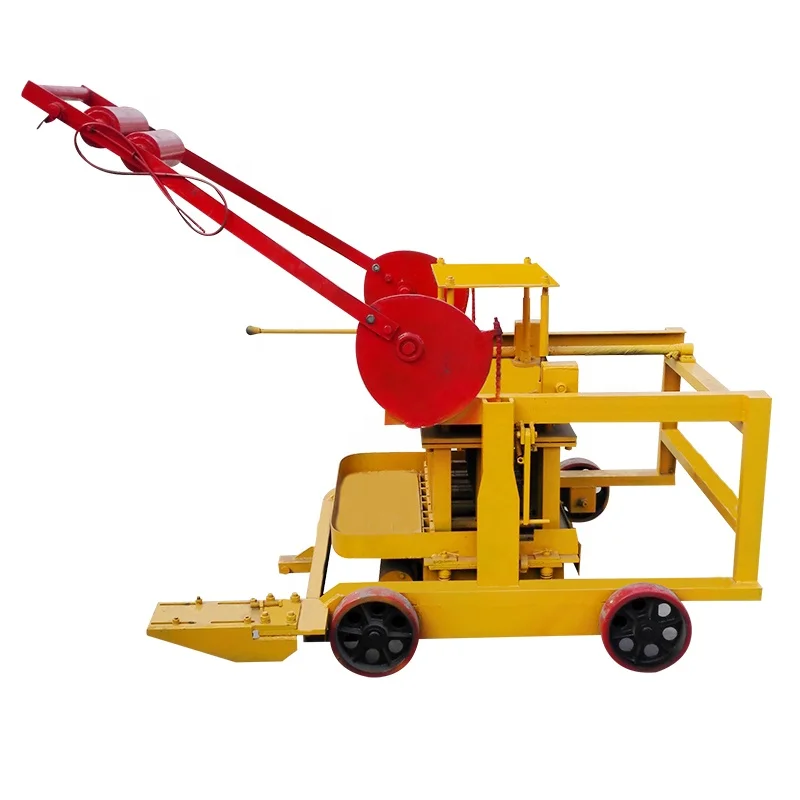
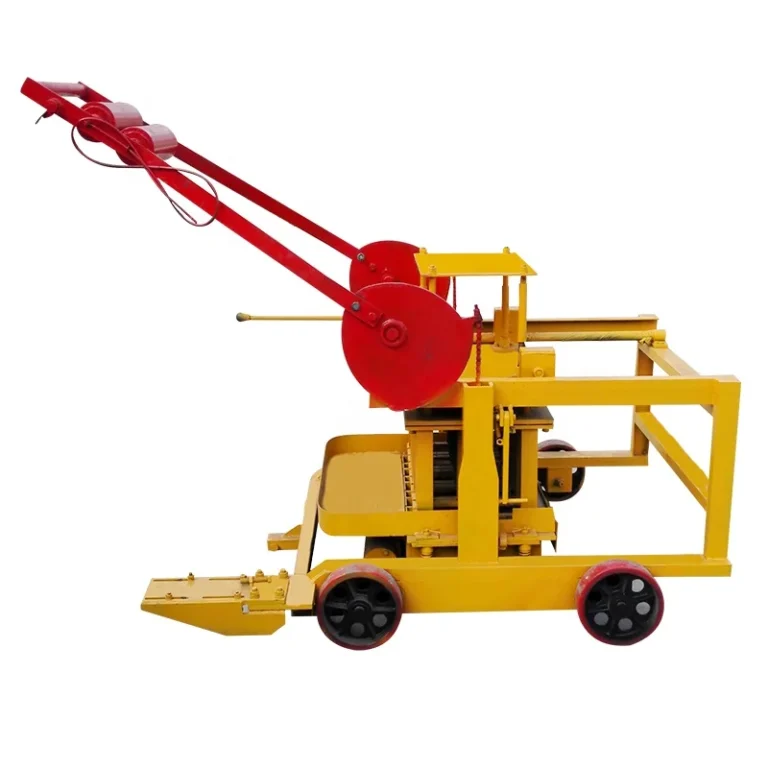 Mobile block machine