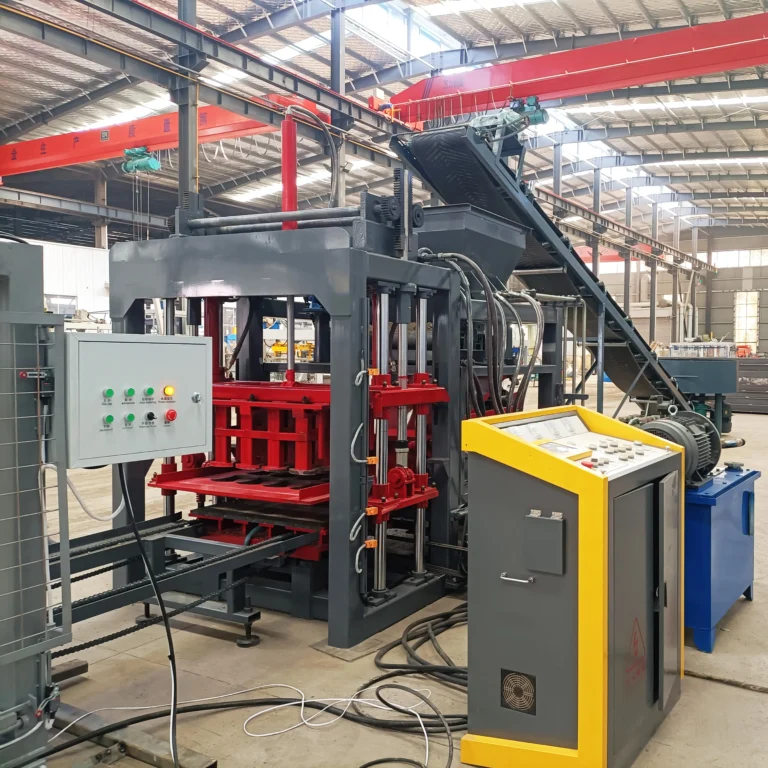
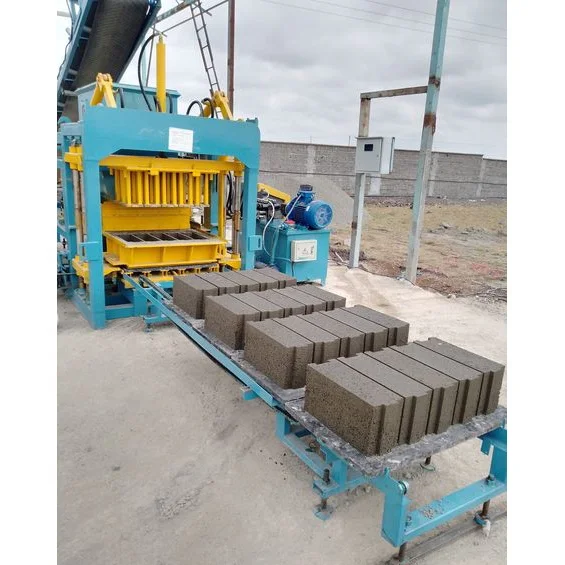
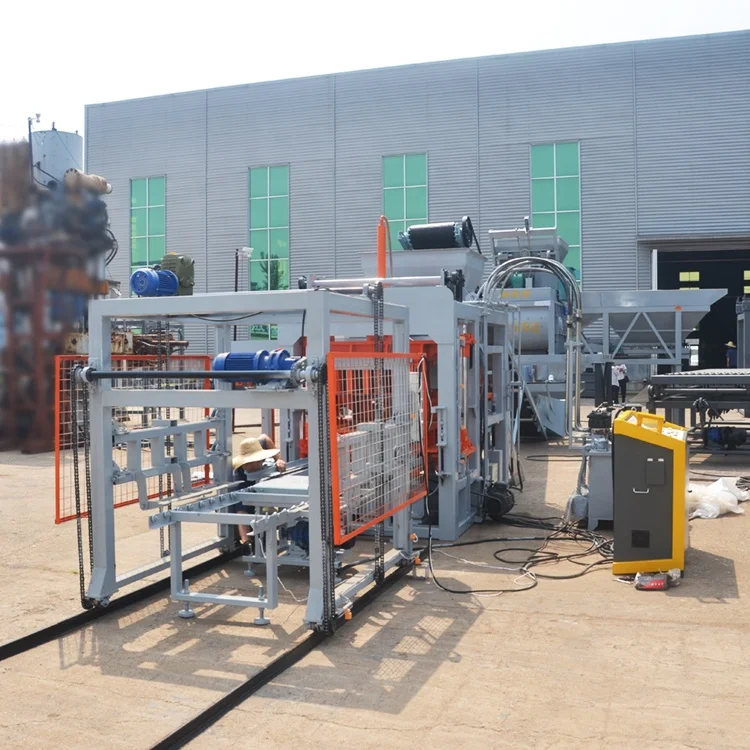
Hollow Block Hydraulic Concrete Block Making Machine – Manufacturer
System-matched configuration — Every QT6-15 is configured around the buyer’s actual mix design and target block format rather than a catalogue default, ensuring the hydraulic pressure, vibration force, and pallet size work as one coordinated production unit from day one.
Technical Specifications
| Parameter |
Value |
| Model |
QT6-15 |
| Product Type |
Hydraulic Concrete Block Making Machine |
| Overall Dimensions (L×W×H) |
7400×1900×2660 mm |
| Molding Cycle |
15–25 s |
| Vibration Frequency |
4600 r/min |
| Exciting Power |
40–50 KN |
| Total Power |
31.25 kW |
| Mixer Model |
JQ350 |
| Pallet Size |
850×550×25 mm |
| Total Weight |
7 T |
| Applied Products |
Hollow block, solid brick, paver, curbstone |
| Raw Materials |
Crushed stone, sand, cement, dust, fly ash |
| Control System |
PLC control system |
| Hydraulic Station |
Included |
| Pallet Feeder |
Included |
| Brick Conveyor |
Included |
| Block Sweeper |
Included |
| Output (400×200×200 mm hollow block, 15–20 s cycle) |
1200–1680 pcs/hr |
| Output (400×150×200 mm hollow block, 15–20 s cycle) |
1800–2400 pcs/hr |
| Output (240×115×53 mm solid brick, 15–20 s cycle) |
3240 pcs/hr |
| Daily Output (400×200×200 mm hollow block, 8 hr) |
9600–13440 pcs |
| Daily Output (400×150×200 mm hollow block, 8 hr) |
14400–19200 pcs |
| Daily Output (240×115×53 mm solid brick, 8 hr) |
16200–19440 pcs |
| Automation Level |
Semi-automatic (manual hydraulic trolley included) |
| Standards |
CE declaration available where applicable |
Application Suitability
| Application |
Material or Output |
| Hollow block production |
Crushed stone, sand, cement, fly ash |
| Solid brick manufacturing |
Cement, sand, dust, crushed stone |
| Paver block production |
Aggregates and cement blends |
| Curbstone forming |
High-density concrete mixes |
| On-site block production for housing projects |
Locally sourced sand and crushed stone |
What "1,200 Pieces per Hour" Leaves Out About the QT6-15
Capacity only means something when the block format behind the number is clearly stated.
A surprising number of quotations for a hydraulic concrete block making machine manufacturer quote a single output figure and never reveal which block size produced it. The result: a buyer expecting 1200 blocks per hour finds that figure was calculated for a 400×150×200 mm hollow block, while the format they actually sell — 400×200×200 mm — runs noticeably slower. Over an eight-hour shift that gap compounds into thousands of blocks. The QT6-15 capacity table above lists each output against its specific block dimensions and cycle time, so the daily volume you plan around matches the format your market demands [NEED_CITE: capacity calculation methods for concrete block production].

Where the QT6-15 Sits in the SHIYUE Range
The SHIYUE range spans semi-automatic workshop machines through high-capacity fully automatic lines. The QT6-15 occupies the mid-tier, where a hydraulic concrete block making machine manufacturer needs enough volume to supply a growing construction market without the capital outlay of a full automatic stacker-and-cuber line. For a first-time plant or a contractor producing blocks on a housing project site, this tier keeps the footprint manageable and the initial investment contained while leaving a clear upgrade path.
Matching Machine Tier to Your Actual Market Volume
Picking the right tier starts with one question: how many blocks does your market absorb per day, in which formats? A plant serving a single housing development may never exceed 10,000 hollow blocks daily, placing it squarely in the QT6-15 range. A distributor feeding multiple retail yards will outgrow this tier quickly. Mapping your format mix and realistic daily demand against the SHIYUE range prevents over-investing in capacity you cannot fill or under-investing and losing orders [NEED_CITE: block plant capacity planning by market segment].
How Vibration and Hydraulic Pressure Work Together
Vibration frequency of 4600 r/min and exciting power between 40–50 KN compact the aggregate particles, while the hydraulic station applies downward pressure to lock them in place before the mix sets. If vibration is too weak relative to hydraulic pressure, the block emerges dense but brittle; if vibration dominates, the block holds shape but lacks compressive strength. The QT6-15 balances both forces so that your specific mix — whether fly-ash-heavy or crusher-dust-based — reaches the strength your local building code requires.
Pallet Size and the Rest of Your Curing Layout
The 850×550×25 mm pallet is a dimension that must align with your existing curing racks, forklift tine spacing, and yard area. A mismatch here means either rebuilding the curing yard or running a forklift that cannot reach the rack height. The QT6-15 ships with pallets sized for standard rack configurations, and the pallet feeder keeps them cycling without manual lifting, reducing operator fatigue across an eight-hour shift.
The Cost of Ignoring the Mould-Change Reality
A machine that takes most of a shift to swap moulds cancels the format flexibility you paid for. If your market demands hollow blocks on Monday and pavers on Tuesday, the actual number of productive hours lost to changeover determines whether that flexibility is real or just a line in a brochure. Buyers who skip asking about changeover procedure and tooling often discover the truth only after the first production week [NEED_CITE: mould changeover practices in block manufacturing].
Why Source the QT6-15 Through SHIYUE
Block machinery is our single focus, which means the press, mould, pallet, and handling equipment are specified as one matched system rather than assembled from separate suppliers. Every QT6-15 is configured against your actual mix design and local aggregate, not a catalogue default. Mould design covers the formats your market actually sells, including custom drawings when standard formats fall short. The semi-automatic configuration lets you start lean and add automation stations later. Installation and commissioning include operator training on your specific PLC language.
Documentation & Verification
- Line layout and capacity calculation stating the block format assumed for each output figure
- Machine specification sheet with hydraulic pressure and vibration force matched to your mix
- Mould drawing and format list confirming every block size you intend to produce
- Voltage, frequency, and PLC display language confirmation before production begins
- Factory test record demonstrating cycle time with your specified raw materials
- Operation and maintenance manual in your chosen language
Installation, Commissioning & Support
- Foundation pad sized to the 7400×1900 mm footprint with vibration-isolation mounting points
- Dedicated power circuit rated for the 31.25 kW total draw at your confirmed voltage and frequency
- Machine arrives partially assembled; on-site assembly covers hydraulic station and pallet feeder alignment
- PLC language and parameter settings configured for your operators before first production run
- Operator training on mould change procedure, cycle adjustment, and daily maintenance checkpoints
- Wear parts and mould list provided at delivery for your first reorder planning
What to Share Before Requesting a Quote
To receive a QT6-15 configuration that matches your plant, provide the block formats and dimensions your market sells, your target daily volume per format, the raw materials you can source locally, and your available curing-yard dimensions. Include your local voltage, frequency, and preferred PLC display language. If you already own forklifts or curing racks, share their specifications so pallet and rack sizing can be verified before the machine is built.
Frequently Asked Questions
Q: How is output capacity calculated and which block format does each figure assume?
A: Every capacity figure for the QT6-15 is listed alongside the specific block dimensions and cycle time that produced it. The table shows hollow block, solid brick, and paver outputs separately, so you can match the figure to the format your market actually buys rather than relying on a single headline number.
Q: What automation levels are available and can I start semi-automatic and upgrade later?
A: The QT6-15 ships as a semi-automatic line with a manual hydraulic trolley. As your volume grows, you can add automatic pallet feeding, stacking, and cubing stations to the same press. This upgrade path lets you match investment to actual demand instead of committing to full automation on day one.
Q: How do I confirm voltage, frequency, and control language match my local grid and operators?
A: Voltage, frequency, and PLC display language are confirmed during the proposal stage, before production starts. You provide your local grid specifications and preferred language, and these are documented in the machine specification sheet so there are no surprises at commissioning.
Q: What is the plant footprint and how does the QT6-15 compare to other tiers in the range?
A: The QT6-15 measures 7400×1900×2660 mm and occupies the mid-tier in the SHIYUE range. Smaller workshop models require less floor space but deliver lower output, while high-capacity automatic lines need a larger footprint and more handling equipment. Your daily volume target determines which tier fits.
Q: Which mould formats are included and how long does a mould change take?
A: Standard moulds cover hollow blocks, solid bricks, pavers, and curbstones. Mould change time depends on the specific format pair and operator experience; it is confirmed during installation training on your machine so your team can plan production schedules around realistic changeover durations.

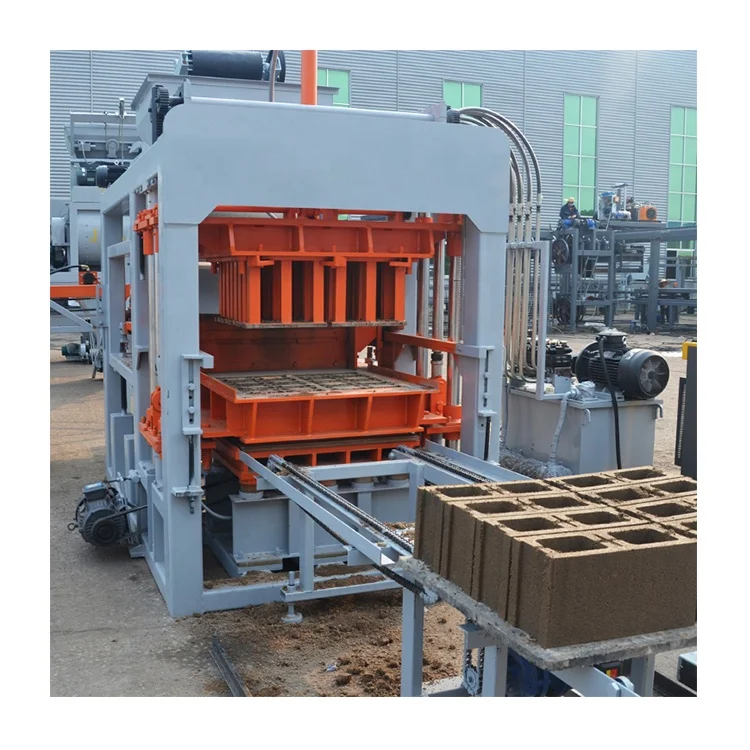
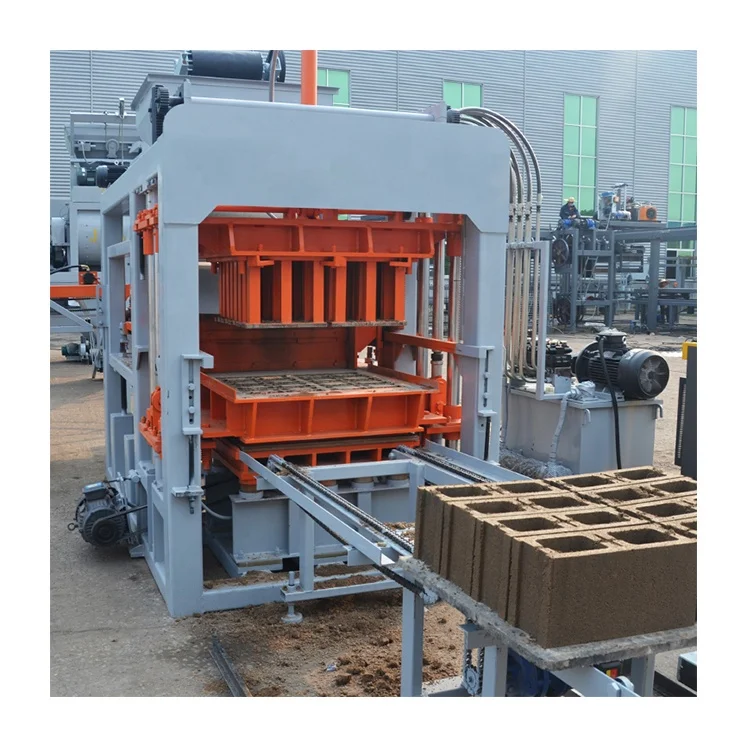 High quality block machine