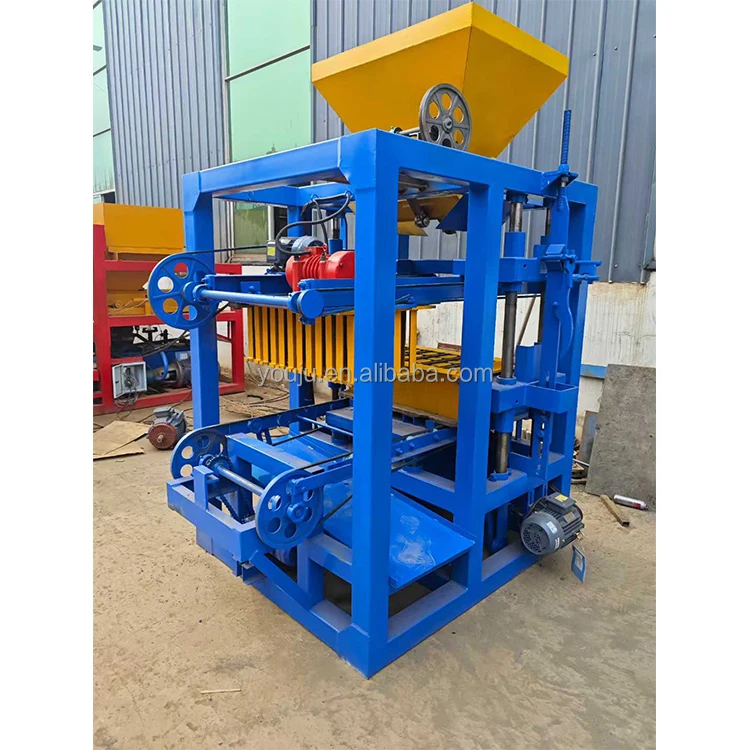
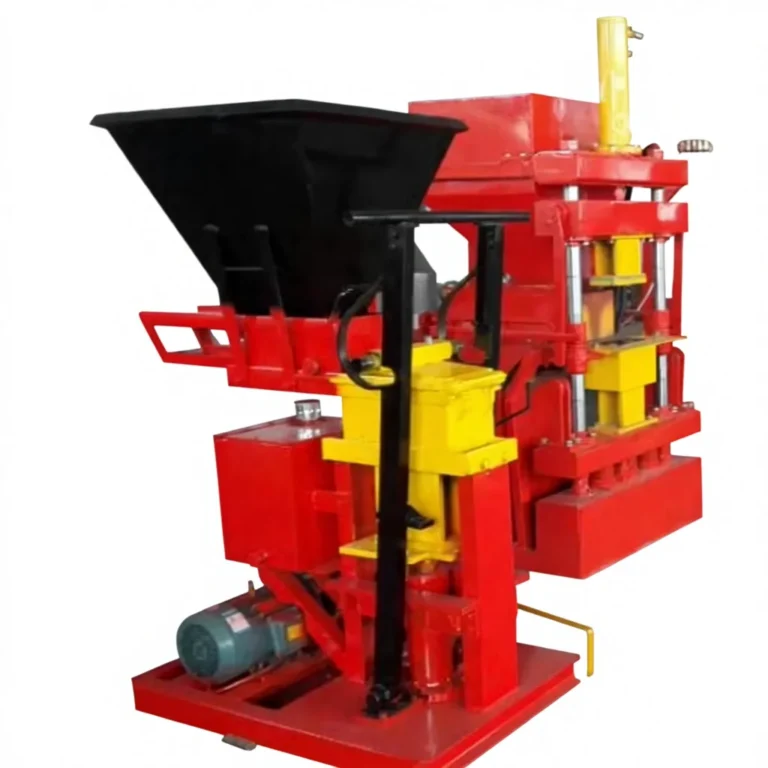
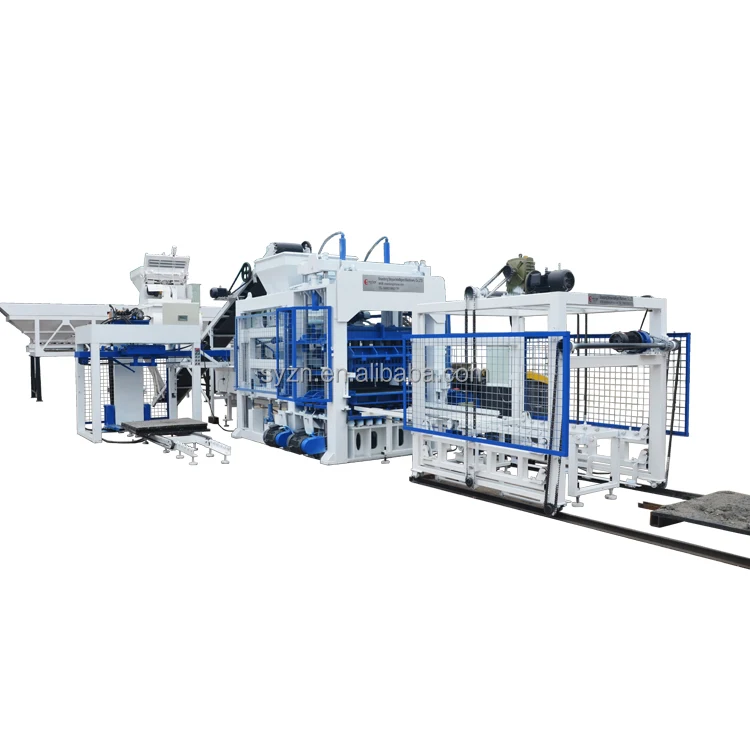
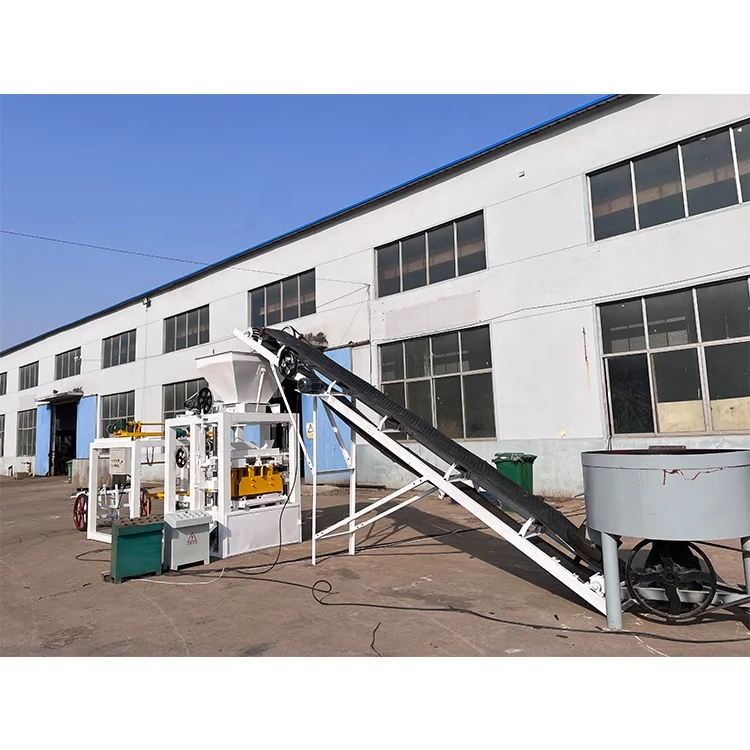
Matched System Supply — the QTJ4-40 stationary block making machine for sale is specified as one integrated unit covering press, pallet, mould and handling rather than assembled from separate sources.
Technical Specifications
| Parameter |
Value |
| Model |
QTJ4-40 |
| Product Type |
Stationary Concrete Block Making Machine |
| Main Vibration Form |
Platform Vibration |
| Vibration Frequency |
2800 r/min |
| Pallet Size |
850 × 450 mm |
| Mould Cavities |
4 pcs (400×200×200 mm); 5 pcs (400×150×200 mm); 9 pcs (225×112.5×60 mm) |
| Output Capacity |
360 pcs/h for 400×200×200 mm hollow block; 500 pcs/h for 400×150×200 mm block; 900 pcs/h for 225×112.5×60 mm interlocking block |
| Daily Output by Format |
2880 pcs (400×200×200 mm); 4000 pcs (400×150×200 mm); 7200 pcs (225×112.5×60 mm) |
| Machine Weight |
1 T |
| Overall Dimensions |
1350 × 1460 × 1800 mm |
| Factory Area Required |
200 m² |
| Workers Required |
1–3 people |
| Motor Option |
Diesel and electric motor available |
| Automation Level |
Manual / semi-automatic with top die push-pull and automatic scraper |
| Raw Material Ratio |
Cement 8%–10%, sand 30%–40%, stone 50%–60% (approx. 1:4:5) |
| Certification |
CE |
Application Suitability
| Application |
Material or Output |
| Small-scale hollow block plant |
Crushed stone, sand and cement producing 400×200×200 mm hollow blocks |
| On-site contractor block production |
Locally sourced aggregate and cement for 400×150×200 mm solid blocks |
| Interlocking paver manufacturing |
Fine sand, stone dust and cement for 225×112.5×60 mm interlocking pavers |
| First block plant for entrepreneurs |
Entry-tier output with 200 m² footprint using fly ash, gravel or slag mixes |
What "Pieces per Hour" Leaves Out About a Stationary Block Making Machine for Sale
Every output figure must be tied to a specific block format, or it means nothing.
Sellers often quote a single cycle capacity and leave the buyer to assume that number applies to whichever block they plan to produce. In reality, the same machine pressing a 400×200×200 mm hollow block turns out far fewer units per shift than it does a smaller interlocking paver. When a buyer budgets daily revenue on the higher number but sells the larger format, the shortfall compounds week after week. I have seen plants shut down for days because the owner ordered a machine based on a headline capacity that did not match their actual product. [NEED_CITE: common block format capacity discrepancies in quotations]

Where the QTJ4-40 Sits on the Machine Range
The QTJ4-40 occupies the entry tier of the stationary block making machine for sale lineup. Buyers evaluating their first plant or adding a parallel line can use this tier to establish a baseline before comparing against mid-range semi-automatic or high-capacity automatic configurations. The 200 m² factory area requirement and one-to-three worker operation keep the initial footprint and labour commitment manageable for a startup operation.
How Output Tiers Shape Plant Planning
Choosing a tier is not just about today’s output target. A buyer who starts at the QTJ4-40 level needs to know the pallet size, curing area and material feed setup will remain compatible if production volume grows and a higher-tier machine is added later. The 850 × 450 mm pallet dimension should match the forklift and curing rack system already in place or planned for the site. When tiers are treated as isolated purchases rather than steps on a range, buyers end up replacing peripheral equipment with each machine change. [NEED_CITE: block plant expansion planning and pallet compatibility]
Reading the Specs That Matter on Site
Platform vibration at 2800 r/min transfers energy through the 850 × 450 mm pallet into the mould cavity, compacting the mix from the bottom up. This vibration form suits the QTJ4-40’s output class because it delivers adequate density for hollow and interlocking formats without requiring the hydraulic pressure systems found on larger tiers. The top die push-pull mechanism with automatic scraper reduces the manual effort per cycle, placing operation complexity closer to semi-automatic equipment than to purely manual machines. Raw material ratio of approximately one part cement to four parts sand and five parts stone means the machine handles conventional concrete mixes available in most regional markets, though local aggregate hardness will affect mould wear rates over time.
The Cost of Skipping Tier Alignment
A buyer who selects a machine tier without confirming the block format they actually sell faces two problems. First, the daily output falls short of the revenue projection that justified the purchase. Second, the mould inventory, pallet quantity and curing space were all sized to the wrong figure, so the entire downstream workflow bottlenecks before the machine reaches its real capacity. Plants in this position often add overtime shifts to compensate, which accelerates wear on vibration components and drive motors without solving the underlying mismatch. [NEED_CITE: downstream workflow bottlenecks from incorrect capacity assumptions]
Why Source the Entry Tier Here
Block machinery is the single focus, so the QTJ4-40 press, its moulds, pallets and handling equipment are specified as one matched system rather than pulled from unrelated suppliers. The configuration is set against the buyer’s actual mix design and local aggregate, not a catalogue default. Mould design covers the formats the buyer’s market sells, and custom drawings are available when standard cavity counts do not match local demand. The automation level is selectable — a buyer can begin with manual pallet handling and move to higher tiers without replacing the entire downstream layout. Installation and commissioning support includes operator training so the crew understands cycle timing from day one.
Documentation & Verification
- Line layout showing the QTJ4-40 footprint within a 200 m² area and pallet flow path
- Capacity calculation document stating the block format assumed for each output figure
- Pallet specification sheet confirming 850 × 450 mm size against your curing rack dimensions
- Mould drawing and format list for every block type your market requires
- Voltage, frequency and motor type confirmation before production begins
Installation, Commissioning & Support
- Site must provide 200 m² level ground with clearance for the 1350 × 1460 × 1800 mm machine envelope
- Dedicated power circuit matching confirmed voltage and frequency for the selected electric or diesel motor
- Platform vibration alignment checked on site to ensure 2800 r/min transfers evenly across the pallet
- Top die push-pull and automatic scraper adjusted to the buyer’s specific mould cavity depth
- Operator training on cycle timing, mould change procedure and daily vibration component inspection
- Wear parts list provided with recommended spare mould and scraper inventory for the buyer’s aggregate hardness
Preparing Your Inquiry
Share the specific block formats your market sells, including dimensions and daily volume targets for each. Confirm your site’s available area, local voltage and frequency, and whether you plan to use diesel or electric power. If you already have curing racks and forklifts on site, provide the pallet dimensions they accept so the 850 × 450 mm pallet can be verified against your existing equipment.
Frequently Asked Questions
Q: How do I verify the real daily output of the QTJ4-40 for my specific block format?
A: Request a capacity calculation document that states output per format, not a single generic figure. The QTJ4-40 produces 2880 pieces per shift for 400×200×200 mm hollow blocks but reaches 7200 pieces per shift for 225×112.5×60 mm interlocking blocks. Your actual number depends entirely on which format you plan to sell.
Q: Where does this machine sit compared to semi-automatic and fully automatic tiers?
A: The QTJ4-40 is the entry tier with manual to semi-automatic operation. It suits first plants and small workshops running 200 m² or less. Higher tiers add automatic pallet feeding, stacking and cubing for buyers whose daily volume demands reduced manual handling and higher throughput consistency.
Q: What factory area and pallet handling setup do I need at this tier?
A: Plan for 200 m² to accommodate the machine, raw material storage and fresh block curing. The 850 × 450 mm pallet must match your curing rack spacing and forklift fork width. Pallets are handled manually at this tier, so allocate labour for moving pressed blocks to the curing area each cycle.
Q: Can I start with the QTJ4-40 and move to a higher automation tier later?
A: Yes. The pallet size and downstream handling layout can be designed so that upgrading to a higher-tier press later does not require replacing your entire curing and stacking setup. Confirm the upgrade path during the initial line layout discussion.
Q: How are voltage, frequency and control language confirmed before shipment?
A: These details are locked in during the quotation stage, before production begins. Provide your site voltage, frequency and preferred display language so the motor and any control components are configured correctly, avoiding delays when the machine arrives on site.

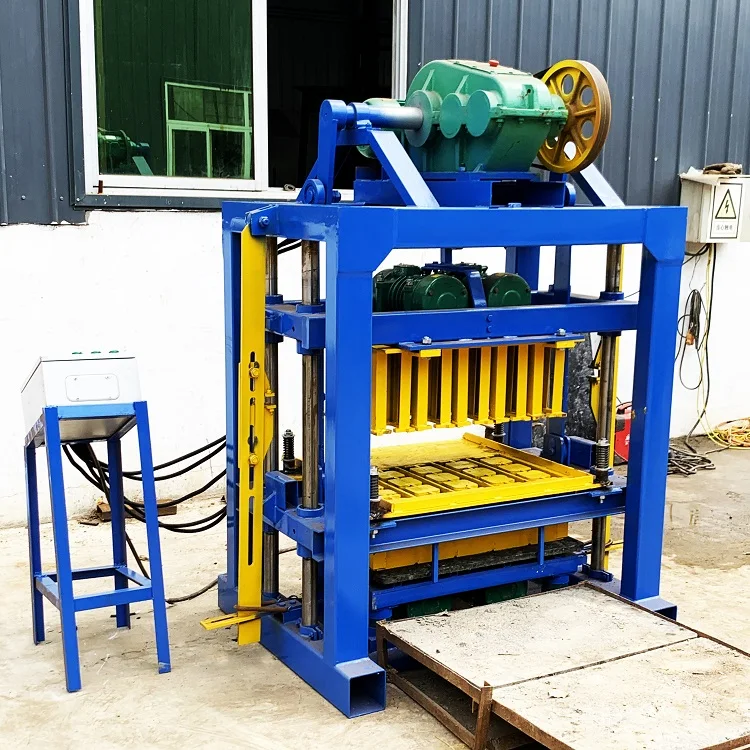
 Stationary block machine