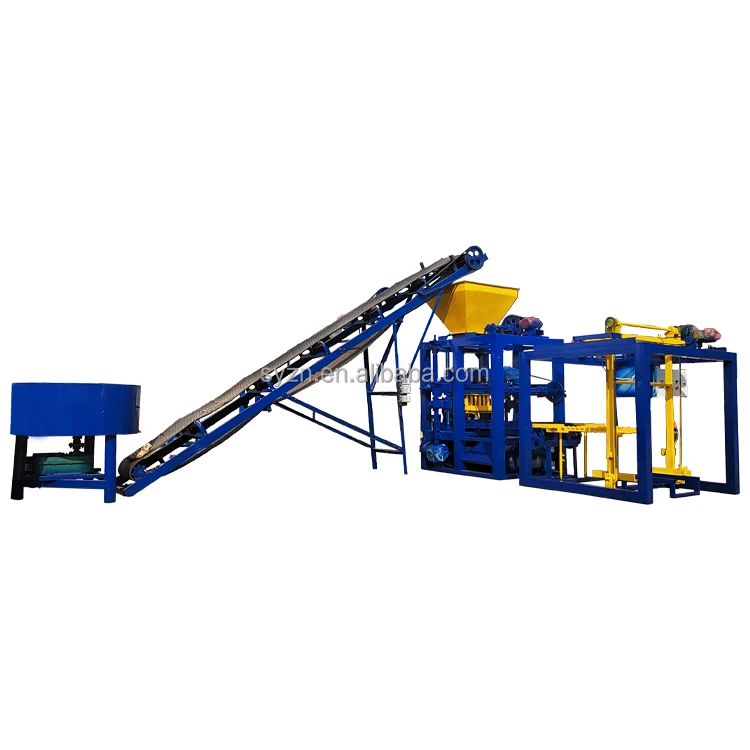
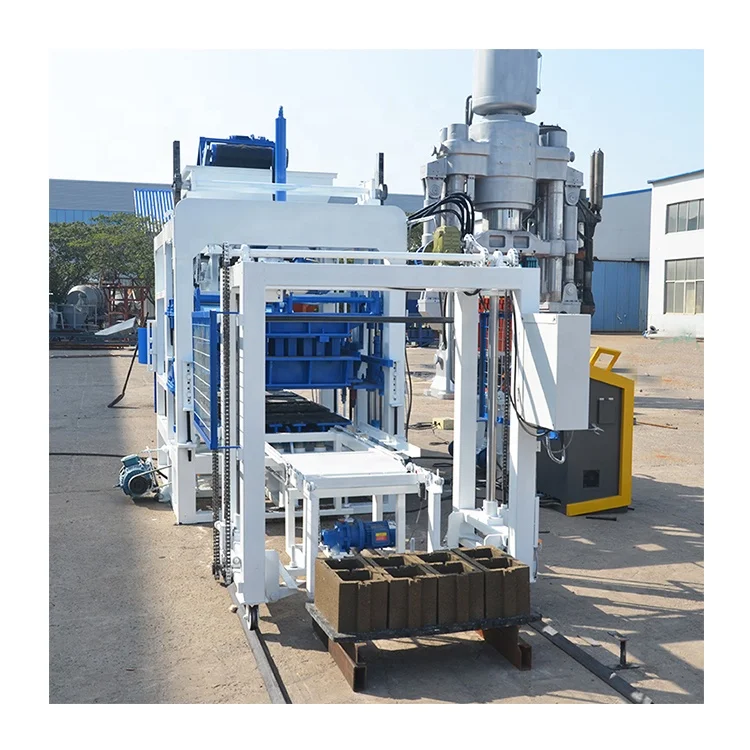
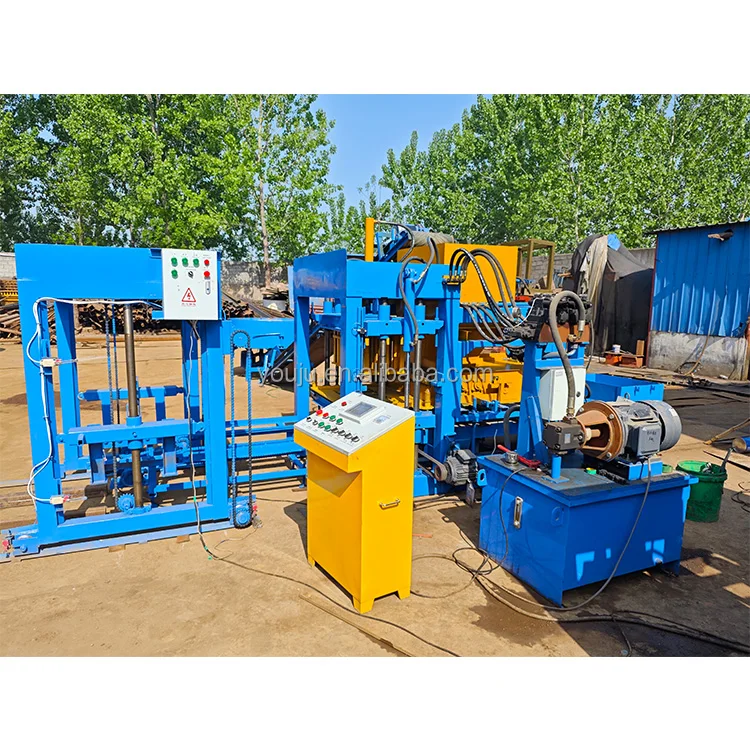
Matched System Supply — we specify the QTJ4-24 block machine, moulds, pallets and handling as one coordinated package so that cycle times, power draw and curing logistics actually line up on your shop floor.
Technical Specifications
| Parameter |
Value |
| Model |
QTJ4-24 |
| Product Type |
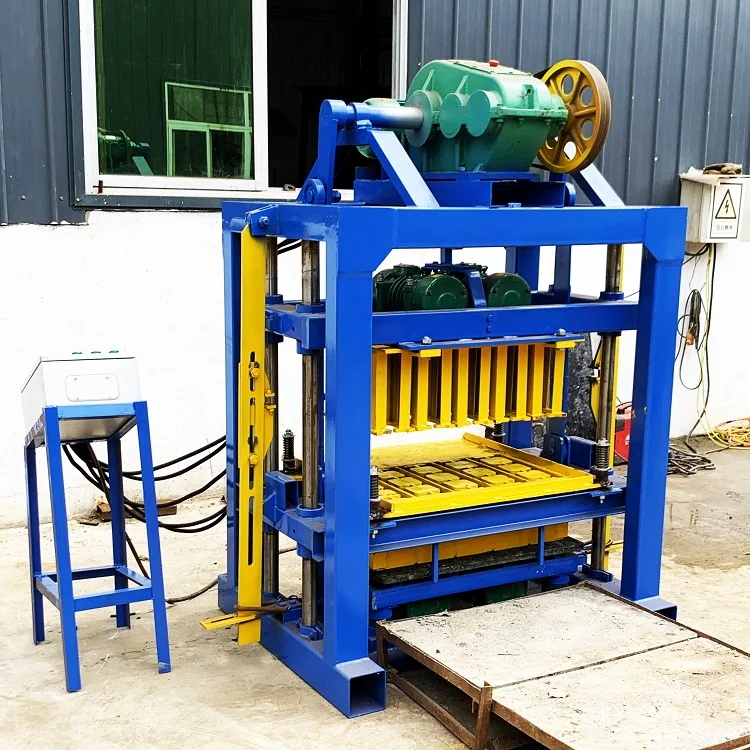
Stationary Concrete Block Making Machine |
| Overall Dimensions (L×W×H) |
3600×1700×2560 mm |
| Pallet Size |
850×450 mm |
| Molding Cycle |
24–26 s (basis not stated in source — confirm block format / material / thickness) |
| Overall Power |
11.95 kW |
| Vibration Force |
45 kN |
| Vibration Configuration |
2×3 kW lower vibrators + 2×1.5 kW upper vibrators |
| Total Mass |
2 T |
| Molding Method |
Mechanical |
| Material Distribution |
Full-automatic spiral |
| Reducer for Mold Lifting |
350-type |
| Raw Materials |
Cement, sand, stone |
| Control System |
PLC Controlled |
| Drive Type |
Engine Powered, Gear Drive |
| Voltage & Frequency |
Configurable to site requirements (must be confirmed before production) |
| Mould Format Options |
Hollow block, interlocking brick, paving brick, solid brick |
| Automation Level |
Semi-automatic (mechanical molding, manual pallet handling) |
| Warranty |
1 year for whole machine (excluding spare parts) |
Application Suitability
| Application |
Material or Output |
| Hollow block production for masonry walls |
Crushed stone, sand, and cement mixes |
| Solid block production |
Dense aggregate and cement blends |
| Interlocking brick production |
Fine sand and cement with specific mould tooling |
| Paving brick production |
High-density aggregate mixes with surface finish requirements |
| Small to medium block plants |
Moderate daily volume with semi-automatic operation |
| On-site production for contractors |
Local aggregate sourcing with portable pallet setups |
Why the Voltage Question Must Precede the Quotation
A misquoted electrical supply is the single most common reason a QTJ4-24 block machine manufacturer sees commissioning delays that stretch into weeks.
We have watched brand-new block machines sit idle on African and Southeast Asian job sites because the supplier assumed 380V/50Hz while the local grid delivered 415V or 220V/60Hz. The QTJ4-24 pulls 11.95 kW across four vibration motors and a spiral feeder; feeding it the wrong voltage either burns out the windings within the first shift or causes the PLC to fault repeatedly. [NEED_CITE: voltage and frequency standards by export market] That is why we require a photo of your existing distribution board and a written confirmation of voltage, frequency, and phase before the QTJ4-24 enters final assembly. The extra week of paperwork on our end saves you a month of electrician standby costs on yours.

Placing the QTJ4-24 Within the Stationary Range
The QTJ4-24 occupies the entry-to-mid tier of stationary block machines, positioned below fully automatic hydraulic lines that handle high-volume hollow block and paver output. Buyers evaluating a QTJ4-24 block machine manufacturer are typically comparing this mechanical-vibration platform against larger hydraulic presses that demand higher capital outlay and more extensive electrical infrastructure. The 11.95 kW overall power requirement means the QTJ4-24 can run in workshops where a 30 kW hydraulic line would require a transformer upgrade.
Where Semi-Automatic Operation Fits Your Business Model
Semi-automatic means the QTJ4-24 handles material distribution through its full-automatic spiral feeder and executes the vibration cycle under PLC control, but pallet feeding and removal remain manual operations. This configuration suits entrepreneurs launching a first block plant, construction contractors producing hollow blocks on a project site, or distributors adding block formats to an existing catalogue without committing to a fully automatic stacking and cubing system. [NEED_CITE: typical staffing requirements for semi-automatic block plants] Labour cost stays predictable, and the automation upgrade path remains open if your daily volume eventually justifies hydraulic pressure and automatic pallet handling.
Reading the Vibration and Power Specs
The 45 kN vibration force comes from a four-motor layout: two 3 kW motors mounted below the mould table and two 1.5 kW motors on the upper head. This split configuration compacts the mix from both directions, which matters when you are producing hollow blocks where wall thickness is narrow and inconsistent density leads to breakage during curing. The 350-type reducer on the mould lifting mechanism is sized to handle the repeated shock loading of a 24–26 second cycle without premature gear wear. Pallet size at 850×450 mm dictates your curing rack dimensions and forklift tine spacing; if your existing pallets are a different size, the mould and pallet must be re-specified together before the machine ships.
The Hidden Cost of Skipping Pallet and Curing Alignment
When a buyer orders a block machine without confirming pallet size against their curing yard, the result is pallets that do not stack on existing racks or that require a forklift the site does not own. For the QTJ4-24, the 850×450 mm pallet is compact enough for small curing areas, but if your yard was built around 900×550 mm pallets from a previous machine, every block coming off the line has to be re-stacked by hand. [NEED_CITE: pallet handling inefficiencies in block production facilities] That manual rehandling erases the labour advantage you expected from a semi-automatic machine and introduces block damage that shows up as customer complaints weeks later.
Why Source the QTJ4-24 Through This Supply Chain
Block machinery is our single focus, so the QTJ4-24 press, its moulds, pallets, and handling equipment are specified as a matched system rather than assembled from unrelated suppliers. We configure the machine against your actual mix design and local aggregate, not a catalogue default, which prevents the situation where a buyer receives a machine tuned for river sand but only has access to crushed granite. Mould design covers the formats your market actually sells, and custom drawings are available if your region demands a block profile outside the standard hollow, solid, interlocking, and paving range. Automation level is selectable, meaning you can start with the QTJ4-24’s semi-automatic setup and plan an upgrade path as volume grows. Installation support includes operator training so your crew understands the PLC interface, mould change procedure, and daily maintenance checkpoints from the first production run.
Documentation & Verification
- Line layout and capacity calculation stating the block format assumed for the 24–26 s cycle
- Voltage, frequency, and PLC display language confirmation sheet signed before production
- Mould drawing and format list showing included tooling versus optional additional moulds
- Pallet specification cross-checked against your curing rack spacing and forklift capacity
- Factory test record demonstrating mechanical vibration and spiral feeder operation under load
- Hydraulic and electrical schematic for your on-site electrician before the machine arrives
Installation, Commissioning & Support
- 3600×1700 mm footprint requires a level concrete pad with anchor bolt provisions
- 11.95 kW total draw demands a dedicated circuit sized for motor starting current
- Machine ships partially dismantled; vibration motors and reducer bolt on at site
- First-run commissioning verifies PLC language, vibration timing, and spiral feed rate
- Operator training covers mould change, daily greasing points, and pallet inspection
- Wear parts list identifies vibration motor mounts and spiral auger as priority spares
What to Include in Your Inquiry
Tell us which block format drives your revenue — hollow, solid, interlocking, or paving — along with your target daily output and the raw materials available locally. Confirm your site voltage, frequency, and the language your operators need on the PLC display. If you already have curing racks, pallets, or a forklift, share those dimensions so the 850×450 mm pallet specification can be validated or adjusted before we lock the configuration.
Frequently Asked Questions
Q: How is the QTJ4-24 daily output calculated, and which block format does the cycle time assume?
A: The 24–26 second cycle is a mechanical timing figure that does not specify which block format it references. Realistic daily output depends on block size, mix consistency, operator speed on pallet handling, and curing logistics. We provide a capacity calculation sheet that states the assumed format and shifts per day so you can plan production accurately rather than guessing from a bare cycle number.
Q: Where does the QTJ4-24 sit compared to fully automatic block machines?
A: The QTJ4-24 is a semi-automatic mechanical-vibration machine in the entry-to-mid tier, below fully automatic hydraulic lines that include automatic pallet feeding, stacking, and cubing. It suits buyers who need reliable output without the capital and electrical infrastructure a high-capacity automatic line requires, and it leaves room for future automation upgrades.
Q: What voltage configurations are available, and is the PLC language set before shipment?
A: Voltage and frequency are configured to match your local supply, and we require written confirmation plus a photo of your distribution board before assembly begins. The PLC display language is set and verified during factory testing so the interface reads correctly when the QTJ4-24 powers up on your site.
Q: Are pallets, moulds, and material handling included in the base quotation?
A: The base quotation covers the QTJ4-24 press, PLC control, and spiral feeder. Pallets, specific mould formats, and upstream mixing or downstream handling equipment are line items we configure based on your production plan. We provide a detailed scope document so nothing arrives unexpectedly or is missing when commissioning starts.
Q: Can the QTJ4-24 be upgraded to higher automation later?
A: The mechanical platform supports adding automatic pallet feeding and stacking systems as separate modules if your volume eventually justifies them. In some cases, buyers transition to a hydraulic machine for higher output rather than retrofitting; we discuss both paths during the initial configuration stage so you can plan accordingly.

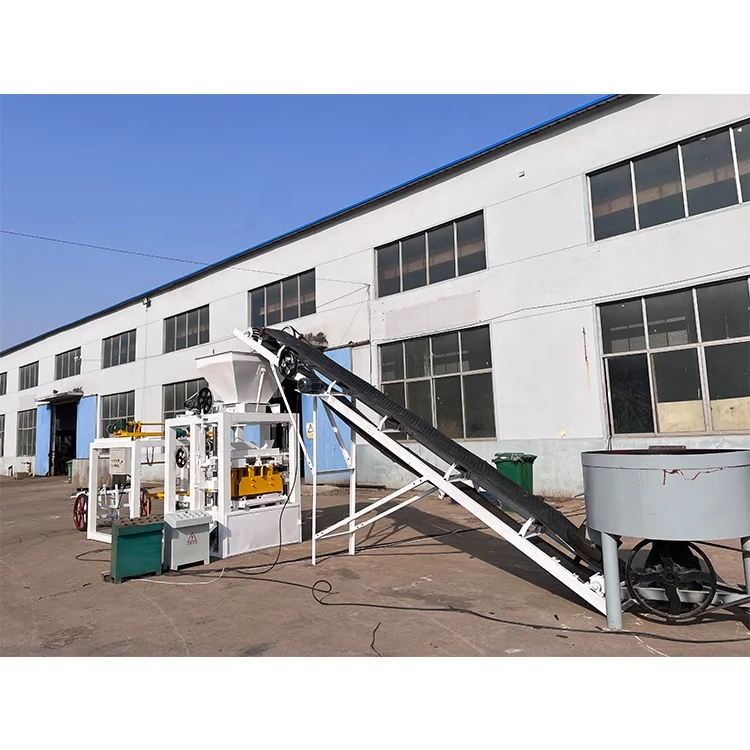
 Stationary block machine