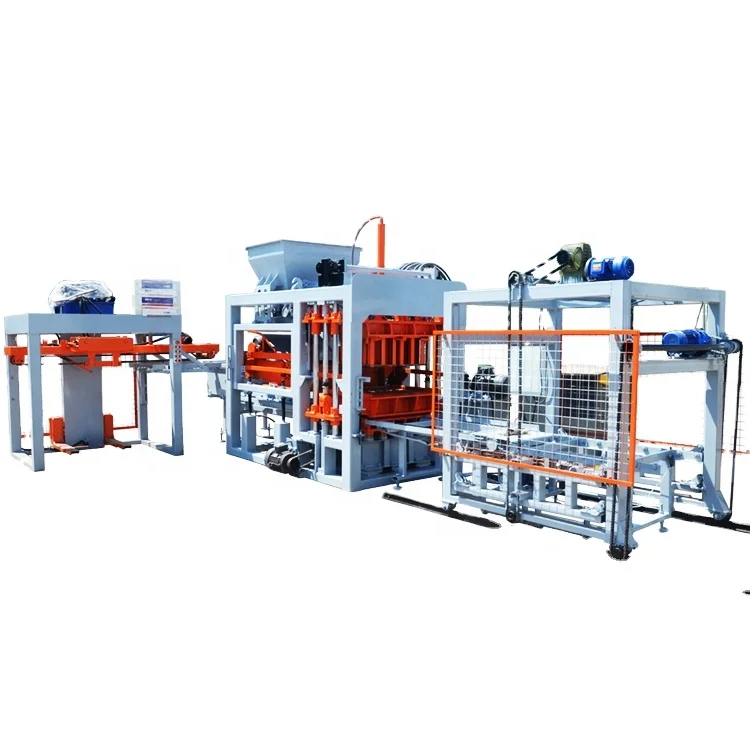
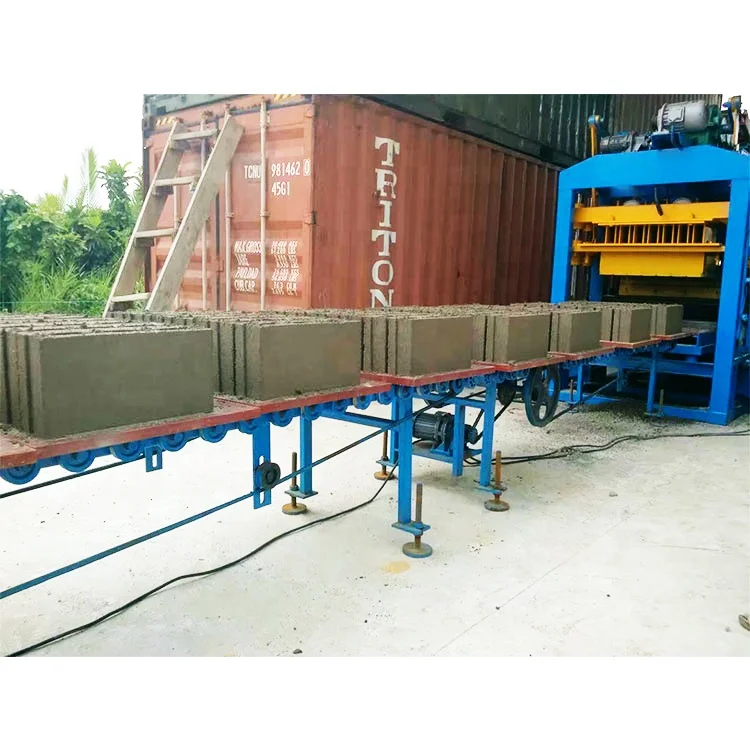
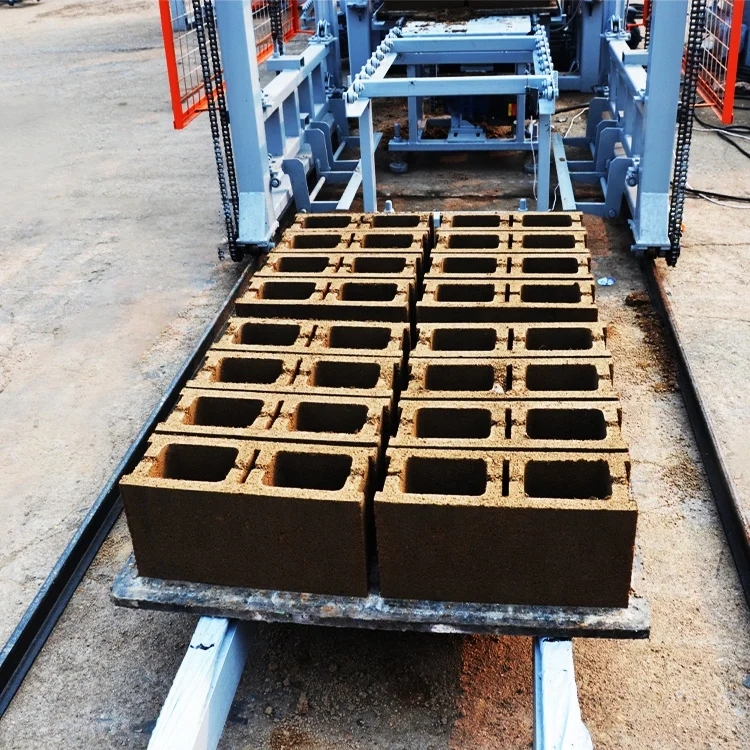
Matched system engineering — Every QT8-15 configuration is built around your actual block format, local aggregate, and curing setup rather than a catalogue default.
Technical Specifications
| Parameter |
Value |
| Model |
QT8-15 |
| Product Type |
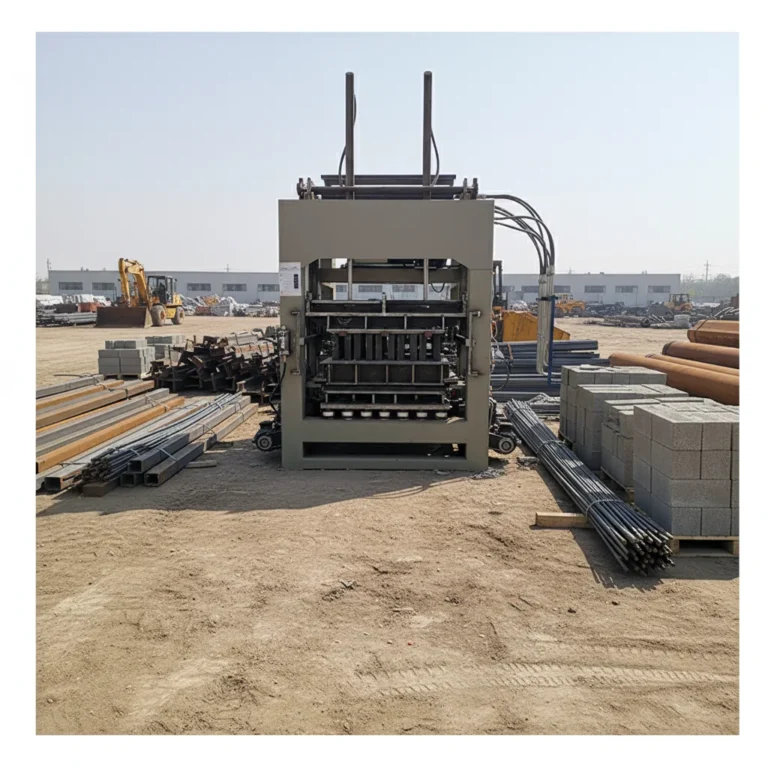
Automatic Hydraulic Concrete Block Making Machine |
| Overall Dimension |
8300×1860×3000 mm |
| Total Mass |
8 T |
| Rated Pressure |
21 MPa |
| Main Vibration Form |
Platform Vibration |
| Vibration Frequency |
2800–4500 r/min |
| Vibration Force |
45 kN |
| Pallet Size |
950×900 mm |
| Molding Cycle |
15–20 s (basis not stated in source — confirm block format / material / thickness) |
| Overall Power |
55.5 kW |
| Demolding Method |
Hydraulic |
| Factory Area |
300 m² |
| Automation Level |
Automatic |
| Control System |
PLC (language options to be confirmed) |
| Voltage & Frequency |
To be confirmed per target market |
| Raw Material Compatibility |
Crushed stone, sand, cement, dust, fly ash, gravel, slag |
| Applied Products |
Concrete hollow blocks, solid blocks, pavers, interlocking blocks, curbstone, colored pavers |
Application Suitability
| Application |
Material or Output |
| Block production plants |
Hollow and solid blocks from crushed stone, sand, and cement |
| Paver and curbstone manufacturing |
Interlocking pavers and kerbstones with fly ash or gravel blends |
| On-site construction production |
Concrete blocks from locally available aggregate for housing projects |
| Building material distribution |
Multiple concrete product formats including colored pavers from cement and slag |
Why Catalogue Output Figures Mislead First-Time Buyers
Real capacity depends on which block format you run, not just the press cycle speed.
When a quotation states a cycle time without naming the block format behind that number, daily output can fall well short of what you planned your staffing and logistics around. The QT8-15 molding cycle is listed at 15–20 seconds, but that span covers different block types with different compaction requirements. An automatic concrete block making machine manufacturer that quotes a single headline number without breaking it down per format leaves you guessing until the machine arrives on your floor. [NEED_CITE: importance of format-specific capacity calculations in block production]
A hollow block requires longer vibration and higher pressure than a thin paver, so the same press delivers fewer units per hour on the heavier format. Without that clarity upfront, you may order supporting equipment — mixers, pallet feeders, stacking systems — sized for a throughput the press cannot actually sustain in your primary product.
Where the QT8-15 Sits in the Shiyue Lineup
The QT8-15 occupies the mid-to-high tier among Shiyue automatic machines. Smaller semi-automatic models suit first plants with limited investment, while larger high-capacity lines serve established operations running continuous shifts. This model bridges the gap: it carries full automatic concrete block making machine manufacturer specification with PLC control and hydraulic demolding, yet its 300 m² factory area requirement keeps it within reach of growing operations that cannot dedicate an entire warehouse to block production.

Matching Vibration and Pressure to Your Mix Design
Platform vibration at 45 kN combined with 21 MPa hydraulic pressure determines how densely each block compacts before curing. The vibration frequency range of 2800–4500 r/min allows adjustment for different aggregate sizes — coarser crushed stone needs higher amplitude at lower frequency, while fine sand and fly ash blends respond better to faster, lower-amplitude vibration. Getting this balance wrong produces blocks that either crack during demolding or fail compression tests at the construction site. Every automatic concrete block making machine manufacturer should specify how vibration parameters adapt to your local materials. [NEED_CITE: effect of vibration frequency on concrete block density]
Pallet Size and Plant Logistics Alignment
The 950×900 mm pallet size defines how many blocks fit per cycle and how the cured product moves through your yard. If your existing forklifts and curing racks were built around a different pallet dimension, you face the choice of replacing your handling infrastructure or accepting lower throughput per trip. The QT8-15 total mass of 8 T and 8300 mm length also dictate foundation depth and bay door clearance. Buyers who confirm these physical constraints before ordering avoid costly rework when the machine arrives.
What the Pressure and Vibration Numbers Mean for Block Strength
The 21 MPa rated pressure pushes the raw mix into the mould cavity, while the 45 kN platform vibration eliminates air pockets and settles aggregate into a dense matrix. Together they determine whether a hollow block meets the compressive strength your local building code requires. A higher vibration force without matching hydraulic pressure causes the mix to segregate — heavy aggregate sinks, cement paste rises — producing blocks with inconsistent strength across the same batch. The 55.5 kW overall power rating supports both systems running simultaneously through the full 15–20 second molding cycle without voltage sag affecting PLC accuracy. [NEED_CITE: relationship between hydraulic pressure and vibration force in block compaction]
The Cost of Skipping Configuration Confirmation
When voltage and frequency are not confirmed in writing before production, the machine arrives with a motor wound for the wrong supply standard, delaying commissioning by weeks while a replacement motor is shipped. Similarly, when PLC display language defaults to a language your operators cannot read, troubleshooting becomes guesswork and minor faults escalate into production stops. These are not manufacturing defects — they are specification gaps that an automatic concrete block making machine manufacturer should close during the quotation stage. [NEED_CITE: common causes of commissioning delays in exported industrial machinery]
Why Buyers Specify the QT8-15 Through Shiyue
Block machinery is our single product focus, so the press, mould, pallet, and handling equipment are specified as one matched system rather than assembled from separate suppliers. Configuration is set against your actual mix design and local aggregate, not a catalogue default. Mould design covers the formats your market sells, including custom drawings for non-standard shapes. Automation level is selectable, allowing you to start at one configuration and expand within the Shiyue range as demand grows. Installation and commissioning support includes operator training on your specific block formats.
Documentation & Verification
- Line layout with capacity calculation stating the block format assumed for each output figure
- Machine specification sheet covering hydraulic pressure, vibration force, pallet size, and power rating
- Mould drawing and format list showing every block type the QT8-15 will produce
- Voltage, frequency, and PLC display language confirmation signed before production begins
- Factory test record run on your specified block format before dispatch
- CE declaration where applicable to your destination market
Installation, Commissioning & Support
- Foundation design guidance based on the 8 T total mass and platform vibration load
- Power supply verification for 55.5 kW overall power on your local voltage and frequency
- PLC control language set to your operator preference before the machine leaves the factory
- Mould change procedure demonstrated on your specific block formats during commissioning
- Operator training covering hydraulic system checks, vibration adjustment, and pallet handling routines
- Wear parts list with mould and hydraulic component replacement intervals documented
What to Include in Your Inquiry
Send your target block formats with dimensions, your daily output requirement per format, and a local aggregate or material test report so we can match vibration and pressure parameters to your mix. Confirm your site voltage, frequency, and preferred PLC display language. If you have existing curing racks, forklifts, or pallet inventory, share the dimensions so the QT8-15 configuration integrates with what you already have on the ground.
Frequently Asked Questions
Q: Where does the QT8-15 fit compared with smaller semi-automatic and larger high-capacity models?
A: The QT8-15 sits in the mid-to-high tier of the Shiyue automatic range. It carries full PLC control and hydraulic demolding with a 300 m² footprint, bridging smaller semi-automatic machines suited to first plants and larger high-capacity lines that require continuous multi-shift operation and expanded yard space.
Q: How is output capacity calculated and which block format is assumed?
A: The molding cycle of 15–20 seconds varies by block format, mix design, and thickness. A hollow block requires longer compaction than a thin paver. We calculate capacity per format and state the assumption in writing so your line layout reflects the products you will actually run each day.
Q: What plant footprint and foundation does the QT8-15 require?
A: The machine occupies a factory area of approximately 300 m² with an overall length of 8300 mm and total mass of 8 T. Foundation depth depends on your soil bearing capacity and the dynamic load from platform vibration. We provide a layout drawing showing machine position, pallet circulation, and curing rack placement.
Q: Can I start at one automation level and upgrade later?
A: The Shiyue range allows automation level selection, so you can begin with the QT8-15 at a configuration that matches your current volume and add automatic stacking or cubing modules as your plant output grows without replacing the press itself.
Q: Which voltage, frequency, and control language options are available?
A: Voltage and frequency are configured to your local supply standard, and the PLC display language is set to your preference. Both are confirmed in writing before production so the machine is ready for commissioning immediately upon arrival at your site.

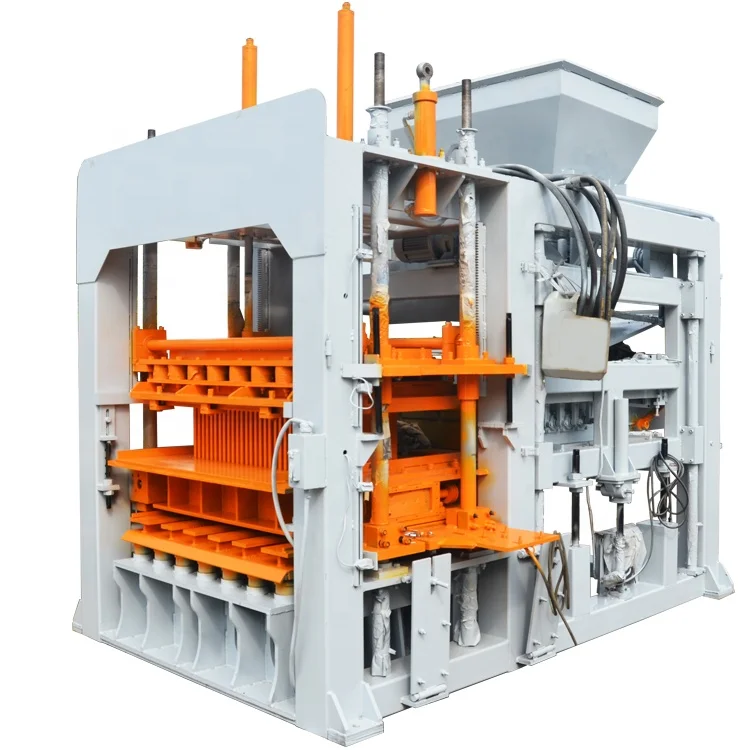
 High quality block machine