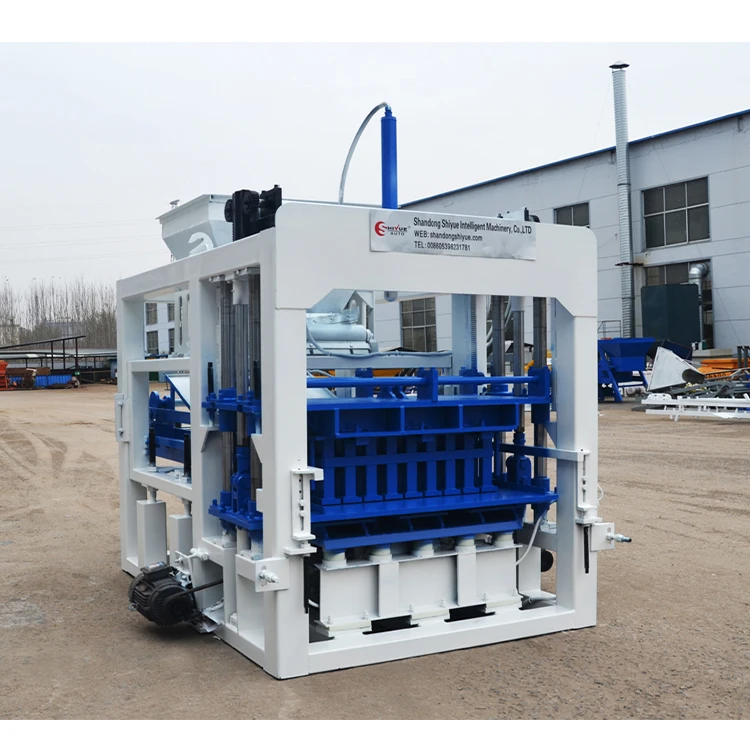
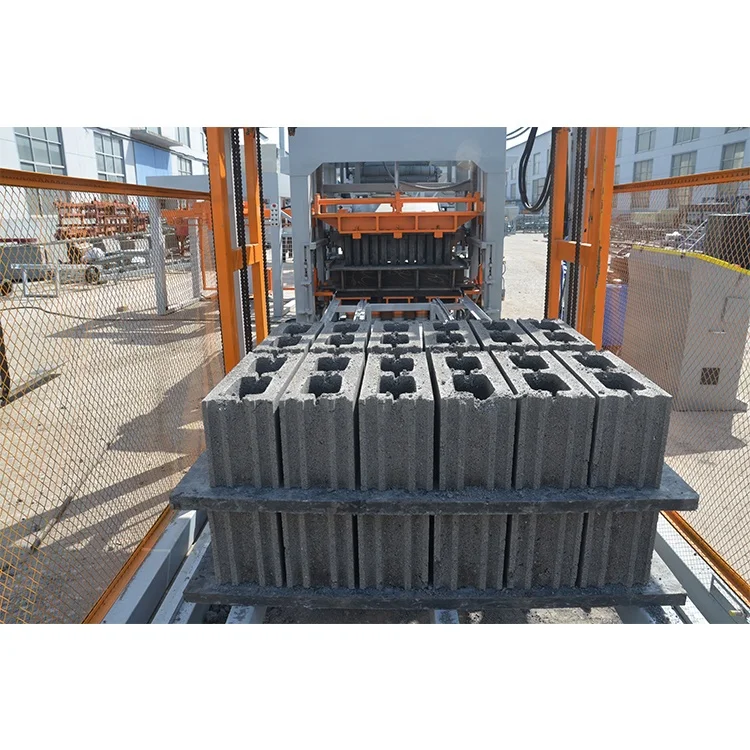
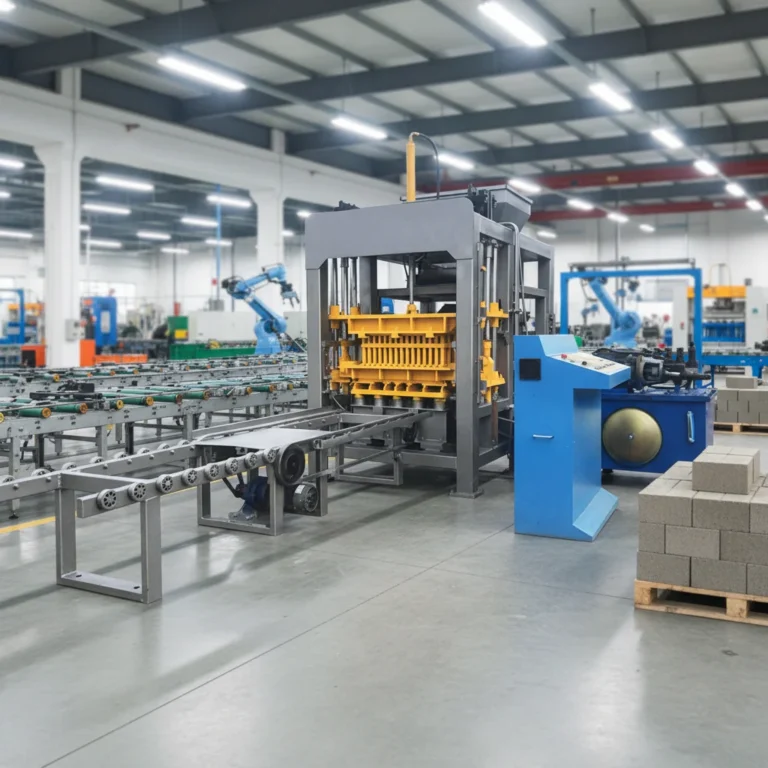
Configured as a matched system — The QT8-15 block making machine manufacturer supplies the press, mould, pallet, and handling equipment as one verified set, so output figures align with your actual block format and curing setup.
Technical Specifications
| Parameter |
Value |
| Product Type |
Automatic Hydraulic Block Making Machine |
| Model |
QT8-15 |
| Overall Dimensions (L×W×H) |
8300×1860×3000 mm |
| Rated Pressure |
21 MPa |
| Main Vibration Form |
Platform Vibration |
| Vibration Frequency |
2800–4500 r/min |
| Pallet Size |
950×900 mm |
| Molding Cycle |
15–20 s |
| Overall Power |
55.5 kW |
| Vibration Force |
45 kN |
| Total Mass |
8 T |
| Demolding Method |
Hydraulic |
| Factory Area Required |
300 m² |
| Automation Level |
Automatic |
| Key Features |
Custom mould design, CE compliant, PLC configurable |
Application Suitability
| Application |
Material or Output |
| Hollow block production |
Crushed stone, sand, cement, fly ash |
| Paver and interlocking brick manufacturing |
Gravel, slag, colored aggregates |
| Solid block and kerbstone forming |
Cement, dust, local aggregate blends |
| On-site construction block production |
Portable raw material feed configurations |
Why Cycle Time Without Block Format Means Nothing
When evaluating a QT8-15 block making machine manufacturer, the molding cycle of 15–20 seconds only becomes meaningful once the specific block format is defined.
A hollow block, a paving stone, and an interlocking brick all demand different compaction times and hydraulic dwell periods within that 15–20 second window. Sellers often quote a single pieces-per-hour number derived from the fastest format, leaving buyers to discover the shortfall only after commissioning. Real daily output depends entirely on which format dominates your production schedule and how your local aggregate responds to the 21 MPa pressure and 45 kN vibration force [NEED_CITE: block format impact on daily output calculations].

Positioning Within the Full Machine Range
The QT8-15 occupies the mid-to-high automatic tier, bridging the gap between small workshop semi-automatic units and large-scale fully automatic lines with integrated stacking and cubing. For a buyer surveying options, this model provides the hydraulic pressure and pallet size necessary for commercial volume, while the overall power of 55.5 kW and 300 m² factory area requirement keep the initial infrastructure investment manageable.
Understanding the Upgrade Path
Automation level is selectable on this platform. A plant can begin with manual pallet handling and basic PLC control, then add automatic pallet feeding and stacking as market demand grows. This flexibility means the QT8-15 block making machine manufacturer can configure a line that matches your current budget without forcing a premature jump to a higher output tier that would leave the press idle for half the shift.
How Pressure and Vibration Define Block Density
The 21 MPa rated pressure and 45 kN vibration force work in tandem to compact the mix. Hydraulic pressure squeezes the material into the mould cavity, while platform vibration at 2800–4500 r/min settles fine particles into voids. If your local aggregate has high dust content or unusual moisture characteristics, the balance between these two forces must be adjusted accordingly — a fixed catalogue setting will produce inconsistent block strength across batches [NEED_CITE: hydraulic pressure and vibration matching for local aggregate].
The Cost of Ignoring Pallet and Curing Alignment
The 950×900 mm pallet size dictates your curing rack dimensions, forklift capacity, and stacking layout. Buyers who select a pallet specification without cross-referencing their existing curing infrastructure end up hand-stacking output or purchasing new forklifts. The pallet material must also withstand the vibration frequency and hydraulic demolding force over thousands of cycles; mismatched pallets crack prematurely, disrupting the entire line rhythm [NEED_CITE: pallet size and curing area coordination].
Procurement Based on Matched Configuration
Block machinery is the single focus here, meaning the QT8-15 is specified alongside its mould, pallet, and handling equipment as one system rather than assembled from separate suppliers. Configuration is set against your actual mix design and target block format, not a catalogue default. Mould design covers the formats your market sells, with custom drawings accepted. The automation level is selectable so you can start semi-automatic and expand. Installation includes operator training, and mould and wear parts support continues after commissioning.
Documentation & Verification
- Line layout and capacity calculation stating the block format assumed for each output figure
- Machine specification sheet with voltage, frequency, and PLC display language confirmed before production
- Mould drawing and format list showing all available options for your target market
- Factory test record and packing photographs provided before shipment
Installation, Commissioning & Support
- Foundation plan scaled to the 8300×1860 mm footprint and 8 T total mass
- Dedicated electrical circuit sized for the 55.5 kW overall power draw and confirmed voltage
- Main press arrives fully assembled; supporting line equipment configuration verified on site
- Commissioning includes parameter tuning against your specific mix design and aggregate source
- Operator training covers mould change procedures and daily maintenance intervals for the hydraulic system
- Wear parts and mould replacement list provided with recommended reorder intervals
Before You Request a Quote
To configure the QT8-15 correctly, provide the specific block formats your market demands, your target daily output per format, and the raw materials available locally. Confirm your site voltage, frequency, and preferred PLC display language. If you have existing curing racks or forklifts, share their specifications so the 950×900 mm pallet can be validated against your infrastructure.
Frequently Asked Questions
Q: How is the QT8-15’s daily output calculated, and which block format does the capacity figure assume?
A: Output depends on the block format, as each requires a different portion of the 15–20 second molding cycle. Capacity calculations are provided per format — hollow block, paver, or interlocking brick — so the figure you see reflects the product you actually intend to manufacture, not a generic maximum.
Q: Where does the QT8-15 sit in the full range compared to smaller or larger models?
A: It occupies the mid-to-high automatic tier. Smaller semi-automatic models require more manual pallet handling but lower investment. Larger fully automatic lines add integrated stacking and cubing for higher volume. The QT8-15 balances commercial output with a manageable 300 m² factory area requirement.
Q: What plant footprint does the QT8-15 require compared to adjacent tiers?
A: The main press measures 8300×1860×3000 mm and the recommended factory area is 300 m², covering raw material feed, mixing, and curing space. Adjacent higher tiers demand significantly more floor area for automatic stacking and cubing systems, while lower tiers can operate in reduced footprints with manual handling.
Q: Can I start with the QT8-15 at a semi-automatic configuration and upgrade later?
A: Yes. The automation level is selectable. You can begin with manual pallet handling and basic control, then add automatic pallet feeding and stacking modules as production volume justifies the investment, without replacing the main press.
Q: What voltage and control language options are available, and how are they confirmed?
A: Voltage and frequency are configurable and must match your local grid. PLC display language is also selectable. Both are confirmed in writing before production begins — a step that prevents the kind of on-site delays that idle entire work crews waiting for transformers or language patches.

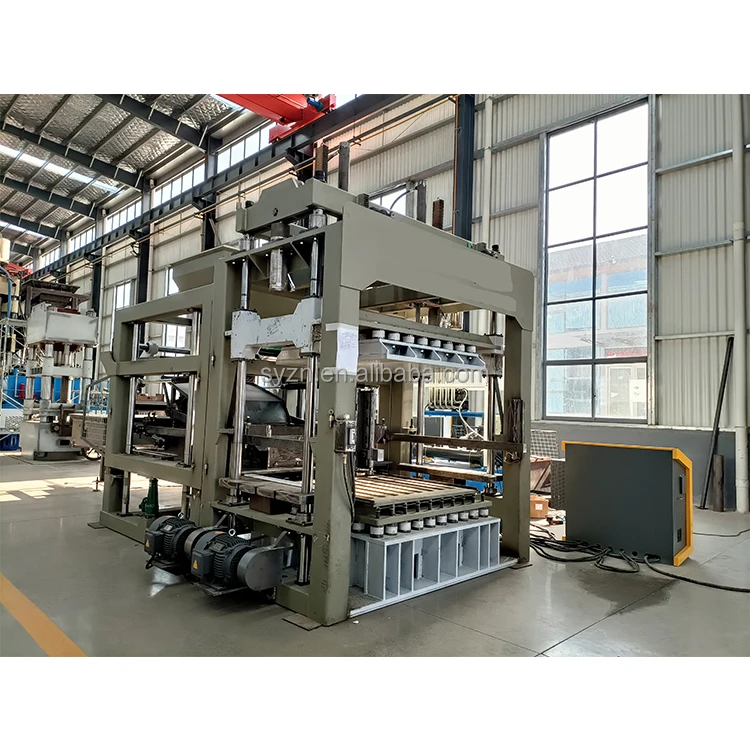
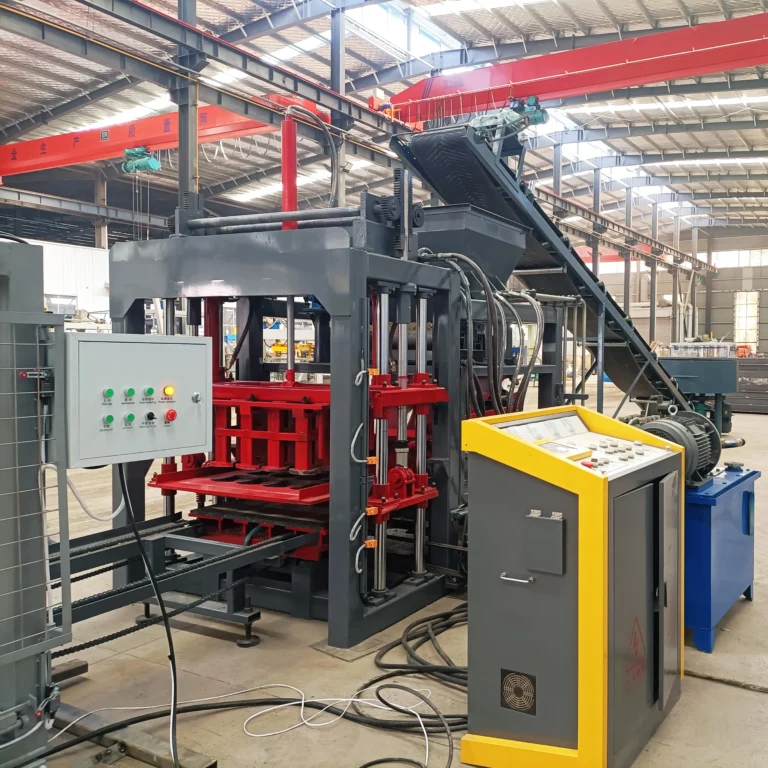 High quality block machine