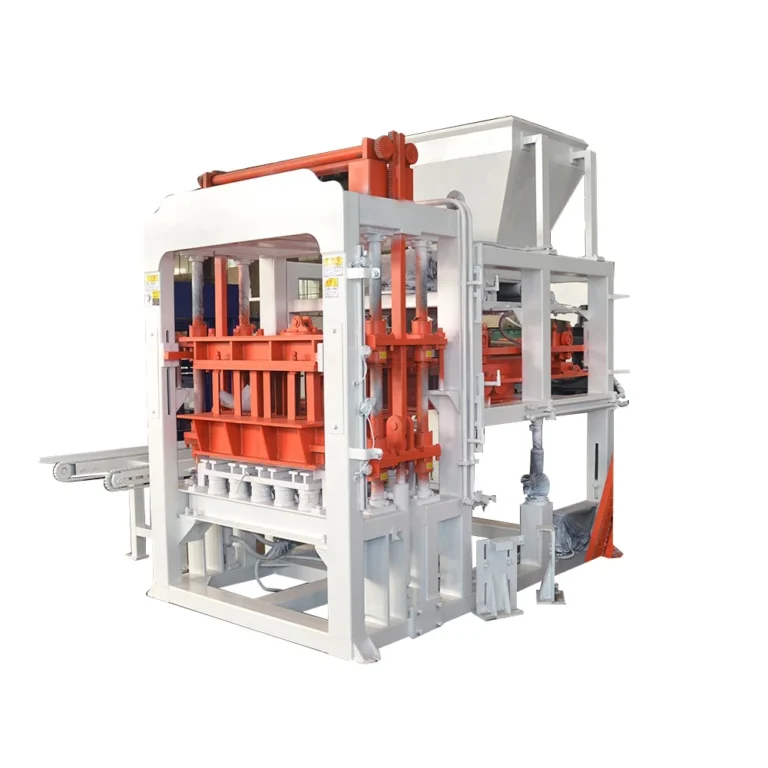
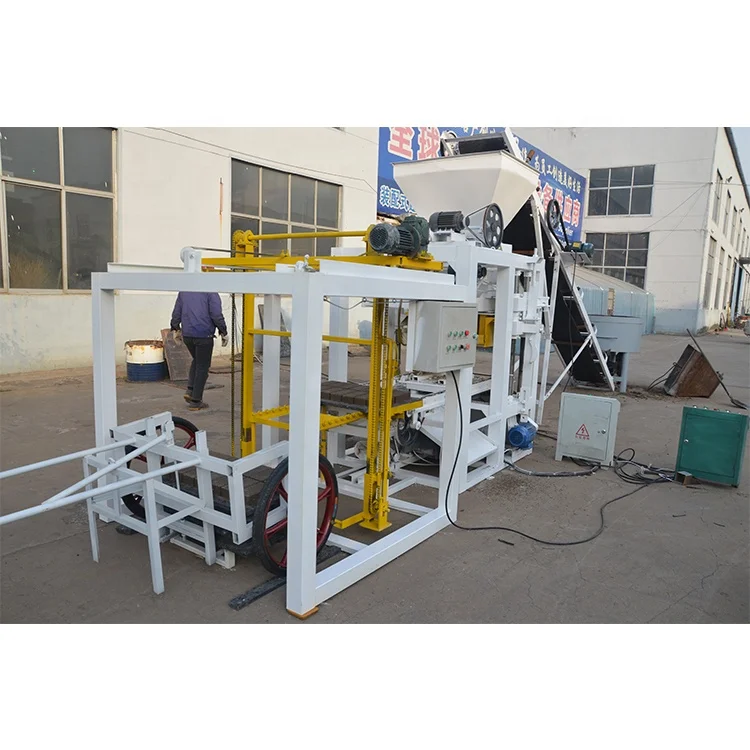
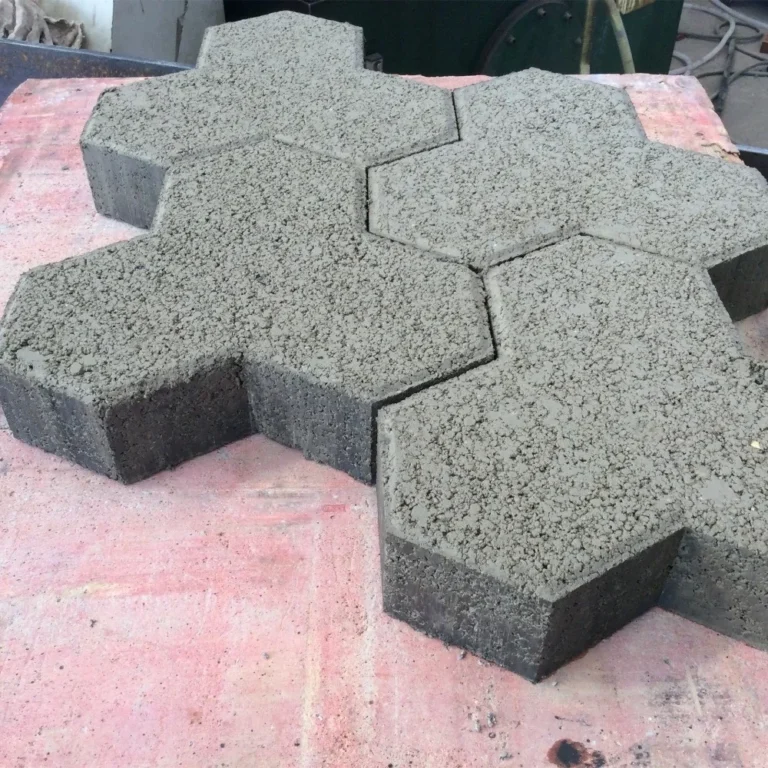
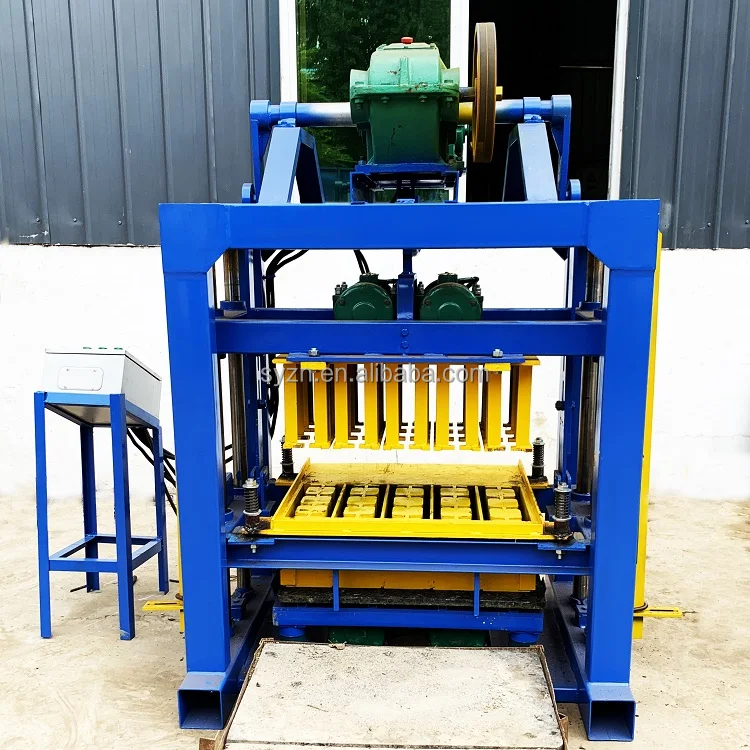
Matched System Integration — the QT15-15 is specified alongside its mould, pallet and handling stations as one coordinated line, not a stand-alone press bolted to unrelated auxiliaries.
Technical Specifications
| Parameter |
Value |
| Model |
QT15-15 |
| Product Type |
Stationary Concrete Block Making Machine |
| Overall Dimensions (L×W×H) |
9350×2520×2950 mm |
| Net Weight |
15 T |
| Rated Power |
45.7 kW |
| Voltage & Frequency |
380V (frequency and exact voltage configurable to buyer requirements) |
| Hydraulic Pressure |
21 MPa |
| Vibration System |
Four external vibration motors with reduced individual starting load |
| Upper Mould Synchronization |
Dual-side synchronous gear, four-point stabilization |
| Material Feeder |
Cylinder with turning arm (European design) |
| Vibration Damping |
Airbag system with adjustable air pressure per brick type |
| Pallet Size |
1350×850×40 mm |
| Output — Hollow Block 400×200×200 mm |
15 pcs/mould, 3600 pcs/hour, 28800 pcs/day |
| Output — Hollow Block 400×150×200 mm |
16 pcs/mould, 4320 pcs/hour, 34560 pcs/day |
| Output — Solid Brick 240×115×53 mm |
62 pcs/mould, 14000 pcs/hour, 112000 pcs/day |
| Cycle Time |
basis to be confirmed per block format |
| Mould Change Time |
basis to be confirmed |
| Automation Level |
configurable from manual pallet handling to fully automatic stacking and cubing |
| Color Options |
according to buyer request |
| Warranty |
1 year |
| Standards |
ISO 9001:2008, CE |
Application Suitability
| Application |
Material or Output |
| Hollow concrete block production |
400×200×200 mm and 400×150×200 mm formats from crushed stone, sand and cement |
| Solid concrete brick production |
240×115×53 mm standard bricks from local aggregate blends |
| Interlocking paver production |
Format-dependent, requiring dedicated paver moulds |
| Block and paver production plants |
High-capacity stationary lines with automatic or semi-automatic downstream handling |
| Construction contractors producing on-site |
Large-format blocks for project-specific wall construction |
| Building material manufacturers |
Expanding existing product ranges with additional hollow and solid formats |
What "3,600 Pieces per Hour" Actually Means on the QT15-15
Every capacity figure on this page is tied to a specific block size — the 3,600 pcs/hour rate applies only to 400×200×200 mm hollow blocks, and the 14,000 pcs/hour figure applies only to 240×115×53 mm solid bricks.
Capacity claims without a stated format are one of the most common reasons buyers discover their real daily output falls far short of what the brochure suggested. A stationary concrete block making machine manufacturer quoting cycles per hour without naming the assumed block shape is leaving out the single variable that determines whether the line meets its production target. I have seen buyers sign contracts based on a headline number, only to find that the format their market actually purchases runs at a substantially slower cycle [NEED_CITE: common discrepancies between quoted and actual block machine output].

Where the QT15-15 Sits in the Full Machine Range
The QT15-15 occupies the high-capacity tier of our stationary block machine lineup, designed for plants that need continuous daily output across one or more block formats. Buyers comparing this model against semi-automatic or mobile alternatives should consider not just the press itself but the pallet handling, stacking and curing space that a machine of this output demands. A stationary concrete block making machine manufacturer should always present the press within its full line context so buyers can see the footprint and auxiliary requirements before committing.
Matching Output Tier to Your Plant Reality
A buyer currently running a smaller stationary press may find that upgrading to the QT15-15 requires expanding the curing area and adding forklift capacity to move the higher pallet volume. The 1350×850×40 mm pallet size must align with existing rack dimensions and handling equipment. If the curing yard cannot absorb the daily pallet count, the press will spend time idle regardless of its rated cycle speed [NEED_CITE: block plant curing area and throughput balance].
Reading the Specs That Matter for Daily Production
The 21 MPa hydraulic pressure works together with the four external vibration motors to compact the concrete mix into the mould cavity — neither pressure nor vibration alone determines block density, and both must be matched to the buyer’s actual aggregate and cement ratio. The dual-side synchronous gear on the upper mould provides four-point stabilization, which keeps wall thickness consistent across every cavity in a multi-cavity mould. The European-design material feeder with its turning arm cylinder distributes concrete evenly before each press cycle, reducing the variation in block weight from one pallet to the next. The airbag vibration damping system allows the operator to adjust air pressure depending on whether the run is hollow blocks or solid bricks, preventing over-vibration that can crack green products.
The Hidden Cost of Skipping Configuration Checks
Ordering a high-output press without confirming the automation level means the buyer may receive a machine that still requires manual pallet feeding and hand stacking, negating the labour savings the investment was supposed to deliver. Similarly, if voltage and frequency are not confirmed before production, the control panel and motors may arrive incompatible with the local grid, delaying commissioning by weeks [NEED_CITE: voltage and frequency standards by export market]. Pallet material and thickness also affect forklift handling — specifying pallets without regard to the buyer’s existing equipment leads to damage and replacement costs from the first week.
Why Source This Tier Through a Single-System Supplier
Block machinery is the sole focus here, so the QT15-15 press, its moulds, pallets and handling stations are specified as one matched system rather than assembled from separate vendors. Configuration starts with the buyer’s actual mix design and local aggregate, not a catalogue default — I once saw a buyer forced into a costly material switch because the machine had been set up for a sand type unavailable in their region. Mould design covers the formats the buyer’s market actually sells, with custom drawings available for non-standard sizes. Automation level is selectable, letting a plant owner begin with semi-automatic pallet handling and upgrade to full stacking and cubing as volume grows. Installation includes on-site commissioning and operator training so the line is producing saleable blocks before the support team leaves.
Documentation & Verification
- Line layout and capacity calculation stating the exact block format assumed for each QT15-15 output figure
- Machine specification sheet confirming hydraulic pressure, vibration force and pallet size matched to your mix
- Voltage, frequency and PLC display language confirmed in writing before the QT15-15 enters production
- Mould drawing and format list showing which block sizes ship with the machine and which require separate orders
- Factory test record on your specified block format before dispatch
Installation, Commissioning & Support
- Foundation plan sized to the QT15-15 footprint of 9350×2520 mm with vibration isolation provisions
- Dedicated power circuit rated for the 45.7 kW total load at the confirmed voltage and frequency
- Machine shipped in assembly state agreed during quotation to match container loading and site crane access
- On-site commissioning includes cycle tuning per block format with the buyer’s actual raw materials
- Operator training covers mould change procedure, airbag pressure adjustment and daily maintenance checkpoints
- Wear parts list provided with hydraulic seal and vibration motor specifications for local sourcing
Before You Request a Quote
To size the QT15-15 correctly within the full range, share the block formats your market purchases, the daily output target per format, and a sample or description of your local aggregate and sand. Confirm the voltage, frequency and preferred PLC display language for your site, along with the automation level — whether you need manual pallet handling or full automatic stacking and cubing. If you already operate a curing yard and forklift fleet, provide the pallet dimensions and rack spacing so the line is configured around them.
Frequently Asked Questions
Q: How is the stated capacity of 3,600–14,000 pcs/hour verified, and which block format does each figure assume?
A: The 3,600 pcs/hour figure applies specifically to 400×200×200 mm hollow blocks at 15 pieces per mould, while 14,000 pcs/hour applies to 240×115×53 mm solid bricks at 62 pieces per mould. Each rate is based on a defined cycle time for that format. Capacity for other block sizes will differ and is calculated during the quotation stage.
Q: Where does the QT15-15 sit in the full machine range compared to smaller stationary models?
A: The QT15-15 is positioned in the high-capacity tier, suited for plants requiring continuous daily production across multiple formats. Smaller stationary models serve lower output tiers and smaller pallet sizes. The choice depends on your target daily volume, available curing space and the automation level you plan to run.
Q: What automation level options are available for the QT15-15?
A: The line is configurable from manual pallet handling through semi-automatic operation to fully automatic stacking and cubing. The automation level chosen affects labour requirements, downstream equipment cost and the total plant footprint. Buyers can start at a lower automation tier and upgrade later.
Q: How are pallet size and material chosen to match the buyer’s existing curing area?
A: The standard pallet size is 1350×850×40 mm, but material and thickness are selected based on the buyer’s curing rack spacing, forklift capacity and local climate conditions. Confirming these details before production ensures the pallets work with the equipment already on site.
Q: What voltage, frequency and PLC language confirmation is completed before production begins?
A: The buyer’s local voltage and frequency are confirmed in writing, along with the preferred PLC display language. This confirmation is part of the pre-production checklist so the electrical cabinet and control interface are built to match the destination site from the start.

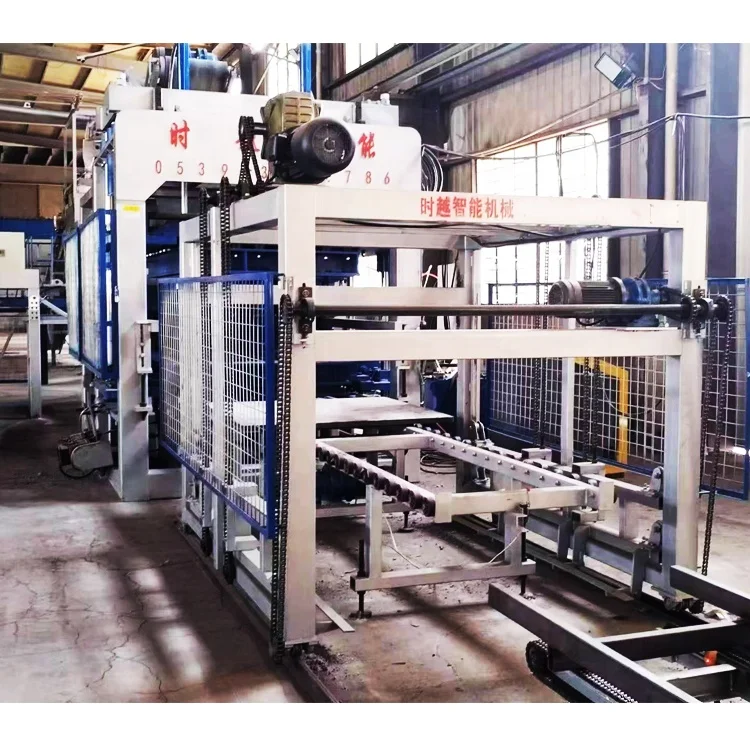
 Stationary block machine